Printing shipping labels should be quick, reliable, and easy to repeat. The best USB shipping label printers help online sellers and small businesses produce clear 4 x 6 labels without ink cartridges or unnecessary setup.
We compared 10 popular models across connectivity, software compatibility, print quality, portability, and everyday usability to help you choose the right printer for your shipping volume and workflow.
Best 10 USB Shipping Label Printers Picks for 2026
Best Overall
Rollo USB Shipping Label Printer

- Fast 150mm/s direct thermal printing
- Works with Windows and Mac via USB
- Supports shipping, barcode, and custom labels
Best For: Online sellers needing versatile wired printing
Best for Wireless Flexibility
NULLTONEX Bluetooth Shipping Label Printer

- Bluetooth and USB connectivity
- App includes 1,800+ templates
- Includes 25 sample 4x6 labels
Best For: Small businesses printing from computers and mobile devices
Best for High-Volume USB Printing
Westinghouse Commercial Thermal Printer

- Prints up to 60 4x6 labels per minute
- Supports 1.57- to 4.25-inch labels
- Includes sample labels and label tray
Best For: High-volume wired shipping and inventory workflows
Best for Bluetooth Label Printing
JADENS Wireless Thermal Printer

- Bluetooth and USB printing options
- Supports roll and fanfold labels
- Includes 50 test labels and one-year warranty
Best For: Small businesses wanting mobile-friendly label printing
Commercial USB Pick

- USB and Ethernet connectivity
- Up to 6-inch-per-second printing
- Includes starter labels and holder
Best For: Small businesses needing fast, wired label printing
Flexible Wireless Choice

- USB and app-based Bluetooth printing
- Up to 72 4x6 labels per minute
- Works with roll and fanfold labels
Best For: Users wanting wired and wireless printing flexibility
App-Focused Compact Pick
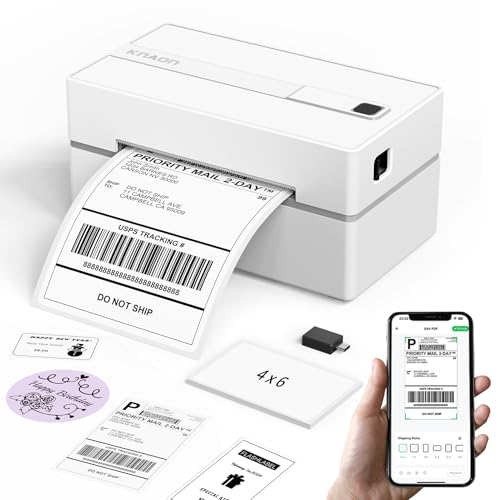
- USB and app-based Bluetooth support
- Prints up to 180 mm/s
- Includes extensive app templates and design tools
Best For: Compact, customizable labeling for small sellers
Flexible Bluetooth Pick
Labeer 4x6 Thermal Label Printer

- USB and Bluetooth connectivity
- Supports multiple label widths
- Automatic calibration and jam detection
Best For: Multi-device home offices, sellers, and warehouse labeling
Fast Compact Workhorse
Rongta RP425 USB Shipping Label Printer

- Prints up to 150 mm/s
- USB and Bluetooth connectivity
- Automatic label detection
Best For: High-volume small-business and home-office shipping
Mobile-Friendly Value
Rongta RP425 Wireless Label Printer
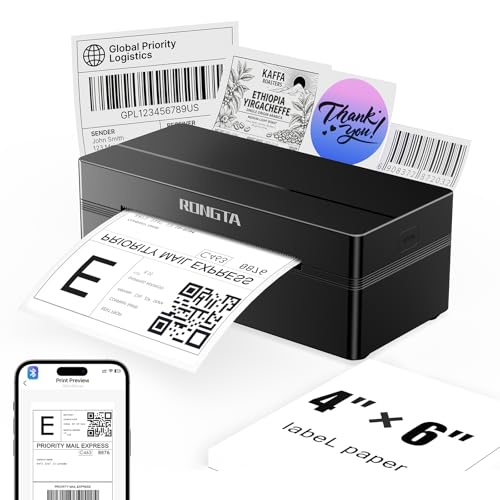
- USB and Bluetooth printing
- Supports 4x6 and smaller labels
- Up to 150 mm/s printing
Best For: Mobile sellers and small offices with varied labeling needs
Best Overall – Rollo USB Shipping Label Printer
The Rollo USB Shipping Label Printer is a dependable choice for businesses seeking usb shipping label printers with broad platform support. Its direct thermal printing, 203 DPI resolution, and 150mm/s speed make it suitable for clear 4×6 shipping labels and other custom labels.
Best For: Online sellers who want a fast, USB-connected printer that also handles product, barcode, QR code, and sticker labels.
Pros:
- Works with Windows and Mac computers through USB.
- Prints one 4×6 label per second without ink or toner.
- Supports major carriers, marketplaces, and shipping platforms.
- Handles label widths from 1.57 to 4.1 inches.
Cons:
- USB connectivity is wired rather than wireless.
- Its 203 DPI resolution is practical but not designed for high-resolution graphics.
Rollo’s combination of speed, compatibility, and flexible label sizing makes it a strong all-around option for home offices and growing shipping operations.
Best for Wireless Flexibility – NULLTONEX Bluetooth Shipping Label Printer
The NULLTONEX is one of the more flexible usb shipping label printers because it supports both USB and Bluetooth connections. It combines 203 DPI direct thermal printing with a companion app offering templates, fonts, and offline design tools.
Best For: Small businesses that want to print from computers, phones, or tablets and create customized labels through an app.
Pros:
- Offers both Bluetooth and USB connectivity.
- Prints up to 150mm/s without ink or toner.
- FlashLabel Pro includes more than 1,800 templates and 300 fonts.
- Includes 25 sample 4×6 thermal labels to get started.
Cons:
- Prints in black and white only.
- Bluetooth printing requires the FlashLabel Pro app.
With dual connectivity and extensive app customization, this printer is a practical fit for sellers who switch between desktop and mobile workflows.
Best for High-Volume USB Printing – Westinghouse Commercial Thermal Printer
The Westinghouse WHTP203v is built for shoppers comparing usb shipping label printers for frequent package processing. It reaches speeds of up to 6 inches per second, supports standard 4×6 labels, and uses direct thermal technology to avoid ink and toner costs.
Best For: Commercial, ecommerce, and home users who prioritize fast wired printing for shipping and inventory labels.
Pros:
- Prints up to 60 4×6 labels per minute.
- Supports label widths from 1.57 to 4.25 inches.
- Includes sample labels, a label tray, USB cable, adapter, and user guide.
- Handles shipping labels, barcodes, QR codes, and warehouse labels.
Cons:
- Does not support Bluetooth.
- Connectivity is limited to USB.
This model emphasizes throughput and straightforward wired operation, making it especially appealing when speed matters more than wireless convenience.
Best for Bluetooth Label Printing – JADENS Wireless Thermal Printer
The JADENS JD268BT gives shoppers a wireless alternative among usb shipping label printers while retaining USB support for Windows and Mac computers. Its 203 DPI direct thermal printhead works with roll and fanfold labels in multiple sizes.
Best For: Online small businesses that want Bluetooth printing from compatible computers or app-based printing from Android and iOS devices.
Pros:
- Supports USB printing on Windows 7 and newer and Mac OS 10.9 and newer.
- Offers Bluetooth printing and a dedicated mobile app.
- Works with roll and fanfold labels from 1.57 to 4.1 inches wide.
- Includes 50 test labels and a one-year warranty.
Cons:
- Android and iOS phones require the JADENS app for printing.
- Labels need recalibration when changing label types or sizes.
JADENS is a useful pick for sellers who value mobile printing and broad label-format support, provided they are comfortable with app-based phone setup.
Commercial USB Pick – Westinghouse WHTP203e
The Westinghouse WHTP203e is a commercial-grade option for shoppers comparing usb shipping label printers for regular ecommerce, warehouse, or small-business use. It connects by USB or Ethernet, prints 4×6 labels at up to 6 inches per second, and uses direct thermal printing without ink or toner.
Best For: Small businesses and ecommerce sellers that prioritize fast, consistent desktop printing and Ethernet connectivity.
Pros:
- Supports Windows, macOS, and Linux, with USB and Ethernet connectivity.
- Prints at up to 6 inches per second with 203 DPI resolution.
- Works with fanfold or roll labels and includes starter labels plus a label holder.
Cons:
- It is not Bluetooth-capable.
- Ethernet and USB-C cables or adapters are sold separately.
- Setup requires following the included driver-installation guidance.
Choose this model if wired reliability and commercial-style throughput matter more than mobile printing. Its broad operating-system support and included accessories make it a practical desktop shipping station.
Flexible Wireless Choice – Nelko PL70e-BT
The Nelko PL70e-BT is a versatile choice among usb shipping label printers, combining USB desktop printing with Bluetooth support through the NELKO app. It produces 4×6 labels at up to 72 labels per minute, supports multiple operating systems, and requires no ink or toner.
Best For: Home users and small businesses that want both USB printing and app-based wireless printing from compatible devices.
Pros:
- Supports USB printing on Windows, macOS, and ChromeOS.
- Bluetooth printing works through the NELKO app on iOS and Android, with additional Windows support.
- Prints at up to 150 mm/s and supports roll or fanfold labels from 1.54 to 4.1 inches wide.
Cons:
- Bluetooth printing requires the NELKO app rather than a direct device connection.
- Mac users can use USB, but not Bluetooth, according to the supplied notes.
- Shipping-platform labels must be saved as PDFs and uploaded to the app for printing.
This is a strong fit when connection flexibility matters. Its compact design and wireless option add convenience, while USB keeps it useful as a conventional desktop label printer.
App-Focused Compact Pick – KNAON Y813BT
The KNAON Y813BT combines USB and app-based Bluetooth printing in a compact design for shoppers evaluating usb shipping label printers. It works with Windows, macOS, ChromeOS, and Linux through USB, supports labels up to 4.2 inches wide, and prints at speeds up to 180 mm/s.
Best For: Small sellers who want a compact printer with mobile-app templates for shipping, barcode, mailing, and custom labels.
Pros:
- Supports USB connectivity across Windows, macOS, ChromeOS, and Linux.
- Bluetooth printing is available through the FlashLabel Pro app.
- The app includes more than 3,000 templates, 5,000 icons, and 100 fonts.
Cons:
- Bluetooth devices must connect through the FlashLabel Pro app.
- ChromeOS requires the FlashLabel browser extension.
- The package includes only 10 test-printing papers.
The Y813BT stands out for customization and portability rather than heavy-duty specifications. It is a useful choice for sellers who want one compact device for shipping labels and smaller organizational or promotional labels.
Flexible Bluetooth Pick – Labeer 4×6 Thermal Label Printer
If you want a USB shipping label printer that also handles mobile printing, the Labeer Y43BT offers useful flexibility for home offices, packing stations, and small businesses. It prints standard 4×6 labels at 203 DPI and supports several narrower label sizes without ink, toner, or ribbons.
Best For: Sellers and warehouse users who need USB or Bluetooth printing across Windows, macOS, ChromeOS, Linux, iPhone, and Android devices.
Pros:
- Supports USB and Bluetooth connections, including mobile printing through the FlashLabel Pro app.
- Handles 4×6 labels plus compatible sizes from 1.57 to 4.41 inches wide.
- Automatic gap detection, calibration, paper-out detection, and jam detection simplify repeated jobs.
Cons:
- Mobile printing requires the FlashLabel Pro app.
- Its 203 DPI resolution is practical for shipping labels but not intended for high-resolution graphics.
The Labeer is a versatile choice when device flexibility matters. Its USB support makes it suitable for a desktop setup, while Bluetooth and app-based printing are convenient when labels need to be printed from a phone or tablet.
Fast Compact Workhorse – Rongta RP425 USB Shipping Label Printer
The Rongta RP425 is a practical USB shipping label printer for small businesses and home offices that prioritize quick output. It prints up to 150 mm/s, supports standard 4×6 labels, and connects to computers or mobile devices through USB or Bluetooth.
Best For: Online sellers and shipping teams that want fast, compact label printing with Windows, Mac, ChromeOS, iOS, or Android compatibility.
Pros:
- Prints up to 60 labels per minute at 203 DPI using direct thermal technology.
- Supports USB, Bluetooth, and printing from phones or tablets through the RONGTA app.
- Automatic label detection and support for widths from 0.98 to 4.37 inches improve versatility.
Cons:
- Computer setup requires downloading the appropriate driver.
- Printing cannot be triggered simultaneously from a computer and phone because of potential data conflicts.
- Intel-based Apple laptops do not support Bluetooth connection according to the supplied notes.
With its fast stated speed and compact design, the RP425 is well suited to recurring shipping batches. USB provides a dependable computer connection, while Bluetooth adds flexibility for mobile workflows.
Mobile-Friendly Value – Rongta RP425 Wireless Label Printer
This Rongta RP425 is a compact USB shipping label printer designed for flexible 4×6 shipping and smaller labeling tasks. Its direct thermal printing reaches up to 150 mm/s at 203 DPI, while Bluetooth support lets users print from iOS and Android devices through the RONGTA app.
Best For: Small businesses, offices, and mobile sellers that print shipping, barcode, QR code, and smaller product labels.
Pros:
- Supports USB and Bluetooth connections with Windows, macOS, ChromeOS, iOS, and Android.
- Accepts direct thermal labels from 0.98 to 4.37 inches wide, including 4×6 labels.
- Automatic label identification and feeding reduce manual alignment work.
Cons:
- The supplied notes list compact dimensions inconsistently, so buyers should verify available desk space.
- Bluetooth mobile printing requires the RONGTA app.
- Its 203 DPI output is focused on functional monochrome labels rather than detailed graphics.
The RP425 offers a useful balance of portability, speed, and label-size flexibility. It is a good fit when a USB desktop connection is important but phone-based printing is also part of the workflow.
How We Picked the Best USB Shipping Label Printers
We focused on the features that matter most when printing shipping labels regularly: USB compatibility, support for standard 4 x 6 thermal labels, setup requirements, operating-system support, print speed, reliability, and suitability for small-business workflows. Models that also offer Bluetooth were considered for shoppers who want to print from phones or tablets, but wireless capability was not treated as a substitute for dependable computer connectivity.
We also considered compatibility with common shipping platforms and carriers, including USPS, UPS, FedEx, Amazon, Shopify, and other online marketplaces. Because advertised compatibility can vary by software and operating system, confirm the product’s current requirements before purchasing.
Quick Comparison
USB-only models are often a good fit for a dedicated workstation, while USB-and-Bluetooth printers offer more flexibility for sellers who switch between a computer and mobile device. Commercial-grade models may be better suited to higher daily volumes, whereas compact portable options can work well for occasional shipments or limited workspace.
All-in-one thermal printers typically use direct thermal printing, so they do not require ink or toner. You will still need compatible labels, and long-term running costs depend largely on label prices and how efficiently the printer handles your workflow.
Key Buying Factors for USB Shipping Label Printers
Connectivity and Device Support
Check whether the printer supports USB on your specific Windows or Mac computer. If you want mobile printing, look for Bluetooth support and verify whether the required app works with your phone or tablet.
Label Size and Software Compatibility
Most shipping labels use the 4 x 6-inch format, but confirm the printer supports your preferred label type and roll or fanfold format. Review compatibility with your store, marketplace, carrier, and label-generation software before buying.
Print Quality and Speed
Sharp barcodes and readable addresses are essential. For occasional shipping, standard print speed may be sufficient; higher-volume sellers should prioritize consistent feeding, quick output, and a duty cycle appropriate for daily use.
Setup, Maintenance, and Total Cost
Look for straightforward driver installation, automatic calibration, and accessible customer support. Compare the price of replacement labels, included accessories, warranty coverage, and the printer’s footprint—not just its upfront price.
Who Should Buy Which USB Shipping Label Printers?
Choose a USB-focused printer if you print primarily from one Windows or Mac workstation and want a simple, stable setup. Choose a Bluetooth model if you need to create labels from a phone or tablet, share the printer among devices, or keep your workspace flexible.
Choose a commercial-grade option for frequent marketplace orders, small-business fulfillment, or a dedicated packing station. Choose a compact or portable model if you ship occasionally, have limited desk space, or need to move the printer between locations. Before ordering, confirm the included accessories, supported label media, operating-system requirements, and return policy.