Choosing an ultrasonic cleaner for laboratory glassware is about more than tank size. The best models balance cleaning power, heat, timer control, and capacity for beakers, test tubes, flasks, and other delicate lab items.
Below, we focus on practical buying factors so you can narrow in on a machine that fits your workflow, cleaning volume, and glassware mix without overspending on features you will not use.
Best 10 Ultrasonic Cleaner for Laboratory Glassware Picks for 2026
Premium Heated Bath
Branson CPXH Digital Cleaning Bath

- Heated to 69°C for stronger cleaning
- Fully programmable with digital controls
- 2.5-gallon capacity for larger workloads
Best For: Labs needing a larger heated ultrasonic bath
Cleaning Solution Pick
Surgical Instrument Cleaner Concentrate

- Made for ultrasonic or manual cleaning
- Concentrated liquid formula
- Surface recommendation includes glass
Best For: Ultrasonic cleaning liquid for glassware and instruments
Lab Workhorse
StonyLab 3.2L Ultrasonic Cleaner
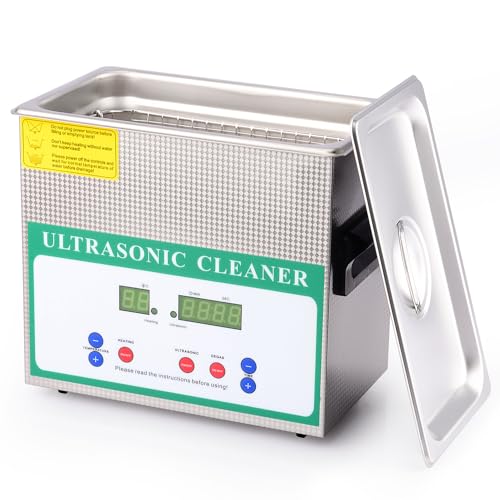
- Built for laboratory glassware and instruments
- 40kHz cleaning with up to 80°C heat
- 304 stainless steel tank with digital controls
Best For: Stainless steel lab cleaner with heat control
Digital Capacity Choice
Sper Scientific 2.5L Ultrasonic Cleaner

- 2.5L stainless steel tank
- Heater reaches up to 65°C
- Five timer settings for flexible cycles
Best For: Feature-rich cleaner with flexible timing
Compact Daily Cleaner

- 48,000Hz cleaning for delicate items
- 5-minute and 7-minute preset modes
- Compact 304 stainless steel 12oz tank
Best For: Small-batch cleaning of glasses and delicate items
Lab-Ready Mid-Size Option
CREWORKS 3.2L Heated Sonic Cleaner

- 3.2L basin for larger batches
- 120W ultrasonic power with heat
- Up to 30 minutes and 70-175°F settings
Best For: Users needing a larger heated cleaner for glassware and tools
Digital Precision Pick
Magnasonic 20oz Ultrasonic Cleaner

- 42,000Hz deep-cleaning ultrasonic waves
- Five preset cleaning cycles on a digital display
- 20oz stainless tank with cleaning basket
Best For: Compact digital cleaning of small glassware and instruments
Heavy-Duty Lab Capacity
CREWORKS 30L Digital Ultrasonic Cleaner

- 30L tank supports larger cleaning loads
- 600W ultrasonic power for stubborn grime
- Heater, timer, and digital controls add convenience
Best For: Large-batch cleaning in labs or workshops
Gentle Mode Pick
CREWORKS 3L Ultrasonic Cleaner with Degas

- Gentle mode helps protect fragile surfaces
- Degas mode improves cavitation effectiveness
- Compact 3L tank suits smaller setups
Best For: Delicate glassware and small-batch cleaning
Balanced Digital Choice

- Dual transducers and 40kHz cleaning frequency
- Digital timer and temperature controls
- 304 stainless steel tank with safety features
Best For: Compact lab cleaning with precise control
Premium Heated Bath – Branson CPXH Digital Cleaning Bath
If you need an ultrasonic cleaner for laboratory glassware with more control than a basic bath, the Branson CPX-952-518R adds heating, programmable operation, and power management features that help dial in repeatable cleaning cycles.
Best For: Labs that want a larger-capacity heated ultrasonic bath with flexible settings for routine glassware cleaning.
Pros:
- Heated cleaning up to 69°C/156.2°F can help improve cleaning performance.
- Fully programmable with digital timer and high/low power control for repeatable cycles.
- Includes degas and conditioning functions for setup and bath prep.
- 2.5-gallon capacity gives it room for larger cleaning workloads.
Cons:
- At 22.4 pounds, it is relatively heavy for a benchtop unit.
- 120V power may limit use in facilities with different electrical requirements.
This model stands out when you want a lab-focused ultrasonic bath with more control over heat and power than entry-level units. The tradeoff is size and weight, but the feature set is well suited to repeated glassware cleaning tasks.
Cleaning Solution Pick – Surgical Instrument Cleaner Concentrate
This surgical instrument cleaner is a concentrated liquid made for manual or ultrasonic cleaning and soaking, making it a practical add-on if you already have an ultrasonic cleaner for laboratory glassware and want a solution that is also listed for glass surfaces.
Best For: Users who need a concentrated cleaning liquid for ultrasonic or manual cleaning of glassware and instruments.
Pros:
- Designed for use in ultrasonic cleaning or soaking.
- Concentrated formula can help stretch each bottle.
- Surface recommendation includes glass.
- Biodegradable material feature adds a practical maintenance angle.
Cons:
- It is a cleaner, not an ultrasonic machine.
- 8 fl oz bottle size may be small for frequent high-volume use.
If your current setup already includes an ultrasonic bath, this concentrate is a straightforward companion product for cleaning glassware and accessories. It is best viewed as a support item rather than the main equipment purchase.
Lab Workhorse – StonyLab 3.2L Ultrasonic Cleaner
The StonyLab ultrasonic cleaning machine is built specifically for laboratory glassware and instruments, with digital temperature and time displays that make it easier to run controlled cleaning cycles in a lab setting.
Best For: Labs wanting a stainless steel ultrasonic cleaner with heat control and straightforward digital operation.
Pros:
- Designed for laboratory glassware and instruments.
- 40kHz operation with heat adjustable up to 80°C.
- Digital displays show temperature and time clearly.
- 304 stainless steel tank is corrosion and high-temperature resistant.
Cons:
- 3.2L capacity may be limiting for larger glassware batches.
- 110V power limits it to compatible electrical setups.
For many lab users, this model hits a useful balance of capacity, heat, and user-friendly controls. The included basket and one-year limited warranty add practical value for everyday cleaning tasks.
Digital Capacity Choice – Sper Scientific 2.5L Ultrasonic Cleaner
The Sper Scientific 100007 is a digital ultrasonic cleaner for laboratory glassware and instruments that combines a 2.5 liter tank, heater, and multiple timer settings in a compact bench-friendly format.
Best For: Buyers who want a feature-rich ultrasonic cleaner with flexible timing and a built-in heater.
Pros:
- 2,500 ml stainless steel tank suits glassware and lab instruments.
- Ceramic heater reaches up to 65°C for warmed cleaning cycles.
- 35,000 Hz ultrasonic frequency and high-powered transducers.
- Five timer settings from 90 to 480 seconds provide cycle flexibility.
Cons:
- 2.5 liter capacity may be modest for larger batches.
- Timer range is shorter than some programmable lab units.
This model is a solid middle-ground option if you want digital controls without moving up to a larger, more complex bath. Features like the cooling fan, auto heater shutoff, and dipping basket make it feel well thought out for regular use.
Compact Daily Cleaner – Miorcols 48KHz Ultrasonic Pod
If you need an ultrasonic cleaner for laboratory glassware that also handles small personal items, this Miorcols unit offers a simple, compact cleaning option. Its 48,000Hz waves are aimed at delicate pieces like glasses, retainers, and other items that benefit from routine rinsing with a cleaning solution.
Best For: Small-batch cleaning of glasses, lab-style glass items, and other delicate everyday accessories.
Pros:
- 48,000Hz ultrasonic action for deep cleaning of delicate items
- Two preset cycles: 5 minutes for routine cleaning and 7 minutes for heavier buildup
- 304 stainless steel tank with overheating protection
- Compact 12oz size is easy to place in a home, office, or travel setup
Cons:
- Cannot remove oxidized rust
- Small capacity limits it to light, small-item cleaning
- Best results require a cleaning solution, not just water
This is a practical pick when portability and simplicity matter more than tank size. It fits routine cleaning well, but users needing a larger laboratory workflow will likely want a bigger basin.
Lab-Ready Mid-Size Option – CREWORKS 3.2L Heated Sonic Cleaner
For buyers comparing an ultrasonic cleaner for laboratory glassware, this CREWORKS model stands out with its 3.2L basin, heater, and timer controls. The combination of 120W ultrasonic power and heated cleaning makes it better suited to larger batches and more stubborn residue on glassware, tools, and other intricate items.
Best For: Users who want a mid-size ultrasonic cleaner with heat for glassware, tools, and mixed cleaning jobs.
Pros:
- 3.2L capacity supports larger cleaning loads than compact units
- 120W ultrasonic power plus 100W heating for more intensive cleaning
- Timer up to 30 minutes and temperature range from 70 to 175°F
- 304 stainless steel basket and tank banding for durable daily use
Cons:
- Bigger and heavier than small countertop cleaners
- Knob controls are functional but less precise than digital interfaces
- Heating and longer cycles may be more than needed for simple rinse-only jobs
This is the most versatile choice in the group if you need a practical mix of capacity, heat, and straightforward controls. It makes more sense for regular glassware cleaning than ultra-compact jewelry units.
Digital Precision Pick – Magnasonic 20oz Ultrasonic Cleaner
If you’re shopping for an ultrasonic cleaner for laboratory glassware and want a smaller unit with more control, the Magnasonic is a well-rounded option. Its 42,000Hz cleaning, five cycle settings, and 20oz stainless steel tank make it a practical choice for compact glassware, instruments, and other small items that need repeatable cleaning cycles.
Best For: Buyers who want a compact digital cleaner with preset cycles for small glassware and instruments.
Pros:
- 42,000Hz ultrasonic waves for deep cleaning in crevices and cavities
- Five cleaning modes provide more cycle flexibility
- 20oz stainless steel tank with anti-corrosion and scratch-resistant protection
- Includes a cleaning basket and lifetime customer support
Cons:
- 20oz capacity is modest for larger laboratory glassware batches
- Does not remove tarnish, so expectations should stay focused on grime and dirt
- Less suited to heavy-duty workloads than larger heated units
This model is a strong fit when you want a compact cleaner with simple digital control rather than maximum capacity. It balances flexibility and size well, especially for smaller glass items and precision cleaning tasks.
Heavy-Duty Lab Capacity – CREWORKS 30L Digital Ultrasonic Cleaner
If you need an ultrasonic cleaner for laboratory glassware with room for larger batches, this 30L Creworks unit is built for high-capacity cleaning. Its 600W ultrasonic output, heater, and digital timer/temperature controls make it practical for tackling stubborn residue in hard-to-reach areas on glassware, tools, and other lab-adjacent items.
Best For: Labs or workspaces that need a large-capacity ultrasonic cleaner for laboratory glassware, parts, and mixed cleaning loads.
Pros:
- Large 30L stainless steel tank suits bigger cleaning batches.
- 600W ultrasonic power helps remove grime from intricate surfaces.
- Built-in heater and digital controls let you set time and temperature easily.
- Drain valve and inset handles make handling and cleanup more convenient.
Cons:
- The large footprint is less ideal for very small benches or tight spaces.
- Max timer of 30 minutes may feel limiting for extended cycles.
- Designed as a broad-purpose cleaner, so it may be more machine than some glassware-only users need.
Overall, this is the strongest pick for buyers who value capacity and power over compact size. It’s a solid option when you want one machine that can handle laboratory glassware plus larger, tougher items.
Gentle Mode Pick – CREWORKS 3L Ultrasonic Cleaner with Degas
This ultrasonic cleaner for laboratory glassware is a good fit when you want a smaller tank with more control over delicate items. The 3L Creworks model includes degas and gentle modes, plus a heater and timer, so you can improve cleaning effectiveness while reducing risk to fragile surfaces.
Best For: Smaller lab setups or users cleaning delicate glassware and other fragile items.
Pros:
- Gentle mode halves power for more delicate surfaces.
- Degas mode helps remove bubbles for more effective cavitation.
- Compact 3L size is easier to place on a bench or cart.
- Heater and knob controls make setup straightforward.
Cons:
- 3L capacity is better for smaller loads than bulk cleaning.
- Controls are manual knobs and switches rather than a digital panel.
- Not as powerful or spacious as larger lab-style ultrasonic cleaners.
For users prioritizing control and a smaller footprint, this model is a practical choice. The gentle mode makes it especially appealing for more fragile laboratory glassware and similarly delicate items.
Balanced Digital Choice – VEVOR 3L Ultrasonic Cleaner
If you want an ultrasonic cleaner for laboratory glassware that balances size, control, and durability, this 3L VEVOR model is worth a look. Its dual 60W transducers, 40kHz frequency, and digital time-and-temperature settings are designed to deliver consistent cleaning for small items with complex shapes.
Best For: Labs, clinics, or home users who want a compact digital ultrasonic cleaner for laboratory glassware and other small items.
Pros:
- Dual 60W transducers and 40kHz frequency support effective deep cleaning.
- Digital controls allow precise timing and temperature adjustment.
- 304 stainless steel tank is corrosion- and rust-resistant.
- Includes a basket, anti-slip feet, and dual fuse protection for safer everyday use.
Cons:
- 3L capacity is best for small loads, not large-volume cleaning.
- Less specialized than a model with a dedicated gentle mode.
- May be more feature-rich than needed for very basic glassware cleaning.
This VEVOR unit stands out as a balanced option for users who want reliable digital controls in a compact tank. It’s a strong fit when you need consistent cleaning for laboratory glassware, small parts, and other precision items.
How We Picked the Best Ultrasonic Cleaner for Laboratory Glassware
We prioritized models that make sense for lab use: stainless steel tanks, adjustable temperature or heater support, reliable timers, and capacities that match common glassware loads. We also looked for straightforward controls, durability, and options that can handle both routine cleaning and heavier soil removal.
Because laboratory glassware can be fragile and contamination-sensitive, we favored cleaner designs that support consistent cycles over flashy extras. The goal is repeatable performance, not just raw power.
Quick Comparison
Smaller 2L to 3L units are usually best for benchtop work, routine rinsing, and smaller batches of glassware. Mid-size units around 3L to 8L offer more flexibility for mixed loads and busier labs. Large-capacity machines are better for shared environments or larger items, but they take up more space and may be more than a small lab needs.
Key Buying Factors for an Ultrasonic Cleaner for Laboratory Glassware
Tank Size and Usable Capacity
Match the tank to your most common glassware. A tank that is too small forces awkward loading, while one that is too large wastes bench space and solution. Check internal dimensions, not just advertised liters or gallons.
Heat and Temperature Control
Heating helps remove residue faster, especially with grease, salts, and dried film. For an Ultrasonic Cleaner for Laboratory Glassware, look for adjustable heat or at least a stable heated function so you can avoid overheating sensitive items.
Timer and Cycle Control
Multiple timer settings are useful when cleaning different soils. Short cycles can handle light contamination, while longer cycles help with stubborn residue. Simple, repeatable controls are often better than complicated presets.
Tank Material and Build Quality
Stainless steel tanks are the standard for a reason: they resist corrosion and are easier to keep clean. A sturdy lid, basket, and well-fitted controls also matter if the cleaner will see daily use.
Frequency and Cleaning Style
Higher-frequency units can be gentler on delicate glassware, while lower frequencies may be more aggressive on heavy residue. If your load includes fragile labware, prioritize balanced cleaning over maximum intensity.
Who Should Buy Which Ultrasonic Cleaner for Laboratory Glassware?
If you run a small lab or teaching setup, a compact 2L to 3L unit is often enough. For mixed daily use, a mid-size heated model with a digital timer offers the best mix of convenience and versatility. Larger labs, prep rooms, or facilities cleaning many items at once should look at higher-capacity options with stronger output and more robust baskets.
For most buyers, the best Ultrasonic Cleaner for Laboratory Glassware is the one that fits your routine, not the one with the longest feature list. Start with capacity, then narrow by heat, timer precision, and build quality to find a dependable match.