Reliable temperature records are essential for laboratories managing samples, reagents, instruments, and regulated storage. The right logger can help document conditions, identify excursions, and simplify reporting.
We compared ten options across probe design, measurement capacity, data export, reusability, environmental protection, and practical laboratory workflows.
Best 10 Temperature Data Loggers for Laboratories Picks for 2026
Best Overall
Elitech RC-5 USB Temperature Data Logger

- 32,000-point storage across -30°C to 70°C
- Built-in USB reporting without a separate reader
- IP65 protection, alarms, and LCD display
Best For: Routine laboratory temperature monitoring and storage
Best Bottle-Probe Model
Traceable Data Logging Thermometer
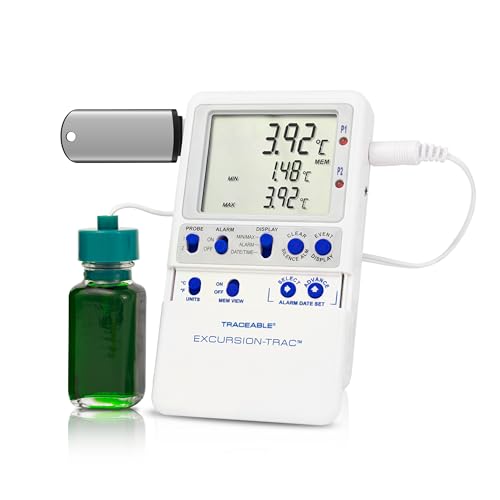
- Glass bottle probe for indoor monitoring
- Stores 525,600 recent temperature observations
- Visual and audible Smart-Alarm system
Best For: Laboratory storage monitoring with bottle-based sensing
Best Multi-Parameter Logger
USB Temperature Humidity Pressure Logger

- Tracks temperature, humidity, and pressure together
- Creates PDF and Excel reports over USB
- Stores 16,000 groups with customizable alarms
Best For: Environmental comparisons requiring three data types
Best Compliance-Focused Option
Elitech GSP-6 Dual Probe Logger

- Dual external probes with temperature and humidity sensing
- Designed for CDC/VFC and FDA 21 CFR Part 11 workflows
- Includes calibration certificate and battery/USB power
Best For: Pharmaceutical, vaccine, and regulated cold-chain monitoring
Best Disposable Lab Logger

- 28,800 readings and up to 200-day battery life
- USB PDF and CSV reports without drivers
- IP68 protective pouch for damp shipments
Best For: Single-use lab and cold-chain monitoring
Best Multi-Channel Logger
AZ Instruments 4-Channel Thermocouple

- Four-channel recording from -200°C to 1370°C
- One-second programmable sampling
- 8GB SD card and two included K-type probes
Best For: Reusable multi-channel laboratory measurements
Best Shipment Logger
Deltatrak FlashLink Mini 10-Pack

- Monitors single-use trips up to 85 days
- Automatic PDF and CSV reports via USB
- Reports available in Celsius and Fahrenheit
Best For: Documented in-transit laboratory shipments
Best Overall Pen-Style Logger

- 32,000-point reusable recording
- PDF export without software
- IP65 pen-style housing
Best For: Compact laboratory and cold-chain monitoring
Best for Multi-Point Monitoring

- Five reusable data loggers
- Embedded PDF reports
- Up to five alarm settings
Best For: Multiple refrigerators, shipments, or storage areas
Best with External Probe

- External USB temperature sensor
- 32,000-point reusable recording
- Automatic PDF reporting
Best For: Indoor monitoring requiring separate probe placement
Best Overall – Elitech RC-5 USB Temperature Data Logger
For laboratories seeking temperature data loggers for laboratories, the Elitech RC-5 is a practical general-purpose option. It records up to 32,000 points across a -30°C to 70°C range, displays key readings on its LCD, and connects directly to a computer through its built-in USB plug for data downloads and PDF reports.
Best For: Routine temperature monitoring, freezer storage, vaccine handling, and transport applications.
Pros:
- Wide -30°C to 70°C measurement range with 0.1°C/°F resolution
- Built-in USB connector requires no separate cable or reader
- Reusable design with replaceable battery and up to six months of stated battery life
- IP65 protection, temperature alarms, and an easy-to-read LCD
Cons:
- Temperature-only monitoring does not track humidity or pressure
- Calibration certificate is available by contacting the seller rather than listed as a standard included component
The RC-5 balances useful storage capacity, straightforward USB reporting, and portable monitoring in a compact unit. It is a strong fit when a laboratory needs simple, reusable temperature logging rather than multi-parameter environmental data.
Best Bottle-Probe Model – Traceable Data Logging Thermometer
The Traceable Data Logging Thermometer is a specialized choice among temperature data loggers for laboratories that need bottle-based sensing. Its glass bottle probe supports detailed monitoring, while rolling memory stores the latest 525,600 observations and the display shows current, high, and low temperatures together.
Best For: Indoor laboratory storage monitoring where a bottle probe and persistent alarm behavior are useful.
Pros:
- Glass bottle probe configuration for laboratory temperature monitoring
- Rolling memory retains up to 525,600 temperature observations
- Stores up to 10 unique alarm events and supports downloadable memory clearing
- Smart-Alarm provides visual and audible alerts, even after conditions normalize
Cons:
- Designed for indoor use rather than outdoor monitoring
- Records temperature only, without humidity or pressure measurements
- The supplied notes do not specify the full temperature measurement range
This model prioritizes extensive observation history and alarm tracking over compact USB convenience. Its bottle probe and simultaneous high/low/current display make it particularly appropriate for controlled indoor storage checks.
Best Multi-Parameter Logger – USB Temperature Humidity Pressure Logger
When temperature data loggers for laboratories need to capture more than temperature, this USB model also records humidity and atmospheric pressure. It measures -30°C to 70°C, stores up to 16,000 groups of readings, and generates PDF graphics and Excel reports through its built-in Windows-compatible software.
Best For: Laboratories comparing environmental conditions across samples, rooms, or recording periods.
Pros:
- Simultaneously records temperature, humidity, and barometric pressure
- Built-in USB software produces PDF and Excel reports without an external reader
- Adjustable sampling interval, alarm range, units, and password settings
- IP65 waterproof design with a mark function for noting environmental changes
Cons:
- Report software requires a Windows computer
- Stores 16,000 groups, fewer than some temperature-only loggers
- Listed response time is 30 seconds
This logger is more versatile than a temperature-only device, especially for environmental comparisons and documentation. Choose it when humidity and pressure data matter as much as temperature, and Windows-based reporting fits the laboratory workflow.
Best Compliance-Focused Option – Elitech GSP-6 Dual Probe Logger
The Elitech GSP-6 is a compliance-oriented option among temperature data loggers for laboratories, with dual external probes, humidity monitoring, and a stated design for CDC/VFC requirements and FDA 21 CFR Part 11 compliance. Its large LCD, alarms, magnetic mounting, and battery/USB power options support continuous monitoring in refrigerators and other controlled environments.
Best For: Pharmaceutical, vaccine, hospital, and cold-chain monitoring where dual probes and documentation features are priorities.
Pros:
- Dual-probe design with temperature and humidity monitoring
- Wide temperature range of -40° to 185° and humidity range of 10% to 99% RH
- Battery and USB power options help maintain operation
- Includes a calibration certificate, external sensors, alarms, LCD, and magnetic mounting
Cons:
- More specialized than needed for basic temperature-only logging
- Listed response time is 10,000 milliseconds
- Advanced functions require the Elitechlog software
The GSP-6 offers the most specialized monitoring package in this group, combining dual probes, broad sensing ranges, alerts, and compliance-focused positioning. It is a compelling choice for regulated storage workflows that need more than a standalone temperature reading.
Best Disposable Lab Logger – Frigga U1 10-Pack
For laboratories that need straightforward temperature data loggers for laboratories and cold-chain shipments, the Frigga U1 provides single-use monitoring across a -30°C to 70°C range. It records up to 28,800 points and generates PDF and CSV reports through its built-in USB connection.
Best For: Labs, medical refrigerators, vaccine shipments, and other single-use cold-chain applications.
Pros:
- Stores up to 28,800 readings with a stated battery life of up to 200 days.
- Downloads PDF and CSV reports without drivers, software installation, network setup, or monthly fees.
- Offers configurable intervals from 10 seconds to 24 hours and high/low alarms through Frigga Data Center software.
- Its protective pouch is rated IP68 when kept intact until data download.
Cons:
- It is single-use rather than reusable.
- The current version displays Celsius only.
- Accuracy varies by temperature range, with ±1°C specified outside -20°C to 40°C.
The U1 is a practical choice when you want multiple disposable loggers, simple computer-based reporting, and protection for damp shipping conditions. Its Celsius-only display and single-use design are the main limitations for laboratories needing reusable or Fahrenheit-focused monitoring.
Best Multi-Channel Logger – AZ Instruments 4-Channel Thermocouple
For laboratories needing reusable temperature data loggers for laboratories, this AZ Instruments unit combines four-channel thermocouple measurement with SD-card recording. It supports a broad -200°C to 1370°C range, programmable sampling from one second, and independent high/low alarms for each channel.
Best For: Reusable bench testing, process monitoring, and experiments requiring multiple K-type thermocouple inputs.
Pros:
- Records four temperature channels and includes two K-type thermocouple probes.
- Supports manual memories and automatic logging limited by the SD card capacity.
- Includes an 8GB SD card for data storage and a large 104 × 47 mm LCD.
- Provides selectable Celsius/Fahrenheit units, real-time date and time display, and independently programmable alarms.
Cons:
- The listed accuracy is ±(0.3% of reading + 1°C) under stated ambient conditions.
- It requires four AA batteries.
- Only two K-type probes are included for its four channels.
This is the most flexible option of the three for ongoing laboratory work and high-temperature measurements. Its reusable design and four-channel capacity suit experiments and process checks, while the thermocouple setup is less convenient than a compact single-use USB logger.
Best Shipment Logger – Deltatrak FlashLink Mini 10-Pack
The Deltatrak FlashLink Mini is designed for shipment monitoring, making it a convenient option among temperature data loggers for laboratories that receive or send cold-chain materials. Its single-use format supports trips up to 85 days, and the built-in USB connector automatically produces PDF and CSV reports.
Best For: In-transit laboratory samples, medical products, and shipments requiring simple inspection-ready documentation.
Pros:
- Supports trips of up to 85 days in a compact single-use format.
- Built-in USB enables plug-and-play report retrieval without special reading hardware or software.
- Creates PDF and CSV reports in both Celsius and Fahrenheit.
- The shipping card includes traceability space, a peel-away barcode label, and shipper/receiver instructions in English and Spanish.
Cons:
- It is single-use and intended primarily for transit monitoring.
- The package does not include the cable shown in product imagery.
- Its stated trip duration is up to 85 days, shorter than the Frigga U1’s listed 200 days.
The FlashLink Mini is a strong fit when shipment paperwork and easy receiving inspections matter as much as temperature recording. Its dual-unit reports and built-in reporting make it especially convenient for laboratories handling documented in-transit loads.
Best Overall Pen-Style Logger – Elitech RC-51H
For laboratories seeking temperature data loggers for laboratories with a compact, reusable design, the Elitech RC-51H combines a readable LCD with programmable recording settings and USB PDF export. Its pen-shaped housing is also rated IP65 for protection against dust and water.
Best For: Life science, food cold-chain, and industrial monitoring where a compact logger with on-device readings is useful.
Pros:
- Stores up to 32,000 data points and supports adjustable logging intervals.
- Exports data as a PDF without requiring software.
- Displays current, minimum, and maximum readings, date, and record count.
- Includes a calibration certificate and supports Fahrenheit/Celsius switching.
Cons:
- Its listed response time is 2 minutes, which may not suit fast-changing conditions.
- Advanced functions require Elitechlog software.
The RC-51H is a practical choice when portability, basic environmental protection, and straightforward report export matter more than specialized probe placement.
Best for Multi-Point Monitoring – Elitech RC-5+ 5-Pack
The Elitech RC-5+ five-pack is a practical option for laboratories comparing temperature data loggers for laboratories across multiple refrigerators, shipments, or storage areas. Each reusable unit records up to 32,000 points and creates an embedded PDF report without requiring software to open the file.
Best For: Teams monitoring several locations or shipments involving vaccines, blood products, pharmaceuticals, and other perishable materials.
Pros:
- Five reusable loggers provide coverage for multiple monitoring points.
- Generates automatic PDF reports with embedded data.
- Supports up to five alarm settings and adjustable logging intervals.
- Includes calibration certificates, USB cable, warranty, and customer support access.
Cons:
- The package may be more equipment than needed for a single monitoring location.
- The supplied specifications list the color as Celsius, so buyers should confirm preferred display settings.
Choose this bundle when consistent monitoring across several assets is more valuable than buying individual units, especially for cold-chain and pharmacy workflows.
Best with External Probe – Elitech RC-5+ TE
For applications that benefit from sensor placement outside the logger body, the Elitech RC-5+ TE adds an external USB sensor while retaining PDF reporting and reusable 32,000-point recording. It is a useful candidate among temperature data loggers for laboratories when the probe needs to be positioned separately.
Best For: Indoor laboratory, refrigerator, and cold-chain monitoring where an external probe can simplify sensor placement.
Pros:
- Includes an external USB temperature sensor for flexible placement.
- Creates an automatic PDF report with embedded data and no software required to access it.
- Displays current, minimum, and maximum readings plus date and record count.
- Offers adjustable alarm settings and logging intervals.
Cons:
- It is specified for indoor use rather than indoor and outdoor use.
- The external sensor adds a separate component to manage during setup.
- The listed response time is 2,000 milliseconds.
The RC-5+ TE is the better fit of these options when an external probe is more important than the simplest all-in-one form factor.
How We Picked the Best Temperature Data Loggers for Laboratories
We focused on the features that affect day-to-day monitoring rather than simply prioritizing the highest advertised accuracy. The selection includes compact USB devices, probe-based thermometers, Bluetooth models, multi-channel thermocouple systems, reusable recorders, and single-use cold-chain loggers.
Our comparison considered recording capacity, temperature and humidity support, probe placement, alarm and display functions, PDF or CSV export, software requirements, enclosure protection, calibration practicality, and total cost over repeated use. Because laboratory requirements vary widely, no single model is ideal for every application.
Quick Comparison
| Type | Best suited to | Key advantage | Watch for |
|---|---|---|---|
| USB temperature logger | Routine refrigerator, freezer, or room monitoring | Simple data transfer and reporting | Confirm software and operating-system compatibility |
| Probe-based logger | Liquid, vial, or bottle temperature checks | Better representation of stored material temperature | Probe placement and cable management |
| Bluetooth logger | Remote review and multi-parameter monitoring | Convenient wireless access | App, phone, and connection requirements |
| Thermocouple recorder | Validation, testing, and multiple measurement points | Several channels and flexible probes | Requires compatible K-type thermocouples |
| Disposable logger | Shipments and one-way cold-chain trips | Fast deployment without return logistics | Single-use economics and limited reuse |
Key Buying Factors for Temperature Data Loggers for Laboratories
Measurement Range and Accuracy
Choose a range that covers the actual storage or test conditions with comfortable margin. For regulated work, review stated accuracy, resolution, calibration documentation, and performance at the temperatures you use—not only the headline specification.
Sensor and Probe Design
An internal sensor is convenient for ambient air or enclosure monitoring. A bottle, wired, or external probe may provide more meaningful readings for samples and liquids, particularly when the logger must remain outside a refrigerator or freezer.
Data Capacity and Export
Check the number of readings, sampling interval, start options, and whether reports export as PDF, CSV, or both. USB models are useful when records must be downloaded without specialized equipment, while Bluetooth can reduce the need to open a monitored enclosure.
Environment and Workflow
Look for suitable IP protection, operating-temperature limits, battery life, display readability, and mounting options. Reusable units generally suit recurring monitoring; disposable recorders can be more practical for in-transit shipments and distributed sampling.
Documentation and Compliance
Determine whether you need calibration certificates, alarm history, audit-friendly reports, password controls, or traceability to a laboratory quality system. A low-cost logger may not meet documentation requirements for validated or regulated processes.
Who Should Buy Which Temperature Data Loggers for Laboratories?
Choose a compact reusable USB model for routine refrigerator, freezer, incubator, or room checks where straightforward downloads matter most. Select a bottle or external-probe design when the temperature of a liquid or stored sample is more important than surrounding air.
Bluetooth is a strong choice for teams that want convenient mobile review and combined temperature-humidity tracking. A four-channel thermocouple recorder is better for validation work, equipment testing, or experiments requiring measurements at multiple locations.
For shipments, field transfers, and one-way cold-chain routes, disposable USB loggers can simplify deployment and eliminate return handling. Before purchasing, confirm the intended temperature range, logging duration, sampling interval, reporting format, and calibration needs against your laboratory’s written procedures.