The best science experiment sets turn screen-free play into hands-on learning, giving children a structured way to explore chemistry, physics, earth science, and biology.
We compared 10 popular kits by experiment variety, age fit, included materials, educational value, and ease of use to help you choose a set that matches your child’s interests and attention span.
Best 10 Science Experiment Sets Picks for 2026
Best Magic-and-STEM Pick
National Geographic Science Magic Kit

- 20 included magic experiments plus 85+ bonus activities
- Designed for ages 8 and up
- No batteries required
Best For: Magic-loving kids who want entertaining STEM activities
Best Extensive Experiment Variety
Doctor Jupiter Ultimate Science Kit

- 135+ combined experiments and 90+ bonus activities
- Includes lab tools and separate leak-proof ingredient bottles
- Illustrated instructions support parent-child use
Best For: Families seeking a large, reusable activity selection
Best Chemistry-Focused Choice
National Geographic Chemistry Set

- 45 guided chemistry experiments
- Includes volcano, geyser, and rocket activities
- Illustrated instructions explain reactions and STEM concepts
Best For: Kids who want structured chemistry demonstrations
Best Hands-On Starter Set
Science Kit for Kids: 80 Experiments

- Includes 80 guided laboratory experiments
- Comes with goggles, test tubes, droppers, gloves, and more
- Progressive guidance ranges from simple to challenging
Best For: Beginners who enjoy science play and role-play tools
Best Earth Science Pick
National Geographic Earth Science Kit

- 15+ Earth science activities
- Includes volcano, crystals, and dig kits
- Full-color learning guide
Best For: Kids who enjoy geology and hands-on Earth science
Best Variety Value
UNGLINGA 150 Experiments Science Kit

- 150 projects across multiple topics
- Includes tools, materials, and goggles
- Illustrated step-by-step manual
Best For: Families wanting a broad selection of home experiments
Best Gross Science Pick
National Geographic Gross Science Kit

- 15 included plus 30 bonus experiments
- Covers polymers, reactions, and pH
- Kid-friendly illustrated instructions
Best For: Kids who enjoy quirky, messy, and memorable STEM projects
Most Experiments
272-Experiment Chemistry Science Kit

- Includes 272 hands-on STEM activities
- Covers chemistry, physics, and visual experiments
- Includes child-sized plastic lab tools
Best For: Kids ages 8 and up who want maximum experiment variety
Best Three-in-One Set
National Geographic Mega Science Lab
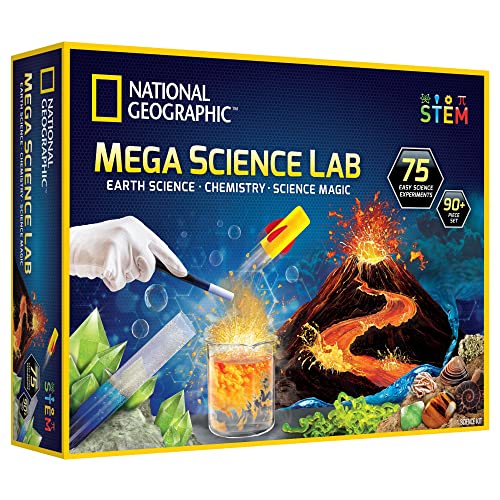
- Offers Earth science, chemistry, and magic
- Provides 75 experiments in total
- Includes real specimens and a fossil activity
Best For: Kids ages 8–12 who want varied, structured science exploration
Best Household-Material Option
50+ Science Lab Experiments Kit

- Includes over 50 STEM activities
- Covers Earth science, chemistry, and magic
- Uses common household items for some projects
Best For: Kids ages 8 and up exploring science at home
Best Magic-and-STEM Pick – National Geographic Science Magic Kit
For kids who enjoy a theatrical twist, this science experiment set combines 20 included magic experiments with a bonus booklet containing more than 85 additional activities. It is designed for ages 8 and up and focuses on hands-on STEM play without requiring batteries.
Best For: Children who enjoy magic tricks, science demonstrations, and imaginative STEM activities.
Pros:
- Offers more than 100 total experiments and tricks.
- Includes everything needed for 20 magic experiments plus a bonus activity booklet.
- Supports hands-on STEM learning for kids ages 8 and up.
- Backed by a U.S. support team and manufacturer warranty.
Cons:
- The magic-focused theme may be less suitable for children seeking a dedicated chemistry set.
- The product notes do not specify the exact contents of every included experiment.
This is a strong choice when entertainment matters as much as experimentation. Its large activity count and magic theme make it especially appealing for independent play, demonstrations, or a science-themed gift.
Best Extensive Experiment Variety – Doctor Jupiter Ultimate Science Kit
This science experiment set is built around variety, with more than 135 activities covering color changes, glowing water, underwater volcanoes, potions, and more. Clear illustrated instructions, separate leak-proof chemical bottles, and bonus household-material experiments make it a flexible option for ages 8 and up.
Best For: Families looking for a broad, repeatable science activity set to use together.
Pros:
- Provides more than 135 combined experiments, including 90+ bonus activities using household items.
- Includes practical lab-style tools such as a measuring cylinder, conical flask, funnel, tray, and test tube stand.
- Uses illustrated, step-by-step instructions designed for parent-child participation.
- Ingredients are stored in separate leak-proof bottles for repeated use.
Cons:
- Some bonus experiments require additional household materials.
- The extensive activity list may require more setup and supervision than a smaller kit.
Doctor Jupiter stands out for families prioritizing maximum activity variety and shared learning time. The included equipment and repeat-use ingredients add practical value, while the bonus booklet extends the kit beyond its supplied materials.
Best Chemistry-Focused Choice – National Geographic Chemistry Set
For young scientists specifically interested in reactions, this chemistry-centered science experiment set includes 45 activities involving volcanoes, geysers, rockets, and fizzy or bubbly chemical reactions. The illustrated guide also introduces the scientific process and chemistry fundamentals for ages 8 and up.
Best For: Kids who want structured, hands-on chemistry activities with recognizable science demonstrations.
Pros:
- Includes 45 guided experiments with a clear chemistry focus.
- Features engaging activities such as a volcano eruption, geyser, and rocket.
- Provides kid-friendly illustrated instructions and explanations of chemical reactions.
- Requires no batteries and supports hands-on STEM learning.
Cons:
- Offers fewer total activities than the larger kits in this roundup.
- The chemistry focus may feel narrower for children seeking magic or broader science topics.
This set is a practical middle ground for families that want a focused introduction to chemistry rather than an oversized collection. Its familiar demonstrations can make scientific concepts approachable while keeping activities structured.
Best Hands-On Starter Set – Science Kit for Kids: 80 Experiments
This science experiment set offers 80 guided laboratory activities, including rainbow rain, fountains, volcanoes, and bottle-blowing balloons. It includes a wide selection of child-sized tools and materials, with guidance that progresses from simpler experiments to more challenging ones.
Best For: Younger children and beginners who enjoy role-play alongside simple science activities.
Pros:
- Includes 80 experiments with step-by-step scientific guidance cards.
- Supplies a broad collection of tools, including goggles, petri dishes, test tubes, droppers, gloves, and measuring cups.
- Materials are separated into bottles with tightly closed lids for continued use.
- Suitable for children from 36 months to 12 years according to the listed manufacturer age range.
Cons:
- The listed age range is broad, so younger children will likely need close adult supervision.
- The product dimensions are listed as 1 x 1 x 1 inches, which may not describe the full packaged kit accurately.
- It provides less detail about the specific scientific concepts than the chemistry-focused alternatives.
This kit favors variety, accessible demonstrations, and scientist role-play. It can be a good entry point for children who benefit from visual instructions and a large assortment of props, though adult guidance remains important.
Best Earth Science Pick – National Geographic Earth Science Kit
For shoppers seeking science experiment sets with an Earth-science focus, this National Geographic kit offers more than 15 included activities, including volcanoes, water tornadoes, crystals, and geologic dig kits. Its illustrated learning guide adds useful explanations while keeping the projects approachable for kids ages 8 and up.
Best For: Curious kids who enjoy geology, volcanoes, crystals, and hands-on STEM activities with family or friends.
Pros:
- Includes more than 15 hands-on Earth science activities.
- Features two geologic dig kits, crystal growing, an erupting volcano, and dueling water tornadoes.
- Full-color guide explains the science behind the experiments.
- Designed for sharing with family, friends, or classmates.
Cons:
- The included activities center primarily on Earth science rather than a broad range of scientific fields.
- Some projects may require additional household participation or setup.
This is a strong choice when educational explanations and Earth-themed projects matter more than having the widest possible subject range. Clear instructions and included activities make it a practical pick for guided discovery.
Best Variety Value – UNGLINGA 150 Experiments Science Kit
This UNGLINGA set stands out among science experiment sets for its large selection of 150 projects spanning earth science, chemistry, physics, surface tension, and more. The illustrated, step-by-step manual and included kid-friendly tools make it suitable for home science time with children ages 8 and up.
Best For: Families looking for a broad mix of experiments and a hands-on activity set for weekends, school breaks, or gifts.
Pros:
- Offers 150 experiments across several science topics.
- Includes science tools, materials, and goggles for a lab-style experience.
- Illustrated instructions use a step-by-step format.
- Many projects can also use common household items.
Cons:
- The large number of projects may require organization and adult guidance.
- Some experiments depend on additional household materials.
Choose this kit if variety is your top priority. It provides an extensive menu of activities and tools, though families should review each project for the materials and supervision needed before starting.
Best Gross Science Pick – National Geographic Gross Science Kit
For kids who learn best through humor and memorable demonstrations, this National Geographic kit brings a gross-science theme to science experiment sets. It includes supplies for 15 projects plus a bonus booklet with 30 experiments using household products, covering topics such as polymers, chemical reactions, and pH science.
Best For: Kids ages 8 and up who are excited by slime, glowing worms, boiling “boogers,” and other yucky STEM activities.
Pros:
- Includes 15 supplied gross-science experiments and 30 additional household-item projects.
- Uses engaging activities such as slime making, glowing worms, and a test-tube “vomit” project.
- Illustrated instructions explain each step and the science involved.
- Introduces polymers, chemical reactions, and pH concepts through play.
Cons:
- The gross theme may not appeal to every child or household.
- Some of the 30 bonus experiments require common household products.
This is a focused, entertaining option for children drawn to unusual or messy demonstrations. Its bonus activities extend the kit beyond the included materials, while the guide helps connect the spectacle to real STEM concepts.
Most Experiments – 272-Experiment Chemistry Science Kit
For families seeking science experiment sets with plenty of variety, the UNGLINGA 272 Experiments Science Kit offers a broad collection of hands-on activities. Kids can explore volcanoes, crystal growing, holographic projection, walking water, and physics reactions with child-sized lab tools and an illustrated guide.
Best For: Kids ages 8 and up who want a large selection of guided STEM activities to share with family, friends, or classmates.
Pros:
- Includes 272 experiments spanning chemistry, physics, and visual science activities.
- Comes with plastic test tubes, a measuring spoon, beaker, and conical flask.
- Illustrated instructions are designed to make each activity easier to follow.
Cons:
- The recommended age is 8 years and up, so younger children may need another option.
- The large number of activities may require adult help with setup and supervision.
This is a strong choice when experiment count is the priority. Its broad activity mix and lab-style accessories make it especially appealing for extended use during weekends, school breaks, or group projects.
Best Three-in-One Set – National Geographic Mega Science Lab
Among science experiment sets, the National Geographic Mega Science Lab stands out for combining Earth science, chemistry, and science magic in one package. It includes 45 guided experiments, a bonus guide with 30 activities using household items, and real rock, mineral, crystal, and fossil specimens.
Best For: Kids ages 8 to 12 who want a structured, multi-topic science kit with collection pieces and household-material activities.
Pros:
- Combines three themes: Earth science, chemistry, and science magic.
- Includes 75 total experiments across the main kit and bonus guide.
- Features real rock, mineral, crystal, and fossil specimens.
Cons:
- Some bonus experiments rely on common household items not included in the kit.
- Its 5.7-pound size may be less convenient for compact storage or travel.
This is the most balanced pick for children who may lose interest in a single science theme. The combination of experiments, specimens, and science-magic demonstrations gives it strong educational and play value.
Best Household-Material Option – 50+ Science Lab Experiments Kit
The UNGLINGA 50+ Science Lab Experiments Kit is a practical choice among science experiment sets for families who want guided activities supplemented by materials already at home. Its projects cover Earth science, chemistry, and magic, including volcanoes, foamy fountains, gemstones, color-changing flowers, and rainbow rain.
Best For: Kids ages 8 and up who want an at-home lab experience with a manageable selection of experiments and household liquids.
Pros:
- Includes more than 50 activities across Earth science, chemistry, and magic.
- Uses common household items for some experiments and encourages creating new activities.
- Provides a detailed guide explaining the science behind the projects.
Cons:
- Some activities require additional household materials.
- It offers fewer included experiments than the larger 272-experiment kit.
This kit is a good middle ground for families that want variety without committing to the largest set. Its emphasis on household materials can also make follow-up experiments easier to plan.
How We Picked These Science Experiment Sets
We focused on kits that offer multiple guided activities rather than one-off demonstrations. Our comparison considered the number and variety of experiments, the clarity of instructions, the level of adult supervision required, and whether the kit supports meaningful STEM concepts instead of relying only on novelty.
We also looked at specialization. Some sets emphasize chemistry, while others explore earth science, gross science, magic-style demonstrations, or broad laboratory play. Experiment counts can be useful, but they do not always indicate better value: a smaller kit with complete materials and clear explanations may be more practical than a large set requiring extensive household supplies.
Quick Comparison
- Best for broad variety: Choose a high-count kit with chemistry, physics, and general STEM activities.
- Best for chemistry beginners: Look for guided reactions, simple lab tools, and age-appropriate explanations.
- Best for earth science: Earth-focused kits are a good fit for children interested in rocks, weather, geology, and natural systems.
- Best for reluctant learners: Gross science and magic-themed experiments can make scientific ideas feel more entertaining.
- Best for role-play: Lab coats, tools, and scientist-style activities add imaginative play alongside experiments.
Key Buying Factors for Science Experiment Sets
Age and Supervision
Match the kit to the child’s recommended age, reading ability, and patience. Younger children generally need an adult to measure ingredients, explain instructions, and handle cleanup. Even kits labeled for older children may require supervision for powders, liquids, heat, glassware, or small parts.
Experiment Quality and Materials
Check what is included and what must be supplied at home. A long list of activities is less useful if many require uncommon ingredients. Favor kits with reusable tools, clearly labeled components, and instructions that explain the science behind each result.
Subject Focus
Choose a focused chemistry, earth science, or gross-science kit when a child has a strong interest. A broader set is better for families who want to sample different STEM topics or use the kit with more than one child.
Storage and Cleanup
Science activities can involve liquids, powders, stains, and disposable materials. Look for organized packaging and plan to use a washable work surface, protective eyewear where appropriate, and a nearby water supply.
Who Should Buy Which Science Experiment Sets?
Buy a broad, high-experiment-count kit for curious children who enjoy variety and are likely to return to the set over time. Select a chemistry-centered option for budding lab enthusiasts who prefer reactions, formulas, and tool-based activities. Earth science kits suit children fascinated by rocks, weather, and the planet, while gross-science sets are ideal for kids motivated by unusual or silly demonstrations.
For younger or less experienced experimenters, prioritize clear instructions and manageable activities over the biggest number on the box. Families buying for siblings should consider duplicate tools, shared-material requirements, and whether the projects can be completed independently or work better as supervised group activities.