The best science experiment sets for classrooms make complex ideas easier to teach through structured, hands-on activities. This roundup compares 10 options spanning chemistry, circuits, magnetism, plant science, and general lab skills.
Whether you need a bulk kit for group work or a focused set for a specific unit, use the guide below to match materials, age range, and lesson goals with your classroom needs.
Best 10 Science Experiment Sets for Classrooms Picks for 2026
Best Beginner Chemistry Pick
National Geographic Junior Chemistry Set

- 50 hands-on chemistry experiments
- 20+ child-safe lab tools included
- Illustrated instructions for ages 4+
Best For: Early elementary chemistry exploration
Best Magnetism Demonstration Set

- 38 pieces for magnetism experiments
- Includes electromagnet and levitation equipment
- Designed for physics teaching demonstrations
Best For: Older students learning magnetism and electromagnetism
Best Shared Lab Tool Set

- 39 reusable plastic lab tools
- Multiple beakers, flasks, and test tubes
- Includes four goggles and four magnifying glasses
Best For: Small-group classroom science stations
Best Bulk Circuit Activity

- Eight individually packed student kits
- Builds a working fan and simple circuit
- Designed for ages 8–12
Best For: Elementary classroom circuit projects
Classroom Chemistry Starter

- 33 plastic lab tools for exploratory activities
- Includes beakers, test tubes, droppers, goggles, and pipettes
- Colorful, easy-to-clean design
Best For: Supervised chemistry activities for older students
Magnetism & STEM Exploration
122-Piece Magnetic Science Kit

- Includes magnetic balls, wands, chips, rings, and shapes
- Supports magnetism, sorting, math, and physics activities
- Storage box keeps the many pieces organized
Best For: Early STEM centers and supervised magnetism lessons
Early Science Skills Builder
37-Piece Beaker & Test Tube Set
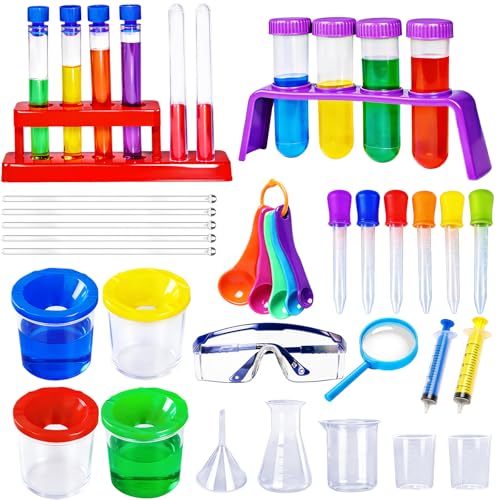
- Includes beakers, test tubes, droppers, funnels, and measuring tools
- Smooth plastic design is easy to clean and handle
- Encourages observation and careful operation
Best For: Guided introductory science activities for young learners
Hands-On Physics Pick
Electricity & Magnetism Lab Kit

- 55-piece set with more than 50 experiments
- Explores circuits, electromagnets, and magnetic controls
- Illustrated manual and organized storage case
Best For: Physics lessons for students ages 13–18
Group Project Value

- Includes 12 individual student kits
- Builds fiber optic lights and simple circuits
- Designed for ages 8 and up with no complex tools
Best For: Elementary classroom groups and STEM activity stations
Living Science Choice

- Includes six varieties for growth comparisons
- Transparent planters reveal roots and shoots
- Supports hands-on botany and school gardening
Best For: Early science and classroom gardening projects
Best Beginner Chemistry Pick – National Geographic Junior Chemistry Set
For younger learners, the National Geographic Junior Chemistry Set is a hands-on choice among science experiment sets for classrooms. It includes 50 illustrated experiments, more than 20 child-safe lab tools, and activities using familiar household materials such as baking soda and vinegar.
Best For: Early elementary classrooms and introductory chemistry activities for children ages 4 and up.
Pros:
- Offers 50 interactive experiments for repeated use.
- Includes more than 20 lab tools, including test tubes and goggles.
- Illustrated, step-by-step instructions support independent participation.
- Requires no batteries and uses some common household materials.
Cons:
- The age recommendation may limit its usefulness for older students.
- Many activities require additional household ingredients.
This kit is a practical option when a classroom needs approachable chemistry demonstrations with built-in tools and clear directions. Its young age focus makes it better suited to foundational exploration than advanced lab work.
Best Magnetism Demonstration Set – 38-Piece Magnet Physics Kit
The EXBEPE Magnet Kit is a focused choice among science experiment sets for classrooms that need demonstrations of magnetism and electromagnetism. Its 38 pieces support activities involving magnetic fields, attraction and repulsion, magnetic levitation, compasses, and a basic electromagnet.
Best For: Physics classrooms and teacher-led demonstrations for students studying magnetism and electromagnetism.
Pros:
- Includes a broad selection of magnets, wires, pins, and related tools.
- Supports classic magnetic-field, levitation, and electromagnet experiments.
- Includes two small cars and magnetic butterflies for more engaging demonstrations.
- Diagrams are provided to guide experiments step by step.
Cons:
- The manufacturer lists a recommended age of 15 years and up.
- Some activities require batteries and careful teacher supervision.
- Its specialized focus is narrower than a general science kit.
Choose this set when the learning goal is specifically magnetism rather than broad STEM coverage. The assortment is well suited to demonstrations and exploratory stations, especially when an instructor guides the experiments.
Best Shared Lab Tool Set – Copkim 39-Piece Science Kit
The Copkim 39-Piece Science Kit emphasizes shared classroom equipment rather than a fixed experiment curriculum. With multiple flasks, beakers, test tubes, racks, droppers, goggles, magnifying glasses, funnels, and other tools, it gives young learners a practical setup for science experiment sets for classrooms.
Best For: Small-group early science stations where students use common household materials to explore basic chemistry and observation.
Pros:
- Includes multiple pieces of key equipment for group activities.
- Provides four pairs of safety goggles and several containers for collaborative work.
- Thick plastic construction is designed to handle drops, spills, and rough play.
- Supports observation, hypothesis formation, and introductory chemistry concepts.
Cons:
- The set does not specify a collection of prepackaged experiment materials.
- Teachers must supply household ingredients and design or select activities.
- The listed manufacturer age range is 12–16, despite its early-learning positioning.
This is a useful classroom supply kit when flexibility and multiple student workstations matter most. It works best alongside teacher-created demonstrations or lesson plans rather than as a complete, ready-to-run curriculum.
Best Bulk Circuit Activity – 8-Pack Electric Fan Kits
These bulk electric fan kits are a convenient choice among science experiment sets for classrooms where each student needs an individual project. Eight separately bagged kits let learners assemble a simple fan while exploring basic circuits, motors, battery holders, and engineering concepts.
Best For: Ages 8–12, elementary STEM lessons, after-school programs, classroom projects, and group activities.
Pros:
- Includes eight individually packed kits for easy distribution.
- Provides a hands-on introduction to circuits and motor operation.
- Uses a no-screw, easy-to-assemble design with step-by-step instructions.
- Encourages problem-solving and creativity through a working fan project.
Cons:
- AA batteries are required but not included.
- The activity centers on one project rather than multiple experiments.
- Assembly components are plastic and intended for a basic introduction.
For teachers planning a one-session build or take-home STEM activity, the eight-pack offers straightforward logistics and equal student participation. Budget for AA batteries before class, and use it as an introductory circuit project rather than a full electronics unit.
Classroom Chemistry Starter – 33-Piece Plastic Lab Set
For classrooms seeking science experiment sets for classrooms with hands-on chemistry tools, this 33-piece plastic lab set provides a broad assortment for demonstrations and guided activities. The colorful, easy-to-clean pieces let students observe changes while practicing basic measuring and handling skills.
Best For: Classroom or home chemistry activities for students ages 16 and up, with adult guidance as appropriate.
Pros:
- Includes beakers, test tubes, a rack, droppers, goggles, a magnifying glass, funnel, conical flask, pipettes, and more.
- Colorful plastic construction supports visible observations and easier cleanup.
- Offers varied tools for exploratory science projects and junior chemistry activities.
Cons:
- Plastic components may be less suitable than glass for advanced laboratory work.
- The manufacturer lists a recommended age of 16 years and up, so it may not fit younger classrooms.
Its extensive tool selection makes it a flexible option for structured classroom stations or supervised demonstrations, especially when durability and easy cleanup matter.
Magnetism & STEM Exploration – 122-Piece Magnetic Science Kit
This 122-piece magnetic kit is one of the more versatile science experiment sets for classrooms focused on magnetism, sorting, and introductory physics. Its assortment of magnetic balls, wands, chips, rings, and shaped magnets supports hands-on lessons for young learners.
Best For: Kindergarten and preschool classrooms, STEM centers, and children ages 5–12 exploring magnetism and forces with supervision.
Pros:
- Includes 122 pieces, including two bingo wands, 100 chips, magnetic balls, rings, and seven magnet shapes.
- Supports activities involving magnetic attraction, sorting, math, physics, and forces.
- Durable, non-toxic materials and a storage box help keep the set organized.
- Colorful pieces encourage hands-on exploration and reduce reliance on screens.
Cons:
- Contains many small items requiring adult supervision, particularly for children under five.
- The set is focused on magnetism rather than broad chemistry or biology experiments.
For teachers building an early STEM activity center, the large piece count and varied shapes offer plenty of options for group demonstrations, sorting tasks, and simple magnetic investigations.
Early Science Skills Builder – 37-Piece Beaker & Test Tube Set
For educators comparing science experiment sets for classrooms aimed at younger learners, this 37-piece plastic kit offers familiar tools for simple, supervised activities. Beakers, test tubes, droppers, funnels, measuring tools, and stir sticks help children practice observation and careful operation.
Best For: Introductory science play and guided classroom activities for children ages 3 and up, with supervision for small components.
Pros:
- Includes test tubes with a stand, magnifier, safety glasses, dropper, funnels, measuring tools, beaker, and stir sticks.
- Sturdy plastic construction with smooth, rounded edges is designed for easier handling.
- Supports observation, measurement, and fine-motor practice through hands-on activities.
- Plastic pieces are easy to clean after experiments.
Cons:
- The manufacturer’s age details are inconsistent, listing 3+ in the product information and 14+ as the recommended age.
- Plastic tools are intended for educational play rather than advanced laboratory use.
This is a practical choice for teachers wanting a broad starter assortment for demonstrations and sensory science stations, provided activities are age-appropriate and supervised.
Hands-On Physics Pick – Electricity & Magnetism Lab Kit
For classrooms seeking science experiment sets for classrooms focused on physics, this kit offers a substantial electricity and magnetism activity collection. It includes 55 items, more than 50 listed experiments, and an illustrated manual covering circuits, electromagnets, magnetic switches, LED controls, and other concepts.
Best For: Physics lessons and older students who can work through guided circuit and magnetism activities.
Pros:
- Includes more than 50 hands-on experiments and 55 items.
- Covers electricity, magnetism, circuits, electromagnets, and related STEM topics.
- Illustrated manual explains both procedures and the underlying reasons.
- Solid storage case keeps components organized and portable.
Cons:
- Manufacturer recommends it for ages 13–18, limiting use with younger classes.
- Its physics focus may be narrower than a general science kit.
This is a strong choice when a classroom needs repeatable, concrete physics activities rather than a broad mix of science topics. The organized case and detailed manual also support structured instruction and cleanup.
Group Project Value – 12-Piece Fiber Optic STEM Kit
For teachers comparing science experiment sets for classrooms, this 12-pack is designed for group distribution. Each individual kit includes a fiber optic bundle, LED bulb, battery box, simple connection components, an instruction manual, and a card for an accessible light-and-circuit building activity.
Best For: Elementary classroom projects, partner work, and take-home STEM activities for children ages 8 and up.
Pros:
- Provides 12 individual kits for simultaneous student participation.
- Combines fiber optic light assembly with simple electrical circuits.
- Requires no complex tools and supports teamwork and problem-solving.
- Each kit includes its own instructions and core components.
Cons:
- AA batteries are required but not included.
- The activity may be more of a guided build than an open-ended experiment.
This pack stands out for classrooms that need one activity per student or small group. Teachers should plan ahead for batteries and review the updated wire-connection instructions before distributing the kits.
Living Science Choice – Root Viewer Seed Kit
Among science experiment sets for classrooms, this root viewer kit offers a slower-paced botany activity built around observation and care. Students can grow six seed varieties—including kidney bean, pea, soybean, radish, chili, and carrot—and compare sprouting times, root shapes, colors, and growth patterns through transparent planters.
Best For: Early science lessons, school gardening projects, and observation journals for children ages 4–12.
Pros:
- Includes six seed varieties with different growth timelines.
- Transparent planters let children observe roots and shoots up close.
- Supports comparisons, labeling, patience, and ongoing observation.
- May provide edible radishes or chilies when successfully grown.
Cons:
- Plant growth requires ongoing care and may take days or weeks.
- The set is focused on gardening and botany rather than multiple science disciplines.
- Some varieties, such as chili, may not provide quick results.
This kit is a practical fit for classrooms that can maintain a living project over time. Its transparent growing format makes root development visible, while the varied seeds create natural opportunities for recording and comparing results.
How We Picked the Best Science Experiment Sets for Classrooms
We selected these Science Experiment Sets for Classrooms based on the variety of activities, suitability for supervised student use, included tools, classroom quantity, and alignment with common STEM topics. The list includes broad introductory kits as well as focused options for electricity, magnetism, chemistry, and plant growth.
We also considered whether a kit supports individual or small-group work, since the number of students served can matter as much as the experiment count. Product descriptions and included components should be checked carefully before purchase, especially when planning lessons for a specific grade.
Quick Comparison
| Classroom Need | Best Kit Type | What to Look For |
|---|---|---|
| General STEM introduction | Multi-topic science kit | Several experiment types and reusable tools |
| Chemistry activities | Chemistry set | Test tubes, droppers, measuring tools, and clear instructions |
| Electricity lessons | Circuit kit | Wires, holders, switches, bulbs, or circuit boards |
| Magnetism and physics | Magnet kit | Multiple magnets and materials for comparison tests |
| Group projects | Bulk STEM kit | Enough components for pairs or teams |
| Life science | Root viewer or plant kit | Seeds, viewing containers, and growth instructions |
Key Buying Factors for Science Experiment Sets for Classrooms
Grade Level and Lesson Scope
Choose activities that match students’ reading ability, motor skills, and science background. Younger learners typically benefit from visual demonstrations and simple cause-and-effect experiments, while older students can handle circuits, variables, measurement, and recording results.
Quantity and Reusability
Check whether the set is intended for one child, a pair, or a full class. Reusable beakers, test tubes, magnets, and circuit components can reduce long-term costs, but consumable materials may need to be replenished between lessons.
Safety and Supervision
Review the manufacturer’s age guidance and warnings before using any kit. Teachers should identify small parts, sharp edges, liquids, heat sources, and other potential hazards. Student activities should follow school safety policies and remain appropriately supervised.
Instructions and Curriculum Fit
Clear experiment directions save preparation time. Look for observation prompts, expected outcomes, and opportunities to measure or record results. A kit is more useful when its activities support the concepts already planned in your science curriculum.
Who Should Buy Which Science Experiment Sets for Classrooms?
Choose a broad chemistry or general lab set for teachers building a flexible STEM activity station. Circuit-focused kits are better for units on energy and basic electrical systems, while magnet sets suit forces, attraction, and introductory physics. Bulk kits are the practical choice when several teams need to work simultaneously.
For early elementary classrooms, simple lab-tool sets and root-viewer activities offer accessible introductions to observation and experimentation. For older elementary students, electricity, magnetism, and multi-step STEM kits provide more opportunities to test variables and explain results. Before ordering, confirm the expected class size, available storage, required consumables, and whether protective equipment or additional materials are needed.