If you need reliable bench testing for power supplies, batteries, chargers, or DC components, a programmable electronic load is one of the most useful tools you can add to your lab.
In this roundup, we focus on models that balance power, accuracy, control modes, and value so you can choose the right load tester with confidence.
Best 10 Programmable Electronic Load Picks for 2026
Lab-Grade Bench Load
Siglent SDL1020X-E 200W Programmable DC Load

- 150 V / 30 A / 200 W single-channel output
- CC, CV, CR, and CP with dynamic modes
- List function supports up to 100 steps
Best For: Lab users needing a precise bench load for dynamic DC testing
Portable Test Meter
Eyes.sys 180W Battery and Cable Load Tester

- 180W, 200V, 20A portable electronic load tester
- CC, CV, CP, and CR modes with reports
- 2.4-inch color screen plus dual temperature monitoring
Best For: Portable battery and USB cable testing with report generation
High-Speed Lab Load
Rigol DL3021 200W Programmable DC Load

- 150 V / 40 A / 200 W single-channel load
- Dynamic mode up to 15 kHz with adjustable slew rate
- RS232, USB, and LAN for automated test setups
Best For: Fast bench testing and automated lab or production workflows
Automated Bench Tester
OWON OEL3030 300W Programmable DC Load

- Up to 300 V, 30 A, and 300 W operating range
- USB, RS232, RS485, and SCPI support
- Battery charge/discharge testing with curve output
Best For: Automated R&D and production testing with broader voltage range
High-Feature 400W Bench Load
ET5410A+ 400W DC Electronic Load Tester

- 400W, 0-150V, 0-40A capacity
- CC, CV, CR, CP plus combo modes
- Battery, LED, dynamic, and scanning tests
Best For: Versatile bench testing with battery and LED functions
Compact 200W Load Tester
ET5406A+ 200W Programmable DC Load

- 200W, 0-120V, 0-30A rating
- CC, CV, CR, CP plus battery and dynamic tests
- USB remote control with protection prompts
Best For: Compact DC load testing with core functions
Precision 150W Load Tester
MATRIX PEL8150 Programmable DC Load

- 0.1mV and 0.1mA resolution
- CC, CV, CR, CP, and dynamic mode
- RS232 support with bright VFD display
Best For: Precision bench testing with PC software support
Best All-Around Bench Load
150V/40A USB Programmable Load Tester

- 400W single-channel load with 0-150V and 0-40A range
- Supports CC, CV, CR, CP, dynamic, scan, list, and battery tests
- USB remote control plus overvoltage, overcurrent, and thermal protection
Best For: bench users who want broad test modes and USB control
Precision Pick
ET5420A+ Dual-Channel High-Accuracy Load

- 1mV/10mV and 1mA/10mA resolution for precise control
- Dual 20A channels with CC, CR, CV, and CP modes
- Battery discharge, LED testing, and safety lock features
Best For: precision testing of batteries, supplies, and components
Value Choice
400W USB Programmable DC Electronic Load
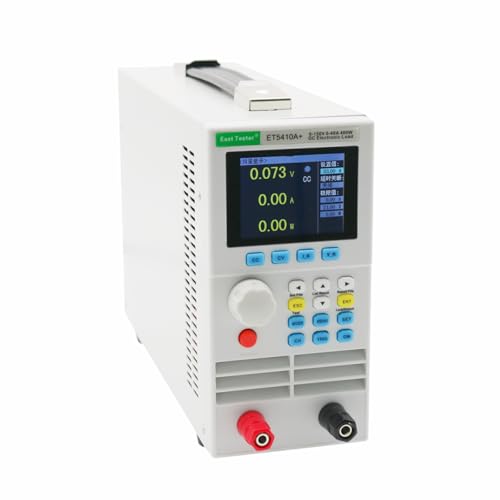
- 400W, 150V, 40A load tester with USB communication
- CC, CV, CR, CP plus CC+CV and CR+CR modes
- Battery, LED, dynamic, scan, list, and resistance tests
Best For: buyers who want broad features at a straightforward level
Lab-Grade Bench Load – Siglent SDL1020X-E 200W Programmable DC Load
Siglent Technologies SDL1020X-E Programmable DC Electronic Load,1 Channel,150 V/30 A, 200 W
Check Price On AmazonIf you need a programmable electronic load for bench testing, the Siglent SDL1020X-E is built for straightforward DC validation work. It offers a single channel with up to 150 V, 30 A, and 200 W, plus CC, CV, CR, and CP modes for common power-supply and battery tests.
Best For: Engineers and lab users who want a compact single-channel load with strong dynamic-mode control and list testing.
Pros:
- Supports four static modes: CC, CV, CR, and CP.
- Dynamic operation includes CC up to 25 kHz and CP up to 12.5 kHz.
- List function can edit up to 100 steps for test sequencing.
- Adjustable current rise time from 0.001 A/μs to 2.5 A/μs.
Cons:
- Single-channel design limits simultaneous testing.
- At 15 pounds, it is relatively heavy for a bench instrument.
The SDL1020X-E stands out when you want a disciplined bench tool with flexible test modes and controlled transient behavior. It is a good fit if your work depends more on repeatable DC load profiles than on portable convenience.
Portable Test Meter – Eyes.sys 180W Battery and Cable Load Tester
The Eyes.sys unit is a practical programmable electronic load for battery and cable checks when you want a portable tester with a display. It supports constant current, constant voltage, constant power, and constant resistance modes, and it adds reporting plus a 2.4-inch HD color screen for easier on-the-spot testing.
Best For: Users who need a battery capacity tester and cable test tool with portable operation and built-in data reporting.
Pros:
- Four operating modes: CC, CV, CP, and CR.
- Auto-generates data reports for test results.
- Includes 3 safety protections to monitor discharge status in real time.
- External wired NTC thermometer supports dual temperature measurement.
Cons:
- Battery-powered design may not suit every bench workflow.
- Best suited to lower-power testing than larger lab loads.
This model makes sense if you want a flexible tester rather than a heavy bench instrument. Its mix of modes, reporting, and temperature monitoring is especially useful for battery and USB cable evaluation.
High-Speed Lab Load – Rigol DL3021 200W Programmable DC Load
The Rigol DL3021 is a programmable electronic load aimed at bench testing where speed and readback precision matter. It handles up to 150 V, 40 A, and 200 W, with CC, CV, CR, and CP modes plus dynamic operation up to 15 kHz for more advanced load profiling.
Best For: Bench users who need higher current capability, fast dynamic testing, and communication interfaces for automated setups.
Pros:
- Up to 150 V, 40 A, and 200 W total power.
- Dynamic mode reaches up to 15 kHz.
- Fine readback resolution of 1 mV and 1 mA.
- Includes RS232, USB, and LAN communication interfaces.
Cons:
- Single-channel design may not suit multi-device workflows.
- Requires corded electric power, so it is not portable.
The DL3021 is a strong option when you want a bench load with fast transitions, solid protections, and automation-friendly connectivity. It fits well in lab and production test environments that need dependable repeatability.
Automated Bench Tester – OWON OEL3030 300W Programmable DC Load
The OWON OEL3030 is a programmable electronic load designed for higher-voltage bench work and automated test setups. With up to 300 V, 30 A, and 300 W, plus SCPI support over USB, RS232, or RS485, it is aimed at users who need both range and integration.
Best For: R&D and production users who want a 300W electronic load with broad connectivity and battery testing support.
Pros:
- Wide operating range up to 300 V, 30 A, and 300 W.
- USB, RS232, and RS485 interfaces with SCPI protocol support.
- Dynamic testing up to 5 kHz with adjustable current rise rate.
- Includes battery charge/discharge testing and curve output through PC software.
Cons:
- Lower dynamic speed than some bench-focused alternatives.
- Single-channel format keeps it focused on one DUT at a time.
The OEL3030 is the most integration-friendly option in this roundup, especially if your workflow depends on automated control and data capture. Its higher voltage ceiling also gives it useful headroom for tougher DC testing jobs.
High-Feature 400W Bench Load – ET5410A+ 400W DC Electronic Load Tester
If you need a programmable electronic load for more advanced bench work, the ET5410A+ stands out for its wide test coverage and strong 400W rating. It combines common load modes with battery and LED testing features, making it a practical pick for charger checks, power supply validation, and production-style workflows.
Best For: Users who want a versatile 400W load tester with battery and LED test functions.
Pros:
- Supports CC, CV, CR, CP, plus CC+CV and CR+CV modes.
- Includes battery capacity, internal resistance, dynamic, scanning, and LED testing.
- 2.8-inch TFT LCD, key-lock function, and data retention during power loss.
- Built-in overcurrent, overvoltage, overpower, and over-temperature protection.
Cons:
- Optional RS-232 support means full remote control may depend on configuration.
- Single-channel design may be limiting for multi-output test setups.
Overall, the ET5410A+ is a solid choice if you want one programmable electronic load that covers both standard DC load testing and more specialized battery evaluation. Its combination of power, protections, and test modes makes it especially useful in labs and service environments.
Compact 200W Load Tester – ET5406A+ 200W Programmable DC Load
The ET5406A+ is a compact programmable electronic load aimed at users who need reliable DC load testing without moving into a larger 400W unit. It offers the core load modes plus several test functions, making it a practical option for chargers, linear and switching supplies, and battery-related checks.
Best For: Buyers who want a smaller 200W programmable load with useful test modes and USB control.
Pros:
- Offers CC, CV, CR, CP, battery test, dynamic mode, tran test, list test, and short circuit test.
- High-resolution 1mV/10mV and 1mA/10mA settings for finer adjustment.
- USB remote control support for computer-based operation.
- Includes overcurrent, overvoltage, overpower, over-temperature, and reverse polarity prompts.
Cons:
- 200W output is lower than larger bench models.
- SCPI/software access is noted as something to request from the supplier.
For users who value a smaller footprint and a strong mix of test functions, the ET5406A+ covers the essentials well. It is especially attractive if you want a programmable electronic load that is straightforward for day-to-day charger and power-supply testing.
Precision 150W Load Tester – MATRIX PEL8150 Programmable DC Load
The MATRIX PEL8150 is a precision-focused programmable electronic load built for users who care about resolution and display clarity as much as basic power rating. With 0.1mV and 0.1mA resolution, it is a strong fit for controlled testing of DC power supplies and other equipment that benefits from fine adjustment.
Best For: Users who want a precise 150W programmable load with RS232 PC compatibility.
Pros:
- High 0.1mV and 0.1mA resolution with 0.1% accuracy.
- Supports CC, CV, CR, CP, plus dynamic mode.
- VFD screen improves readability in low-light environments.
- Includes external trigger input/output and RS232 PC software compatibility.
Cons:
- 150W output is lower than the larger 200W and 400W options here.
- Single output design may not suit more complex test benches.
If your priority is measurement precision and PC integration, the PEL8150 is the most refinement-oriented option in this group. It is a practical programmable electronic load for labs and technical users who need detailed control rather than maximum wattage.
Best All-Around Bench Load – 150V/40A USB Programmable Load Tester
If you need a programmable electronic load for general bench testing, this 400W single-channel unit covers the core jobs well. It supports CC, CV, CR, CP, CC+CV, and CR+CV modes, plus battery internal resistance testing, dynamic tests, scan tests, list modes, and short-circuit testing, so it can handle power supplies, batteries, LEDs, and similar devices.
Best For: Engineers, hobbyists, and technicians who want a versatile bench load with USB remote operation and broad test modes.
Pros:
- Wide 0-150V, 0-40A, 0-400W operating range for common bench tasks
- Multiple test modes, including battery, LED, dynamic, scan, and list functions
- USB remote control, external trigger input, and remote compensation support
- Built-in protections for overvoltage, overcurrent, overpower, overtemperature, and short circuit
Cons:
- Single-channel design limits it to one load path at a time
- At 8 pounds and with a larger footprint, it is less portable than compact testers
- Feature-rich interface may be more than casual users need for simple discharge tests
This is a strong all-around programmable electronic load if you want one unit that can do more than basic constant-current discharge. The protection features, USB control, and broad mode selection make it practical for lab use and deeper testing workflows.
Precision Pick – ET5420A+ Dual-Channel High-Accuracy Load
This programmable electronic load is built for precision work on power supplies, batteries, and components. The ET5420A+ offers 1mV/10mV and 1mA/10mA resolution, CC/CR/CV/CP modes, and high-speed, high-precision operation, making it a solid fit when measurement detail matters.
Best For: Users who need a high-accuracy load for battery testing, component evaluation, or controlled discharge workflows.
Pros:
- High-resolution control for finer measurement and adjustment
- Dual 20A channels with a 400W, 150V rating for flexible testing setups
- Dedicated battery discharge functions for capacity, resistance, and discharge checks
- 2.8-inch TFT display with Chinese and English support plus key-lock protection
Cons:
- Battery-powered operation may not suit every fixed bench setup
- Included accessories appear minimal based on the supplied notes
- Its precision focus may be more than needed for simple pass/fail load testing
For buyers who care more about accuracy and control than sheer simplicity, the ET5420A+ stands out. Its fine resolution, dual-channel configuration, and battery-test features make it especially useful in labs and quality-control environments.
Value Choice – 400W USB Programmable DC Electronic Load
If you want a programmable electronic load that covers the basics without overcomplicating the bench, this 400W model is a practical choice. It provides CC, CV, CR, CP, CC+CV, and CR+CR modes, along with battery testing, LED testing, dynamic tests, scanning tests, list tests, and internal resistance testing for batteries and power supplies.
Best For: Buyers looking for a straightforward bench load with strong feature coverage and USB connectivity.
Pros:
- 0-150V, 0-40A, 0-400W rating supports a wide range of bench devices
- Six measurement modes plus battery, LED, dynamic, scan, and list functions
- USB port for communication and device protection functions
- 2.8-inch TFT screen keeps operation simple and readable
Cons:
- Supplied notes do not list detailed accessory contents
- Single-load setup may not be enough for multi-device workflows
- The control set is capable, but not as specialized as higher-end precision models
This model is a sensible fit if you want a dependable programmable electronic load with familiar test modes and USB support. It balances feature depth with a simple interface, making it easy to use for everyday power-supply and battery checks.
How We Picked the Best Programmable Electronic Load
We prioritized a mix of load capacity, voltage and current range, operating modes, measurement resolution, dynamic response, and connectivity. For a Programmable Electronic Load, those specs matter because they determine how well the unit can simulate real-world demand and reveal weak spots in a power source.
We also looked for practical bench features such as clear interface controls, stable regulation, and enough power headroom for common lab and repair workflows.
Quick Comparison
Higher-wattage units are better for power supplies, battery packs, and charger testing, while lower-power models can still be a smart choice for light bench use, DIY projects, and occasional diagnostics. If you test a wide range of devices, pay close attention to maximum voltage, maximum current, and whether the unit supports CV, CC, CR, and CP modes.
Key Buying Factors for a Programmable Electronic Load
Power, Voltage, and Current Limits
Choose a load with enough wattage and input range for your largest expected tests. Leave margin above your typical use case so the unit can run safely without constantly hitting its limits.
Load Modes and Control
CC mode is essential, but CV, CR, and CP add flexibility for battery discharge, PSU validation, and component characterization. Dynamic testing support is a plus if you need to simulate changing demand.
Accuracy and Resolution
Finer readback resolution helps when you are checking small changes in voltage, current, or resistance. Better accuracy is especially important for calibration work, battery analysis, and repeatable comparisons.
Cooling, Interface, and Connectivity
Active cooling is common at higher power levels, so pay attention to fan noise and thermal design. USB, RS232, or similar interfaces can make logging and remote control much easier during longer test sessions.
Who Should Buy Which Programmable Electronic Load?
Choose a compact, lower-power model if you mainly test chargers, small power adapters, or hobby circuits. Step up to a 200W to 400W unit if you work with bench power supplies, battery packs, and higher-current DC systems.
If you need more advanced analysis, look for stronger resolution, broader mode support, and remote connectivity. That combination gives you more flexibility now and better room to grow later.