The best power strips for computers do more than add outlets. They help organize a desk, protect connected electronics from surges, and provide convenient USB charging for peripherals and mobile devices.
We selected 10 practical options with different outlet counts, cord lengths, surge ratings, and charging configurations so you can match a power strip to your workstation, home office, dorm, or gaming setup.
Best 10 Power Strips for Computers Picks for 2026
Best High-Capacity Pick
Teiobar 12-Outlet Power Strip with USB-C

- 12 AC outlets plus four USB ports
- 2700 joules of surge protection
- 6-foot cord and ETL listing
Best For: Busy home offices and dorm workstations
Best Fast-Charging Option
Anker 351 12-Outlet Power Strip

- 12 AC outlets with spaced plug layout
- 20W USB-C port for fast phone charging
- 2100 joules and eight-point safety system
Best For: Desks needing AC capacity and USB-C charging
Best Warranty Value
ALESTOR 12-Outlet Surge Protector

- 12 outlets and four USB ports
- 2700 joules with overload protection
- 24-month warranty and 6-foot cord
Best For: Apartment offices and media cabinets
Best Heavy-Duty Protection
Belkin 12-Outlet Surge Protector

- 12 AC outlets with 3940-joule rating
- 8-foot cord with angled flat plug
- UL listed and wall mountable
Best For: Equipment-heavy computer workstations
Most Expandable

- 22 AC outlets plus 6 USB ports
- Widely spaced, mountable design
- 2100J surge protection and 6.5-ft cord
Best For: Large gaming, office, and media setups
Highest Surge Rating
24-Outlet Computer Power Strip

- 24 AC outlets and 4 USB ports
- 4100J surge-protection rating
- ETL certified with a 6-ft flat-plug cord
Best For: High-capacity computer and gaming desks
Best Compact USB-C Mix

- 12 AC outlets with 3 USB-A and 3 USB-C
- 1.7-inch wide-spaced outlet layout
- 2400J protection with a thin angled plug
Best For: Compact home-office and dorm desks
Best All-Around Choice
Nuetsa 8-Outlet Surge Protector
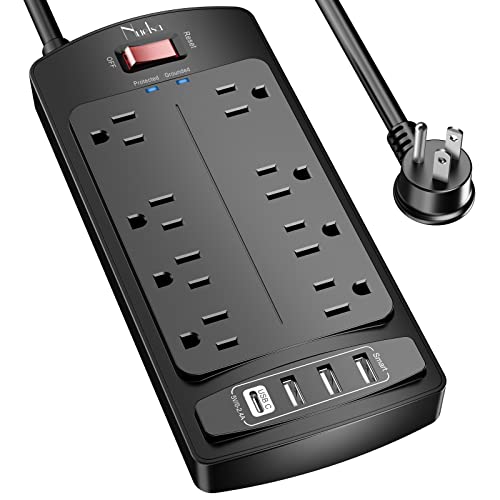
- Eight AC outlets plus four USB ports
- 2,700-joule surge protection
- Six-foot cord with flat plug
Best For: Computer desks needing AC and USB charging
Best for Long Reach

- Ten-foot flat extension cord
- Twelve widely spaced AC outlets
- Wall-mountable three-sided design
Best For: Computer setups far from the wall outlet
Best for Large Setups
POWSAV 18-Outlet Surge Protector
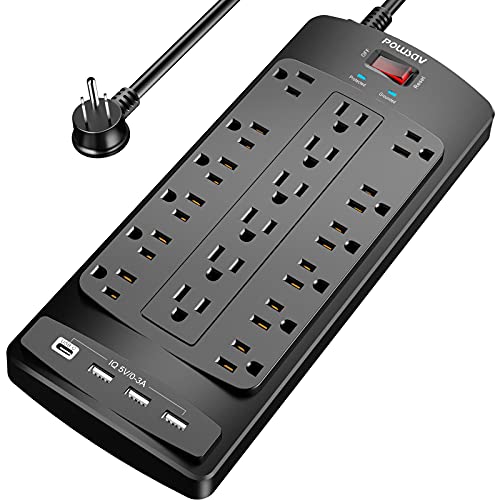
- Eighteen widely spaced AC outlets
- Four USB ports and 2,100-joule protection
- Six-foot cord with cable ties
Best For: Crowded computer and gaming desks
Best High-Capacity Pick – Teiobar 12-Outlet Power Strip with USB-C
For shoppers comparing power strips for computers, the Teiobar offers substantial capacity for a desk or office setup. It combines 12 AC outlets with four USB ports, including two USB-C ports, plus 2700-joule surge protection and a 6-foot cord.
Best For: Home offices, dorm rooms, and workstations with multiple computers, monitors, and USB devices.
Pros:
- 12 AC outlets include two widely spaced positions for bulky adapters.
- Four USB ports provide two USB-A and two USB-C charging connections.
- 2700-joule surge protection, overload protection, ETL listing, and a 12-month warranty.
Cons:
- It is a relatively large 11-by-3.9-inch rectangular unit.
- The 6-foot cord may be limiting for setups farther from the wall outlet.
The Teiobar is a practical choice when outlet count and built-in USB charging matter more than a compact footprint. Its mounting feature and long cord also suit organized computer workspaces.
Best Fast-Charging Option – Anker 351 12-Outlet Power Strip
The Anker 351 is a strong option for power strips for computers when you also want convenient device charging. It provides 12 AC outlets, a 20W USB-C port, two USB-A ports, 2100-joule surge protection, and a 5-foot cord suited to desks and side tables.
Best For: Computer desks that need several AC connections and fast USB-C charging for phones.
Pros:
- The 20W USB-C port can charge an iPhone 15 from 0% to 50% in about 26 minutes, according to the supplied specifications.
- Extra outlet spacing accommodates bulky plugs.
- Includes overload, temperature, fire-resistance, and other safety protections, plus an 18-month warranty.
Cons:
- The three USB ports share a maximum total output of 15W.
- Its 5-foot cord offers less reach than some 6- or 8-foot alternatives.
- The maximum current is listed as 13A.
Choose this model if USB-C charging speed is a priority alongside computer power. Its 5-foot cable is particularly suitable for standard desks, bedside tables, and sofa side tables.
Best Warranty Value – ALESTOR 12-Outlet Surge Protector
The ALESTOR is a useful contender among power strips for computers, offering 12 AC outlets, four USB charging ports, and 2700-joule surge protection. Its 6-foot heavy-duty cord and widely spaced outlets make it suitable for computer equipment and other desk electronics.
Best For: Home offices, apartment setups, and TV cabinets that need many outlets and USB charging.
Pros:
- Two widely spaced AC outlets help fit larger power adapters.
- Four USB ports include one USB-C port and three USB-A ports.
- ETL certified with overload protection and a supplied 24-month warranty.
Cons:
- Only one of the four USB ports is USB-C.
- The 11-by-3.9-inch body may take up noticeable desk or cabinet space.
- It lacks a stated mounting feature in the supplied product details.
The ALESTOR stands out for combining a high outlet count with a longer warranty than the Teiobar model. It is a sensible choice for users who want broad connectivity and straightforward surge protection.
Best Heavy-Duty Protection – Belkin 12-Outlet Surge Protector
For computer users prioritizing surge capacity, the Belkin 12-Outlet Surge Protector provides 12 AC outlets and a high 3940-joule protection rating. Its 8-foot flat-plug cord, widely spaced outlets, and wall-mountable design work well in home offices and workstations.
Best For: Computer desks with multiple monitors, hard drives, peripherals, and other AC-powered equipment.
Pros:
- 3940 joules of surge protection is the highest rating among these listed models.
- An 8-foot cord and angled plug help reach outlets in tight spaces.
- UL-listed, wall-mountable, and backed by a two-year limited warranty plus connected-equipment coverage.
Cons:
- There are no USB charging ports.
- Its 13-by-4.13-inch body is larger than the Teiobar and ALESTOR units.
- The supplied notes contain both 3,780- and 3,940-joule references; the detailed rating lists 3,940 joules.
The Belkin is the strongest fit when AC outlet capacity, cord reach, and surge protection take precedence over USB charging. It is especially well suited to a fixed, equipment-heavy computer workstation.
Most Expandable – 28-Outlet USB Power Strip
For computer desks, gaming stations, and media centers with many devices, this SUPERDANNY model is one of the most expandable power strips for computers. It combines 22 AC outlets with six USB ports, widely spaced connections, a 6.5-foot cord, and a mountable design.
Best For: Gaming rooms, computer workstations, and entertainment setups that need maximum outlet capacity.
Pros:
- Provides 22 grounded AC outlets plus five USB-A and one USB-C port.
- Widely spaced outlets help accommodate bulky adapters and power bricks.
- Includes 2100-joule surge protection, overload protection, and other listed safety protections.
- Can be mounted to a wall or furniture and uses a 45-degree flat plug.
Cons:
- The side outlets cannot be rotated.
- Its large footprint may be more than smaller desks require.
This is a strong choice when outlet quantity and setup flexibility matter most. Its extensive capacity may be unnecessary for a basic computer-and-monitor arrangement, but it is well suited to dense work or gaming stations.
Highest Surge Rating – 24-Outlet Computer Power Strip
This QINLIANF model is a practical option for shoppers comparing power strips for computers with a high surge-protection rating. It offers 24 AC outlets, four USB ports, a 6-foot flat-plug cord, and a 4100-joule rating for busy home-office or gaming setups.
Best For: Computer desks and gaming areas that need many outlets and a higher listed surge-protection rating.
Pros:
- Offers 24 AC outlets and four USB charging ports, including two USB-C ports.
- 4100-joule surge protection is the highest listed rating among these products.
- ETL certified, with overload protection and a flame-resistant PC shell.
- Flat 6-foot cord supports placement near desks and other indoor setups.
Cons:
- The USB-C port does not support devices requiring 9–22V charging.
- It provides fewer USB ports than the other two options.
Choose this strip if surge-rating specifications and abundant AC outlets are priorities. The USB-C limitation is worth checking against your devices before purchase, especially if you expect higher-voltage USB-C charging.
Best Compact USB-C Mix – 12-Outlet Surge Protector
For smaller desks and everyday electronics, this QKP unit offers a more compact alternative among power strips for computers. It includes 12 AC outlets, three USB-A ports, three USB-C ports, wide spacing for adapters, and a thin angled flat plug.
Best For: Home offices, dorm rooms, and desktop setups needing convenient USB-C charging without a very large power strip.
Pros:
- Combines 12 AC outlets with an even split of three USB-A and three USB-C ports.
- 1.7-inch outlet spacing accommodates laptop chargers and bulky adapters.
- 2400-joule surge protection and a resettable overload circuit breaker are included.
- Its 0.5-inch, 45-degree flat plug fits behind furniture and leaves the lower outlet accessible.
Cons:
- It has fewer AC outlets than the other two products.
- The USB-A and USB-C ports share a 5V/3.1A total output specification.
This is the most balanced pick for a typical computer station where USB-C access and space-saving placement matter more than maximum outlet count. Its 12-outlet capacity should cover everyday peripherals while keeping the footprint manageable.
Best All-Around Choice – Nuetsa 8-Outlet Surge Protector
For shoppers comparing power strips for computers, this Nuetsa model offers a practical mix of eight AC outlets, four USB charging ports, and 2,700 joules of surge protection. Its six-foot cord and flat design suit computer desks, home offices, and entertainment setups.
Best For: Computer desks that need AC outlets plus USB charging in one compact strip.
Pros:
- Eight AC outlets and four USB ports, including one USB-C port.
- 2,700 joules of surge protection with overload protection.
- Six-foot cord, flat plug, on/off switch, and mountable design.
- ETL-listed construction with a fire-resistant PC shell.
Cons:
- The USB-C port does not support devices requiring 9–22V charging voltage.
- Its 13-amp maximum may provide less capacity than some larger 15-amp models.
This is a well-rounded option when you want strong surge protection and convenient USB charging without requiring an unusually large outlet bank.
Best for Long Reach – Addtam 12-Outlet Power Strip
If your computer setup sits far from the wall outlet, this Addtam model is a flexible choice among power strips for computers. The 10-foot flat cord, widely spaced outlets, and right-angle plug make it useful behind furniture, while its mountable design can keep a desk or dorm setup organized.
Best For: Desks, dorm rooms, and offices where outlet distance and plug spacing are priorities.
Pros:
- Twelve widely spaced AC outlets accommodate larger adapters.
- Ten-foot extension cord helps reach inconvenient wall outlets.
- Three-sided layout and 45-degree flat plug work well in tight spaces.
- Can be wall-mounted or used as a desktop charging station.
Cons:
- Its listed surge protection rating is 1,050 joules, lower than the other options here.
- The supplied details conflict on the USB count, so verify the configuration before buying.
- The product details list a 15-amp maximum but also identify 1,875 watts/15 amps as the limit; avoid exceeding that rating.
This model stands out for reach and flexibility rather than the highest surge rating, making it a sensible fit for computer equipment spread across a room or mounted beneath a desk.
Best for Large Setups – POWSAV 18-Outlet Surge Protector
For a crowded workstation or gaming desk, this POWSAV model provides one of the largest outlet counts in this roundup. Its 18 widely spaced AC outlets, four USB ports, six-foot flat cord, and 2,100-joule surge rating make it a strong candidate among power strips for computers with many connected peripherals.
Best For: Large computer, gaming, and electronics setups with many plugs.
Pros:
- Eighteen widely spaced AC outlets reduce plug crowding.
- Four USB ports add convenient charging capacity.
- 2,100 joules of surge protection with overload protection.
- Six-foot flat cord, cable ties, mountable design, and ETL listing.
Cons:
- The large 11.7-inch body may take considerable desk or wall space.
- Its six-foot cord is shorter than the 10-foot option in this roundup.
- The supplied details list a 15-amp maximum, so the total connected load must stay within that limit.
Choose this strip when outlet capacity matters most. It is particularly practical for a computer desk with monitors, peripherals, chargers, and other electronics that would otherwise require multiple strips.
How We Picked the Best Power Strips for Computers
We compared the selected models by looking at the features that matter most in a computer workstation: outlet capacity, surge-protection rating, USB availability, cord length, plug design, and stated electrical limits. We also considered whether each option suits a compact desk, a multi-device home office, or a larger entertainment and gaming setup.
Surge ratings are listed in joules, while maximum electrical capacity is generally expressed in watts or amps. These figures help with comparison, but no power strip can guarantee protection against every electrical event. Use products according to their labels and applicable safety guidance.
Quick Comparison
| Feature | What to Look For | Best Use |
|---|---|---|
| Outlet count | 8 to 12 outlets for most desks; 18 or more for large setups | Computers, monitors, hubs, speakers, and accessories |
| Surge rating | About 2,000 joules or higher for valuable electronics | Everyday home-office and gaming equipment |
| USB ports | USB-A for common devices; USB-C for newer accessories | Phones, tablets, headphones, and small peripherals |
| Cord length | 6 feet for most desks; 8 to 10 feet for distant outlets | Flexible room and furniture placement |
| Plug style | Flat plugs fit behind desks and cabinets | Compact or space-constrained installations |
Key Buying Factors for Power Strips for Computers
Outlet Layout and Capacity
Count every device you expect to connect, including monitors, speakers, printers, routers, chargers, and lamps. Widely spaced outlets are especially useful for bulky adapters. High outlet counts are convenient, but avoid filling every socket without checking the strip’s total load rating.
Surge Protection and Electrical Rating
A higher joule rating generally indicates more capacity to absorb repeated small surges. Also check the strip’s amp and watt limits, particularly when connecting high-draw equipment. A power strip should not be used as a substitute for proper circuit protection or a UPS when battery backup is required.
USB Charging and Cord Design
USB ports can reduce adapter clutter, although their output may be shared across devices. USB-C ports are useful for newer accessories, but verify charging speed before expecting laptop-class power. Choose a cord length that reaches the wall outlet without stretching, and consider a flat plug for furniture placed close to the wall.
Safety and Placement
Look for clearly stated safety certifications or listings, an accessible on/off switch, and a sturdy enclosure. Keep the strip uncovered, dry, and away from heat. Do not daisy-chain power strips, and replace one that shows damage, overheating, or a loose connection.
Who Should Buy Which Power Strips for Computers?
Choose a compact eight- or 12-outlet model for a standard computer desk with one or two monitors and several accessories. Choose a long-cord option when the outlet is behind furniture or across a home office. Choose a high-outlet model for gaming desks, shared workstations, or entertainment systems with many low- to moderate-draw devices. Choose USB-C-equipped models if you regularly charge newer phones, tablets, or accessories. For equipment that must remain powered during an outage, choose a properly sized UPS instead of relying on surge protection alone.