The best physics experiment sets turn abstract concepts into hands-on discoveries. From circuits and magnets to lenses, pulleys, and dynamics carts, the right kit can make STEM learning more engaging and easier to understand.
This roundup compares 10 physics experiment sets for different ages, subjects, and learning environments, helping you choose a kit that matches your student’s interests and experience level.
Best 10 Physics Experiment Sets Picks for 2026
Best Complete Circuit Lab
Basic Electricity & Magnetism Kit
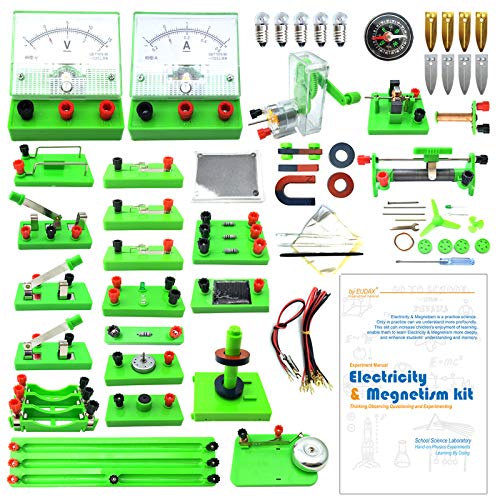
- 79-piece set for electricity and magnetism
- Includes manual, tools, and storage bag
- Build circuits, electromagnets, and generators
Best For: Grades 9–11 and hands-on home labs
Best Motion-Building Set
Inertia, Friction & Circular Motion Kit

- Build six working physics models
- Covers inertia, friction, and circular motion
- Includes theory, quizzes, and a 3D app
Best For: Builders age 9+ learning motion concepts
Best Optics Demonstration Set
Multifunction Light & Lens Kit

- Includes lenses, mirrors, prism, and light source
- Demonstrates reflection and refraction
- Compact set with color-page manual
Best For: Optics learners age 14+ and teachers
Best Family Electricity Kit
50-Piece Circuits & Magnetism Set

- Includes 18 guided experiments
- Combines meters, circuits, motors, and magnets
- Full-color 40-page manual included
Best For: Children age 8+ and family STEM activities
Hands-On Mechanics

- 26 guided model-building exercises
- Includes spring scale for force measurements
- Covers gears and six classic simple machines
Best For: Ages 8+ learning introductory mechanics through construction
Electricity Explorer
Electricity and Magnetism Lab Kit

- Offers more than 50 DIY experiments
- Includes 55 components and illustrated manual
- Storage case keeps parts organized
Best For: Ages 13–18 studying circuits, electricity, and magnetism
Classroom Mechanics

- Includes equipment for 26 mechanics experiments
- Covers force, motion, pressure, and buoyancy
- Designed for classroom and independent study
Best For: Ages 14+ studying classical mechanics with lab equipment
Best for Demonstrating Light Behavior
Magnetic Optics Experiment Set

- Magnetic components work on whiteboards and blackboards
- Includes lenses, prism, acrylic block, and light source
- Explores reflection and refraction with portable storage
Best For: Classroom optics demonstrations and introductory student experiments
Best for Newtonian Motion Lessons
Dynamics Carts Physics STEM Kit

- Explores velocity, acceleration, friction, and momentum
- Includes two carts with steel and rubber bumpers
- Suitable for classroom or home lab activities
Best For: Hands-on Newton's laws and collision experiments
Most Comprehensive Optics Curriculum

- Supports reflection, refraction, imaging, and color experiments
- Includes a no-assembly integrated optical bench
- Provides 37 components in a storage box
Best For: Older students and structured optics lab programs
Best Complete Circuit Lab – Basic Electricity & Magnetism Kit
For students ready to move beyond simple demonstrations, this physics experiment set combines electricity and magnetism activities in one organized kit. It includes 79 items, a color-page manual, and projects ranging from series circuits and fruit batteries to electromagnets and hand-crank generators. Note that three AA batteries are required and are not included.
Best For: Students in grades 9–11, home labs, and hands-on introductions to electricity and magnetism.
Pros:
- Covers both electricity and magnetism with numerous project options.
- Includes 56 electricity items, 21 magnetism items, repair tools, and a storage bag.
- Manual supports learning basic principles alongside practical experiments.
Cons:
- Requires three AA batteries, sold separately.
- The broad component set may be more involved for younger beginners.
This is a versatile choice when you want one physics experiment set that supports repeated circuit and electromagnetism projects rather than a single demonstration.
Best Motion-Building Set – Inertia, Friction & Circular Motion Kit
This physics experiment set uses working models to make motion concepts tangible. Children can build six models, including a rocket launcher, crash-test rig, and sharpening wheel, while the theory book, experiments, quiz section, and interactive 3D app add structure to the activities.
Best For: Kids age 9 and up who enjoy building projects while exploring inertia, friction, and circular motion.
Pros:
- Offers six working model options in one construction kit.
- Includes theory, experiments, facts, quizzes, and an interactive 3D app.
- Supports construction, creative, logical, and critical-thinking skills.
Cons:
- Focuses primarily on motion laws rather than a broad range of physics topics.
- Plastic construction components may appeal less to children who prefer laboratory equipment.
Choose this set if building and rebuilding models is the main draw. It is especially suited to learners who understand physics concepts better through moving mechanisms.
Best Optics Demonstration Set – Multifunction Light & Lens Kit
For focused optics lessons, this physics experiment set provides lenses, mirrors, a triangular prism, and an adjustable three-way linear light source. It supports demonstrations of refraction, reflection, diffuse reflection, and lens behavior, with an English color-page manual included. Two AAA batteries are needed but not included.
Best For: Learners age 14 and up, teachers, and students studying introductory optical principles.
Pros:
- Targets a wide range of reflection and refraction demonstrations.
- Includes three biconvex lenses, concave and convex lenses, a prism, and reflector.
- Compact 8-piece format is convenient for indoor teaching and storage.
Cons:
- Requires two AAA batteries, sold separately.
- Recommended for ages 14 and up, limiting its suitability for younger children.
- The acrylic components are intended for demonstrations rather than advanced laboratory measurement.
This is a practical pick when optics is the priority. Its focused component list makes it easier to plan light experiments without purchasing a larger all-purpose lab.
Best Family Electricity Kit – 50-Piece Circuits & Magnetism Set
This physics experiment set is designed for accessible, hands-on exploration of circuits and magnetism. Its 50 pieces and 40-page full-color manual support 18 experiments, including fruit batteries, electric bells, hand-crank generators, and motor activities, making it suitable for guided family or school sessions.
Best For: Children age 8 and up, parent-child science activities, and introductory STEM enrichment.
Pros:
- Provides 18 guided experiments across electricity and magnetism.
- Includes meters, bulbs, switches, resistors, magnets, a motor, and generator.
- Full-color manual encourages structured, family-friendly discovery.
Cons:
- The extensive component list may require adult guidance for younger users.
- It is focused on introductory experiments rather than advanced physics investigations.
Among beginner-friendly physics experiment sets, this one stands out for its combination of measurement tools and engaging projects. It offers enough variety to support repeated parent-child or classroom activities.
Hands-On Mechanics – Simple Machines Physics Set
This approachable option for physics experiment sets focuses on how simple machines redirect and reduce effort. With 26 model-building activities, a spring scale, and an illustrated manual, it gives learners a practical way to investigate gears, levers, pulleys, and other everyday mechanisms.
Best For: Children ages 8 and up exploring introductory physics, simple machines, and engineering through guided construction.
Pros:
- Includes 26 hands-on model-building exercises.
- Covers all six classic simple machines plus gears.
- Spring scale lets learners measure changes in force direction and magnitude.
- Modular pieces are compatible with other Thames & Kosmos construction kits.
Cons:
- Its subject focus is primarily simple machines rather than broad physics topics.
- Plastic components may be less suitable for advanced laboratory work.
This is a strong starter choice when the goal is visual, build-first learning. The step-by-step manual and familiar examples—such as wheelbarrows, seesaws, and flagpoles—help connect each experiment to real-world use.
Electricity Explorer – Electricity and Magnetism Lab Kit
For shoppers seeking physics experiment sets centered on circuits and magnetism, this bundle offers more than 50 guided DIY activities. Its 55 pieces include circuit, LED, magnetic-switch, electromagnet, and Joule’s first-law experiment modules, with a manual designed to explain both procedures and principles.
Best For: Students ages 13–18 who want a broad, hands-on introduction to electricity, circuits, and magnetism.
Pros:
- Provides more than 50 experiments across electricity and magnetism.
- Includes 55 items and a student-oriented illustrated manual.
- Supports both guided projects and user-designed experiments.
- Comes in a solid storage case with designated spaces for the components.
Cons:
- The manufacturer recommends it for ages 13–18, so it may be too advanced for younger children.
- Its focus is specialized around electricity and magnetism rather than mechanics.
- The kit includes an alkaline battery component, so battery requirements should be checked before use.
This is the more expansive choice for learners interested in electronics and electromagnetism. The portable case and large experiment count make it useful for continued exploration at home, in class, or with classmates.
Classroom Mechanics – 26-Experiment Physics Lab Set
This physics experiment set is built for more structured mechanics study, with equipment for 26 experiments involving force, motion, pressure, buoyancy, and gravity. It includes a tray balance, pulleys, lever ruler, U-tube pressure gauge, spring dynamometer, trolley, ramp, and a professional manual.
Best For: Middle- and high-school students, teachers, and independent learners ages 14 and up who need a broader classical-mechanics lab setup.
Pros:
- Covers Newton’s laws, kinematics, gravity, friction, pressure, buoyancy, pulleys, and levers.
- Includes multiple dedicated lab tools, including a trolley, ramp, gauges, balance, and force equipment.
- Professional manual provides operating steps and principle analysis.
- Metal and plastic components are designed for repeated classroom or home use.
Cons:
- Its 14+ recommendation makes it less appropriate for younger children.
- The equipment-oriented design may require more setup and supervision than basic activity kits.
- It focuses on classical mechanics rather than electricity or magnetism.
This is the best fit when a buyer wants a mechanics-focused set that goes beyond simple-machine demonstrations. Its range of measuring tools and experiments supports more systematic classroom instruction and independent physics practice.
Best for Demonstrating Light Behavior – Magnetic Optics Experiment Set
This magnetic physics experiment set focuses on reflection and refraction with interchangeable lenses, mirrors, a prism, and a three-way light source. Its magnetic components can be demonstrated on a whiteboard or blackboard, making it a practical choice for guided lessons and visual explanations.
Best For: Classroom demonstrations and students learning introductory optics concepts.
Pros:
- Includes convex and concave lenses, an acrylic block, prism, and semicircular lens.
- Magnetic design supports demonstrations on blackboards and whiteboards.
- Comes with a storage box, angle diagram, and English color manual.
- Supports experiments involving reflection, refraction, and light direction.
Cons:
- Requires two AAA batteries, which are not included.
- Its focus is primarily on optics rather than broader physics topics.
This is a compact, portable option for teachers or learners who want a straightforward way to show how light changes direction across different surfaces and media.
Best for Newtonian Motion Lessons – Dynamics Carts Physics STEM Kit
This pair of dynamics carts is a focused choice among physics experiment sets for exploring motion, collisions, and Newton’s laws. The carts offer a simple setup for classroom activities or home labs, with interchangeable bumpers for comparing collision types.
Best For: Hands-on lessons covering velocity, acceleration, friction, and momentum.
Pros:
- Teaches motion dynamics, Newton’s laws, friction, and conservation of momentum.
- Low-friction snap-in wheels support rolling experiments.
- Deep weight wells allow varied experiment setups.
- Includes two carts, steel bumpers, rubber bumpers, and experiment suggestions.
Cons:
- Does not include a broader selection of physics equipment beyond the carts and bumpers.
- Additional materials may be needed for more advanced or measurement-focused activities.
For learners studying force and motion, this set provides a durable, adaptable foundation for observing how different bumpers affect collisions and recoil.
Most Comprehensive Optics Curriculum – 37-Piece Physics Optics Kit
This 37-piece physics experiment set is designed for a broad range of optics activities, from mirror reflection and refraction to convex-lens imaging, pinhole imaging, and primary-color exploration. The integrated 60 cm optical bench and included accessories make it suited to structured lab work at home, in classrooms, or in institutions.
Best For: Older students, teachers, and programs needing a wide selection of optics experiments in one kit.
Pros:
- Covers reflection, refraction, lens imaging, pinhole imaging, and light colors.
- Includes an integrated optical bench that requires no assembly.
- Provides three adjustable light sources and a large collection of lenses, mirrors, screens, and accessories.
- Acrylic optical components are described as shatterproof, durable, and transmissive.
Cons:
- The manufacturer-recommended age is 14 years and up.
- The larger component count may require more setup and organization than a basic optics kit.
- Some experiments use water and additional handling steps.
This is the strongest fit for buyers who want one optics-focused kit to support a varied sequence of lessons rather than just a single demonstration.
How We Picked These Physics Experiment Sets
We focused on kits that support practical learning rather than simple demonstrations alone. The selection covers core physics areas, including electricity, magnetism, optics, mechanics, force, motion, friction, inertia, and Newton’s laws. We also considered the variety of included components, the suitability of each set for its intended age group, and whether the activities can support repeatable experiments.
Because these kits serve different purposes, there is no single best option for every learner. Some are designed around basic circuits, while others concentrate on light, mechanical advantage, or classroom dynamics experiments.
Quick Comparison
- Electricity and magnetism: Best for learning about circuits, electromagnetism, current, and magnetic effects.
- Optics: Best for investigating reflection, refraction, lenses, mirrors, color, and image formation.
- Mechanics: Best for exploring pulleys, balance, force, simple machines, and mechanical advantage.
- Motion and dynamics: Best for studying inertia, friction, acceleration, collisions, and Newton’s laws.
- Broad STEM exploration: Best for younger learners who benefit from varied, construction-based activities.
Key Buying Factors for Physics Experiment Sets
Subject Coverage
Start with the physics topics you want to teach. A circuit kit is a strong choice for electrical fundamentals, but it will not replace an optics or mechanics set. If you are building a home science collection, choosing kits from different categories can provide broader coverage.
Age and Difficulty
Check the recommended age and the level of adult guidance required. Younger children generally benefit from larger, simpler components and clearly structured activities. Older students may prefer adjustable equipment, measurement tools, and experiments that encourage them to form hypotheses and record results.
Included Equipment
Look for complete, usable component sets rather than a long parts list alone. Useful equipment may include wires, switches, circuit boards, magnets, lenses, mirrors, light sources, pulleys, force gauges, carts, balances, and measurement accessories.
Durability and Repeat Use
Physics Experiment Sets offer better value when parts can be reused for multiple investigations. Check whether components are easy to handle, store, and replace, especially if the kit will be used by a classroom or several children.
Safety and Supervision
Review the instructions and supervise experiments where appropriate. Avoid modifying components beyond their intended use, keep small parts away from young children, and use only the recommended power sources for electrical activities.
Who Should Buy Which Physics Experiment Sets?
For circuit beginners: Choose an electricity and magnetism kit with straightforward connections and visible results. These sets are suitable for introducing conductors, switches, current, and electromagnets.
For optics learners: Select a kit containing lenses, mirrors, prisms, and a controlled light source. It is a good fit for students interested in reflection, refraction, color, and image formation.
For mechanics and engineering: Look for pulleys, balances, force gauges, and simple machines. These kits are useful for connecting classroom formulas with physical demonstrations.
For motion-focused study: Dynamics carts are especially helpful for investigating collisions, force, acceleration, and Newton’s laws with repeatable setups.
For younger STEM learners: A construction-oriented kit covering concepts such as inertia, friction, or circular motion can provide an approachable introduction through guided projects. Match the set to the child’s age, patience, and need for adult support.