Choosing particle counters for indoor air can be confusing because some models focus on dust sizing and counting, while others bundle in CO2, TVOC, humidity, and temperature.
This roundup helps you compare the best 2026 options for home, office, HVAC, and inspection use so you can match the tool to your monitoring goals.
Best 10 Particle Counters for Indoor Air Picks for 2026
Indoor Air Quality Spot-Checker
PCE-MPC 10 PM2.5 & PM10 Monitor
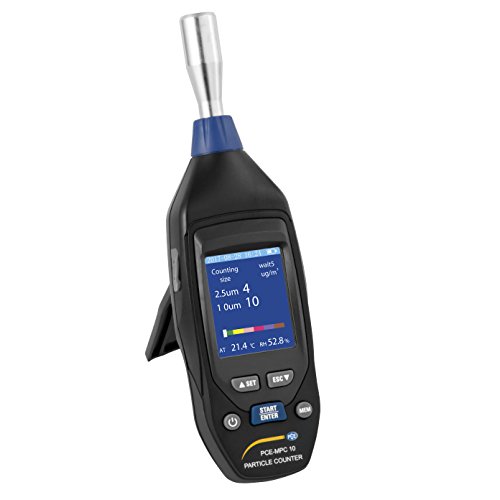
- Measures PM2.5 and PM10
- Includes temperature and humidity
- 5000-data logger with USB
Best For: Homes, offices, and basic indoor air checks
Cleanroom Data Logger

- 6 particle sizes from 0.3μm to 10μm
- Counting and weighing modes
- PDF export and USB logging
Best For: Cleanrooms and documentation-heavy inspections
All-in-One Home Monitor

- PM1.0, PM2.5, and PM10 readings
- Adds CO2, TVOC, HCHO, temp, humidity
- Rechargeable with up to 12 hours use
Best For: Homes and shared spaces needing broad indoor air monitoring
Field-Ready Dust Meter
Temtop Handheld Particle Counter

- Measures 0.3μm, 0.5μm, 1.0μm plus PM readings
- Includes temp, humidity, and 32GB storage
- 3500mAh battery for 4+ hours
Best For: Labs, facilities, and workshop air checks
Comprehensive Multi-Gas Particle Counter

- Six-channel particle counting from 0.3–10 µm
- Monitors CO2, HCHO, CO, TVOC, PM1.0/2.5/10
- Logs up to 10,000 groups with CSV export
Best For: Homes, offices, labs, and inspections needing broad air tracking
Portable 3-Channel Dust Counter
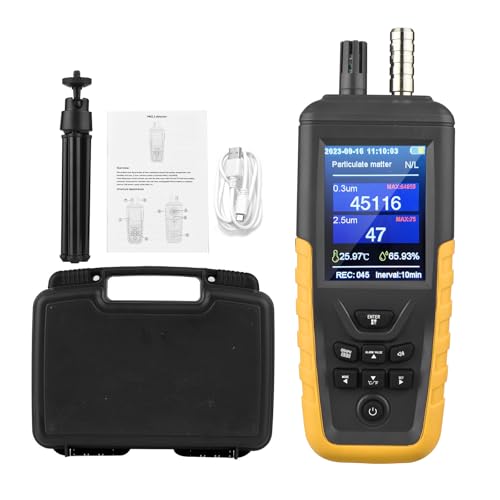
- Measures 0.3 µm, 2.5 µm, and 10 µm particles
- Stores 999 records and exports PDF reports via USB
- Includes alarms, color pollution bar, and tripod
Best For: Compact indoor dust monitoring with easy logging
Professional Indoor/Outdoor Particle Monitor
Temtop LKC1000S Air Quality Monitor

- Measures PM2.5, PM10, HCHO, temperature, humidity, and AQI
- Stores at least 3 months of continuous data
- Uses pre-calibrated sensors and industrial-grade laser detection
Best For: Indoor air tracking with formaldehyde and PM monitoring
6-Channel Cleanroom Meter
6-Channel Particle Counter with Storage
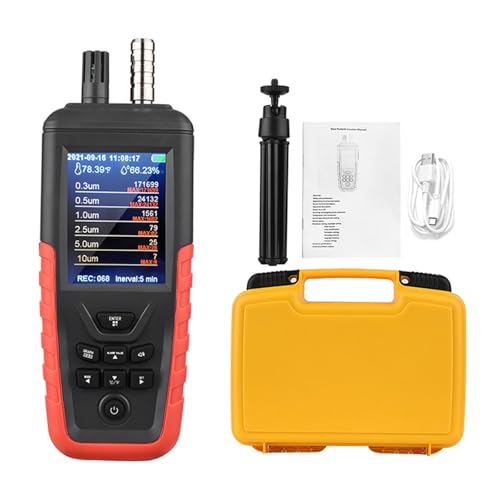
- Tracks six particle sizes plus PM2.5/PM10
- Stores 999 records and exports via USB to PC
- Includes alarm thresholds, color indicator, and tripod
Best For: Cleanrooms, contamination checks, and long-term indoor monitoring
Portable PM Monitor
Temtop PM2.5 and PM10 Air Counter

- Uses a second-generation laser sensor
- Shows 12-hour data history with a histogram
- Portable handheld design with back stand
Best For: Portable indoor and outdoor PM2.5/PM10 checks
7-in-1 IAQ Tracker
Temtop PM, HCHO, VOC, and AQI Monitor

- Tracks PM2.5, PM10, HCHO, VOCs, humidity, temp, and AQI
- Exports 3 months of data to Excel via USB
- Includes a 12-hour trend histogram and battery/plug-in use
Best For: Renovation monitoring, ventilation checks, and multi-parameter indoor tracking
Indoor Air Quality Spot-Checker – PCE-MPC 10 PM2.5 & PM10 Monitor
If you want a straightforward particle counter for indoor air, the PCE-MPC 10 focuses on the most common fine-dust checks: PM2.5 and PM10. It also adds temperature and humidity readings, making it a practical handheld option for quick room-to-room assessments and basic indoor air quality tracking.
Best For: Homes, offices, and facilities that need simple PM2.5/PM10 monitoring with temp and humidity data.
Pros:
- Measures PM2.5 and PM10 for common indoor particle monitoring
- Includes temperature and humidity measurement for broader air checks
- 2-inch full-color LCD with user-friendly graphics
- Built-in 5000-data logger and USB connectivity
Cons:
- Tracks fewer particle channels than multi-size cleanroom-focused models
- Designed more for basic indoor air quality checks than advanced classification
Overall, this is a solid pick if you mainly need readable, everyday indoor air data without a lot of setup or complexity. Its logging and display features make it useful for repeated spot checks and simple recordkeeping.
Cleanroom Data Logger – 6-Channel Particle Counter
This handheld particle counter for indoor air is built for users who need more than a simple dust reading. It measures six particle sizes, supports both counting and weighing modes, and adds temperature and humidity readings, making it a strong fit for cleanroom checks and detailed air quality validation.
Best For: Cleanrooms, QA teams, and industrial users who need multi-size particle data and report-ready logging.
Pros:
- 6-channel detection from 0.3μm to 10μm
- Supports pcs/L counting and μg/m³ weighing modes
- ISO 14644-1 compatible for ISO5-ISO9 cleanroom classification
- One-click PDF report export plus USB data transfer
Cons:
- More specialized than a basic home air monitor
- Higher-end feature set may be more than casual users need
For documentation-heavy environments, this model stands out because it combines broad particle coverage with on-device reporting and storage. It is especially appealing when you need inspection records as well as live readings.
All-in-One Home Monitor – 16-in-1 Indoor Air Tester
If you want particle counters for indoor air plus broader room monitoring, this 16-in-1 device covers much more than dust alone. It combines PM1.0, PM2.5, and PM10 with CO2, TVOC, HCHO, temperature, humidity, and AQI, so it works well as a single-screen indoor air snapshot for everyday spaces.
Best For: Bedrooms, offices, classrooms, and homes that need all-in-one indoor air monitoring.
Pros:
- Measures PM1.0, PM2.5, and PM10 along with CO2 and VOC-related readings
- 7 color-coded AQI levels make air conditions easy to read quickly
- Rechargeable design with up to 12 hours of use
- Bright display with adjustable brightness and audible alerts
Cons:
- Not a dedicated multi-channel cleanroom particle counter
- Best suited to general indoor monitoring rather than formal classification work
This is a smart choice if you want one portable monitor to watch dust, gases, and comfort conditions at the same time. It is designed for convenience and quick awareness rather than specialized particle testing.
Field-Ready Dust Meter – Temtop Handheld Particle Counter
For users comparing particle counters for indoor air in workshops, labs, or facilities, this Temtop handheld model offers a practical mix of particle, PM, and environmental readings. It measures 0.3μm, 0.5μm, and 1.0μm particles, adds PM2.5, PM10, and TSP, and includes temperature and humidity for a fuller look at conditions.
Best For: Lab, facility, and workshop users who want handheld particle monitoring with longer runtime and onboard storage.
Pros:
- Measures 0.3μm, 0.5μm, and 1.0μm particles plus PM2.5, PM10, and TSP
- Includes temperature and humidity monitoring
- 3500mAh battery supports more than 4 hours of operation
- 32GB internal storage with USB data transfer
Cons:
- Particle size coverage is narrower than 6-channel counters
- Handheld design may be less ideal for fixed, continuous monitoring
This is a useful middle ground if you need more than a basic dust meter but do not need the full reporting workflow of a cleanroom-focused unit. Its storage and battery setup make it well suited to field checks and longer sessions.
Comprehensive Multi-Gas Particle Counter – 12-in-1 Air Quality Monitor
If you want a serious option among particle counters for indoor air, this 12-in-1 monitor gives you broad coverage in one unit. It tracks six particle sizes from 0.3 to 10 µm while also measuring CO2, HCHO, CO, TVOC, PM1.0, PM2.5, PM10, temperature, and humidity, making it a practical pick for detailed indoor checks.
Best For: Homes, offices, labs, and inspection work that need particle counts plus gas monitoring in one device.
Pros:
- Six-channel particle counting covers 0.3–10 µm for more granular indoor air analysis.
- Includes active sampling with an integrated gas pump for more consistent readings.
- Stores up to 10,000 data groups and supports CSV export to a computer.
- Offers configurable alarms, CO2 calibration, and manual PM adjustments.
Cons:
- Requires a 10-minute warm-up before readings stabilize.
- Broader feature set may be more than casual users need.
This is the most feature-packed option here, especially if you need both particle counter data and multi-gas monitoring. The rechargeable battery, USB-C charging, and remote firmware updates add convenience, while the adjustable alerts and logging make it better suited to ongoing monitoring than quick spot checks.
Portable 3-Channel Dust Counter – Laser Particle Meter
This laser unit is a straightforward choice if you want particle counters for indoor air with clear, focused particle data. It measures 0.3 µm, 2.5 µm, and 10 µm particles, adds temperature and humidity, and can show trends on screen or export records to a PC for longer-term review.
Best For: Users who want a compact particle meter with simple monitoring, alarms, and data export.
Pros:
- Detects particle counts at 0.3 µm, 2.5 µm, and 10 µm.
- Stores up to 999 records and exports history as PDF via USB.
- Includes customizable alarms plus a color pollution indicator.
- Comes with a tripod for hands-free fixed-point monitoring.
Cons:
- Tracks fewer particle sizes than some more advanced monitors.
- Does not list gas measurements like CO2 or VOCs.
For buyers who mainly need dust and PM readings, this model keeps the workflow simple. The included tripod, on-screen trend curves, and battery-saving features make it practical for continuous spot monitoring in homes, offices, and other routine indoor spaces.
Professional Indoor/Outdoor Particle Monitor – Temtop LKC1000S Air Quality Monitor
If you need particle counters for indoor air with a more professional feel, the Temtop LKC1000S is built around reliable PM and formaldehyde monitoring. It measures PM2.5, PM10, HCHO, humidity, temperature, and AQI, and its data export plus long memory make it a strong pick for tracking indoor air over time.
Best For: Buyers who want a polished monitor for indoor air tracking with formaldehyde and particulate data.
Pros:
- Measures PM2.5, PM10, HCHO, humidity, temperature, and AQI in one device.
- Supports data export and stores at least 3 months of continuous records.
- Uses pre-calibrated sensors and an industrial-grade laser particle sensor.
- Large TFT display with a 6-level color health indicator is easy to read.
Cons:
- Does not advertise multi-channel particle size counting like some dedicated counters.
- Higher-end feature set may be unnecessary for basic home use.
This model stands out if you want a balanced monitor that focuses on the most commonly checked indoor factors. The combination of long sensor life, clear display, and exportable data makes it especially useful when you need ongoing air-quality records rather than just instant readings.
6-Channel Cleanroom Meter – 6-Channel Particle Counter with Storage
If you need particle counters for indoor air with cleanroom-level detail, this 6-channel meter goes beyond basic PM readings. It tracks particle counts at 0.3, 0.5, 1.0, 2.5, 5.0, and 10 μm, plus PM2.5/PM10, temperature, and humidity, making it useful for contamination checks and ongoing air-quality monitoring.
Best For: Cleanrooms, contamination checks, and fixed-point indoor air monitoring
Pros:
- Measures six particle sizes and PM2.5/PM10 in one unit
- Stores up to 999 records and exports data to PC as PDF via USB
- Custom alarm thresholds and color pollution indicator make readings easy to interpret
- Includes tripod, storage case, and rechargeable battery for portable or fixed use
Cons:
- More specialized than a simple home air monitor
- Best suited to users who want detailed particle data and logging
This is a strong pick if your priority is detailed particle counting rather than just a quick comfort check. The logging, export, and tripod setup make it especially practical for long-term indoor air monitoring and cleanroom-related work.
Portable PM Monitor – Temtop PM2.5 and PM10 Air Counter
For shoppers comparing particle counters for indoor air, the Temtop P600 keeps the focus on simple PM2.5 and PM10 monitoring. It uses a second-generation laser sensor, shows colorful health-level indicators, and includes a data graph that displays the past 12 hours so you can spot trends instead of relying on a single reading.
Best For: Portable indoor and outdoor PM2.5/PM10 checks
Pros:
- Upgraded laser sensor for PM2.5 and PM10 measurement
- Displays colorful health-level indicators for quick reading
- Stores and graphs the past 12 hours of data
- Handheld design with a back stand for easy daily use
Cons:
- Measures fewer air-quality factors than multi-parameter monitors
- Designed more for spot checks and trend viewing than deep reporting
The P600 is a straightforward choice if you want a portable monitor that is easy to understand at a glance. It works best when you mainly care about PM2.5 and PM10 trends in everyday indoor or outdoor settings.
7-in-1 IAQ Tracker – Temtop PM, HCHO, VOC, and AQI Monitor
If you want particle counters for indoor air that also cover chemical exposure, this Temtop monitor combines PM2.5, PM10, formaldehyde, TVOC, humidity, temperature, and AQI in one device. It’s built for trend detection, with a 12-hour histogram and USB data export to Excel, so it can support renovation checks, ventilation testing, or longer-term indoor tracking.
Best For: Renovation monitoring, ventilation checks, and multi-parameter indoor air tracking
Pros:
- Tracks seven parameters including PM, HCHO, VOCs, humidity, and temperature
- Exports up to 3 months of data to Excel via USB
- 12-hour trend histogram helps identify spikes and pollution sources
- Can run on battery for spot checks or plugged in for continuous monitoring
Cons:
- More complex than a basic particle-only monitor
- Not intended for gas or CO leak detection
This is the most feature-rich option in the group if you need more than particle counts alone. Its combination of trend history, exportable data, and multiple sensors makes it well suited to indoor air investigations where source tracking matters.
How We Picked the Best Particle Counters for Indoor Air
We focused on Particle Counters for Indoor Air that offer meaningful size channels, clear readings, and practical usability. Priority went to models with useful particle size ranges, fast sampling, portable designs, and features that fit real-world indoor monitoring rather than lab-only use.
We also favored devices that balance accuracy, ease of reading, and value. For buyers comparing indoor air tools, that means separating true particle counting needs from broader air quality monitoring needs such as CO2 or VOC detection.
Quick Comparison: What You’re Really Buying
Not all units do the same job. Some are dedicated dust and particle meters that show counts across several microns. Others are air quality monitors that include particle data plus temperature, humidity, CO2, and gas readings. If you mainly want to track airborne dust, prioritize particle channels and sampling consistency. If you want a fuller picture of indoor conditions, an all-in-one monitor may be the better fit.
Key Buying Factors for Particle Counters for Indoor Air
Particle Size Channels
Look for the size bands you actually need, such as PM0.3, PM2.5, and PM10. More channels can help you see where contamination is concentrated, but only if the device presents them clearly.
Counting Versus AQI Monitoring
Some monitors estimate air quality indices, which are useful for quick checks but not a replacement for particle counting. If you need trend data, diagnostic work, or source tracking, choose a model that reports raw particle levels or counts.
Sampling Method
Handheld units with pump suction can be better for targeted checks near vents, filters, or work areas. Ambient monitors are more convenient for continuous room monitoring. Choose based on whether you need spot testing or ongoing observation.
Environment Readings and Portability
Temperature, humidity, and formaldehyde or TVOC readings can add context, especially in homes, schools, and offices. Portability matters too, since a compact meter is easier to move between rooms and compare conditions.
Who Should Buy Which Particle Counters for Indoor Air?
If you want straightforward particle tracking, choose a dedicated particle meter with multiple size channels. If you need broad indoor diagnostics, an all-in-one air quality monitor may be the smarter choice. HVAC techs, inspectors, and serious DIY users often benefit most from handheld, pump-assisted Particle Counters for Indoor Air, while homeowners may prefer simpler monitors that are easy to read day to day.
For the best results, buy the device that matches your use case first, then compare sampling features, readout clarity, and the particle sizes you care about most.