Choosing among optical spectroscopes for students depends on more than magnification or price. The right instrument should match the learner’s age, experiment goals, precision needs, and whether it will be used at home, in a lab, or across a classroom.
Our roundup includes quantitative spectroscopes for wavelength measurements, simple diffraction-grating models for demonstrations, and compact handheld options for jewelry, gemology, and general science exploration.
Best 10 Optical Spectroscopes for Students Picks for 2026
Best Quantitative Pick
EISCO Premium Quantitative Spectroscope

- 400–700 nm measurement range
- ±5 nm stated accuracy
- 500 lines/mm diffraction grating
Best For: Measured classroom and laboratory investigations
Best Compact Student Pick
Mini Handheld Physics Spectroscope

- About 10 cm long
- Optical glass with composite prism
- Suitable for labs and science fairs
Best For: Portable introductory spectrum observation
Best Classroom Set
EISCO Economy Spectroscope Tube Set

- Six matching spectroscope tubes
- Adjustable rotating slit cap
- Built for optics demonstrations
Best For: Group classroom lessons and experiments
Best Budget Hobby Pick
Handheld Light Emission Spectroscope

- Optical glass and composite prism
- Compact 3.94-inch handheld design
- Shows visible emission-spectrum examples
Best For: Affordable hobby and science-fair exploration
Best for Easy Setup
Eisco Premium Quantitative Spectroscope 10pk

- 10 spectroscopes for group activities
- 400–700 nm wavelength measurement
- Useful for flame, gas-tube, and astronomy labs
Best For: STEM classrooms and group spectrum experiments
Gemology Pick
Pocket Diffraction Spectroscope
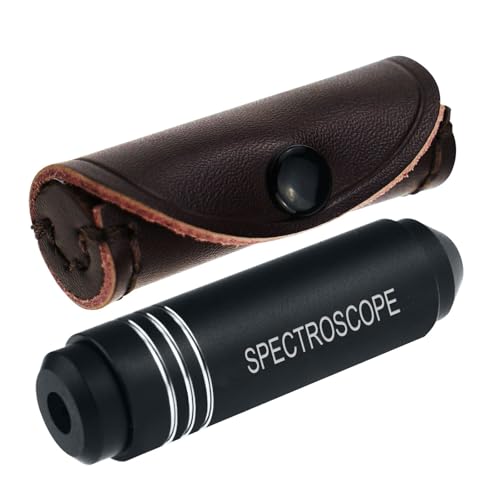
- Pocket-sized and travel-friendly
- Aluminum body with diffraction grating
- Designed for gemstone absorption spectra
Best For: Portable gemology and jewelry-identification practice
Physics Starter
Eisco Direct Vision Spectroscope

- Direct-vision spectrum viewing
- 400–700 nm graduated scale
- Includes three cuvettes
Best For: Introductory physics demonstrations and solo study
Hands-On Optics Pick

- Observes spectra from varied light sources
- Prism-and-lens vertical-tube design
- Lightweight option for labs and science fairs
Best For: Introductory student spectrum observations
Measurement-Focused Pick
Eisco Quantitative Spectroscope

- 400–700 nm measurement range
- ±5 nm stated accuracy
- 500 lines/mm grating with readable scale
Best For: Student experiments requiring wavelength readings
Classroom Value Pick

- 500 lines/mm diffraction grating
- Adjustable slit and metal body
- Designed for home and classroom experiments
Best For: Beginner optics demonstrations and discovery
Best Quantitative Pick – EISCO Premium Quantitative Spectroscope
For students who need measurable results from optical spectroscopes for students, the EISCO Premium model is the most capable option here. It covers 400–700 nm, includes a 500 lines/mm diffraction grating, and is rated for ±5 nm accuracy, making it suitable for structured light-source and color-spectrum investigations.
Best For: Students and instructors measuring visible wavelengths in lab work, flame tests, gas-tube studies, or basic astronomy activities.
Pros:
- Measures across the 400–700 nm visible range.
- Provides stated accuracy of ±5 nm.
- Secured grating and scale support clearer readings without taping.
- Works with gas tubes, flame tests, and basic astronomy applications.
Cons:
- Its quantitative design may be more equipment than casual observers need.
- It is corded electric, according to the supplied details.
This is the strongest choice when wavelength measurement matters more than minimal size or price. The metal enclosure and dedicated scale add a more serious laboratory feel, while the visible-range coverage suits common student experiments.
Best Compact Student Pick – Mini Handheld Physics Spectroscope
Woideklu Mini Spectroscope Physics Educational Equipment for Jewelry Lab Students
Check Price On AmazonThis mini handheld model is a practical entry point for optical spectroscopes for students who value portability and simple observation. Its optical-glass construction, composite prism, and condenser lens support direct viewing of dispersed light, while the approximately 10 cm body is easy to carry between class, home, and science-fair settings.
Best For: Beginners, student labs, amateur science projects, and science-fair demonstrations requiring a compact visual spectroscope.
Pros:
- Compact 10 cm design weighs about 2.12 ounces.
- Optical glass, prism, and condenser lens support clear observations.
- Fluorescent-light use can reveal mercury lines against a continuous spectrum.
- Simple handheld operation is suitable for introductory activities.
Cons:
- The supplied notes do not specify a wavelength scale or measurement accuracy.
- Solar viewing requires reflected sunlight rather than direct observation.
Choose this spectroscope for accessible visual exploration rather than numerical wavelength readings. Its small size and straightforward operation make it especially convenient for students learning how prisms separate light.
Best Classroom Set – EISCO Economy Spectroscope Tube Set
For group instruction, this six-pack offers a practical way to equip a classroom with optical spectroscopes for students. Each 10.25-inch tube includes an adjustable rotating slit cap, allowing learners to explore diffraction and visible-light spectra during shared demonstrations and hands-on optics lessons.
Best For: Teachers needing matching spectroscopes for classroom experiments, demonstrations, and small-group optics activities.
Pros:
- Six spectroscope tubes support group participation.
- Adjustable rotating slit cap helps students examine diffraction patterns.
- Designed for identifying visible-light wavelengths and teaching optics.
- No batteries are required.
Cons:
- The supplied details do not state a numerical measurement accuracy.
- The cardboard-and-plastic construction is more classroom-oriented than premium laboratory equipment.
- Its larger tube format is less portable than a mini handheld model.
This set is the sensible choice when access for multiple students matters most. It prioritizes quantity, repeat classroom handling, and guided exploration over precision wavelength measurement.
Best Budget Hobby Pick – Handheld Light Emission Spectroscope
Hubceuo 1Pc Handheld Spectroscope Light Emission Spectroscopy Spectrum Physics Science Hobby
Check Price On AmazonThis handheld model gives students and hobbyists a simple way to explore light emission spectroscopy. It uses optical glass with a composite prism and converging lens to produce a visible dispersed spectrum, and the compact blue body is suited to student labs, amateur science, and science-fair projects.
Best For: Hobbyists and students wanting an economical, visual introduction to emission spectra and fluorescent-light observations.
Pros:
- Compact design measures about 3.94 inches long.
- Optical-glass prism and converging lens support direct spectrum viewing.
- Fluorescent light may show three mercury lines against a continuous background.
- Lightweight at approximately 1.39 ounces.
Cons:
- The supplied notes do not provide a wavelength scale or accuracy specification.
- Sunlight must be observed indirectly using reflected light from a mirror.
- It is intended for visual analysis rather than documented quantitative measurements.
This is a good low-complexity option for seeing spectroscopy concepts firsthand. Select it when portability and economical experimentation are more important than calibrated readings or classroom multipacks.
Best for Easy Setup – Eisco Premium Quantitative Spectroscope 10pk
For classrooms comparing optical spectroscopes for students, this 10-pack provides a consistent way to examine visible light from gas tubes, flame tests, and basic astronomy activities. Its secured diffraction grating and scale support wavelength readings from 400.0 to 700.0 nm.
Best For: STEM classrooms, group laboratory activities, and introductory quantitative spectrum measurements.
Pros:
- Includes 10 spectroscopes for shared classroom use.
- Measures the visible range from 400.0 to 700.0 nm.
- Designed for gas tubes, flame tests, and basic astronomy applications.
- Holds the diffraction grating and scale securely for legible readings.
Cons:
- The manufacturer recommends it for ages 18 and up.
- The 10-pack may be more than needed for individual learners.
This is the strongest choice when multiple students need matching instruments and the lesson emphasizes measuring wavelengths rather than simply viewing colors.
Gemology Pick – Pocket Diffraction Spectroscope
Among optical spectroscopes for students, this pocket-sized diffraction model is aimed at hands-on gemstone identification. Its aluminum body, grating, and portable design make it suitable for examining absorption lines while traveling, at gem markets, or during practical demonstrations.
Best For: Students exploring gemology, jewelry identification, and portable absorption-spectrum observations.
Pros:
- Compact design measures about 2.17 by 0.59 by 2.17 inches.
- Aircraft-aluminum construction is designed for durability.
- Helps users examine absorption lines characteristic of individual stones.
- Intended for gemstone identification, including YAG and cubic zirconia comparisons.
Cons:
- Its focus is gemological analysis rather than general classroom spectroscopy.
- The supplied specifications list battery power, but do not describe battery life.
This is a specialized, highly portable option for learners whose projects center on gemstones rather than wavelength measurement across a classroom light-source setup.
Physics Starter – Eisco Direct Vision Spectroscope
For students comparing optical spectroscopes for students in a physics setting, this direct-vision model offers a straightforward way to view a slit spectrum and read its position against a graduated scale. The scale covers the visible range from 400 to 700 nm, and the metal case is supplied with three cuvettes.
Best For: Introductory physics demonstrations and individual visible-spectrum observations.
Pros:
- Direct-vision optical design lets users view the decomposed light spectrum.
- Graduated 400–700 nm scale supports visible-spectrum observations.
- Includes three cuvettes for practical demonstrations.
- Metal construction provides a compact, defined instrument format.
Cons:
- Only one spectroscope is included.
- Users must tilt the slit end to locate the bright green and violet lines.
This model suits learners who need a simple, guided introduction to spectral lines and scale reading without purchasing a larger classroom pack.
Hands-On Optics Pick – Handheld Prism Spectroscope
For students seeking optical spectroscopes for students, this lightweight handheld model offers a straightforward way to observe emission spectra from different light sources. Its prism glass, converging lens, and vertical-tube design make it suitable for introductory demonstrations and science projects.
Best For: Student lab activities, hobbyists, amateur scientists, and science fair projects involving basic light-spectrum observation.
Pros:
- Can analyze the spectrum from a variety of light sources.
- Prism glass and converging lens are integrated into the vertical tube.
- Lightweight, simple, and economical for hands-on learning.
- Allows users to observe the Sun’s emission spectrum.
Cons:
- The supplied notes do not provide a numerical wavelength range or accuracy rating.
- Its primarily observational design may be less suitable for precise quantitative measurements.
This is a practical entry-level choice when the priority is directly viewing spectra rather than recording exact wavelength readings. Its simple construction should fit classroom demonstrations and exploratory student experiments.
Measurement-Focused Pick – Eisco Quantitative Spectroscope
Eisco Labs - Premium Quantitative Spectroscope, Pack of 2-400-700nm Range, +/-5nm Accuracy
Check Price On AmazonAmong optical spectroscopes for students, this Eisco quantitative model stands out for learners who need readable wavelength measurements. It covers 400.0–700.0 nm, uses a 500 lines/mm diffraction grating, and is rated to ±5.0 nm accuracy for structured experiments.
Best For: Students analyzing gas-tube spectra, flame tests, color spectra, and basic astronomy applications.
Pros:
- Measures wavelengths across a 400.0–700.0 nm range.
- Provides a stated accuracy of ±5.0 nm.
- Its 500 lines/mm diffraction grating supports detailed spectra.
- Securely holds the grating and scale for more legible readings.
Cons:
- Its quantitative features may be more than beginners need for casual viewing.
- The supplied details list battery power but do not explain the battery requirements.
This is the strongest fit of the three for students who want to move beyond simply seeing color bands and begin making recorded wavelength observations. The integrated reading design also supports more organized lab work.
Classroom Value Pick – Eisco Economy Spectroscope
This economy Eisco model is a practical option for students comparing optical spectroscopes for students. Its 500 lines/mm diffraction grating, adjustable slit cap, and 10.25-inch metal body provide a simple hands-on way to explore wavelength differences at home or in the classroom.
Best For: Classroom demonstrations, home science experiments, and beginner exploration of diffraction and light spectra.
Pros:
- 500 lines/mm diffraction grating reveals differences among wavelengths.
- Adjustable slit cap supports basic optical demonstrations.
- Durable metal body is 10.25 inches long and weighs 18.14 g.
- Simple handheld format encourages direct exploration of different light sources.
Cons:
- The supplied notes do not state a wavelength range or measurement accuracy.
- It is designed for basic observation rather than detailed quantitative analysis.
Choose this model when affordability, portability, and accessible optics instruction matter most. It demonstrates how a narrow slit and diffraction grating separate light without adding unnecessary complexity for beginners.
How We Picked the Best Optical Spectroscopes for Students
We evaluated these instruments by looking at the features that matter most in student use: usable wavelength range, stated accuracy, optical design, construction, portability, pack size, and learning curve. We also considered whether each model is better suited to individual experiments, introductory demonstrations, or repeated classroom use.
Quantitative models receive particular attention because a marked scale and stated wavelength accuracy can help students connect observed colors with measurable data. Simpler tube and handheld spectroscopes can still be excellent choices when the goal is to compare emission lines, inspect light sources, or introduce diffraction without requiring advanced setup.
Quick Comparison
| Best For | Recommended Type | Why It Stands Out |
|---|---|---|
| Measuring approximate wavelengths | Quantitative spectroscope | Typically includes a calibrated scale and stated accuracy |
| First-time learners | Basic handheld or tube spectroscope | Simple, portable, and easy to demonstrate |
| Classroom groups | Multi-pack | Supports simultaneous hands-on activities |
| Jewelry and gem inspection | Pocket diffraction or direct-vision model | Compact format for quick viewing of spectral effects |
Key Buying Factors for Optical Spectroscopes for Students
Measurement Range and Accuracy
If students will record results, check the marked wavelength range and the manufacturer’s accuracy specification. A model covering roughly the visible spectrum is generally versatile for school experiments. Remember that stated accuracy is not the same as laboratory-grade resolution; lighting quality, viewing technique, and calibration also affect results.
Optical Design
Diffraction gratings separate light into spectral components and are commonly used for educational demonstrations. Direct-vision designs can be easier to view because the spectrum appears without requiring students to interpret a complex optical path. A prism-based or loupe-style tool may be more useful for specialized inspection than for formal wavelength measurements.
Build, Handling, and Safety
Look for a durable tube or metal case when the instrument will be shared. Lightweight handheld models are convenient, but small parts and narrow viewing windows may be challenging for younger users. Students should view suitable light sources only and never point an optical instrument directly at the Sun.
Quantity and Classroom Value
For a science class, multipacks can provide better practical value than buying one premium instrument. For independent learners, a single quantitative model or two-piece set may offer more useful capability without excess equipment.
Who Should Buy Which Optical Spectroscopes for Students?
Choose a premium quantitative model for students conducting structured labs, comparing known light sources, or learning how spectra relate to wavelength. Choose an economy tube or basic handheld model for introductory physics, demonstrations, and hobby use. A classroom pack is the sensible option when several students need to work at once. For jewelry, antiques, or gem-related observation, prioritize a compact handheld or specialized direct-vision design, while recognizing that these tools are not substitutes for professional analytical equipment.