The best microcontroller kits for students make electronics easier to understand by combining a programmable board with sensors, components, guided experiments, and project-based lessons. The right kit can turn abstract coding and circuit concepts into hands-on skills.
These 10 options cover several learning paths, including Arduino, Raspberry Pi Pico, ESP32, robotics, IoT, and camera projects. Use the guide below to match the kit’s hardware, curriculum, difficulty, and expansion potential to the student’s goals.
Best 10 Microcontroller Kits for Students Picks for 2026
Best Guided Curriculum

- Step-by-step STEM curriculum
- Beginner-friendly hands-on projects
- Includes sensors and breadboard
Best For: Structured classroom or self-paced learning
Best for Connected Projects

- ESP32 with Wi-Fi and Bluetooth
- Camera and 1GB card included
- 122 projects with three languages
Best For: Connected and camera-based experimentation
Best Component Variety

- 200+ components across 63 types
- 30+ guided electronics projects
- Solderless, organized setup
Best For: Classrooms and broad project experimentation
Best Multi-Language Learning
SunFounder Raspberry Pi Pico Kit
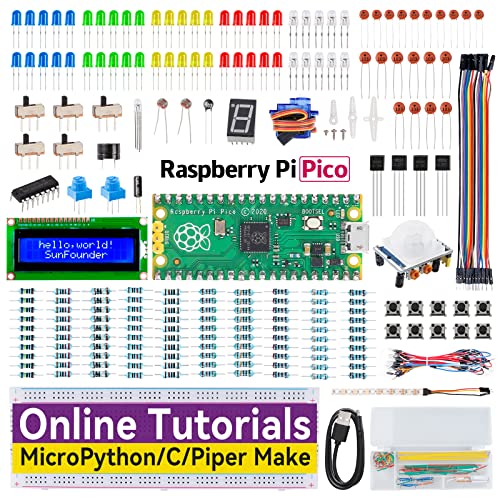
- 40 guided online projects
- 280+ components included
- MicroPython, C/C++, and Piper Make
Best For: Progressive learning across coding styles
Most Complete Project Kit

- 35+ guided electronics projects
- 200+ components and sensors
- Expanded I/O for larger builds
Best For: Teens and STEM learners tackling progressively complex projects
Best Connected Learning Path

- 50 projects from basics to IoT
- 300+ components included
- 100+ free video lessons
Best For: Beginners exploring Arduino and connected projects
Best College-Ready Basics
DFRobot UNO R3 Electronics Kit

- 83 labeled components
- 12 progressive tutorials
- Includes diagrams and sample code
Best For: College STEM beginners and structured self-study
Best for Guided IoT Learning
Raspberry Pi Pico W Ultimate Starter Kit

- 450+ components and 117 projects
- Wi-Fi and Bluetooth connectivity
- MicroPython, C/C++, and Piper Make support
Best For: Beginners exploring guided IoT and Raspberry Pi Pico W projects
Best for Connected Arduino Projects
ELEGOO UNO R4 WiFi Starter Kit

- UNO R4 WiFi with Bluetooth and LED matrix
- 200+ practical components and modules
- Step-by-step Arduino IDE tutorials
Best For: Learners progressing from circuits to wireless Arduino projects
Best Budget Arduino Starter
REXQualis UNO R3 Super Starter Kit
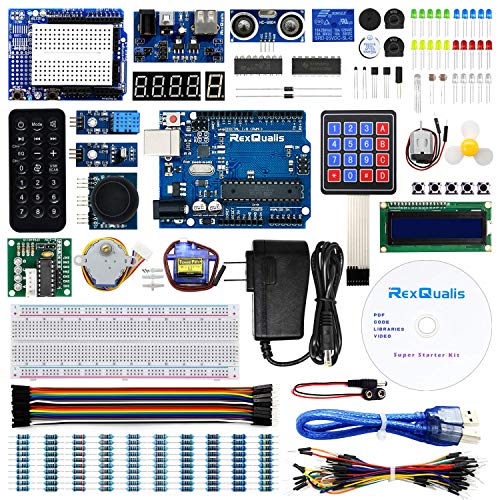
- 120 labeled components in a storage case
- 9V power adapter included
- Arduino IDE-compatible UNO R3 board
Best For: Budget-minded beginners learning basic Arduino STEM and robotics
Best Guided Curriculum – Arduino Student Kit
The Arduino Student Kit is a strong entry point for students looking for microcontroller kits for students with structured, hands-on instruction. Its beginner-friendly projects introduce circuit design, sensors, actuators, and Arduino IDE programming through step-by-step tutorials, videos, and online resources.
Best For: Beginners, classroom STEM lessons, and self-paced learners ages listed by the manufacturer.
Pros:
- Includes guided projects such as a traffic light, light-sensitive lamp, and motion-activated alarm.
- Combines written instructions with video tutorials and online learning resources.
- Provides LEDs, resistors, capacitors, motors, sensors, and a breadboard for experimentation.
Cons:
- The curriculum is primarily designed around beginner-level projects.
- The supplied details do not specify the full component count.
Choose this kit when clear instruction matters more than maximum hardware variety. It offers a focused path from basic circuits to introductory Arduino programming.
Best for Connected Projects – Freenove ESP32 Camera Kit
The Freenove ESP32 Kit stands out among microcontroller kits for students who want to explore cameras, wireless connectivity, and multiple programming languages. It pairs a dual-core ESP32 board with Wi-Fi, Bluetooth, a camera, memory-card support, and 122 guided projects.
Best For: Students ready to progress from basic electronics into connected, camera-based, and software-focused projects.
Pros:
- Offers onboard 2.4 GHz Wi-Fi, Bluetooth 4.2 LE, camera hardware, and a 1GB memory card with reader.
- Supports MicroPython, C, and Processing/Java examples.
- Includes 240 items and a 795-page downloadable or online tutorial covering 122 projects.
Cons:
- The tutorial is online or downloadable rather than printed.
- Its broad feature set may be more challenging for absolute beginners.
This is a versatile choice for learners who want substantial project depth and modern ESP32 capabilities. The extensive documentation can support a longer learning path, though the platform is less narrowly focused than a basic introductory kit.
Best Component Variety – ELEGOO UNO R3 Starter Kit
The ELEGOO UNO R3 Project Starter Kit is a practical pick for microcontroller kits for students who want many classic electronics modules in one organized set. It includes more than 200 components, 30-plus guided projects, a solderless breadboard, and an Arduino IDE-compatible UNO R3 controller.
Best For: Coding clubs, classrooms, and beginners who want to experiment with displays, RFID, sensors, motors, and relays.
Pros:
- Includes more than 200 components across 63 types.
- Projects progress from LEDs to LCD displays, RFID, motion detection, motor control, and environmental monitoring.
- Pre-soldered modules, organized storage, a breadboard, USB cable, and power accessories simplify setup.
- PDF tutorial and example code support Arduino IDE learning.
Cons:
- The included power supply module warning specifies not to use voltage higher than 9V.
- The supplied component list is extensive, so beginners may need to sort through many parts.
For learners who value breadth and repeated experimentation, this kit offers particularly strong coverage. Its organized storage and solderless setup make it easier to move between guided lessons and original modifications.
Best Multi-Language Learning – SunFounder Raspberry Pi Pico Kit
The SunFounder Raspberry Pi Pico Starter Kit gives students a broad introduction to electronics and programming through 40 projects and more than 280 items. It combines a pre-soldered Raspberry Pi Pico with online lessons, practical modules, and three programming approaches: MicroPython, C/C++, and Piper Make.
Best For: Beginners and progressing learners who want to compare text-based coding with a simplified block-style environment.
Pros:
- Includes 40 projects with circuit diagrams, operating explanations, and example code.
- Provides 280-plus items, including an I2C LCD, RGB LED strip, servo, PIR sensor, motors, and sensors.
- Supports MicroPython, C/C++ through Arduino IDE, and Piper Make.
- The included Raspberry Pi Pico is pre-soldered for a simpler start.
Cons:
- Tutorials are provided online rather than as a described printed curriculum.
- The large assortment may be overwhelming when first unpacked.
This kit is a flexible option for learners who want to grow from accessible lessons into more conventional programming. Its combination of project variety and three coding methods makes it useful for mixed-ability learning environments.
Most Complete Project Kit – Mega 2560 Starter Kit
For students looking for microcontroller kits for students that support more advanced builds, the ELEGOO Mega 2560 kit combines 35+ guided projects with more than 200 components. Its larger board and broad sensor selection make it practical for progressing from basic circuits to robotics, monitoring, and interactive displays.
Best For: Teens, coding clubs, and STEM learners ready to move beyond introductory Arduino projects.
Pros:
- Includes 35+ guided projects covering sensors, RFID, motors, displays, and environmental monitoring.
- Mega 2560 provides 54 digital I/O pins, 16 analog inputs, four hardware serial ports, and 256 KB of flash.
- Comes with 200+ components, a breadboard, storage case, and pre-soldered modules.
Cons:
- The large number of components may feel overwhelming for first-time learners.
- The manufacturer recommends it for ages 13 and up.
This is a strong choice when a student needs room to grow and wants one kit capable of supporting larger, more complex prototypes. Its structured lessons and organized parts help make repeated experimentation easier.
Best Connected Learning Path – UNO R4 WiFi Explorer Kit
Among microcontroller kits for students, the SunFounder Elite Explorer Kit stands out for its combination of an original Arduino UNO R4 WiFi, 300+ components, and extensive video instruction. Built-in WiFi and Bluetooth support projects that connect to apps and Arduino IoT Cloud.
Best For: Beginners, students, teachers, and aspiring makers interested in Arduino, coding, and connected IoT projects.
Pros:
- Includes 50 projects across basic, fun, and IoT-focused activities.
- Provides more than 100 free video lessons plus online technical support and troubleshooting forums.
- Original UNO R4 WiFi offers a 32-bit processor, increased memory, built-in WiFi, and Bluetooth.
Cons:
- The connected-project features may be more than needed for simple electronics exercises.
- Its broad component selection can require time to organize and learn.
This kit is particularly appealing for learners who benefit from video guidance and want a clear path from basic circuits to internet-connected projects. Compatibility with other Arduino boards also leaves room for future experimentation.
Best College-Ready Basics – DFRobot UNO R3 Electronics Kit
For students who want microcontroller kits for students with a focused introduction to electronics, this DFRobot set offers an UNO R3-compatible board, 83 labeled components, and 12 progressive tutorials. Its individually packaged parts and wiring diagrams are useful for college STEM courses and self-study.
Best For: College beginners, classroom assignments, and learners building foundational electronics skills.
Pros:
- Includes 83 components and a USB cable, so no extra parts are needed to begin.
- Individually labeled components simplify identification and setup.
- Projects include wiring diagrams, sample code, and explanations of the underlying principles.
Cons:
- With 12 projects, it offers less project breadth than the larger kits in this roundup.
- It uses an UNO R3-compatible board rather than the newer UNO R4 WiFi platform.
This is a practical pick for learners who prefer a focused curriculum over a very large parts inventory. The labeled components and progressive lessons can reduce setup friction while reinforcing why each circuit works.
Best for Guided IoT Learning – Raspberry Pi Pico W Ultimate Starter Kit
For students seeking microcontroller kits for students with a strong project focus, this Raspberry Pi Pico W bundle combines more than 450 components with 117 projects and support for MicroPython, C/C++, and Piper Make. Its wireless connectivity and guided lessons make it a practical option for exploring both electronics and IoT.
Best For: Beginners aged 8 and up who want structured, video-supported Raspberry Pi Pico W projects.
Pros:
- Includes more than 450 components and 117 projects.
- Supports Wi-Fi and Bluetooth connectivity.
- Offers 27 video tutorials plus community and technical support.
- Supports MicroPython, C/C++, and Piper Make.
Cons:
- The large component count may feel overwhelming for first-time learners.
- It is centered on the Raspberry Pi Pico W rather than an Arduino UNO board.
This is the most expansive learning bundle of the three, especially for students interested in connected projects and multiple programming languages. The guided content can help reduce the difficulty of starting with a broad hardware selection.
Best for Connected Arduino Projects – ELEGOO UNO R4 WiFi Starter Kit
Among microcontroller kits for students, this ELEGOO package stands out for its progression from basic circuits to connected STEM projects. The UNO R4 WiFi board works with the Arduino IDE and includes Wi-Fi, Bluetooth, a built-in LED matrix, and a broad selection of practical modules.
Best For: Teens, beginners, educators, and engineering students moving from introductory Arduino exercises toward wireless prototypes.
Pros:
- Includes an UNO R4 WiFi board with Wi-Fi, Bluetooth, USB-C, and a 12 × 8 LED matrix.
- Provides step-by-step wiring diagrams, sample code, and graphical manuals.
- Includes useful modules such as RFID, OLED, motors, sensors, keypad, and joystick.
- Compatible with existing UNO R3 shields and projects.
Cons:
- The number of modules and progressive lessons may be more than needed for very simple starter projects.
- Its wireless features require projects and setup that may be beyond a first circuit lesson.
This kit offers a balanced path for learners who want familiar Arduino compatibility without giving up modern wireless features. Its organized tutorials and varied modules support a gradual move from wiring practice to recognizable maker projects.
Best Budget Arduino Starter – REXQualis UNO R3 Super Starter Kit
For shoppers comparing affordable microcontroller kits for students, the REXQualis Super Starter Kit provides an economical Arduino-compatible starting point. It includes a controller board, sensors, motors, an LCD1602 module, a 9V power adapter, and labeled components stored in a plastic box.
Best For: Beginners who want a straightforward Arduino UNO R3-compatible kit for introductory STEM and robotics projects.
Pros:
- Includes 120 components and an Arduino UNO R3-compatible controller board.
- Comes with a 9V 1A power adapter instead of requiring a 9V battery.
- Includes sensors, servo, motor, LCD, and ULN2003 driver board.
- Components are individually packaged, labeled, and stored in a plastic case.
Cons:
- The product notes specify downloadable PDF tutorials rather than video instruction.
- The kit has a smaller component count than the other two options.
This is a sensible entry-level choice when price, organization, and core Arduino parts matter most. The included power adapter and labeled storage make it convenient for students beginning with basic electronics and robotics experiments.
How We Picked the Best Microcontroller Kits for Students
We focused on kits that provide a useful combination of a capable development board, clearly labeled components, project instructions, and beginner-friendly learning support. We also considered compatibility with popular programming environments, the variety of included experiments, expansion potential, and whether the kit can remain useful as a student’s skills improve.
Because “complete” kits vary widely, we looked beyond item counts. A large component assortment is helpful only when students can identify each part and understand how to use it safely. Kits with structured tutorials, practical projects, and accessible documentation received stronger consideration.
Quick Comparison
| Best For | Recommended Platform | What to Prioritize |
|---|---|---|
| First electronics projects | Arduino UNO R3 or student-focused Arduino kit | Simple tutorials, labeled parts, and guided experiments |
| Modern connected projects | Arduino UNO R4 WiFi or ESP32 | Wi-Fi, Bluetooth, processing power, and IoT examples |
| Python-based learning | Raspberry Pi Pico or Pico W | MicroPython support, coding lessons, and clear wiring diagrams |
| Advanced components and larger builds | Arduino Mega 2560 | More pins, broader component selection, and project variety |
| Computer vision or wireless experiments | ESP32 camera kit | Camera support, wireless connectivity, and suitable software guides |
Key Buying Factors for Microcontroller Kits for Students
Board and Programming Language
Arduino UNO boards are often the easiest starting point because they have a large beginner community and extensive example libraries. Raspberry Pi Pico kits are appealing for students learning MicroPython or C/C++, while ESP32 and UNO R4 WiFi boards are better suited to connected projects. Check the required software and operating-system support before buying.
Curriculum and Project Quality
Look for step-by-step lessons that explain both the code and the circuit. A kit with fewer, well-documented projects may be more useful than one advertising hundreds of loosely organized exercises. Projects should progress from LEDs and buttons to sensors, displays, motors, or wireless control.
Components and Expandability
Useful starter parts include breadboards, jumper wires, resistors, LEDs, buttons, sensors, displays, and motor-control components. Confirm that the kit includes the board, USB cable, and any required accessories. Expansion headers, standard libraries, and broad community support make future upgrades easier.
Age, Supervision, and Safety
Choose a complexity level that matches the student’s reading, coding, and wiring experience. Younger learners may benefit from visual instructions and adult supervision. Students should understand polarity, voltage limits, short circuits, and proper power handling before connecting unfamiliar modules.
Who Should Buy Which Microcontroller Kits for Students?
Choose an Arduino UNO R3 learning bundle for a first introduction to circuits and programming, especially when straightforward tutorials matter most. A dedicated Arduino Student Kit is a strong choice for structured classroom or self-guided STEM learning.
Choose a Raspberry Pi Pico kit for students who want to learn Python-style programming or explore a broad range of sensors and modules. Select the Pico W version when wireless projects are part of the plan. For IoT, Bluetooth, or camera experiments, an ESP32 or Arduino UNO R4 WiFi kit offers more relevant connectivity.
Students ready for larger circuits should consider an Arduino Mega kit with additional pins and room for more simultaneous components. Finally, compare included documentation and project support carefully: the most suitable kit is the one the student can start confidently and continue expanding after the first few lessons.