Choosing among four channel oscilloscopes can be tricky because bandwidth, sample rate, memory depth, and display quality all affect what you can actually see on the screen.
This roundup highlights 10 strong options for bench work, mixed-signal troubleshooting, and portable field use, so you can match the scope to your workflow and budget.
Best 10 Four Channel Oscilloscopes Picks for 2026
Bench-Ready 4-Channel Pick
Siglent SDS1104X-E 100MHz 4-Channel
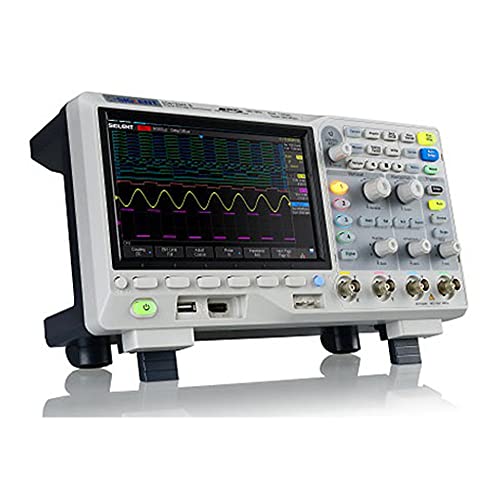
- 100MHz scope with 4 analog channels
- Standard decoders for Iic, Spi, Uart/Rs232, Can, and Lin
- Includes 4 probes, USB cable, and calibration certificate
Best For: Bench users who want decoding support and everyday debugging
Automotive Diagnostic Pick
TOPDON Phoenix Scope 4-Channel

- Automotive-focused 4-channel oscilloscope
- 50M memory depth with waveform recording and playback
- Requires compatible Phoenix diagnostic tools
Best For: Technicians working within the Phoenix tool ecosystem
Higher-Bandwidth Lab Pick
Siglent SDS1204X-E 200MHz 4-Channel

- 200MHz scope with 4 channels and 1GSa/s
- 7-inch display plus 14Mpts memory
- Wide intelligent trigger set for detailed capture
Best For: Lab users wanting more bandwidth and trigger control
Best-Value 4-Channel Pick

- 50MHz scope with 4 analog channels
- Up to 24 Mpts memory and 30,000 wfms/s capture rate
- Serial decode for RS232/UART, I2C, and SPI
Best For: Value shoppers who need deep memory and everyday troubleshooting
High-Resolution Bench Pick
Siglent SDS804X HD 70 MHz 12-bit 4CH

- 12-bit ADCs with up to 2 GSa/s sampling
- 50 Mpts/ch memory depth and 4 analog channels
- Bode plot, Power Analysis, and 4 math traces
Best For: Bench users who want high-resolution 4-channel capture and analysis
Portable Midrange Value

- 110 MHz bandwidth and 1 GS/s real-time sampling
- 7-inch display with four channels and cursor tools
- USB storage plus 30 automatic measurement functions
Best For: Users wanting a portable 4-channel scope with useful everyday features
Mixed-Signal Upgrade
Siglent SDS814X HD 100 MHz 4CH
- 100 MHz bandwidth with 2 GSa/s sampling
- 12-bit resolution and 50 Mpts memory depth
- Optional 16 digital channels with add-on hardware
Best For: Bench users who want a 4-channel scope with mixed-signal expansion potential
Portable 70MHz 12-Bit Four-Channel Scope

- 70 MHz, 4 analog channels, 12-bit resolution
- Up to 25 Mpts memory depth and 1.25 GSa/s sampling
- UltraAcquire, waveform search, LAN, USB, HDMI
Best For: Portable bench troubleshooting, embedded bring-up, and power rail checks
Mixed-Signal 70MHz Four-Channel Scope

- 4 analog channels plus 16 digital channels
- Up to 8 GSa/s sampling and 100 Mpts memory
- Over 500,000 wfm/s capture rate
Best For: Professional mixed-signal debugging and correlating analog with digital signals
Portable 100MHz 12-Bit Four-Channel Scope

- 100 MHz bandwidth with 4 analog channels
- 12-bit resolution and up to 25 Mpts memory depth
- UltraAcquire, search/navigation, LAN, USB, HDMI
Best For: Portable troubleshooting when you want more bandwidth than a 70 MHz model
Bench-Ready 4-Channel Pick – Siglent SDS1104X-E 100MHz 4-Channel
Siglent Technologies SDS1104X-E 100Mhz Digital Oscilloscope 4 Channels Standard Decoder, Grey
Check Price On AmazonIf you want four channel oscilloscopes for general electronics work, the Siglent SDS1104X-E gives you a practical 100MHz bench platform with 4 analog channels and included standard protocol decoding. It’s a solid fit when you need a compact scope for timing checks, bus troubleshooting, and day-to-day debugging with the usual essentials already in the box.
Best For: Electronics hobbyists, benches, and mixed signal troubleshooting where decoding support matters.
Pros:
- 100MHz bandwidth with 4 channels for common bench measurements
- Standard decoder support for Iic, Spi, Uart/Rs232, Can, and Lin
- Includes 4 passive probes, USB cable, quick start, and calibration certificate
- Compact footprint and listed FCC compliance
Cons:
- Option-based MSO digital channels are only for the four-channel series
- USB AWG module is also an option, not included here
This model keeps the focus on core oscilloscope use plus common serial decoding, making it a sensible choice when you need reliability more than extra frills. For buyers comparing four channel oscilloscopes, it stands out as a straightforward bench instrument with useful protocol coverage.
Automotive Diagnostic Pick – TOPDON Phoenix Scope 4-Channel
Among four channel oscilloscopes aimed at vehicle work, the TOPDON Phoenix Scope is built for fast automotive signal diagnosis rather than standalone bench use. It captures waveforms, supports record-and-replay analysis, and pairs with compatible Phoenix diagnostic tools to help technicians inspect circuits, sensors, actuators, ignition, and communication signals.
Best For: Automotive technicians using compatible Phoenix diagnostic platforms.
Pros:
- 4-channel oscilloscope designed for automotive electronics and wiring checks
- 50M memory depth with global and detailed waveform views
- One-tap fast waveform storage and waveform recording/playback
- Includes advanced math functions and FFT analysis
Cons:
- Works exclusively with Phoenix Max, Smart, Elite, Lite 3, Lite 2, Plus, and Plus 2 tools
- Does not work independently as a standalone scope
- Not compatible with Phoenix Nano or XLink
This is a specialized pick for users already invested in the supported Phoenix ecosystem. If your priority is automotive diagnostics, the combination of recording, replay, and one-tap storage makes it a focused option in the four channel oscilloscopes category.
Higher-Bandwidth Lab Pick – Siglent SDS1204X-E 200MHz 4-Channel
If you need four channel oscilloscopes with more bandwidth headroom, the Siglent SDS1204X-E steps up to 200MHz and a 1GSa/s sample rate. It also adds a large 7-inch display, 14Mpts memory, and a broad trigger set, making it a stronger choice for users who want more capture detail in routine lab or troubleshooting work.
Best For: Users who want a 200MHz four-channel scope with deeper analysis tools.
Pros:
- 200MHz bandwidth with 4 channels and 1GSa/s sample rate
- 7-inch TFT-LCD with 800 x 480 resolution
- 14Mpts memory with true measurement and math functions
- Intelligent trigger options include edge, slope, pulse width, window, runt, interval, timeout, and pattern
Cons:
- Heavier and larger than smaller bench scopes
- Memory and trigger features may be more than casual users need
For buyers comparing four channel oscilloscopes, this model is the more capable Siglent option when bandwidth and trigger flexibility matter. It fits well in a lab where you want stronger visibility into signal behavior without moving into a more specialized platform.
Best-Value 4-Channel Pick – Rigol DS1054Z 50MHz 4-Channel
For buyers comparing four channel oscilloscopes on a budget, the Rigol DS1054Z is a classic value choice with 50MHz bandwidth and 4 analog channels. It focuses on the core tools that matter for troubleshooting, including deep memory, a high capture rate, serial decode support, and remote-friendly connectivity for bench use.
Best For: Budget-conscious users who want deep memory and useful capture tools.
Pros:
- 50MHz digital oscilloscope with 4 channels and up to 1 GSa/s sample rate
- Up to 24 Mpts memory and 30,000 wfms/s capture rate
- Waveform recording/playback up to 60,000 frames
- Serial bus trigger/decoding for RS232/UART, I2C, and SPI plus LAN, USB Host, and USB Device
Cons:
- Lower bandwidth than the 100MHz and 200MHz options here
- Best suited to general debugging rather than higher-frequency work
This is the most value-oriented option in the group when you want usable depth, capture speed, and basic decode features without stepping up in bandwidth. It’s a practical fit for electronics debugging, teaching labs, and embedded bring-up.
High-Resolution Bench Pick – Siglent SDS804X HD 70 MHz 12-bit 4CH
If you’re comparing four channel oscilloscopes for detailed bench work, the Siglent SDS804X HD stands out for its 12-bit acquisition, 70 MHz bandwidth, and 50 Mpts per channel memory depth. It combines four analog channels with a 2 GSa/s sample rate and a 7-inch 1024 × 600 display, making it a practical choice when you want more resolution and analysis capability than a basic scope.
Best For: Users who want a 4-channel oscilloscope with high-resolution 12-bit capture and strong analysis tools for bench troubleshooting.
Pros:
- 12-bit ADCs and up to 2 GSa/s sample rate for higher-resolution signals
- 50 Mpts/ch memory depth helps preserve more waveform detail
- Four analog channels with up to 70 MHz bandwidth
- Includes analysis tools like Search, Navigate, Counter, Bode plot, and Power Analysis
Cons:
- 70 MHz bandwidth is lower than some other 4-channel options
- At 8.73 pounds, it is less portable than compact handheld scopes
This model makes the most sense if resolution and analysis features matter more than maximum bandwidth. For a four channel oscilloscope in a lab or workshop setting, it offers a strong mix of depth, display quality, and measurement tools.
Portable Midrange Value – HANMATEK DOS1104 110 MHz 4CH
The HANMATEK DOS1104 is a straightforward option if you want four channel oscilloscopes with a higher bandwidth ceiling and portable form factor. It offers 110 MHz bandwidth, 1 GS/s real-time sampling, a 7-inch TFT LCD, and a 20K-point minimum record length, plus practical extras like USB storage and cursor measurement.
Best For: Buyers who want a portable 4-channel scope with solid bandwidth, basic analysis features, and storage support.
Pros:
- 110 MHz bandwidth with 1 GS/s real-time sampling
- 7-inch true-color display and four-channel input
- Supports USB device/host interfaces and U-disk storage
- Includes 30 automatic measurement functions and SCPI support
Cons:
- 20K-point minimum record length is modest versus deeper-memory scopes
- Not as feature-rich in signal analysis as higher-end models
For users who need a capable general-purpose four channel oscilloscope without moving into premium pricing territory, this model covers the essentials well. Its mix of bandwidth, portability, and built-in measurement tools makes it easy to use on the bench or in the field.
Mixed-Signal Upgrade – Siglent SDS814X HD 100 MHz 4CH
Among four channel oscilloscopes, the Siglent SDS814X HD is aimed at users who want higher resolution and room to grow into mixed-signal work. It delivers 100 MHz bandwidth, 2 GSa/s sampling, 12-bit conversion, and 50 Mpts memory depth, with a 7-inch touch screen and optional digital-channel expansion.
Best For: Users who want a 4-channel oscilloscope with 12-bit resolution and the option to add digital channels later.
Pros:
- 100 MHz bandwidth with 2 GSa/s sampling
- 12-bit ADC and 50 Mpts memory depth for higher-resolution capture
- 7-inch touch screen and up to 80,000 wfm/s capture rate
- Optional support for 16 digital channels with the right accessories
Cons:
- Digital channels require separately sold options and probe
- Heavier at 8.4 pounds, so it is more bench-oriented than portable
This scope is a smart fit if you want a four channel oscilloscope with stronger bandwidth than the 70 MHz class and the flexibility to expand into mixed-signal use. It is best viewed as a bench instrument for users who expect to do more advanced debugging over time.
Portable 70MHz 12-Bit Four-Channel Scope – RIGOL DHO804
If you want four channel oscilloscopes that are compact but still built for detailed bench work, the RIGOL DHO804 is a strong fit. Its 70 MHz bandwidth, 12-bit vertical resolution, and 1.25 GSa/s sampling make it useful for checking rail relationships, small ripple, and timing issues without giving up portability.
Best For: Engineers, students, and hobbyists who need a portable 4-channel scope for power, embedded, and protocol troubleshooting.
Pros:
- 4 analog channels with 70 MHz bandwidth for multi-signal checks
- 12-bit resolution and up to 25 Mpts memory depth for finer detail
- UltraAcquire up to 1,000,000 wfms/s plus waveform search/navigation for finding glitches
- LAN, USB, HDMI, and SCPI support for lab workflows and remote control
Cons:
- Only 70 MHz bandwidth, so it is not aimed at higher-frequency work
- No built-in logic channels are listed in the supplied specs
- Best suited to bench and portability use rather than deep mixed-signal expansion
Overall, the DHO804 is a practical choice if you value compact size, modern acquisition features, and clean vertical detail in a four-channel oscilloscope. It balances everyday diagnostic capability with enough connectivity to fit a teaching lab or small engineering bench.
Mixed-Signal 70MHz Four-Channel Scope – Rigol MSO5074
Among four channel oscilloscopes, the Rigol MSO5074 stands out if you need a true mixed-signal setup. It combines four analog channels with 16 included digital channels, a 70 MHz bandwidth, and up to 8 GSa/s real-time sampling, making it useful when you need to correlate analog behavior with digital activity.
Best For: Professional users who want four analog channels plus digital inputs for mixed-signal debugging.
Pros:
- Four analog channels plus 16 digital channels included
- Up to 8 GSa/s real-time sample rate for fast signal capture
- 100 Mpts memory depth, with optional expansion up to 200 Mpts
- High waveform capture rate over 500,000 wfm/s helps reveal activity
Cons:
- Requires the optional PLA2216 logic probe to operate the digital channels
- Heavier and larger than the portable DHO models listed here
- Bandwidth is still 70 MHz, so it is not a high-frequency specialist
The MSO5074 is the most feature-rich option here when your troubleshooting needs extend beyond analog-only measurement. If you regularly move between buses, control lines, and analog signals, this model gives you a more complete view of the system.
Portable 100MHz 12-Bit Four-Channel Scope – RIGOL DHO814
If you want four channel oscilloscopes with a little more bandwidth, the RIGOL DHO814 is the step-up option in this group. It keeps the portable form factor while increasing bandwidth to 100 MHz and preserving the 12-bit resolution, 1.25 GSa/s sampling, and up to 25 Mpts memory depth that help with multi-rail and embedded troubleshooting.
Best For: Users who want a portable 4-channel oscilloscope with more bandwidth for broader everyday diagnostics.
Pros:
- 100 MHz bandwidth with 4 analog channels for wider coverage
- 12-bit vertical resolution for clearer small-signal detail
- UltraAcquire up to 1,000,000 wfms/s and waveform search/navigation for anomalies
- LAN, USB, HDMI, and SCPI support for remote use and documentation
Cons:
- Still limited to 4 analog channels, so it is not a mixed-signal model
- Memory depth and sampling are strong, but not aimed at specialist high-speed work
- Advanced decode support is limited to the listed serial protocols and 4-bit parallel decode
For buyers comparing four channel oscilloscopes, the DHO814 is appealing because it adds bandwidth without giving up the portable, modern workflow of the DHO line. It is a sensible pick when you want a bit more measurement headroom for general lab and field-style use.
How We Picked These Four Channel Oscilloscopes
We focused on practical specifications that matter in real troubleshooting: analog bandwidth, sample rate, memory depth, input accuracy, trigger features, and overall usability. We also weighed how well each model fits common buyer needs, from entry-level electronics work to more demanding lab and service tasks.
For Four Channel Oscilloscopes, the best choice is often the one that balances enough bandwidth for your signals with a clear interface and enough acquisition depth to capture detail without slowing you down.
Quick Comparison: What Stands Out
Some models emphasize value and simplicity, while others lean into higher bandwidth, 12-bit resolution, or mixed-signal capabilities. Portable units are useful for service calls and crowded benches, while larger benchtop scopes usually offer a more comfortable workflow for daily debugging.
Fast Rule of Thumb
If you mostly work on basic embedded systems or audio circuits, a lower-bandwidth model may be enough. For automotive diagnostics, power electronics, or faster digital buses, higher bandwidth and better triggering become much more important.
Key Buying Factors for Four Channel Oscilloscopes
Bandwidth and Sample Rate
Bandwidth determines how fast a signal the scope can accurately display, while sample rate affects how much detail it captures. As a general guide, choose more bandwidth than your current projects strictly require so you do not outgrow the scope too quickly.
Memory Depth and Waveform Capture
Deeper memory helps preserve detail during longer captures and makes it easier to inspect intermittent events. This is especially helpful when debugging serial communications, startup sequences, or noisy analog behavior.
Resolution and Signal Visibility
Standard 8-bit scopes are fine for many jobs, but 12-bit models can reveal smaller voltage changes with greater clarity. That extra resolution is especially useful when measuring ripple, sensor output, and low-level analog signals.
Mixed-Signal and Software Features
If you also need to monitor digital lines, mixed-signal support can save time and bench space. Built-in decoding, automated measurements, and a responsive interface can make Four Channel Oscilloscopes much easier to use day to day.
Who Should Buy Which Four Channel Oscilloscopes?
Hobbyists and students should prioritize ease of use and value. Technicians and repair professionals may prefer portable, feature-rich models that travel well and speed up diagnostics. Engineers and advanced users should look for higher bandwidth, better resolution, and stronger capture performance for more demanding work.
In short, the best Four Channel Oscilloscopes are the ones that fit your signal types, your workspace, and how often you need advanced capture or analysis features.