Moisture can turn otherwise good filament into inconsistent prints, stringing, popping, and rough surfaces. The right dryer helps hobbyists restore damp spools and keep moisture-sensitive materials ready to use.
This roundup compares 10 filament dryers across capacity, heating performance, temperature control, storage design, and everyday usability, so you can choose a setup that matches your printer collection and materials.
Best 10 Filament Dryers for Hobbyists Picks for 2026
Best High-Capacity Pick

- Dries up to four 1kg spools
- Three fans and 350W PTC heating
- Eight filament exits and 35–70°C control
Best For: Multi-printer hobby workshops
Best Dual-Chamber Option

- Fits four 1kg or two 2kg spools
- Dual 200W chambers reach 85°C
- Sealed storage helps limit moisture return
Best For: High-volume filament users
Best Simple Single-Spool Choice

- 35–70°C heat and 0–99-hour timer
- Transparent lid and rotating spindle
- Supports common filament diameters and materials
Best For: Routine single-spool drying
Best Compact Dual-Spool Value
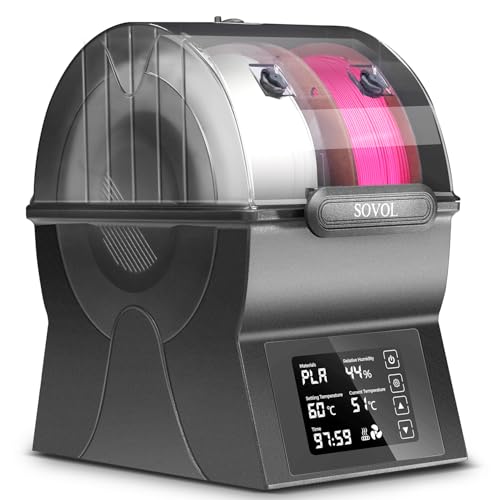
- Dries two 1kg spools simultaneously
- Reaches 70°C within 25 minutes
- Preset modes and built-in safety protections
Best For: Compact two-printer hobby setups
Best for Easy Setup

- Dries up to four 1 kg spools
- Independent 45–85°C zone controls
- Includes annealing and humidity modes
Best For: Multi-spool hobbyists and advanced material users
Best Automation Features

- Independent dual chambers for four spools
- Automatic humidity-based drying mode
- 360° circulation and touchscreen control
Best For: Hobbyists wanting automated multi-spool drying
Best Compact Starter

- Fan-assisted moisture removal
- 35–55°C adjustable temperature range
- Compact single-spool design with LCD
Best For: Beginners and casual single-spool users
Budget Dual-Spool Option
Comgrow SH01 Filament Dryer Box

- Holds two 1kg spools
- 40–50°C adjustable heating
- LCD monitoring and sealed outlet
Best For: Everyday PLA, ABS, and silk filament drying
Fast Dual-Spool Upgrade
Creality Space Pi Filament Dryer Plus

- 160W PTC and 360° hot-air heating
- Fits two 1kg spools
- Presets for up to 12 filament types
Best For: Multi-material hobby printing and dual-spool drying
Compact Precision Pick
Creality Space Pi SE Dryer Box

- 45–65°C adjustable temperature
- 0–24-hour drying timer
- Fast 360° heating for one 1kg spool
Best For: Single-spool drying with precise control
Best High-Capacity Pick – SUNLU S4 Four-Spool Dryer
For hobbyists who run several printers or regularly work with filament dryers for hobbyists, the SUNLU S4 offers room for up to four 1kg spools while drying during printing. Its broad material support, adjustable heat, and multiple filament exits make it a flexible choice for a busy home workshop.
Best For: Hobbyists who need to dry and feed several spools at once.
Pros:
- Holds up to four 1kg spools and supports 1.75mm, 2.85mm, and 3.00mm filament.
- Three circulation fans and 360-degree heating help promote more even drying.
- Offers 35–70°C temperature control, a 0–99-hour timer, and eight filament exit holes.
Cons:
- Its large 460 × 220 × 310mm exterior requires substantial workspace.
- At 4kg, it is less convenient to move than smaller single- or dual-spool dryers.
- The listed 3kg-roll modification requires DIY work rather than being a standard configuration.
The S4 is a strong fit when capacity and flexible routing matter more than compactness. It is overbuilt for occasional single-spool drying but practical for multi-printer hobby setups.
Best Dual-Chamber Option – Creality Space Pi X4 Dryer
The Creality Space Pi X4 is designed for hobbyists who want high capacity alongside active storage. It accommodates four standard 1kg spools or two 2kg spools, with dual heating chambers and a sealed enclosure intended to limit moisture re-absorption.
Best For: High-volume users who want drying and moisture-controlled storage in one box.
Pros:
- Holds four standard 1kg spools or two large 2kg spools.
- Dual independent 200W heating chambers reach up to 85°C.
- Sealed storage, an illuminated viewing window, and touch controls support convenient use.
Cons:
- The larger capacity and dual-chamber design may be more than a casual hobbyist needs.
- The supplied notes do not specify a timer range or exact dimensions beyond package size.
- Higher-temperature operation should be reserved for materials suited to those settings.
The Space Pi X4 stands out for combining multi-spool drying with ongoing storage. Its strongest advantage is flexibility for users who rotate through larger quantities of filament.
Best Simple Single-Spool Choice – SUNLU S2 Filament Dryer
The SUNLU S2 is a straightforward option for hobbyists who mainly need to revive damp filament and keep one spool dry while printing. Its touch controls, transparent lid, and adjustable 35–70°C range make everyday operation easy to manage.
Best For: Hobbyists seeking an accessible dryer for routine single-spool use.
Pros:
- Adjustable temperature and drying time from 0–99 hours.
- Supports 1.75mm, 2.85mm, and 3.00mm filament, including PLA, PETG, TPU, and ABS.
- Transparent lid allows inspection without opening the dryer, while the spindle supports continuous rotation.
Cons:
- The supplied notes do not state a multi-spool capacity.
- Its 265 × 274 × 118mm capacity may limit use with unusually large spools.
- The maximum temperature of 70°C may be less suitable for materials requiring higher drying temperatures.
The S2 keeps the feature set focused on practical filament care. It is a sensible starting point for hobbyists who do not need the capacity or higher-temperature range of larger dryers.
Best Compact Dual-Spool Value – Sovol SH02 Dry Box
The Sovol SH02 is a compact filament dryer for hobbyists who want to dry two 1kg rolls simultaneously without taking up the space of a four-spool unit. It combines fast PTC heating, improved sealing, preset material modes, and safety protections for convenient home use.
Best For: Hobbyists who run two printers or want dual-spool drying in a compact box.
Pros:
- Dries two 1kg spools at once and provides two filament holes for different printer layouts.
- 150W PTC heating reaches 50°C within 7 minutes and 70°C within 25 minutes.
- One-key presets cover nine filament types, with overheat and fan-failure safety protection.
Cons:
- Desiccant bags are not included if users want to supplement the sealed storage.
- The 40–70°C range offers less flexibility than dryers with lower minimum settings.
- Its two-spool capacity is unsuitable for users needing to process four or more rolls together.
The SH02 offers a useful middle ground between single-spool simplicity and larger multi-spool systems. Its preset modes and safety features make it particularly approachable for hobbyists who value quick setup.
Best for Easy Setup – SUNLU S4 Pro Dual-Zone Dryer
For hobbyists who run several printers or work with moisture-sensitive materials, the SUNLU S4 Pro is a high-capacity option among filament dryers for hobbyists. Its two independently controlled zones can dry different filaments at temperatures from 45–85°C, while the four-spool capacity supports drying during printing.
Best For: Multi-spool users who need independent temperature control, annealing support, and compatibility with materials such as PLA, PETG, ABS, TPU, PA, PC, and Nylon.
Pros:
- Holds up to four 1 kg spools with two separately controlled chambers.
- Supports drying temperatures up to 85°C and includes an annealing mode.
- Automatic humidity control helps regulate chamber humidity between set thresholds.
- 380W PTC heating and included PTFE tubing support printing while drying.
Cons:
- Its larger 458 × 218 × 340 mm footprint requires substantial workspace.
- At 10.4 pounds, it is less convenient to move than a compact single-spool dryer.
The S4 Pro is a strong choice when capacity and material flexibility matter more than portability. Its dual-zone layout is particularly useful for hobbyists preparing different filaments at the same time.
Best Automation Features – Comgrow SH03 Four-Spool Dryer
The Comgrow SH03 is designed for hobbyists who want substantial capacity and more automated drying management. As one of the filament dryers for hobbyists with dual independent chambers, it can handle up to four 1 kg spools while adjusting operation based on humidity and temperature conditions.
Best For: Users who value automatic drying, touchscreen controls, active air circulation, and separate chamber operation for multiple filament types.
Pros:
- Supports up to four 1 kg spools in two independently controlled chambers.
- Adjustable 45–85°C temperature range accommodates PLA, ABS, PETG, TPU, ASA, PA, and PC.
- Automatic mode can stop drying after humidity falls and a 30-minute countdown finishes.
- 360° hot-air circulation, adjustable operation up to 98 hours, and multiple monitoring protections add practical control.
Cons:
- Its dual-chamber, touchscreen design may be more equipment than casual users need.
- The supplied notes do not specify the unit’s overall dimensions or weight.
With independent controls and an automatic storage mode, the SH03 is geared toward organized, repeatable filament preparation. It is a compelling fit for hobbyists who regularly dry several spools rather than occasional users seeking the simplest setup.
Best Compact Starter – SUNLU S1 Plus Filament Dryer
The SUNLU S1 Plus is a simpler, more compact choice among filament dryers for hobbyists. Its fan-assisted design helps remove moisture while printing, and the 2-inch LCD shows temperature, time, and humidity for straightforward control of one spool.
Best For: Beginners and casual hobbyists who primarily use one spool at a time with PLA, PETG, ABS, TPU, Nylon, or PA filament.
Pros:
- Fan design helps speed moisture removal from filament.
- Adjustable temperature range of 35–55°C suits common lower-temperature materials.
- LCD displays temperature, time, and humidity in a compact interface.
- Supports 1.75 mm, 2.85 mm, and 3.00 mm filament with drying while printing.
Cons:
- Its stated 210 × 89 mm capacity is intended for a single-spool setup.
- The 35–55°C range is less suitable for users seeking high-temperature drying or annealing.
The S1 Plus keeps filament drying approachable and space-conscious. Choose it when you want basic monitoring and fan-assisted drying for everyday materials, rather than the multi-zone capacity of larger dryers.
Budget Dual-Spool Option – Comgrow SH01 Filament Dryer Box
For hobbyists comparing filament dryers for hobbyists, the Comgrow SH01 is a practical storage-and-drying box with room for two 1kg spools. Its 40–50°C temperature range, 6–12-hour timer, and sealed design make it suited to common materials such as PLA, ABS, and silk filament.
Best For: Hobbyists who want two-spool capacity and straightforward drying for standard filaments.
Pros:
- Stores two 1kg spools and supports 1.75mm and 2.85mm filament.
- Provides adjustable 40–50°C heating and 6–12-hour drying settings.
- Includes a 2-inch LCD, touch buttons, temperature and humidity monitoring, and a sealed outlet design.
Cons:
- The maximum temperature is limited to 50°C.
- The drying cycle requires the work state to be displayed or the unit may shut down after three minutes.
- Only two 1kg spools fit, which may limit larger setups.
The SH01 is a sensible entry-level choice when capacity and simple operation matter more than high-temperature drying. Its lower temperature ceiling makes it a better match for everyday filament storage and common materials than demanding high-temperature applications.
Fast Dual-Spool Upgrade – Creality Space Pi Filament Dryer Plus
Among filament dryers for hobbyists, the Creality Space Pi Plus stands out for its two-spool design, 160W PTC heating, and 360° hot-air circulation. It combines one-key presets with manual adjustment from 45–70°C, giving hobbyists broader material support and more control than basic low-temperature dryers.
Best For: Hobbyists drying two spools at once or working with a broad range of standard and composite filaments.
Pros:
- Fits two 1kg spools and includes four filament holes with two PTFE pipes.
- Uses double PTC 360° hot-air heating for more uniform chamber heating.
- Offers presets for up to 12 filament types and a 4-inch LCD touch screen.
- Supports 1.75mm and 2.85mm filaments, including PLA, PETG, ABS, TPU, PA, PC, and carbon-fiber blends.
Cons:
- Its feature set and 5.5-pound weight may be more than needed for occasional drying.
- The supplied notes do not specify a drying-time range.
The Space Pi Plus is the most versatile option here for hobbyists who regularly switch materials or feed two printers. Its wider temperature range and preset system make it especially appealing when convenience and material flexibility are priorities.
Compact Precision Pick – Creality Space Pi SE Dryer Box
For hobbyists seeking filament dryers for hobbyists with precise controls, the Creality Space Pi SE offers adjustable 45–65°C heating and drying times from 0–24 hours. Its built-in fan, 360° circulation, humidity display, and insulated chamber provide a focused setup for one standard 1kg spool.
Best For: Hobbyists who want controlled single-spool drying with a broad timer range.
Pros:
- Heats to 65°C within 15 minutes according to the supplied specifications.
- Provides 45–65°C temperature adjustment and a 0–24-hour timer.
- Uses 360° hot-air circulation, thermal insulation, and real-time humidity monitoring.
- Supports 1kg spools and 1.75mm or 2.85mm filament across materials including PLA, PETG, ABS, ASA, TPU, and nylon.
Cons:
- Designed for one 1kg spool rather than two-spool drying.
- The listed warranty is six months.
- A vacuum bag is still recommended for storage after drying.
The Space Pi SE is a well-balanced choice for hobbyists who prefer precise temperature and time control without needing dual-spool capacity. Its insulation and fast-heating design make it a strong everyday option for a single active spool.
How We Picked These Filament Dryers for Hobbyists
We focused on practical features that matter in a home 3D-printing workspace: spool capacity, temperature range, heating consistency, drying controls, storage sealing, noise, and compatibility with common 1-kg spools. The selection includes compact single- or dual-spool units, larger four-spool dryers, and premium models with independent zones or more precise sensing.
Because material requirements vary, we also considered whether each dryer is suited to everyday PLA and PETG maintenance or offers the higher temperatures often needed for materials such as nylon and polycarbonate. Product names and specifications can vary by revision, so confirm the current manufacturer details before purchase.
Quick Comparison
| Best For | Recommended Type | What to Prioritize |
|---|---|---|
| One active printer | Compact single-spool dryer | Small footprint, simple controls, reliable heating |
| Two printers or frequent material changes | Dual-spool dryer | Independent control, spool fit, feed-through ports |
| Several printers | Four-spool dryer | Capacity, airflow, chamber layout, power efficiency |
| Moisture-sensitive materials | Higher-temperature or precision model | Temperature accuracy, sealing, sustained heat |
| Drying and storing spools | Sealed storage box | Gasket quality, humidity management, easy access |
Key Buying Factors for Filament Dryers for Hobbyists
Capacity and Workspace
Choose capacity based on how many spools you use at once, not simply how many you own. A single-spool dryer is easier to place beside a printer and may use less power. Four-spool models make more sense for multi-printer setups, but they require more counter space and can be less convenient if you rarely run multiple materials.
Temperature Control
Look for adjustable settings rather than a single fixed heat cycle. PLA, PETG, TPU, ABS, nylon, and polycarbonate have different drying needs, and excessive heat can deform a spool or damage filament. Precise sensors and independent zones are especially useful when different materials are being dried simultaneously.
Feeding and Storage Design
If you plan to print while drying, check for smooth filament outlets, compatible spool dimensions, and enough room for the filament path. A good seal, humidity display, and storage mode help prevent the spool from reabsorbing moisture after the drying cycle ends.
Controls, Noise, and Safety
Clear displays and straightforward presets make repeated drying easier. Consider fan noise if the unit will sit near your desk, and look for stable construction, overheat protection, and an automatic shutoff or timer. Wattage can indicate heating speed, but it does not by itself guarantee even drying.
Who Should Buy Which Filament Dryers for Hobbyists?
Choose a compact SUNLU, Comgrow, or similar single-spool model if you are a casual hobbyist with one printer, limited space, and mostly PLA or PETG. These units are usually the simplest and most economical starting point.
Choose a dual-spool dryer if you frequently switch materials, run two printers, or want a balance between capacity and footprint. Models with separate temperature controls are preferable when drying different filament types together.
Choose a four-spool Creality, Comgrow, Sovol, or SUNLU system if you maintain several printers or want multiple rolls ready for production-style projects. Confirm that the chamber arrangement supports your spool sizes and that the total heating capacity is adequate.
Choose a premium or precision-controlled model if you regularly print nylon, polycarbonate, or other moisture-sensitive materials. Better sensors, stronger sealing, and dependable temperature control can matter more than maximum spool count. Whichever model you select, store dried filament in a sealed container when it is not actively feeding into the printer.