Choosing a digital viscometer for laboratory work comes down to more than just price. Accuracy, viscosity range, temperature support, and data handling can all affect how reliable your results are.
Below, we focus on 10 practical options for labs testing inks, paints, coatings, adhesives, oils, and other fluids that need consistent, repeatable measurements.
Best 10 Digital Viscometer for Laboratory Picks for 2026
Lab Data Output Pick
NDJ-8S digital rotary viscometer with RS232
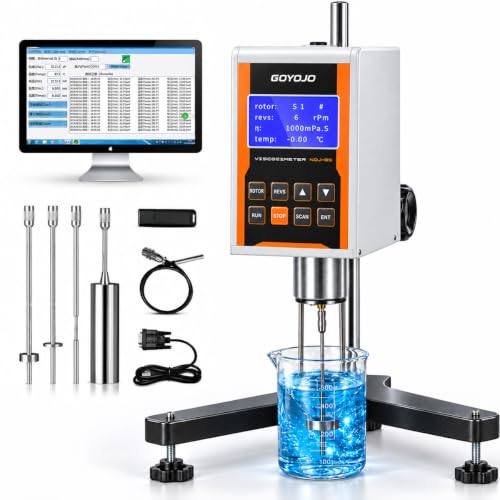
- RS232 interface and software support data transfer and curve printing
- Wide 10 to 2,000,000 mPa.s range with 4 rotors and 4 speeds
- LED screen shows rotor, speed, viscosity, percentage, and temperature
Best For: Labs needing connected data handling and broad viscosity coverage
Low-Viscosity Lab Choice
NDJ-5S rotary viscometer with 0# rotor

- Includes 0# rotor for samples as low as 1 mPa.s
- RS232 and software support computer output and printing
- Blue-backlit LCD shows rotor, speed, viscosity, and percentage
Best For: Very low-viscosity samples and computer-based reporting
Broad-Range Data Model
NDJ-8S viscometer with temperature probe

- RS232, temp probe, and software support curve tracking and printing
- 10 to 2,000,000 mPa.s range covers many sample types
- Digital screen and soft touch controls simplify operation
Best For: Broad lab testing with data output and temperature monitoring
Flexible Value Option
NDJ-5S lab viscometer with optional output

- 1 to 100,000 mPa.s range with 5 rotors and 4 speeds
- 0# rotor supports very low-viscosity measurements
- Computer output and calibration certificate are customizable
Best For: Routine lab use with optional data storage or computer output
Professional Temp-Enabled Lab Pick
Digital Rotary Viscometer with Data Output

- RS232 output with software support
- Temp probe and real-time curve viewing
- Wide range with 4 rotors included
Best For: Labs needing connected data logging and temperature tracking
Smart Touchscreen Value Pick
NDJ-8ST Digital Rotational Meter

- Color touchscreen with live parameter display
- Scan function helps choose rotor and speed
- Stores 50 data sets and prints results
Best For: Labs that want guided operation and easy on-screen readings
High-Accuracy Data Logging Pick
Digital Rotary Viscometer with Printing

- 1% accuracy and 0.5% repeatability
- Timing and shear-rate display included
- Data output with computer and printer support
Best For: Labs focused on precise testing and printed documentation
Best High-Range Pick
Bonvoisin Digital Rotary Viscometer 10-2,000,000mPa.S

- 10–2,000,000 mPa.s range for very thick to thin fluids
- LCD displays spindle, speed, temperature, and torque
- RS232-to-USB output supports PC data storage
Best For: labs testing a very wide viscosity range
Best Mid-Range Lab Choice
VEVOR Digital Rotary Viscometer 10-100,000 mPa.s

- 10–100,000 cP range for routine fluid testing
- ±2% accuracy with four included spindles
- RS232 output supports PC and printer use
Best For: routine lab testing of common fluids
Best Wide-Range Lab Model
VEVOR Digital Rotary Viscometer 10-2,000,000 mPa.s
- 10–2,000,000 cP range for broad sample coverage
- ±2% accuracy with LCD readout of key values
- RS232 data output helps store and transfer results
Best For: labs needing maximum viscosity range coverage
Lab Data Output Pick – NDJ-8S digital rotary viscometer with RS232
If you need a digital viscometer for laboratory use with broad sample coverage and easy data handling, this NDJ-8S model is built around measurement workflow. It supports RS232 data transfer, temperature probing, and software-based curve viewing, saving, and printing, which makes it practical for routine lab checks and report generation.
Best For: Labs measuring inks, paints, adhesives, cosmetics, and other Newtonian or non-Newtonian liquids that need computer-connected data management.
Pros:
- RS232 interface, temperature probe, and software for computer data transfer and curve management
- 10 to 2,000,000 mPa.s range with four rotors and four speeds for 20 combinations
- LED screen with soft touch controls for quick viewing of rotor, speed, viscosity, percentage, and temperature
- Angle adjustment, level bubble, and sliding design help support setup across different container heights
Cons:
- Low-viscosity liquids may require the separately purchased No. 0 rotor
- Measurement accuracy is listed at ±3.0%, which may not suit ultra-high-precision workflows
Overall, this is a flexible lab viscometer for users who want digital readout plus practical data output tools. It stands out most when your testing routine includes computer storage, printing, and a wide viscosity range.
Low-Viscosity Lab Choice – NDJ-5S rotary viscometer with 0# rotor
This digital viscometer for laboratory work is a strong fit when you want a compact rotary unit with a low-end measurement option. The NDJ-5S includes a 0# rotor, RS232 output, and software support, so it handles both measurement and simple data processing without adding extra complexity.
Best For: Labs that need to measure very low-viscosity samples and want computer output for recordkeeping.
Pros:
- Measures from 1 to 100,000 mPa.s and includes a 0# rotor for very low-viscosity samples
- RS232 interface plus software for outputting data to a computer for processing and printing
- LCD with blue backlight shows rotor number, speed, viscosity, and percentage clearly
- Automatic search function helps match rotor and speed more easily
Cons:
- Does not include a temperature probe in the supplied notes
- Lower top-end range than some broader-range models in this roundup
For labs focused on low-viscosity liquids, this model is especially appealing because the 0# rotor expands usability at the bottom end. It is a practical choice if you value straightforward digital operation and computer-connected reporting.
Broad-Range Data Model – NDJ-8S viscometer with temperature probe
When you want a digital viscometer for laboratory testing with a very broad range and built-in data output, this NDJ-8S version is a solid option. It combines RS232 connectivity, a temperature probe, and real-time curve viewing so you can track viscosity changes and store or print results as needed.
Best For: Labs testing everything from low to very high viscosity fluids and needing computer-based result handling.
Pros:
- RS232 interface, temperature probe, and software support real-time curve checks, saving, and printing
- Very wide 10 to 2,000,000 mPa.s range for broad lab applications
- Digital screen and soft touch controls make rotor and speed checks easier
- Four rotors and angle-adjustable lifting system help with different sample setups
Cons:
- Low-viscosity liquids may need the separately purchased #0 rotor
- Accuracy is listed at ±3%, so it is not positioned as an ultra-high-precision instrument
This model is best suited to labs that need range and documentation tools more than specialized niche features. The combination of broad coverage and data output makes it versatile for routine viscosity testing across multiple sample types.
Flexible Value Option – NDJ-5S lab viscometer with optional output
If your lab needs a straightforward digital viscometer for laboratory viscosity checks, this NDJ-5S model covers the basics well. It measures from 1 to 100,000 mPa.s, includes five rotors and four speeds, and can be customized for data storage or computer output if those features are needed.
Best For: Labs that want a simple, adaptable rotary viscometer with optional data handling support.
Pros:
- 1 to 100,000 mPa.s measurement range with 5 rotors and 4 speeds
- Can measure very low viscosity with the 0# rotor
- LCD display shows rotor, speed, viscosity, percentage, and temperature
- Automatic search function helps choose rotor and speed more quickly
Cons:
- Data output to a computer is customized rather than standard in the supplied notes
- Thermometer probe and calibration certificate require separate contact or customization
This is a practical pick if you want the core rotary viscometer functions first and are comfortable with add-ons or customization for advanced reporting. It offers a good balance of range, usability, and flexibility for routine lab work.
Professional Temp-Enabled Lab Pick – Digital Rotary Viscometer with Data Output
If you need a digital viscometer for laboratory use that can both measure and log results, this rotary model is built around that workflow. It covers a very wide viscosity range, includes a temp probe, and supports RS232 data transfer so you can monitor curves, save results, or print them during testing.
Best For: Labs that want a broad-range viscometer with temperature monitoring and computer-connected data handling.
Pros:
- RS232 data output with included software for transferring, saving, and printing results
- Temp probe and real-time curve checking help track viscosity changes during testing
- Large measuring range suits many liquid types, including low-viscosity samples with the #0 rotor
- LED screen and soft-touch controls make setup and parameter checks straightforward
Cons:
- Low-viscosity liquids require the #0 rotor for proper testing
- Bulkier desktop design may be less convenient for tight benchtops
This is a practical choice for labs that value data handling and temperature awareness as much as basic viscosity measurement. The included rotors, adjustable lifting system, and angle controls add flexibility, while the wide application list makes it a versatile general-purpose instrument.
Smart Touchscreen Value Pick – NDJ-8ST Digital Rotational Meter
For buyers comparing a digital viscometer for laboratory workflows, this touchscreen rotational model stands out for its scan function and easy-to-read interface. It measures from 10 to 2,000,000 mPa.s, shows viscosity, speed, temperature, torque, and rotor details on screen, and can store data or connect to a printer.
Best For: Labs that want a touchscreen viscometer with guided rotor/speed selection and simple data handling.
Pros:
- Color touch screen displays viscosity, speed, temperature, torque, and rotor information
- Scan function automatically searches for the correct rotor and speed when viscosity is unknown
- Stores 50 data sets and supports printer output for recordkeeping
- Broad 10 to 2,000,000 mPa.s range covers oils, paints, adhesives, resins, and more
Cons:
- Accuracy is listed at ±2.0%, which is less tight than some other lab models
- Charts can be viewed in real time but cannot be saved
This is a useful option if you want a more guided setup experience and a clear interface for day-to-day lab work. The scan feature is especially helpful when you are unsure of the starting viscosity, and the data storage adds convenience for routine comparisons.
High-Accuracy Data Logging Pick – Digital Rotary Viscometer with Printing
If your lab needs a digital viscometer for laboratory testing with stronger reporting features, this rotary unit adds data output, printing, timing, and shear-rate display. It measures a very wide viscosity range, includes a temp probe, and is designed for users who want to analyze changes over time rather than capture a single reading.
Best For: Labs that need precise measurement plus time-based analysis and printed records.
Pros:
- Data output and printing interface simplify transferring experiment results to a computer or printer
- 1% accuracy and 0.5% repeatability support more precise lab measurements
- Timing and shear-rate display help analyze viscosity changes more completely
- Touch screen and data storage for 20 groups make setup and comparison easier
Cons:
- Data storage is limited to 20 groups, less than some alternatives
- Low-viscosity liquids still require the #0 rotor
This model makes sense when documentation and repeatable analysis matter just as much as the reading itself. The combination of temperature display, shear-rate information, and printing support gives it a strong fit for routine lab workflows where traceable output is important.
Best High-Range Pick – Bonvoisin Digital Rotary Viscometer 10-2,000,000mPa.S
If you need a digital viscometer for laboratory work that can handle both thin and very thick samples, the Bonvoisin NDJ-8S offers a wide 10–2,000,000 mPa.s range. It is suited to Newtonian and non-Newtonian fluids and gives readings for spindle, speed, temperature, mPas, and % torque, which helps when comparing results across different test conditions.
Best For: Labs testing a broad viscosity range, especially adhesive, paint, ink, oil, cosmetic, and food samples.
Pros:
- Very wide 10–2,000,000 mPa.s measurement range.
- LCD shows spindle, speed, temperature, viscosity, and torque.
- 4 rotors and 8 speeds help match the test setup to the sample.
- RS232-to-USB data output supports PC storage and transfer.
Cons:
- Torque should be kept between 15% and 85% for best results.
- Sample temperature must stay under 100°C / 212°F.
Overall, this model is a strong fit when you need broader coverage than a standard lab viscometer and want built-in data output for repeat testing.
Best Mid-Range Lab Choice – VEVOR Digital Rotary Viscometer 10-100,000 mPa.s
This digital viscometer for laboratory use is a practical pick when you need dependable routine fluid testing without stepping up to an extreme high-range model. The VEVOR NDJ-5S measures 10–100,000 cP, includes four spindles, and combines ±2% accuracy with an LCD that shows the key test values at a glance.
Best For: Routine lab testing of oils, honey, paint, cosmetics, and similar fluids.
Pros:
- 10–100,000 cP range covers many common lab samples.
- ±2% accuracy supports consistent measurements.
- Front balance adjustment makes leveling easier during setup.
- RS232 output supports PC data transfer and printer output.
Cons:
- Lower maximum range than the NDJ-8S version.
- Only four included spindles are listed.
For labs that want a straightforward rotational viscosity meter with modern display and output features, this VEVOR model covers the essentials well.
Best Wide-Range Lab Model – VEVOR Digital Rotary Viscometer 10-2,000,000 mPa.s
When your digital viscometer for laboratory workflows needs maximum flexibility, this VEVOR NDJ-8S version stands out with a 10–2,000,000 mPa.s range and ±2% accuracy. It is built for fluid testing across a wide span of viscosities, while the LCD, temperature probe, and RS232 output make everyday lab use easier to manage.
Best For: Labs that need the broadest measurement range for diverse fluid samples.
Pros:
- Huge 10–2,000,000 cP range handles very light and very thick fluids.
- ±2% accuracy supports reliable test results.
- LCD shows spindle number, speed, viscosity, torque, and temperature.
- RS232 interface supports data transfer, storage, and printer output.
Cons:
- Higher range may be unnecessary for simple routine testing.
- Like the other model, it is limited to four spindles.
This is the better VEVOR choice if your lab regularly works across many sample types and wants one instrument that can cover more of them without changing tools.
How We Picked the Best Digital Viscometer for Laboratory
We prioritized models that fit common lab workflows: stable rotational testing, clear digital readouts, useful measurement ranges, and features such as temperature probes, data output, and printing support. We also looked at accuracy claims, sample-type versatility, and whether the instrument could handle both low- and high-viscosity fluids without forcing unnecessary compromise.
Quick Comparison
The main differences among these options are measurement range, accuracy, and workflow features. Some models are better suited to narrower, more controlled samples, while others cover broader viscosity ranges for labs that test multiple materials. If your lab frequently documents results, data output or printing support may matter as much as raw range.
Key Buying Factors for a Digital Viscometer for Laboratory
Measurement Range
Match the range to the fluids you test most often. A broader range is useful for mixed workloads, but a narrower instrument can be a better fit if you only test within a specific band and want simpler selection.
Accuracy and Repeatability
For a Digital Viscometer for Laboratory use, accuracy is not just a spec sheet number. Consistency between runs matters when you compare batches, verify formulations, or track changes over time. Look for stated accuracy that aligns with your quality-control requirements.
Temperature Control
Viscosity changes with temperature, so a built-in temperature probe can improve confidence in your results. If your samples are sensitive to heat or ambient variation, this feature becomes especially important.
Spindle or Rotor Options
Multiple rotors help extend usability across different sample types. More rotor choices can make it easier to test thinner liquids, thicker compounds, or materials that behave differently during measurement.
Data Output and Documentation
Labs that need traceability should pay attention to RS232, direct data output, or printing support. These features reduce manual transcription and make it easier to document results for reports, audits, or production records.
Who Should Buy Which Digital Viscometer for Laboratory?
If your lab mainly tests coatings, inks, adhesives, or similar formulations, choose a model with solid mid-range coverage and a temperature probe. If you need to handle both thin and thick fluids, a wider-range viscometer is the safer long-term choice. For labs focused on routine QC and documentation, prioritize accuracy, repeatability, and output options over extra range you may never use.
If you are standardizing one instrument across multiple users, favor a model with simple controls, clear display information, and enough flexibility to cover the full set of samples your team handles. The best Digital Viscometer for Laboratory use is the one that matches your actual sample mix, testing frequency, and reporting needs.