Choosing among digital sound level meters is easier when you know which features match your testing environment. The models in this roundup cover portable spot checks, workplace monitoring, data logging, and more formal Class 2 measurements.
Use the guide below to compare measurement range, weighting options, display features, memory, calibration support, and day-to-day usability before buying.
Best 10 Digital Sound Level Meters Picks for 2026
Best Classic Meter
Extech 407730 Digital Sound Level Meter

- 40–130 dB range with 0.1 dB resolution
- Fast bar graph plus Max/Min and Max Hold
- Battery powered with windscreen included
Best For: Routine sound checks and straightforward handheld use
Best for Home Monitoring

- 30–130 dB range with ±1.5 dB accuracy
- Fast/slow response, curve view, and alarm history
- Rechargeable battery with 2-inch IPS display
Best For: Home, office, audio, and recurring noise monitoring
Best Professional Option
CRY2831 Class 2 Sound Level Meter

- IEC 61672 Class 2 with calibration certificate
- 29–138 dB range and 20 Hz–12.5 kHz response
- A/C/Z weighting, IP54 body, AC/DC power
Best For: Industrial, workplace, environmental, and facility inspections
Best Budget-Friendly Choice
Tadeto Digital Sound Level Meter

- 30–130 dB range with ±2.0 dB accuracy
- A/C weighting and Fast/Slow response modes
- Portable backlit LCD with 0.1 dB resolution
Best For: Basic household, workplace, factory, and audio checks
Best Overall Accuracy
Protmex PT6708 Digital Sound Level Meter

- 30–130 dB range with ±1.5 dB accuracy
- Fast/slow response plus A/C weighting
- Backlit display and data-hold function
Best For: Routine environmental and equipment-noise checks
Best for Simple Home Checks
TopTes TS-501B Digital Sound Level Meter

- Large 2.25-inch backlit LCD
- A/C weighting with MAX/MIN and data hold
- Includes batteries and carry case
Best For: Portable household and workplace noise checks
Best for Data Logging
DANOPLUS DP-441 Digital Sound Level Meter

- Records up to 43,000 data points
- Exports data to Excel through Windows PC
- Three-color alarm with adjustable threshold
Best For: Extended surveys and PC-based noise analysis
Best Wall-Mount Display

- Large red LCD display
- 30–130 dB measurement range
- Automatic wall-hanging operation
Best For: Fixed-position noise monitoring
Best Feature Set

- 30–130 dB range with ±1.5 dB accuracy
- MAX/MIN, hold, and backlight functions
- FAST and Type A weighting
Best For: Flexible everyday and workplace measurements
Best Portable Value
VLIKE VL6708 Sound Level Meter
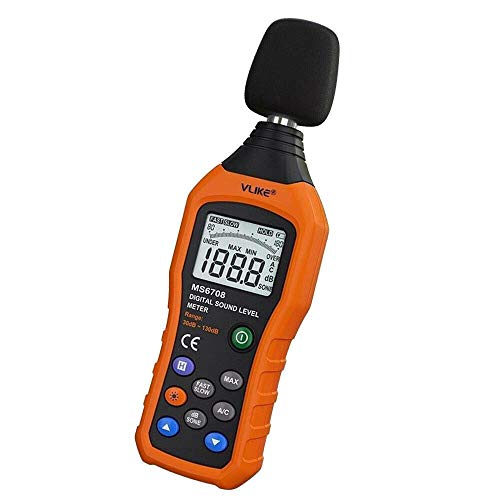
- Portable 30–130 dB measurement
- A/C mode and MAX locking
- Backlight with auto power-off
Best For: Handheld real-time noise checks
Best Classic Meter – Extech 407730 Digital Sound Level Meter
The Extech 407730 is a straightforward choice among digital sound level meters for users who want a familiar handheld design, an easy-to-read digital display, and quick visual feedback from its analog bar graph. It measures from 40 to 130 dB with 0.1 dB resolution and includes useful Max, Min, and Max Hold functions.
Best For: Routine sound checks, workshops, audio setups, and users who prefer a simple battery-powered meter.
Pros:
- Measures 40–130 dB with 0.1 dB resolution.
- Provides 2 dB accuracy and a fast analog bar graph.
- Records Max/Min values and includes Max Hold.
- Includes a microphone windscreen and four AAA batteries.
Cons:
- Its measurement range starts at 40 dB, higher than some alternatives.
- It uses replaceable batteries rather than a rechargeable battery.
Choose this Extech when dependable basic features matter more than advanced logging or specialized weighting options. Auto power-off also helps conserve battery life during routine use.
Best for Home Monitoring – FNIRSI FDM-02 Decibel Meter
The FNIRSI FDM-02 is one of the more versatile digital sound level meters for everyday monitoring at home or work. Its 2-inch IPS screen, rechargeable battery, A/C weighting, fast and slow response modes, and 30-second curve view make it useful for both quick checks and ongoing noise observation.
Best For: Parents, musicians, office workers, home-theater users, and anyone tracking changing noise levels.
Pros:
- Broad 30–130 dB measurement range with ±1.5 dB accuracy.
- Offers A/C weighting and Fast 125 ms or Slow 1 s response.
- Records high and low thresholds plus the 30 most recent alarms.
- Rechargeable 1500mAh battery and carrying case support portability.
Cons:
- Its alarm-history and curve features may be more than needed for occasional checks.
- The supplied notes do not specify an IEC accuracy class or calibration certificate.
This is a strong fit when you want more context than a single live dB reading. The display themes, curve mode, and alarm records make it especially practical for comparing rooms, appliances, speakers, or recurring neighborhood noise.
Best Professional Option – CRY2831 Class 2 Sound Level Meter
The CRY2831 is a professional-oriented option among digital sound level meters, combining IEC 61672-1:2013 Class 2 compliance with a wide 29–138 dB range. A/C/Z frequency weighting, Fast/Slow time weighting, an extended 20 Hz–12.5 kHz response, and a calibration certificate support more demanding acoustic and workplace checks.
Best For: Technicians, EHS teams, facility managers, inspectors, and industrial or environmental spot checks.
Pros:
- IEC 61672-1:2013 Class 2 design with calibration certificate.
- Measures 29–138 dB and covers 20 Hz–12.5 kHz.
- Provides A, C, and Z frequency weighting with Fast and Slow response.
- IP54 enclosure, AC/DC power, and operation from -20°C to 60°C.
Cons:
- Its professional feature set may be unnecessary for casual household readings.
- The supplied notes do not list data logging or computer connectivity.
For users who need standards-oriented measurements and broader configuration options, the CRY2831 is the most specialized choice here. Its rugged enclosure, wide range, and two-year warranty further support field use.
Best Budget-Friendly Choice – Tadeto Digital Sound Level Meter
The Tadeto SL720 is a practical entry-level pick among digital sound level meters for everyday environmental and equipment checks. It offers a 30–130 dB range, ±2.0 dB accuracy, 0.1 dB display resolution, A/C weighting, and selectable Fast or Slow response in a compact handheld format.
Best For: Home, office, factory, transportation, construction, and basic audio-system sound checks.
Pros:
- Measures 30–130 dB with stated ±2.0 dB accuracy.
- A/C weighting supports ambient and higher-intensity machine-noise checks.
- Fast 0.125-second and Slow 1-second response modes are available.
- Backlit LCD improves readability in darker locations.
Cons:
- It does not list a calibration certificate or professional measurement standard.
- Its alkaline battery power requires replacement batteries.
The Tadeto keeps the core controls simple while covering the sound levels most users encounter. It is a sensible choice when portability, a backlit display, and basic weighting modes matter more than advanced recording features.
Best Overall Accuracy – Protmex PT6708 Digital Sound Level Meter
The Protmex PT6708 is a practical choice among digital sound level meters for general environmental and equipment-noise checks. It measures 30–130 dB with ±1.5 dB accuracy and offers fast or slow response settings, A/C weighting, MAX, and data hold.
Best For: Home, office, school, workshop, factory, traffic, and audio noise measurements.
Pros:
- 30–130 dB range with 0.1 dB resolution and ±1.5 dB accuracy.
- Fast and slow response modes support changing or relatively stable noise levels.
- A/C weighting helps with ambient-noise and machine-sound measurements.
- Backlit display, anti-slip design, batteries included, and automatic backlight shutoff.
Cons:
- Cannot generate or retain measurement reports directly from the device.
- Its feature set is focused on handheld readings rather than computer-based logging.
Choose this meter if you want a straightforward, responsive handheld instrument with useful weighting and response controls. It is less suitable when exporting or archiving measurements is a priority.
Best for Simple Home Checks – TopTes TS-501B Digital Sound Level Meter
The TopTes TS-501B keeps digital sound level meter operation simple while covering common household and workplace needs. Its large backlit screen shows 30–130 dB readings, while A/C weighting, MAX/MIN values, and data hold add flexibility for comparing noise levels.
Best For: Home noise checks, noisy-neighbor monitoring, home theaters, offices, workshops, and factories.
Pros:
- Large 2.25-inch backlit LCD is designed for easy reading in dim conditions.
- Measures 30–130 dB with ±1.5 dB accuracy and 30–8000 Hz frequency coverage.
- A/C weighting, MAX/MIN readings, and data hold support different measurement tasks.
- Includes three AAA batteries, a user manual, and a carry case.
Cons:
- Provides handheld readings but does not list computer data logging or export features.
- Automatic power-off may interrupt extended measurements if not monitored.
This is a convenient pick for buyers who want an easy-to-read meter with core measurement features and portable accessories. Consider a data-logging model for long-term records or PC analysis.
Best for Data Logging – DANOPLUS DP-441 Digital Sound Level Meter
The DANOPLUS DP-441 stands out among digital sound level meters for recording and reviewing measurements over time. It stores up to 43,000 data points, connects to Windows PCs for Excel export and analysis, and adds adjustable alarms, chart views, A/C weighting, and fast/slow response modes.
Best For: Extended noise surveys, documented workplace checks, trend analysis, and users who need PC-exportable records.
Pros:
- Stores up to 43,000 readings and supports viewing or exporting data through a PC.
- Windows 7, 10, and 11 connectivity enables analysis and printing.
- Three-color alarm indicators provide customizable low-, medium-, and high-noise alerts.
- Rechargeable 1000mAh battery, colored screen, line chart, A/C weighting, and adjustable response speed.
Cons:
- PC connectivity and export features may be more than needed for occasional spot checks.
- The supplied notes specify Windows compatibility rather than support for other operating systems.
- Charging takes approximately 1.5 hours.
Select this model when measurement history matters as much as the live reading. Its logging, export, alarm, and display features make it the strongest fit for repeatable surveys and documented noise analysis.
Best Wall-Mount Display – SW-525A Sound Level Meter
The SW-525A is a practical choice among digital sound level meters when you want an always-visible reading. Its large red LCD display and automatic operation make it suited to monitoring noise levels without a complicated setup.
Best For: Wall-mounted or fixed-position noise monitoring in homes, offices, workshops, and similar spaces.
Pros:
- Large screen LCD display is easy to read.
- Measures sound from 30 to 130 dB.
- Automatic operation keeps monitoring straightforward.
- Wall-hanging design works well for fixed placement.
Cons:
- Its wall-hanging format is less convenient for handheld measurements.
- The supplied notes do not list data-hold, MAX/MIN, or backlight functions.
Choose this meter if visibility and simple continuous monitoring matter more than portability or advanced recording features. The large display is its main advantage for quick, at-a-glance checks.
Best Feature Set – RISEPRO HT-80A Decibel Meter
The RISEPRO HT-80A stands out among digital sound level meters for combining a broad 30–130 dB range with useful measurement controls. Its backlight, data hold, MAX/MIN readings, and automatic power-off support both routine checks and more demanding monitoring tasks.
Best For: Personal, business, study, and industrial noise checks where flexible readouts and stored high or low readings are useful.
Pros:
- Measures 30–130 dB with stated accuracy of ±1.5 dB.
- Offers FAST 125 ms time weighting and Type A frequency weighting.
- Includes data hold, MAX/MIN readings, backlight, and auto power-off.
- Compact 107 g design includes a carrying pouch and gift box.
Cons:
- The supplied notes do not specify a built-in report-generation feature.
- Its plastic construction may be less rugged than specialized professional equipment.
This is the strongest all-around option in the group when convenience features matter. The combination of accuracy, dual weighting controls, and MAX/MIN tracking gives it more flexibility than a basic display-only meter.
Best Portable Value – VLIKE VL6708 Sound Level Meter
The VLIKE VL6708 is a compact option among digital sound level meters for checking noise in places such as offices, schools, roads, factories, and homes. It provides A/C mode selection, a 30–130 dB range, backlighting, and a portable handheld design.
Best For: Portable real-time noise checks, including nighttime measurements and general household, workplace, or study use.
Pros:
- 30–130 dB measuring range with A/C mode selection.
- Backlight supports reading in darker conditions.
- Auto-ranging, MAX locking, and auto power-off are included.
- Mini handheld format has an anti-drop casing design.
Cons:
- Batteries are not included; it requires four AAA batteries.
- The device cannot keep or generate a report directly.
- The supplied notes do not state measurement accuracy.
The VL6708 makes sense for buyers who prioritize portability and basic versatility. It is well equipped for live readings, but users needing documented reports or specified accuracy should consider a more advanced meter.
How We Picked These Digital Sound Level Meters
We selected models that cover a useful range of real-world needs, from occasional home noise checks to repeated workplace measurements and recordkeeping. Our comparison emphasizes measurement range, A- and C-weighting, readability, data-hold and maximum/minimum functions, portability, power options, and documentation.
Where a product lists standards or calibration documentation, treat those details as important for compliance-related work, but verify the current certificate, stated accuracy, and intended application before relying on any meter for legal or formal reporting.
Quick Comparison
| Best For | Features to Prioritize | Models to Consider |
|---|---|---|
| Home and hobby testing | Simple controls, backlight, data hold | FNIRSI, RISEPRO, VLIKE |
| Workplace spot checks | A/C weighting, broad range, clear display | Extech, Protmex, TopTes |
| Formal or standards-focused work | Class rating, calibration documentation | CRY2831 |
| Long-term monitoring | Memory, export, rechargeable power | Data logger model |
| Visible or fixed-location alerts | Large display, alarm, wall-mount design | SW-525A |
Key Buying Factors for Digital Sound Level Meters
Measurement Range and Accuracy
A 30–130 dB range suits many everyday environments, while a 40–130 dB meter may be adequate for louder spaces. Accuracy specifications matter more than an impressive maximum reading, especially when comparing measurements across locations or over time.
A/C Weighting
A-weighting approximates human hearing and is common for environmental and workplace noise checks. C-weighting captures more low-frequency sound and can be useful around machinery, music, engines, or bass-heavy noise. Choose a meter offering both when your use is varied.
Logging, Memory, and Data Export
Data hold and maximum/minimum readings are useful for quick inspections. For recurring surveys, choose a model with substantial memory, timestamps, and computer export. A logger can save time and provide a record that handheld readings cannot.
Display and Handling
Backlighting helps in dim rooms, while a large screen is helpful when the meter is mounted or held at arm’s length. Also check button layout, microphone placement, tripod compatibility, battery type, auto shutoff, and windscreen availability.
Calibration and Standards
For compliance, occupational safety, or professional documentation, look beyond the product name. Check whether the meter states a recognized class or standard, includes calibration information, and supports periodic verification with a compatible acoustic calibrator.
Who Should Buy Which Digital Sound Level Meters?
For occasional household troubleshooting, renovation checks, classroom use, or hobby projects, a compact backlit meter with hold and maximum readings is usually sufficient. Buyers who need straightforward workplace or equipment checks should favor A/C weighting, a clear display, and a dependable operating range.
Choose the data-logging model if you need to document noise over extended periods or export results. Select the Class 2 option when stated standards and calibration documentation are central to your workflow. For a fixed display or alarm-oriented setup, the wall-hanging design is the more practical choice.
Finally, remember that these instruments measure sound pressure at the microphone position. Use a windscreen outdoors, hold the meter away from reflective surfaces, allow readings to stabilize, and follow the manufacturer’s instructions for the most consistent results.