Choosing among digital moisture balances means comparing more than capacity and display resolution. Heating control, repeatability, workflow features, and data connectivity can have a bigger effect on daily testing.
This roundup compares 10 moisture analyzers across different precision levels, drying ranges, interfaces, and operating styles so you can match the instrument to your samples, throughput, and budget.
Best 10 Digital Moisture Balances Picks for 2026
Best All-Around Digital Moisture Balance
120g Halogen Moisture Analyzer
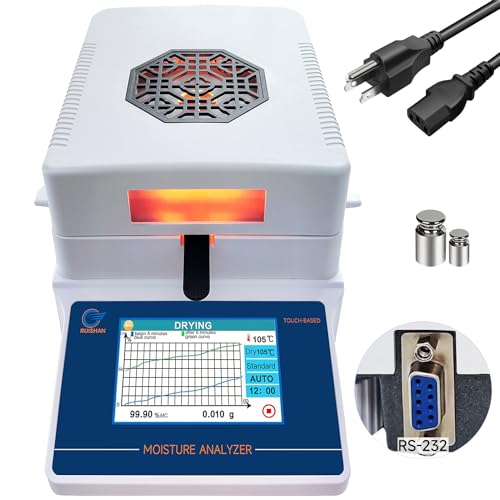
- 50–180°C halogen heating with three drying modes
- Stores up to 32 methods and supports RS232 output
- Includes pans, calibration weights, and handling tools
Best For: Flexible lab and production moisture testing
Best Premium Touchscreen Digital Moisture Balance

- 4.3-inch TFT color touchscreen interface
- 90 g capacity with 0.01% readability
- Custom heating system and stated warranty
Best For: Food, pharmaceutical, and chemical laboratories
Best Compact OHAUS Digital Moisture Balance

- 90 g capacity for routine sample testing
- 1 mg readability specification
- Compact 5 x 4 x 3 inch listed dimensions
Best For: Space-conscious routine moisture measurements
Best Data-Ready Digital Moisture Balance
GS110 Halogen Moisture Analyzer

- 40–160°C adjustable heating and 1–99 minute timing
- Stores 20 historical results with printer connectivity
- Includes 20 pans and a 100 g calibration weight
Best For: Documented, repeat moisture testing across materials
Compact Graphing Pick

- 0.01% moisture readability with 120 g capacity
- Four drying profiles and 20 memory locations
- USB connectivity for PC data analysis
Best For: Compact routine powder testing with saved methods
Touchscreen Precision Choice

- 0.001 g weighing precision and 0.01% moisture precision
- 40–180°C heating range with three operating modes
- 34 memory programs and RS232 connectivity
Best For: Flexible lab and quality-control testing
Data-Management Heavyweight

- 0.01% moisture readability with 120 g capacity
- Stores methods, results, and 2,000 audit records
- Touchscreen, automatic testing, graphs, and RS232
Best For: Traceable laboratory and quality-control workflows
Precision Lab Pick
UXILAII 110g Halogen Moisture Analyzer

- 0.001 g weight and 0.01% moisture readability
- 32 stored methods with RS232 connectivity
- 5-inch touchscreen and three drying modes
Best For: Research and quality-control laboratories
High-Throughput Value
U.S. Solid 110g Moisture Analyzer
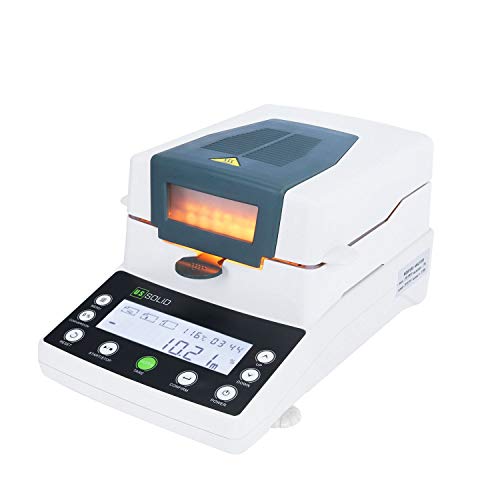
- 5 mg weight and 0.1% moisture readability
- 50 sample pans included
- Stores 15 methods and supports RS232 export
Best For: Routine food, grain, and chemical testing
Data Management Choice
120g Touchscreen Moisture Analyzer
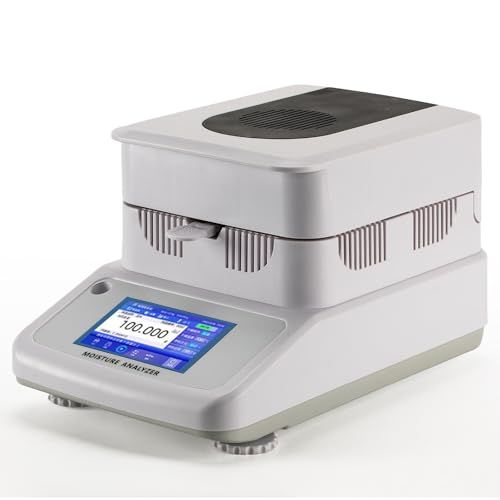
- 120 g capacity with 0.002 g readability
- Stores up to 100 test records
- Four drying programs and RS232 output
Best For: Laboratory and industrial data-driven testing
Best All-Around Digital Moisture Balance – 120g Halogen Moisture Analyzer
For buyers who want flexible digital moisture balances with fast testing and straightforward controls, this model combines a 5-inch touchscreen with halogen heating from 50–180°C. Its multiple drying modes, method storage, and broad sample compatibility make it a practical option for varied lab and production testing.
Best For: Laboratories and small production settings testing food, grain, wood, soil, paper, textiles, and other materials.
Pros:
- Offers standard, fast, and soft drying modes plus automatic or timed operation.
- Stores up to 32 research methods for repeat testing.
- Supports RS232 data output to a printer or computer.
- Includes sample pans, calibration weights, a pan holder, and sample remover.
Cons:
- Its 120 g capacity and 0.01 g readout may not suit applications requiring finer readability.
- The unit weighs 3.3 kg, so it is better suited to a fixed workspace than frequent transport.
This is a strong value-oriented choice when you need adaptable heating, stored methods, and included accessories in one digital moisture balance. The touchscreen and RS232 connection also make routine testing and record handling more convenient.
Best Premium Touchscreen Digital Moisture Balance – OHAUS MB90 Moisture Analyzer
The OHAUS MB90 is a digital moisture balance for users who prioritize an intuitive touchscreen interface and a custom heating system. With 90 g capacity and 0.01% readability, it is designed for controlled moisture analysis in laboratory applications.
Best For: Food, pharmaceutical, and chemical testing where touchscreen operation and percentage readability are priorities.
Pros:
- Uses a custom heating system for moisture analysis.
- Features an intuitive 4.3-inch TFT color touchscreen.
- Provides 90 g capacity with 0.01% readability.
- Includes a warranty according to the supplied product notes.
Cons:
- Its 90 g capacity is lower than some higher-capacity alternatives.
- The supplied notes provide limited information about connectivity, included accessories, and drying settings.
The MB90 is a focused choice for laboratories seeking a recognizable OHAUS instrument with a clear color touchscreen and specified percentage readability. Consider it when interface simplicity matters more than maximum sample capacity or extensive listed accessories.
Best Compact OHAUS Digital Moisture Balance – OHAUS MB27 Moisture Analyzer
The OHAUS MB27 is a compact digital moisture balance offering 90 g capacity and 1 mg readability. Its straightforward specification makes it worth considering for buyers who need a small-footprint moisture analyzer for routine measurements.
Best For: Users seeking a compact OHAUS moisture analyzer with 90 g capacity and milligram readability.
Pros:
- Provides 90 g sample capacity.
- Offers 1 mg readability.
- Compact listed dimensions of 5 x 4 x 3 inches.
- Comes from the OHAUS MB27 product line.
Cons:
- The supplied notes do not specify heating range, drying modes, display type, or data connectivity.
- Accessory and warranty details are not provided in the supplied information.
The MB27 may suit buyers who value a compact form factor and clear capacity/readability specifications. Because the available details are limited, confirm the included equipment and operating features before choosing it for a specialized workflow.
Best Data-Ready Digital Moisture Balance – GS110 Halogen Moisture Analyzer
This GS110 digital moisture balance is built for rapid, repeatable testing, using halogen heating from 40–160°C and real-time weight monitoring. Its historical-data storage, printer interface, and included pans make it a practical fit for labs and production environments that need documented results.
Best For: Food, plant, grain, construction-material, soil, wood, paper, and textile testing with frequent recordkeeping.
Pros:
- Adjusts temperature from 40–160°C in 1°C increments and heating time from 1–99 minutes.
- Stores up to 20 sets of historical data.
- Includes a printer interface with adjustable baud rates.
- Package includes 20 aluminum pans, a calibration weight, wind cover, and handling accessories.
Cons:
- Its 5 mg readability is less fine than models offering 1 mg or 0.001 g readability.
- The supplied notes do not identify the exact display size or provide a detailed capacity specification beyond the product title.
The GS110 stands out for practical workflow support: adjustable heating, automatic monitoring, stored results, and printer connectivity. It is especially appealing when fast moisture determination and organized documentation are more important than the finest available readability.
Compact Graphing Pick – ATS120 Moisture Analyzer
The ATS120 is a compact option for measuring moisture content when you want straightforward operation, repeatable settings, and computer connectivity. Its 0.01% moisture readability, 120 g capacity, and four drying modes make it a practical choice among digital moisture balances for routine powder testing.
Best For: Laboratories and production settings that need a compact analyzer with customizable drying profiles and USB data collection.
Pros:
- Offers Standard, Slow, Step, and Fast drying profiles.
- Stores up to 20 custom parameter sets for repeat testing.
- USB interface supports PC data collection, plotting, and analysis.
- Compact design with a backlit graphical LCD display.
Cons:
- Maximum drying temperature is 160°C, below some competing models’ ranges.
- Its 120 g capacity and 0.001 g weighing resolution may not suit every application.
The ATS120 emphasizes compactness and workflow convenience rather than extensive touchscreen or audit-trail features. Its saved methods and USB interface are useful when consistent test procedures and PC-based reporting matter.
Touchscreen Precision Choice – FLB Halogen Moisture Analyzer
The FLB combines 0.001 g weighing precision with halogen heating and a 5-inch touchscreen. For buyers comparing digital moisture balances, its 40–180°C range, three operating modes, and RS232 connectivity support flexible testing in food, agriculture, chemical, and pharmaceutical environments.
Best For: Laboratories and quality-control teams that want touchscreen operation, programmable methods, and printer or computer connectivity.
Pros:
- Provides a 110 g capacity with 0.001 g weighing precision and 0.01% moisture precision.
- Offers manual, automatic, and timed operation with gentle and rapid drying options.
- Stores 34 programmable memory programs.
- Includes RS232 connectivity, multilingual menus, pre-calibration, and CE certification.
Cons:
- Its 110 g capacity is lower than some 120 g alternatives.
- The unit is a relatively heavy 11-pound desktop instrument.
- It is designed for 110V power.
The FLB is a well-rounded desktop analyzer for users who value accessible controls and repeatable laboratory workflows. Its broad heating range and saved programs add flexibility, while RS232 provides a direct route for reporting and data transfer.
Data-Management Heavyweight – Halogen Moisture Analyzer
This halogen analyzer is built for users who need detailed measurement records alongside 0.01% moisture readability. With a 120 g capacity, 40–180°C heating range, touchscreen controls, and extensive storage, it stands out among digital moisture balances for structured laboratory and quality-control workflows.
Best For: Research, inspection, education, and production environments that need stored methods, audit tracking, automatic testing, and RS232 reporting.
Pros:
- Provides 0.001 g weighing readability, 0.01% moisture readability, and 120 g capacity.
- Includes standard, fast, and soft drying modes with programmable stop criteria.
- Can store 100 test methods, 100 moisture results and averages, and up to 2,000 audit-tracking records.
- Offers a 5-inch color touchscreen, real-time graphs, automatic testing, and RS232 connectivity.
Cons:
- Weight calibration is required before testing.
- The heating device and container become very hot after use, requiring careful handling.
- Some expanded data functions, such as USB tracking, are described as optional.
The analyzer’s strongest advantage is its combination of automated testing and deep data storage. It is a better fit for organizations that need traceability and detailed result management than for users seeking only basic moisture readings.
Precision Lab Pick – UXILAII 110g Halogen Moisture Analyzer
For labs comparing digital moisture balances, the UXILAII stands out with 0.001 g weight readability, 0.01% moisture readability, and a 450 W halogen heater. Its touchscreen controls and stored methods make repeat testing straightforward.
Best For: Food, agriculture, chemical, and pharmaceutical laboratories that need detailed control and RS232 data export.
Pros:
- Offers three drying modes and three ending modes for flexible testing.
- Stores up to 32 research methods for repeat measurements.
- Includes a 5-inch color touchscreen, calibration weights, and four language options.
Cons:
- The heating unit and sample container become hot after testing.
- Calibration with weights is required before testing.
Choose this model if fine readability, touchscreen operation, and method storage matter more than a compact handheld design. The aluminum enclosure and multi-story heating chamber are practical for regular laboratory use.
High-Throughput Value – U.S. Solid 110g Moisture Analyzer
This U.S. Solid model is a practical choice among digital moisture balances for routine food, grain, chemical, and laboratory testing. It combines 5 mg weight readability with 0.1% moisture readability and includes 50 sample pans for repeated work.
Best For: Testing environments that value quick halogen drying, simple result reporting, and a generous supply of included sample pans.
Pros:
- 450 W halogen heating adjusts up to 199°C and offers standard, fast, and soft modes.
- Displays moisture percentage, dry weight, or dry-weight percentage.
- Stores up to 15 preset methods and exports data through RS232.
- Includes 50 sample pans and a 100 g calibration weight is used for manual calibration.
Cons:
- Its 0.1% moisture readability is less fine than some competing models.
- Calibration is manual rather than described as automatic.
The main appeal is workflow efficiency: multiple reporting views, method storage, fast heating, and 50 included pans support recurring tests without many add-ons. It is a sensible fit when 0.1% moisture readability meets your requirements.
Data Management Choice – 120g Touchscreen Moisture Analyzer
For buyers seeking digital moisture balances with built-in recordkeeping, this 120 g halogen analyzer offers a useful combination of precision and data management. It provides 0.002 g weight readability, 0.01% moisture readability, and storage for up to 100 test records.
Best For: Laboratory and industrial users who need flexible drying programs, touchscreen operation, and an internal database for recurring tests.
Pros:
- Uses a 450 W halogen lamp and PT-100 sensor for rapid, controlled analysis.
- Offers standard, mild, fast, and slow drying programs from 40–180°C.
- Stores up to 100 records and supports moisture, solid-content, and moisture-regain conversions.
- Includes RS232 output, calibration weight, sample tray, windproof cover, and stylus.
Cons:
- The package includes one sample tray rather than the larger pan quantity supplied with some alternatives.
- An external printer is optional rather than included.
This model is the strongest fit when internal data storage and selectable heating profiles are central to your workflow. Its larger 120 g capacity also gives it a slight advantage for users handling bigger samples.
How We Picked These Digital Moisture Balances
We focused on the specifications that most directly affect moisture-testing work: maximum sample capacity, readability, temperature range, halogen heating, drying modes, display design, connectivity, and included accessories. The selection includes compact instruments for routine checks, higher-resolution models for laboratory work, and systems with touchscreens, databases, or RS232/USB interfaces for documented workflows.
Because advertised accuracy and repeatability can vary by sample type and test method, treat resolution as a comparison point rather than a guarantee of real-world performance. Your sample preparation, drying program, calibration routine, and environmental conditions all influence results.
Quick Comparison
| Feature | What to compare | Why it matters |
|---|---|---|
| Capacity | 90g to 120g class | Determines the largest usable sample and container load. |
| Readability | 0.001g, 0.002g, or 0.005g | Indicates how finely the balance displays weight changes. |
| Moisture display | 0.01% or 0.1% | Useful for setting reporting and process-control expectations. |
| Heating | Halogen, approximately 40–160°C or wider | Affects drying speed and method flexibility. |
| Connectivity | USB, RS232, or none listed | Supports records, printing, and integration with a workstation. |
Key Buying Factors for Digital Moisture Balances
Capacity and Readability
Choose enough capacity for the sample pan and typical test portion without operating near the limit. A 0.001g readability model is better suited to fine mass changes, while 0.005g instruments may be adequate for screening, production checks, or less demanding materials.
Temperature Control and Drying Programs
Halogen heating can shorten test times, but the correct temperature profile depends on the material. Look for adjustable ranges, timed or automatic shutoff, and multiple drying modes when testing products with different moisture-release behavior. A wider range is not automatically better if the controls are difficult to reproduce.
Repeatability, Calibration, and Usability
Prioritize clear prompts, a stable pan, simple tare operation, and accessible calibration procedures. A graphical display or touchscreen can speed setup, while physical controls may be preferable in dusty or glove-heavy environments. Verify that the instrument supports your preferred calibration weights and routine checks.
Data Handling and Included Accessories
USB or RS232 connectivity is valuable when results must be exported, printed, or attached to quality records. Check whether cables, software, sample dishes, and protective covers are included. Accessories can materially change the total cost of ownership.
Who Should Buy Which Digital Moisture Balances?
- For routine production checks: Choose a straightforward 110g–120g analyzer with 0.005g readability if speed and simplicity matter more than maximum resolution.
- For laboratory and formulation work: Consider a 0.001g model with adjustable heating, repeatable programs, and a documented calibration process.
- For connected workflows: Select a unit with USB or RS232, and confirm compatibility with your printer, computer, or laboratory information system before buying.
- For frequent multi-method testing: Favor models with several drying modes, memory or database functions, and a clear graphical interface.
- For budget-conscious screening: A compact halogen moisture analyzer can provide rapid comparative results, provided its stated capacity, readability, voltage, and temperature range fit your method.
Finally, confirm the required power supply, pan size, warranty, replacement parts, and service support. The best Digital Moisture Balances are those that deliver repeatable results within your validated method while fitting naturally into your team’s daily workflow.