The best digital anemometers make it easier to measure wind speed, airflow, temperature, and—in some cases—heat stress without relying on guesswork. The right model depends on whether you need a simple handheld gauge, duct-access capability, data logging, or app-based reporting.
We compared ten options across measurement functions, display usability, portability, connectivity, and practical HVAC and outdoor applications. Use the guide below to narrow the list by accuracy needs, workflow, and budget.
Best 10 Digital Anemometers Picks for 2026
Best Pocket-Friendly Pick
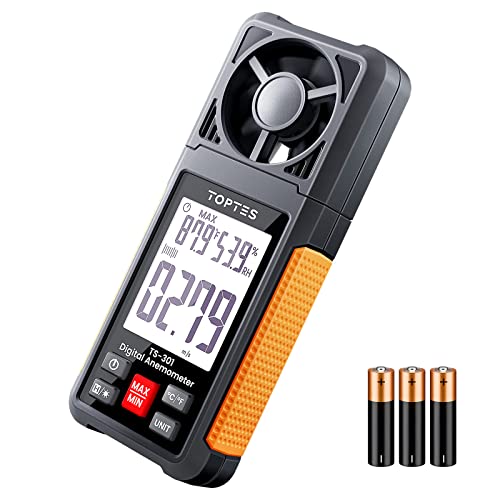
- Large 2.26-inch backlit display
- Six wind-speed measurement units
- Measures temperature and humidity
Best For: Portable outdoor and basic household airflow checks
Best for HVAC Data Logging

- Stores 600 groups of readings
- Calculates CFM and CMM airflow
- Separated extendable sensor
Best For: HVAC balancing and documented airflow testing
Best Connected HVAC Anemometer
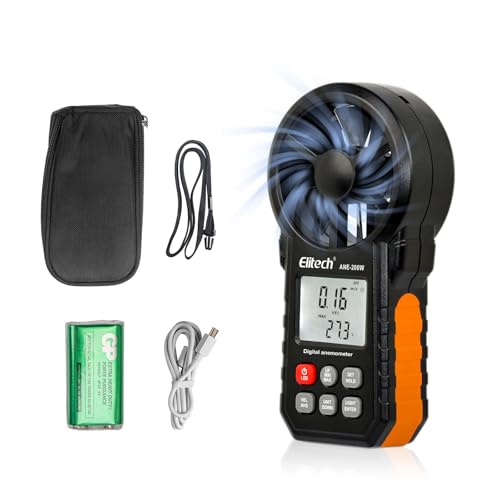
- Bluetooth app monitoring
- USB export to Excel
- Includes airflow, temperature, and wind readings
Best For: Connected HVAC testing and professional data reporting
Best for Light Airflow Checks

- Sensitive eight-blade impeller
- MAX, MIN, and AVG readings
- Tripod mount for hands-free checks
Best For: HVAC vents and changing outdoor wind conditions
Best Professional HVAC Pick
testo 405i Smart Probe Anemometer

- Hot-wire readings for velocity, temperature, and airflow
- 15-inch telescopic shaft reaches confined ducts
- Bluetooth app supports graphs, storage, and reports
Best For: Professional HVAC inspections and in-duct measurements
Best Simple Multipurpose Meter
Mcbazel 3-in-1 Handheld Anemometer

- Measures speed, temperature, and Beaufort level
- Offers five wind-speed measurement units
- Backlit display includes MAX/MIN/AVG and hold
Best For: Portable HVAC, sailing, fishing, and general wind checks
Best Bluetooth Data Logging Value
BT-100APP Bluetooth Anemometer

- Measures speed, temperature, and wind chill
- Logs and exports readings through a Bluetooth app
- Tripod mount supports continuous testing
Best For: App-based HVAC, weather, sailing, and outdoor measurements
Best Heat-Stress Monitor
Multifunctional WBGT Anemometer

- Measures wind, temperature, humidity, and WBGT
- Includes alarms and indoor/outdoor WBGT modes
- Supports MAX/MIN readings and five air-velocity units
Best For: Heat-stress monitoring and HVAC checks
Best Simple 3-in-1 Meter

- Measures wind speed, temperature, and wind level
- Covers 0.06 to 30.0 m/s
- Includes MAX/MIN/AVG, hold, backlight, and auto-off
Best For: Basic HVAC and outdoor wind measurements
Best for HVAC Airflow

- Designed for HVAC and duct airflow measurements
- Includes tripod mounting and wind-chill readings
- Comes with case, strap, manual, and AAA batteries
Best For: HVAC checks and hands-free airflow testing
Best Pocket-Friendly Pick – TopTes TS-301
The TopTes TS-301 is a practical choice among digital anemometers for quick wind checks, recreational use, and basic airflow testing. Its large backlit display, six selectable wind-speed units, and compact design make readings easy to take indoors or outdoors.
Best For: Outdoor enthusiasts, drone pilots, sailors, golfers, and homeowners checking basic HVAC airflow.
Pros:
- Large 2.26-inch backlit LCD screen is easy to read.
- Measures wind speed in six units, including mph, knots, and m/s.
- Also measures temperature and relative humidity.
- Includes three AAA batteries, a carry pouch, and a three-year warranty.
Cons:
- Temperature and humidity sensors may need at least 30 minutes to adjust to a new environment.
- Automatic shutoff occurs after 10 minutes of inactivity.
The TS-301 stands out for portability and straightforward operation. It is a good fit when you want an easy-to-carry wind meter with added temperature and humidity readings rather than advanced data logging.
Best for HVAC Data Logging – Por CFM BT-846A
The Por CFM BT-846A is one of the more feature-focused digital anemometers for HVAC troubleshooting and airflow balancing. It combines a wide wind-speed range with CFM/CMM calculations, a separated extendable sensor, and storage for 600 measurement groups.
Best For: HVAC technicians and users who need stored readings, airflow calculations, or PC-exportable measurement records.
Pros:
- Measures wind speed, temperature, and airflow in CFM or CMM.
- Stores up to 600 groups of data and supports export to a PC.
- Extendable separated sensor helps with vents, registers, and dust-collection systems.
- Provides current, maximum, minimum, average, and 2/3 maximum readings.
Cons:
- Heavier than the other listed handheld models at 1.7 pounds.
- Automatic power-off occurs after five minutes without operation unless changed to manual mode.
For professional airflow work, the BT-846A offers useful measurement management that simpler wind meters lack. Its data storage and export features are especially helpful when documenting HVAC tests over time.
Best Connected HVAC Anemometer – Elitech ANE-200W
The Elitech ANE-200W brings app and computer connectivity to digital anemometers used for HVAC and environmental measurements. It measures wind velocity, airflow, and temperature while supporting Bluetooth monitoring, USB data export, and multiple analysis modes.
Best For: HVAC professionals who want connected monitoring, data logging, and report-ready measurement exports.
Pros:
- Measures wind velocity, airflow in CFM/CMM, and temperature.
- Bluetooth app supports real-time monitoring and data curves.
- USB-connected PC software supports logging, analysis, and Excel export.
- Includes a backlit display, LED work light, data hold, and AVG/MAX/MIN modes.
Cons:
- Its connected features may be more than needed for simple spot checks.
- The supplied notes do not specify a warranty or included accessories beyond the anemometer.
The ANE-200W is the strongest option here for users who need more than an on-screen reading. Bluetooth and USB workflows make it well suited to repeated HVAC measurements and professional documentation.
Best for Light Airflow Checks – HoldPeak 866B
The HoldPeak 866B is a practical option among digital anemometers for checking light airflow at HVAC vents and monitoring changing outdoor wind. Its eight-blade impeller, backlit display, MAX/MIN/AVG functions, and tripod mount support both quick checks and longer measurements.
Best For: Home HVAC checks, outdoor wind monitoring, drone or sailing preparation, and hands-free tripod measurements.
Pros:
- Measures wind speeds from 0.67 to 67.1 mph with listed ±5% accuracy.
- Eight-blade impeller responds to light airflow.
- Provides MAX, MIN, and AVG readings plus wind chill.
- Includes backlight, non-slip grips, wrist strap, carrying case, and tripod compatibility.
Cons:
- Tripod is not included.
- Its stated wind-speed accuracy is ±5%, so it is aimed more at practical checks than highly precise measurement.
The 866B balances useful HVAC and outdoor functions in a compact handheld meter. The tripod mount is a helpful advantage when you need consistent readings without holding the device throughout the test.
Best Professional HVAC Pick – testo 405i Smart Probe Anemometer
For HVAC inspections and in-duct measurements, the testo 405i is one of the more specialized digital anemometers in this roundup. Its hot-wire sensor measures air velocity and temperature, while the extendable telescopic shaft helps reach vents, ducts, and other confined spaces.
Best For: HVAC technicians and professionals who need app-connected airflow measurements in hard-to-reach ducts and vents.
Pros:
- Measures air velocity, temperature, and in-duct airflow, with volume-flow calculations when duct dimensions are entered.
- Hinged telescopic shaft extends up to 15 inches for difficult-to-access measurement points.
- Bluetooth connectivity and the Smart Probe App support remote readings, graphs, data storage, and custom reports.
- Compact, lightweight design is practical for regular HVAC servicing.
Cons:
- App operation requires a compatible smartphone or tablet.
- Its professional HVAC focus may be more capability than casual outdoor users need.
The 405i stands out when duct access and documented measurements matter. It includes three AAA batteries and a certificate of conformity, making it a well-equipped choice for professional inspections.
Best Simple Multipurpose Meter – Mcbazel 3-in-1 Handheld Anemometer
The Mcbazel is a straightforward option among digital anemometers for users who want wind speed, temperature, and Beaufort readings in one portable device. Its backlit double-line display and multiple unit options make it suitable for both indoor checks and outdoor activities.
Best For: HVAC users, sailors, anglers, and hobbyists who want an easy-to-read handheld wind meter with basic data functions.
Pros:
- Measures wind speed, wind temperature, and Beaufort scale level.
- Supports m/s, km/h, knots, ft/s, and mph for flexible reporting.
- Displays speed and temperature together, with backlight, data hold, and MAX/MIN/AVG functions.
- Lightweight ABS construction and auto power-off make it convenient to carry and use.
Cons:
- AAA batteries are required but are not included.
- It does not list Bluetooth connectivity or app-based data logging.
Choose the Mcbazel when quick, readable wind measurements are more important than advanced connectivity. The Beaufort-scale display is especially useful for outdoor users who want an additional interpretation of wind conditions.
Best Bluetooth Data Logging Value – BT-100APP Bluetooth Anemometer
The BT-100APP combines handheld measurements with Bluetooth app support, making it a flexible choice among digital anemometers for HVAC checks and outdoor activities. It measures wind speed, temperature, and wind chill, while its logging and export features help users review readings later.
Best For: Users who want Bluetooth data logging for HVAC airflow checks, weather observations, sailing, or other outdoor activities.
Pros:
- Measures wind speed in five units plus temperature and wind chill.
- Offers MAX/MIN/AVG readings, data hold, backlighting, and adjustable auto-off settings.
- Bluetooth app can log and export data to Excel or TXT files.
- Tripod mounting and sensitivity to low airflow support continuous or HVAC testing.
Cons:
- Airflow in CFM must be calculated manually using velocity and duct area.
- Bluetooth app use adds setup requirements compared with a basic standalone meter.
- Temperature measurement range is limited to -10° to 45°C.
The BT-100APP is a strong fit when data capture matters as much as the live reading. Its tripod mount and exportable logs add useful flexibility for repeated testing, while the compact 155-gram design remains easy to carry.
Best Heat-Stress Monitor – Multifunctional WBGT Anemometer
For buyers who need more than basic wind readings, this digital anemometer combines airflow measurement with ambient temperature, humidity, black globe temperature, and WBGT monitoring. It covers wind speeds from 0 to 30 m/s and includes indoor and outdoor WBGT modes.
Best For: Heat-stress monitoring, HVAC checks, outdoor activities, and environments such as boiler rooms, mining areas, or training grounds.
Pros:
- Measures wind speed, temperature, humidity, and WBGT in one handheld unit.
- Offers MAX/MIN readings, data hold, backlighting, and multiple air-velocity units.
- Includes WBGT alarms and switchable Celsius/Fahrenheit temperature readings.
- Comes calibrated with a one-year warranty and lifetime technical support.
Cons:
- Its specialized WBGT features may be unnecessary for buyers seeking only wind speed.
- Requires a 9V battery.
The BT-881W is the most versatile option here for assessing both airflow and heat conditions. Choose it when humidity and heat-index data matter as much as wind speed.
Best Simple 3-in-1 Meter – Soonkoda Handheld Anemometer
This digital anemometer is a straightforward choice for measuring wind speed, wind temperature, and wind level. Its 0.06 to 30.0 m/s range, Beaufort scale, and dual-line display make it useful for quick readings in the field or around ventilation equipment.
Best For: HVAC work, duct ventilation, sailing, surfing, fishing, flying, and other outdoor activities requiring basic wind information.
Pros:
- Combines wind speed, wind temperature, and Beaufort wind level measurements.
- Measures wind speed in five units, including m/s, km/h, knots, ft/s, and mph.
- Provides MAX, MIN, AVG, data hold, backlight, and auto power-off functions.
- Displays wind speed and temperature simultaneously on its dual-line LCD.
Cons:
- The supplied notes do not specify accuracy or battery details.
- It lacks the humidity and WBGT measurements found on more advanced meters.
The Soonkoda focuses on the core readings many users need without adding heat-stress features. It is a practical fit when wind level and temperature are useful alongside speed.
Best for HVAC Airflow – BT-100 CFM Anemometer
The BT-100 is a digital anemometer aimed at detailed airflow work, with wind speed, wind temperature, and wind-chill readings. Its eight-vane design and two temperature sensors are intended to help detect low airflow in HVAC installations and duct vents, while a tripod mount supports hands-free measurements.
Best For: HVAC airflow checks, duct measurements, CFM calculations, drone or RC activities, and outdoor wind testing.
Pros:
- Measures wind speed from 0.67 to 67.1 mph with a stated accuracy of ±2% of readings.
- Provides five speed units plus Celsius/Fahrenheit temperature readings.
- Includes wind chill, a tripod thread, backlit display, and manual or automatic power-off.
- Comes with a case, neck strap, instruction manual, and two AAA batteries.
Cons:
- Its listed wind-speed range starts at 0.67 mph, rather than zero.
- It does not measure humidity or WBGT.
- The plastic body may be less rugged than a metal-bodied instrument.
With its tripod socket, low-airflow sensitivity, and CFM-oriented design, the BT-100 is especially useful for ventilation work. It also remains portable enough for shooting, sailing, and drone-related checks.
How We Picked the Best Digital Anemometers
We focused on features that affect real-world measurements rather than marketing claims alone. The comparison considers wind-speed and airflow modes, temperature readings, CFM capability, display readability, portability, data storage, Bluetooth connectivity, probe design, and suitability for HVAC or outdoor use.
Models with specialized features—such as telescopic shafts, app support, PC export, or WBGT readings—are evaluated for the situations where those extras provide a meaningful advantage. We also considered ease of handling for quick spot checks, since a technically capable meter is less useful if it is awkward to position or read.
Quick Comparison
| Best For | Features to Prioritize |
|---|---|
| Basic wind checks | Clear backlit display, compact body, and selectable units |
| HVAC diagnostics | Airflow and CFM modes, temperature measurement, and a suitable probe |
| In-duct measurements | Telescopic shaft or remote sensor access |
| Recorded reports | Data logging, PC export, or Bluetooth app connectivity |
| Heat-stress monitoring | WBGT and ambient-temperature measurements |
| Sports and recreation | Fast response, simple controls, and easy portability |
Key Buying Factors for Digital Anemometers
Measurement Modes and Range
Confirm that the meter supports the measurement you actually need. Wind speed is enough for sailing, flying, and general weather checks, while HVAC work usually benefits from airflow, CFM, and temperature modes. Check the stated range and resolution if you need to measure very light airflow or strong outdoor wind.
Probe Design and Placement
A standard handheld sensor works well for open-air readings, but ducts, vents, and hard-to-reach grilles may require an extended or telescoping probe. Consider whether the sensor can be positioned without blocking the airflow or putting your hands near hot, cold, or moving equipment.
Data Handling and Connectivity
For occasional checks, an on-screen reading may be all you need. Logging, PC export, or Bluetooth can be valuable for commissioning, maintenance records, and repeated measurements. App-connected models may also simplify saving or sharing results, but they add setup and battery considerations.
Display, Controls, and Durability
A backlit screen helps in dim mechanical rooms and outdoors. Look for intuitive unit selection, a hold function, maximum or average readings, and an automatic shutoff that will not interrupt longer tests. For field use, assess the body, sensor protection, battery access, and resistance to dust or splashes.
Who Should Buy Which Digital Anemometers?
Choose a straightforward handheld model if you mainly check wind for recreation, drones, shooting, fishing, or general weather observation. HVAC technicians should favor units with airflow and temperature functions, while users working inside ducts should look for a telescopic probe.
Pick a logging or PC-connected meter when you need documentation across multiple locations. Bluetooth models suit technicians who prefer reviewing readings on a phone. If workplace heat exposure is the concern, a dedicated WBGT-capable meter is a better fit than a basic wind-speed gauge. Before buying, verify the required units, measurement range, and included accessories so the meter matches your workflow.