The best beginner physics experiment sets turn abstract ideas into hands-on discoveries. With the right kit, children and students can explore motion, electricity, magnetism, light, and simple machines through guided activities rather than textbook explanations alone.
This roundup compares 10 options across different ages, topics, and levels of complexity, so you can choose a set that matches the learner’s interests, supervision needs, and STEM goals.
Best 10 Beginner Physics Experiment Sets Picks for 2026
Best Hands-On Motion Builder
Physics Laws: Inertia, Friction & Circular Motion

- Build six working motion-themed models
- Includes theory, experiments, and a quiz
- Interactive 3D app supports virtual building
Best For: Construction-focused STEM learning about motion
Best Optics Demonstration Set
Physics Optical Experiment Set

- Explores reflection and refraction
- Includes lenses, mirrors, prism, and light source
- Recommended for ages 14 and up
Best For: Focused hands-on learning about light and optics
Best Broad Science Variety

- Includes up to 150 science activities
- Covers physics, chemistry, and earth science
- Includes tools, materials, goggles, and manual
Best For: Families wanting varied at-home science activities
Best for Simple Machines

- Build 26 models using simple machines
- Includes a force-measuring spring scale
- Recommended for ages 8 and up
Best For: Hands-on learning about levers, pulleys, and force
Best All-Around Electricity Kit
Teenii Electricity and Magnetism Kit

- 18 hands-on electricity and magnetism experiments
- Includes meters, motors, magnets, switches, and bulbs
- 40-page full-color manual for guided learning
Best For: Children ages 8–18 learning circuits and electromagnetism
Best Magnet-Focused Starter
T&K Magnetic Science Physics Set
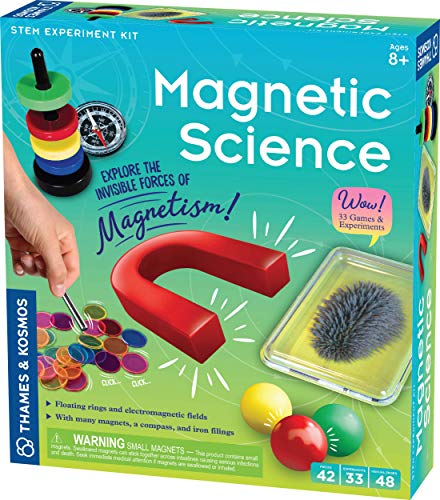
- 33 experiments and games for hands-on learning
- Explores magnetic fields and electromagnets
- Includes a 60-page full-color manual
Best For: Ages 8–15 beginning with magnetism
Best for Structured Circuit Labs
EUDAX Basic Electricity and Magnetism Kit
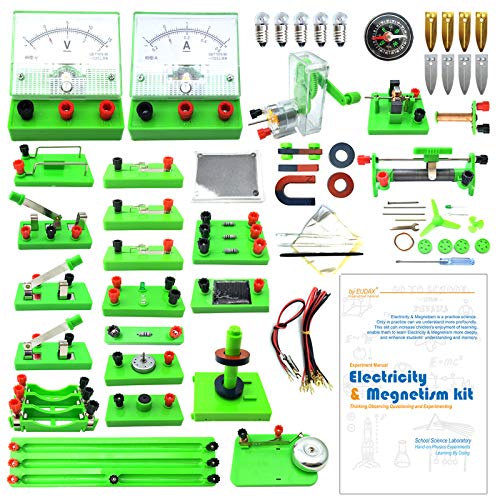
- 79 listed items for electricity and magnetism labs
- Projects include circuits, Ohm’s law, and electromagnets
- Includes manuals, tools, and a storage bag
Best For: Grades 9–11 studying foundational electromagnetism
Best All-in-One Pick

- Seven guided electricity experiments
- Full-color step-by-step manual
- Reusable integrated circuit design
Best For: Kids and teens ages 8–15 learning basic electricity
Best Basic Classroom Kit
EUDAX Introductory Circuit Set

- Builds series and parallel circuits
- English assembly instructions included
- Plastic storage box for components
Best For: Structured introductory electricity lessons
Best for Exploration
Electricity and Magnetism Lab Kit

- More than 50 DIY experiments
- Covers circuits, LEDs, and magnetism
- Illustrated manual and storage case
Best For: Older students seeking broad electricity and magnetism practice
Best Hands-On Motion Builder – Physics Laws: Inertia, Friction & Circular Motion
For shoppers comparing beginner physics experiment sets, the Engino Physics Laws kit offers a structured introduction to motion through building and testing. Designed for ages 9 and up, it includes six working model options, theory, experiments, quizzes, and an interactive 3D app.
Best For: Kids who enjoy construction-based STEM activities and want to explore inertia, friction, and circular motion.
Pros:
- Builds six working models, including a rocket launcher and crash test rig.
- Includes easy-to-follow instructions, theory, experiments, and a four-page quiz.
- Interactive 3D app adds a virtual building option.
- Supports construction, critical thinking, and other STEM skills.
Cons:
- Its focus is limited to selected motion concepts rather than broad physics coverage.
- Recommended for ages 9 and up, so it may be too advanced for younger children.
This is a strong choice when you want a guided building kit rather than a collection of disconnected demonstrations. The six-model format gives children multiple ways to revisit the core motion principles.
Best Optics Demonstration Set – Physics Optical Experiment Set
Among beginner physics experiment sets, this optical experiment kit is aimed at hands-on demonstrations of reflection and refraction. It includes lenses, a prism, mirrors, a multifunctional reflector, a three-way linear light source, and an English manual; the listed recommendation is ages 14 and up.
Best For: Older students, teachers, or families looking for a compact set focused specifically on light and basic optics.
Pros:
- Covers refraction, mirror reflection, diffuse reflection, and lens demonstrations.
- Includes three biconvex lenses, concave and convex lenses, a prism, and acrylic glass tile.
- Adjustable three-way light source supports demonstrations from different directions.
- Compact indoor set with an English color-page manual.
Cons:
- Recommended for ages 14 and up, making it less suitable for younger beginners.
- Requires two AAA batteries, which are not included.
- Its subject matter is concentrated on optics rather than general physics.
This kit makes sense for a focused optics lesson or demonstration station. The variety of lenses and reflectors provides more coverage of light behavior than a single-prism activity, but the older age recommendation should guide your purchase.
Best Broad Science Variety – UNGLINGA 150 Experiments Kit
If you want beginner physics experiment sets with plenty of variety, the UNGLINGA kit combines physics with chemistry, earth science, surface tension, and other topics. It includes tools and materials for up to 150 activities, plus an illustrated step-by-step manual, and is recommended for ages 8 and up.
Best For: Families seeking a large activity collection for guided science time at home, during school breaks, or on weekends.
Pros:
- Offers up to 150 experiments across several science subjects.
- Illustrated, step-by-step manual is designed to make activities easier to follow.
- Includes kid-friendly tools and materials, including goggles.
- Some projects can be completed with regular household items.
Cons:
- Physics is only one part of the kit, so it is less specialized than a dedicated physics set.
- Some experiments require household items in addition to the included materials.
- The broad activity range may provide less depth on individual physics concepts.
This is a practical pick when breadth matters more than a tightly sequenced physics curriculum. It can keep children experimenting over many sessions, while parents can use the manual to add simple explanations along the way.
Best for Simple Machines – T&K Simple Machines
For beginner physics experiment sets centered on forces and mechanical advantage, the T&K Simple Machines kit provides 26 model-building exercises. Children explore levers, wheels and axles, pulleys, inclined planes, screws, wedges, and gears while using the included spring scale to measure force.
Best For: Children ages 8 and up who learn best by building models and measuring how simple machines change force.
Pros:
- Covers all six classic simple machines plus gears.
- Includes a spring scale for hands-on force measurements.
- Offers 26 model-building exercises with step-by-step guidance.
- Durable modular pieces are compatible with other Thames & Kosmos construction kits.
Cons:
- Focuses on machines and force rather than a broad range of physics topics.
- Model building may require more time and patience than quick demonstrations.
This kit stands out for connecting physical construction with measurable results. The spring scale gives learners a concrete way to see how machines alter the direction and magnitude of force, making it a particularly useful introduction to basic mechanics.
Best All-Around Electricity Kit – Teenii Electricity and Magnetism Kit
For shoppers comparing beginner physics experiment sets, the Teenii kit offers broad coverage of electricity and magnetism in one organized package. Its 18 activities, 50 components, and 40-page color manual support practical exploration of circuits, electromagnetism, measurements, and simple motors.
Best For: Children ages 8–18 exploring electricity and magnetism with a parent, teacher, or independently.
Pros:
- Includes 18 hands-on experiments, including fruit batteries, electric bells, and a hand-crank generator.
- Provides a wide assortment of components, including meters, switches, bulbs, magnets, a solenoid, and a motor model.
- The full-color manual and parent-child activity focus make concepts approachable for beginners.
Cons:
- The kit’s broad component list may require careful organization between experiments.
- Its recommended starting age of 8 may make some activities more suitable with adult guidance.
This is a versatile choice when you want one beginner-friendly set covering both circuit fundamentals and magnetism rather than a narrowly focused activity kit.
Best Magnet-Focused Starter – T&K Magnetic Science Physics Set
Among beginner physics experiment sets, the T&K Magnetic Science set is a straightforward option for introducing magnetic fields and electromagnets. It combines 33 experiments and games with magnets in different shapes and sizes, plus a 60-page full-color manual.
Best For: Children ages 8–15 who want a focused introduction to magnets and basic magnetic science.
Pros:
- Offers 33 experiments and games for varied hands-on practice.
- Focuses clearly on magnetic fields, magnet shapes, and building an electromagnet.
- The 60-page full-color manual provides substantial activity guidance.
Cons:
- Its focus is primarily magnetism, so it covers less general circuitry than broader physics kits.
- The supplied component details are less extensive than those listed for the other sets.
This set makes sense for beginners who are especially curious about invisible magnetic forces and want a dedicated, activity-driven introduction.
Best for Structured Circuit Labs – EUDAX Basic Electricity and Magnetism Kit
For learners ready for more structured work, the EUDAX kit is one of the beginner physics experiment sets designed around school-style electricity and magnetism labs. It includes 79 listed items, color instructions, storage, and projects ranging from series circuits and Ohm’s law to electromagnets and hand-crank generators.
Best For: Students in grades 9–11 building foundational electricity and electromagnetism models.
Pros:
- Covers both electricity and magnetism with projects such as parallel circuits, fruit batteries, and Oersted experiments.
- Includes 56 electricity items, 21 magnetism items, repair tools, and a storage bag.
- Supports more formal exploration of measurements, unknown resistance, electromagnets, and force.
Cons:
- Three AA batteries are required but not included.
- The recommended school level may make it less immediately accessible to younger children without supervision.
- The larger component count may require more setup and sorting.
EUDAX is a strong fit when the goal is to move beyond simple demonstrations toward repeatable classroom-style investigations of circuits and electromagnetism.
Best All-in-One Pick – 7-in-1 Electric Circuit Kit
For beginners comparing beginner physics experiment sets, this 7-in-1 circuit kit offers a focused introduction to electricity through guided, hands-on activities. Students can build circuits, test conductivity, explore fruit and saltwater batteries, investigate fiber-optic lighting, and try manual power generation.
Best For: Kids and teens ages 8–15 learning basic electricity at home or in the classroom.
Pros:
- Includes seven electricity-focused experiment modules.
- Step-by-step, full-color manual supports independent learning.
- Integrated components are designed for repeated assembly and use.
- Includes a storage box for organization.
Cons:
- Requires two AA batteries, which are not included.
- Its focus is primarily electricity rather than broader physics topics.
This is a practical starter choice when clear results and guided circuit building matter most. The included activities connect basic theory with visible outcomes, while the reusable board suits repeated practice.
Best Basic Classroom Kit – EUDAX Introductory Circuit Set
This EUDAX set is a straightforward option among beginner physics experiment sets for students who need practice with foundational circuits. The English instructions guide learners through series and parallel circuit construction while reinforcing introductory current and electricity concepts.
Best For: Junior and senior high school science projects, homeschool lessons, clubs, and classroom teaching aids.
Pros:
- Designed as a safe introductory electricity kit.
- Supports series and parallel circuit activities.
- English instructions make assembly easier to follow.
- Components come in a plastic storage box.
Cons:
- Two AA batteries are not included.
- The basic kit is narrower in scope than larger multi-topic experiment sets.
- The supplied listing information gives limited detail about the included experiments.
Choose this kit if your priority is practicing core circuit arrangements rather than exploring a wide range of modules. Its compact storage and classroom-oriented uses make it suitable for structured introductory lessons.
Best for Exploration – Electricity and Magnetism Lab Kit
For learners ready to move beyond simple circuits, this Mysterystone kit stands out among beginner physics experiment sets with more than 50 hands-on electricity and magnetism activities. Projects include a light-control LED, magnetic switch, electromagnet work, and a Joule’s first law experiment module.
Best For: Older students and motivated beginners who want a broad, exploratory introduction to electricity and magnetism.
Pros:
- Offers more than 50 DIY experiments.
- Includes 55 items spanning electricity and magnetism.
- Illustrated manual explains both procedures and underlying ideas.
- Solid storage case has dedicated spaces for the components.
Cons:
- Its manufacturer-recommended age is 13–18, so it may be advanced for younger children.
- The broader project selection may require more time and patience than a basic circuit kit.
- Batteries are referenced in the listing, but included battery details are not specified.
This is the strongest choice for students who want variety and room to design additional experiments. Its electricity-and-magnetism coverage and explanatory manual support learning by doing rather than following only one circuit pathway.
How We Picked These Beginner Physics Experiment Sets
We focused on kits that introduce core physics concepts through practical, repeatable activities. The selection includes broad STEM sets as well as more specialized options for electricity, magnetism, optics, motion, and mechanical advantage.
We also considered the likely age range, educational value, clarity of the experiment format, component variety, and how easily a beginner can start building or testing without advanced equipment. Because kit contents and instructions can vary, check the current product listing before buying.
Quick Comparison
| Best For | Look For |
|---|---|
| General physics exploration | Multi-topic kits with varied experiments |
| Electricity beginners | Clearly labeled circuit components and safe battery-powered projects |
| Magnetism and electromagnetism | Magnets, coils, compasses, and circuit connections |
| Light and optics | Prisms, lenses, mirrors, and a controllable light source |
| Mechanical physics | Levers, pulleys, gears, wheels, and friction activities |
| Older students | Lab-style parts and experiments that support measurement and observation |
Key Buying Factors for Beginner Physics Experiment Sets
Age and Difficulty
Choose a kit that is challenging without being frustrating. Younger learners generally benefit from visual instructions and snap-together parts, while older students may prefer circuit diagrams, measurements, and experiments with less step-by-step guidance.
Physics Topics Covered
A general kit offers variety, but a focused set may teach more effectively if the learner already enjoys a particular subject. Circuit kits suit budding electronics enthusiasts, while optics kits are better for exploring reflection, refraction, lenses, and mirrors.
Safety and Supervision
Prioritize low-voltage, battery-powered equipment for beginners. Review small-part warnings, sharp edges, heat-producing components, and any need for adult supervision. Never connect a kit to household mains electricity.
Instructions and Reusability
Good instructions should explain both what to do and why the result occurs. Reusable components, replacement-friendly parts, and experiments that can be modified add more long-term value than a kit designed for one-time assembly.
Storage and Component Quality
Count the parts, check whether pieces are labeled, and consider whether the set includes a storage case or organized tray. Missing or difficult-to-identify components can quickly reduce the educational value of an otherwise capable kit.
Who Should Buy Which Beginner Physics Experiment Sets?
For a child who wants broad exposure, choose a multi-experiment STEM kit covering several physics ideas. For learners specifically interested in electronics, select a beginner circuit set with clearly marked wires, switches, bulbs, motors, or buzzers.
Choose a magnetism-focused kit for activities involving magnetic fields, coils, and electromagnets. Optics sets are a strong fit for learners fascinated by light and visual demonstrations. Mechanical engineering sets are best for exploring force, work, motion, levers, gears, and pulleys.
Parents and educators buying for a group should favor durable parts, repeatable activities, and instructions that support independent work. For a single student, match the kit to an existing interest and select a difficulty level that encourages experimentation rather than simply following instructions.