Choosing the right automatic titrator for laboratory work can improve consistency, reduce operator error, and speed up routine analysis.
Below, we focus on the most useful options for moisture testing, pH work, and potentiometric titration so you can match the instrument to your method and sample type.
Best 10 Automatic Titrator for Laboratory Picks for 2026
Advanced QA Titration
Ti-50 Advanced Automatic Titrator

- ±0.002 pH accuracy for advanced titration
- DET, MET, SET, and MAT operating modes
- Stores 200 results with touchscreen method management
Best For: Regulated labs, QA, and R&D titration workflows
Moisture Testing Lab Tool

- Measures moisture in liquid and solid samples
- Dual-voltage 110V/230V compatibility
- Includes stirrer and core glassware
Best For: Karl Fischer moisture testing in multi-voltage labs
Flexible Mid-Range Analysis
- ±0.01 pH accuracy across wide mV/pH ranges
- DET, MET, SET, and MAT titration modes
- 10 ml and 20 ml interchangeable burettes
Best For: Routine water, chemical, and industrial QC testing
Ultra-Fine Water Analysis

- 0.1µg resolution from 5µg to 100mg water
- Automatic blank deduction and drift compensation
- 500-result memory with built-in printer
Best For: Transformer oil, insulating fluid, and solvent testing
Potential Endpoint Titrator
CGOLDENWALL Ti-20 LCD Automatic Titrator

- Preset potential endpoint control
- Manual, automatic, and constant pH modes
- Includes JB-1A stirrer
Best For: endpoint-controlled potentiometric titration in lab volumetric analysis
High-Accuracy Potentiometric Titrator
Laboratory Automatic Water Titrator with Touchscreen

- ±0.025 mL burette for precise dosing
- Touchscreen LCD with intuitive operation
- Closed-loop titrant volume control
Best For: routine analytical titration where precision and easy operation matter
Karl Fischer Moisture Titrator
KFT-40C Volumetric Karl Fischer Titrator

- 0.1–250 mg moisture range
- Auto filling, purging, and mixing
- Stores 200 datasets with RS-232 output
Best For: Karl Fischer water content analysis with automation and traceability
Portable Potentiometric Control

- Colorful touchscreen interface
- RS485 transmission support
- Built for practical everyday use
Best For: Labs wanting a simple touchscreen titrator for routine potentiometric work
Routine Analysis Pick

- 0~±1400 mV / 0~14.00 pH range
- ±0.03 pH accuracy
- SET and MAT modes with glass burette
Best For: Teaching labs and small QA teams doing routine water and chemical analysis
Trace Moisture Specialist
Karl Fischer Water Content Titrator
- Designed for Karl Fischer water testing
- 0.1 μg resolution with drift compensation
- Touchscreen, printing, and data storage
Best For: Labs needing dedicated trace moisture measurement for oils, solvents, and reagents
Advanced QA Titration – Ti-50 Advanced Automatic Titrator
If you need an automatic titrator for laboratory QA or R&D work that prioritizes precision and workflow control, the Ti-50 is built for that role. It offers a wide measurement range, multiple titration modes, and a touchscreen interface with method management for structured lab use.
Best For: Regulated labs, QA teams, and R&D users who need high-precision titration with method control.
Pros:
- Measures from -2000.00 to 2000.00 mV and 0.000 to 20.000 pH with ±0.002 pH accuracy.
- Supports DET, MET, SET, and MAT modes for complex analytical workflows.
- 7″ touchscreen with method management helps streamline SOP-driven use.
- Stores up to 200 data sets for traceable reporting.
Cons:
- Designed for professional lab environments rather than casual or basic testing.
- Larger footprint and 22-pound weight may matter for tight benches.
Overall, the Ti-50 is a strong fit when precision, documentation, and multi-mode titration matter more than simplicity. It is especially appealing for labs that need consistent results and detailed recordkeeping.
Moisture Testing Lab Tool – Auto Karl Fischer Titrimeter
This automatic titrator for laboratory moisture analysis is geared toward Karl Fischer testing where water content needs to be measured in liquids or solids. The built-in magnetic stirrer, dual-voltage support, and included glassware make it a practical setup for labs that want a ready-to-use titrimeter.
Best For: Labs that need Karl Fischer moisture testing with flexible power compatibility.
Pros:
- Measures moisture content in a wide range of liquid and solid samples.
- Works with both 110V and 230V power supplies.
- Displays results in mL, mg H2O, or % H2O.
- Includes a built-in magnetic stirrer and essential glassware components.
Cons:
- Product details focus on setup and output formats more than advanced software features.
- Best suited to moisture testing rather than broader titration applications.
For labs centered on moisture determination, this model covers the essentials in a straightforward package. Its broad display options and included components make it useful when you want a functional Karl Fischer workflow without extra complexity.
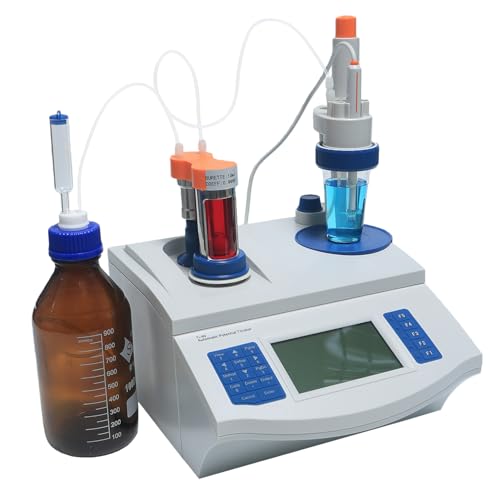
Flexible Mid-Range Analysis – Ti-40 Automatic Titrator
The Ti-40 is an automatic titrator for laboratory users who need dependable pH and mV measurement with room for different sample volumes. With interchangeable burettes, multiple titration modes, and data storage, it suits routine analytical work in water, chemical, and industrial quality control.
Best For: Labs that want flexible titration options with moderate storage and interchangeable burettes.
Pros:
- Measures -1800.0 to 1800.0 mV and 0.00 to 14.00 pH with ±0.01 pH accuracy.
- Supports DET, MET, SET, and MAT modes for varied workflows.
- Includes interchangeable 10 ml and 20 ml burettes.
- Stores up to 50 data sets for QA documentation.
Cons:
- Less precise than the Ti-50 model in this lineup.
- Data storage capacity is limited compared with higher-end systems.
As a mid-range lab titrator, the Ti-40 balances versatility and practicality well. It is a sensible choice if you want multiple titration modes and interchangeable burettes without moving into the more advanced feature set of a top-tier unit.
Ultra-Fine Water Analysis – Karl Fischer Titrator
For an automatic titrator for laboratory water analysis, this Karl Fischer model is focused on very small moisture measurements with high resolution. It combines automatic blank deduction, drift compensation, a touch screen, and built-in printing to support detailed oil and solvent testing workflows.
Best For: Oil, transformer fluid, and solvent labs that need very fine water measurement and reporting.
Pros:
- Detects water from 5µg to 100mg with 0.1µg resolution.
- Uses automatic blank deduction and drift compensation.
- Includes a 320×240 touch screen for parameter setup and control.
- Built-in thermal printer and 500-result memory support traceability.
Cons:
- Built around coulometric Karl Fischer testing rather than general-purpose titration.
- Best fit is specialized moisture analysis, not broad lab use.
This unit is clearly aimed at labs that need tight moisture control and documented results. If your workflow depends on small water detection limits and automatic reporting, it offers a focused, lab-friendly solution.
Potential Endpoint Titrator – CGOLDENWALL Ti-20 LCD Automatic Titrator
CGOLDENWALL Lab Digital LCD Automatic Potential Titrator pH/Mv Meter Tester Ti-20
Check Price On AmazonIf you need an automatic titrator for laboratory work focused on potential endpoint control, the CGOLDENWALL Ti-20 is built for routine potentiometric and pH titration. It supports manual, automatic, and constant pH (potential) titration modes, with solenoid-valve liquid control and a delay circuit for endpoint handling.
Best For: Labs that want a straightforward potentiometric titrator for volumetric analysis and endpoint-controlled titration.
Pros:
- Controls titration endpoints according to preset potential
- Offers manual, automatic, and constant pH (potential) titration modes
- Includes solenoid valve control for dropping liquid
- Comes with a JB-1A stirrer for lab use
Cons:
- Measured in mV/pH rather than broader multi-parameter testing
- Basic LCD interface compared with touchscreen systems
- Designed around potential titration rather than moisture analysis
This model is a practical fit when your workflow centers on endpoint-based titration and you want core automation without unnecessary extras. Its specification set is focused on standard lab volumetric analysis.
High-Accuracy Potentiometric Titrator – Laboratory Automatic Water Titrator with Touchscreen
Laboratory Automatic Water titrator potentiometric Titration Device Analytical Accuracy
Check Price On AmazonThis automatic titrator for laboratory use is aimed at precise potentiometric water testing and general titration work. It combines a high-accuracy burette, closed-loop control of titrant volume, and an LCD touchscreen to support accurate and intuitive operation across a wide measurement range.
Best For: Labs that want a touchscreen potentiometric titrator with fine burette control and broad measurement coverage.
Pros:
- ±0.025 mL burette supports precise titration
- 0.01 pH, 0.1 mV, and 0.1°C resolution
- Closed-loop control of titrant volume for accuracy
- Detachable stirring unit makes maintenance easier
Cons:
- No detailed data storage or GLP features listed
- Positioned as a general titration device rather than a specialized moisture system
- Measurement performance is defined by specs, not workflow automation extras
For labs that value precise dosing and a simple user interface, this model covers the core needs well. Its range and detachable design make it a flexible option for routine analytical work.
Karl Fischer Moisture Titrator – KFT-40C Volumetric Karl Fischer Titrator
If your automatic titrator for laboratory use needs to focus on moisture content, the KFT-40C is built for Karl Fischer volumetric analysis. It offers a 0.1–250 mg measurement range, auto filling, purging, and mixing, plus a live titration curve on the LCD screen for easier monitoring.
Best For: Labs performing Karl Fischer water content analysis that want automation and data traceability.
Pros:
- 0.1–250 mg range with 0.1 mg resolution
- Auto filling, purging, and mixing reduce manual handling
- Stores up to 200 titration datasets for traceability
- RS-232 output supports printer connection
Cons:
- Specialized for Karl Fischer moisture testing, not general titration
- Coupled to volumetric moisture workflows rather than pH endpoint work
- Measured by repeatability and range, not broad multi-parameter testing
This is the most specialized option in the group, and that focus is its strength. Choose it when water content analysis is the primary lab requirement and reproducible records matter.
Portable Potentiometric Control – Colorful Touchscreen Titrator
Rs485 Transmission Ph Meter Potentiometric Titrator Automatic Titrator with Colorful Touchscreen
Check Price On AmazonIf you need an automatic titrator for laboratory work that emphasizes straightforward operation and modern controls, this GOYOJO potentiometric titrator is built around a colorful touchscreen and RS485 transmission support. It is aimed at dependable everyday use, with a practical design for routine pH and titration tasks.
Best For: Labs that want a user-friendly automatic titrator with touchscreen control for routine potentiometric work.
Pros:
- Colorful touchscreen for easier operation and parameter setup
- RS485 transmission support for lab integration
- Practical design focused on dependable everyday use
Cons:
- Supplied details do not list measurement range or accuracy
- Best suited to general usability rather than advanced specification-driven selection
This is a sensible pick if your priority is a simple, modern interface and reliable day-to-day titration workflow rather than a highly specified analytical feature set.
Routine Analysis Pick – Ti-20 Basic Lab Titrator
The Ti-20 is an automatic titrator for laboratory use aimed at routine water and chemical analysis, with straightforward SET and MAT modes and a visible glass burette. Its 0~±1400 mV and 0~14.00 pH measurement range, plus ±0.03 pH accuracy, make it a practical choice when you need reliable basic titration.
Best For: Teaching labs and small QA facilities that need a compact, easy-to-use titrator for routine analysis.
Pros:
- 0~±1400 mV / 0~14.00 pH range for routine titration tasks
- ±0.03 pH accuracy for basic lab work
- SET and MAT modes for different sample needs
- Glass burette for visible, stable reagent delivery
Cons:
- Listed as a manual titration model in the product details
- Designed for basic routine analysis rather than more specialized workflows
Overall, the Ti-20 is a practical match if you want a compact titrator with clear operation and the core features needed for everyday laboratory analysis.
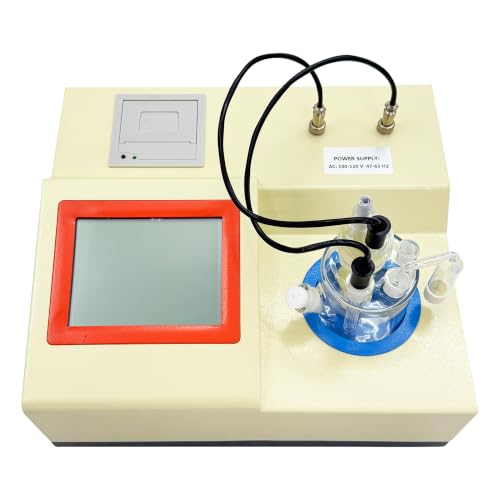
Trace Moisture Specialist – Karl Fischer Water Content Titrator
For moisture testing, this automatic Karl Fischer titrator is purpose-built for water content measurement using the coulometric Karl Fischer principle. With 0.1 μg resolution, auto blank and drift compensation, and a touchscreen with data storage and printing, it is designed for trace-level analysis in industrial and research settings.
Best For: Power, petroleum, and research labs that need precise Karl Fischer moisture measurement.
Pros:
- Purpose-built for water content measurement with the Karl Fischer coulometric principle
- 0.1 μg resolution for trace moisture testing
- Auto blank and drift compensation for more accurate results
- Touchscreen, printing, and 500-set data storage for traceability
Cons:
- Specialized for moisture analysis rather than general titration
- 110V 60Hz configuration may not fit every lab power setup
If your lab needs a dedicated moisture analyzer, this model brings the key automation and traceability features needed for accurate Karl Fischer testing.
How We Picked the Best Automatic Titrator for Laboratory
We prioritized laboratory practicality: measurement range, titration mode support, accuracy, automation features, data handling, and ease of daily operation. For an Automatic Titrator for Laboratory use, the best choice is usually the one that fits your method first, then your throughput needs.
Quick Comparison
Broadly, these 10 picks fall into three groups: Karl Fischer models for water content, potentiometric/pH titrators for general analytical work, and hybrid-style units for labs that need flexible method support. If your work is moisture-focused, start with Karl Fischer. If you run routine acid-base, redox, or endpoint titrations, look at pH/MV and potentiometric options.
Key Buying Factors for an Automatic Titrator for Laboratory Use
Measurement Range and Method Fit
Check whether the instrument covers your expected sample concentration, endpoint type, and titration chemistry. Karl Fischer units are best for water determination, while pH/MV titrators suit general wet chemistry and potentiometric analysis.
Accuracy, Resolution, and Repeatability
Higher resolution is helpful, but repeatability and stated accuracy matter more for real-world results. Match the specification to your required reporting limits and internal quality standards.
Automation Features
Look for automatic filling, purging, mixing, endpoint detection, and mode flexibility. These features reduce hands-on time and help standardize results across operators.
Data and Compliance Needs
Memory, printer support, and export options are valuable for QA/QC workflows. If your lab tracks audits or method history, prioritize systems with clear data storage and traceability features.
Usability and Maintenance
Touchscreens, straightforward menus, and accessible burette or generator components can save time. Also consider consumables, electrode compatibility, and how easy the unit is to clean between runs.
Who Should Buy Which Automatic Titrator for Laboratory?
Choose a Karl Fischer titrator if your main job is moisture analysis in solvents, chemicals, or raw materials. Pick a potentiometric or pH/MV automatic titrator if you need flexible endpoint detection for routine analytical testing. Labs with mixed workloads should favor models with multiple modes, solid data storage, and enough burette capacity to handle day-to-day throughput.
For a busy QC lab, the best Automatic Titrator for Laboratory use is usually the one that balances accuracy, automation, and simple maintenance rather than the one with the longest spec sheet.