The best anemometers for classrooms make wind-speed lessons more tangible, helping students connect weather concepts with hands-on measurement. The options in this roundup range from simple educational instruments to digital meters with backlit displays and broader measurement features.
When choosing among them, consider student safety, readability, durability, measurement range, and whether the meter will be used indoors, outdoors, or across multiple science activities.
Best 10 Anemometers for Classrooms Picks for 2026
Best Classroom Classic

- Mechanical wind-cup design
- Weather-resistant construction
- Compact for field studies
Best For: Hands-on classroom wind-speed lessons
Best Portable Professional Option
Extech 45118 Thermo-Anemometer

- Measures air velocity and temperature
- Includes averaging and wind chill
- Waterproof, floating, drop-resistant design
Best For: Advanced airflow and HVAC classroom activities
Best Digital Display

- Displays speed, temperature, and Beaufort level
- Offers five wind-speed units
- Includes backlight and MAX/MIN/AVG functions
Best For: Digital weather and airflow demonstrations
Best Hands-On Kit
TOYANDONA Wind Vane Anemometer Set

- DIY assembly for active learning
- Combines wind vane and anemometer concepts
- Lightweight plastic classroom kit
Best For: Early science projects and weather activities
Best Digital Pick
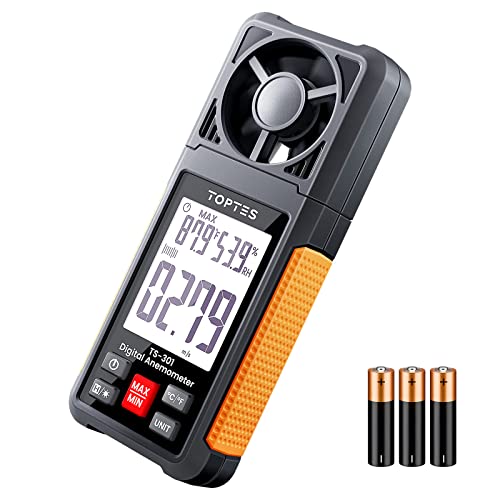
- Large backlit 2.26-inch display
- Six wind-speed measurement units
- Measures temperature and humidity
Best For: Digital classroom experiments involving wind, weather, and airflow
Best Hands-On Model

- Three-cup rotor visibly shows air movement
- Printed scale supports quick observations
- Lightweight design for children and adults
Best For: Hands-on introductory meteorology and outdoor science activities
Best for Airflow Lessons

- Measures speed, temperature, and wind chill
- Five wind-speed measurement units
- Tripod hole enables hands-free readings
Best For: HVAC, ventilation, and engineering-focused classroom labs
Best Compact Pick

- Measures wind speed, temperature, and wind chill
- Backlit display with current, average, and maximum modes
- Lightweight 53 g body with lanyard
Best For: Portable classroom experiments and field activities
Best Heavy-Duty Pick
HoldPeak 866B Digital Anemometer

- Measures light airflow from 0.67 to 67.1 mph
- Includes MAX, MIN, and AVG readings
- Supports tripod-mounted hands-free checks
Best For: Ventilation, HVAC, and engineering demonstrations
Best Beginner Option
Clatoon GM816 Digital Wind Meter
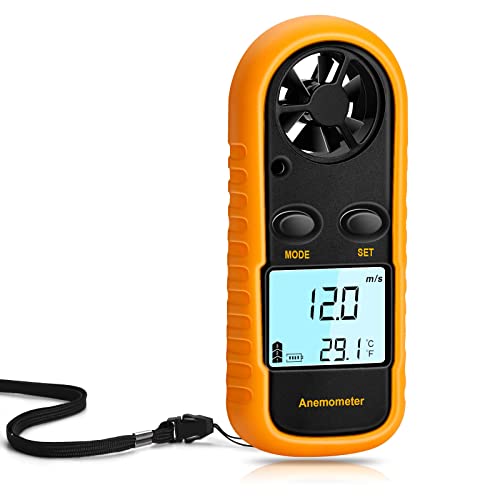
- Measures wind speed up to 65 mph
- Includes temperature, air volume, and wind chill functions
- Comes with battery, case, lanyard, and backlight
Best For: Introductory weather lessons and student fieldwork
Best Classroom Classic – Eisco Small Anemometer
For classrooms seeking a straightforward introduction to wind measurement, the Eisco Small Anemometer is a durable, mechanical option. Its revolving wind cups provide a hands-on way for students to observe wind speed during science lessons or outdoor field studies.
Best For: Classroom demonstrations, science labs, and basic outdoor wind-speed activities.
Pros:
- Simple wind-cup design is easy for students to understand and use.
- Corrosion-resistant, weather-resistant construction supports outdoor activities.
- Compact size—7 inches high and 8.5 inches in diameter—makes it portable.
Cons:
- Has no display, so readings are not digitally shown.
- Requires suitable placement, ideally at least four feet above ground and away from obstructions.
This is a practical pick when the goal is hands-on learning rather than instant digital readouts. Its simple construction suits repeated classroom and field use.
Best Portable Professional Option – Extech 45118 Thermo-Anemometer
The Extech 45118 is a compact waterproof thermo-anemometer for classrooms that want a more feature-rich tool for air-velocity demonstrations. It measures air velocity and temperature, includes wind-chill information, and offers averaging settings for observing changing airflow.
Best For: Advanced science activities involving air velocity, temperature, HVAC concepts, and air quality.
Pros:
- Measures air velocity from 100 to 5,500 ft/min and temperature from 0 to 122°F.
- Offers 5-, 10-, and 13-second averaging for smoother observations.
- Waterproof design, floating construction, and 6-foot drop resistance support field use.
- Compact body includes a 43-inch lanyard and uses a CR2032 battery.
Cons:
- Its specifications may be more advanced than needed for basic elementary demonstrations.
- The supplied notes do not list a large display or classroom-oriented teaching accessories.
Choose this model when lessons benefit from temperature and airflow data in one handheld instrument. Its portable, rugged design also suits demonstrations beyond the classroom.
Best Digital Display – Mcbazel 3-in-1 Anemometer
The Mcbazel 3-in-1 handheld anemometer is a flexible choice for classrooms that prefer clear digital readings. It displays wind speed, temperature, and Beaufort level together, while multiple units and MAX/MIN/AVG functions support different lesson formats.
Best For: Digital classroom demonstrations, weather units, and indoor or outdoor airflow comparisons.
Pros:
- Shows wind speed, temperature, and Beaufort scale readings on a double-line LCD.
- Supports m/s, km/h, knots, ft/s, and mph.
- Backlight, data hold, MAX/MIN/AVG functions, and low-battery indicator improve usability.
- Lightweight, portable design includes auto power-off.
Cons:
- AAA batteries are required but are not included.
- As a handheld instrument, it requires a user to position it in the airflow during measurements.
This model offers the clearest at-a-glance data of the group, making it well suited to lessons where students compare numerical readings. Its unit flexibility also accommodates different curricula.
Best Hands-On Kit – TOYANDONA Wind Vane Anemometer Set
The TOYANDONA wind vane anemometer set is designed for hands-on classroom projects rather than precision measurement. Its lightweight plastic components encourage children to assemble a wind-measuring toy and explore basic ideas about weather, direction, and aerodynamics.
Best For: Early science activities, group projects, science fairs, and introductory weather lessons.
Pros:
- DIY assembly encourages creativity, curiosity, and problem-solving.
- Combines an anemometer and wind vane concepts in one educational activity.
- Lightweight plastic construction is easy for children to handle.
- Compact design supports indoor or outdoor classroom projects.
Cons:
- Designed as an educational toy, so it is not presented as a precision measuring instrument.
- Assembly is required before use.
- The supplied notes do not specify numerical wind-speed readouts.
This set is a good choice when the learning objective is building and experimenting. It gives younger students a tangible introduction to wind measurement without the complexity of a digital meter.
Best Digital Pick – TopTes TS-301 Anemometer
For classrooms seeking versatile anemometers for classrooms, the TopTes TS-301 combines a large backlit display with multiple wind-speed units. It can support lessons involving weather, airflow, temperature, and humidity, while its compact design makes it easy to carry between activities.
Best For: Teachers who want a readable digital meter for weather and indoor airflow demonstrations.
Pros:
- Large 2.26-inch backlit LCD screen is easy to read.
- Measures wind speed in six units, including m/s, mph, knots, and km/h.
- Also measures relative humidity and temperature.
- Includes three AAA batteries, a user manual, and a carry pouch.
Cons:
- Temperature and humidity sensors may need at least 30 minutes to adjust to a new environment.
- Automatic shutoff occurs after 10 minutes of non-use.
The TS-301 is a strong all-around classroom option when students need clear digital readings and several variables to compare. Its humidity and temperature functions add useful depth to weather or HVAC-focused activities.
Best Hands-On Model – Educational Cup Anemometer
This analog cup-style instrument offers a direct, visual introduction to wind measurement, making it a natural choice among anemometers for classrooms. Its three-cup rotor shows air movement in action, helping younger students connect wind currents with a measurement scale.
Best For: Elementary science lessons, outdoor exploration, and hands-on demonstrations of basic meteorology.
Pros:
- Three-cup rotor visibly demonstrates how wind movement is detected.
- Printed measurement scale supports straightforward observation.
- Lightweight handheld design is intended for children and adults.
- Bright blue and yellow construction is easy to identify during activities.
Cons:
- Analog design does not provide the digital readings or extra sensors found on electronic meters.
- The supplied notes do not specify measurement units or a warranty.
This model is best when the learning goal is understanding the principle behind anemometers rather than collecting detailed digital data. Its visible rotating cups can make wind concepts more accessible in group demonstrations.
Best for Airflow Lessons – BT-100 Handheld Anemometer
The BT-100 is a practical choice for advanced anemometers for classrooms activities involving wind speed, wind chill, and ventilation. Its backlit screen, five measurement units, and tripod mounting hole allow students to take handheld readings or leave the meter positioned for continuous observation.
Best For: HVAC, duct-airflow, wind-chill, and engineering-oriented classroom experiments.
Pros:
- Measures wind speed in five units and displays wind temperature and wind chill.
- Provides a stated wind-speed range of 0.67 to 67.1 mph with ±2% reading accuracy.
- Tripod thread supports hands-free continuous measurements.
- Includes a backlit display, carry bag, neck strap, batteries, and manual.
Cons:
- Its wind-temperature range is limited to 14°F–113°F.
- More specialized airflow functions may be unnecessary for basic elementary demonstrations.
With wind-chill readings and a mounting option, the BT-100 suits lessons that go beyond simply watching a rotor spin. It is particularly useful when students compare airflow readings or connect wind speed with duct-area calculations.
Best Compact Pick – BT-816B Handheld Anemometer
For classrooms seeking portable anemometers for classrooms, the BTMETER BT-816B offers a compact way to demonstrate wind speed, temperature, and wind chill. Its backlit display and current, average, and maximum modes make it practical for quick indoor or outdoor activities.
Best For: Hands-on lessons, field activities, and student demonstrations where portability matters.
Pros:
- Measures wind speed from 0.3 to 30 m/s with approximately ±5% reading accuracy.
- Displays temperature, wind chill, and current, average, or maximum readings.
- Lightweight 53 g design includes a backlit LCD, lanyard, and one-year warranty.
Cons:
- The compact display may be less convenient for group viewing.
- Its listed temperature range is limited to -14°F to 113°F.
This is a strong classroom choice when students need to carry the meter between stations or outdoors. The straightforward controls and multiple units support varied activities without adding much equipment weight.
Best Heavy-Duty Pick – HoldPeak 866B Digital Anemometer
The HoldPeak 866B is one of the more classroom-friendly anemometers for classrooms when lessons include ventilation or airflow comparisons. It measures light airflow, supports MAX, MIN, and AVG readings, and can be mounted to a compatible 1/4-inch tripod for hands-free demonstrations.
Best For: HVAC, ventilation, engineering, and data-collection activities.
Pros:
- Measures 0.67 to 67.1 mph with approximately ±5% accuracy.
- Temperature and wind chill readings add environmental context.
- Includes a backlight, wrist strap, protective case, and tripod-mount capability.
Cons:
- The compatible tripod is not included.
- At 200 g, it is heavier than the other listed handheld options.
Choose this model if your classroom projects involve comparing supply vents, return grilles, or exhaust fans. Its MAX, MIN, and AVG functions are useful for recording changing airflow rather than relying on a single reading.
Best Beginner Option – Clatoon GM816 Digital Wind Meter
The Clatoon GM816 is a simple, lightweight option for classrooms introducing students to wind measurement. It measures wind speed, temperature, air volume, and wind chill, while its included battery, protective case, and lanyard make it ready for portable activities.
Best For: Beginner-friendly weather lessons, outdoor observation, and small-group experiments.
Pros:
- Measures wind speed from 0 to 65 mph with approximately 5% accuracy.
- Offers current, maximum, and average wind-speed readings in five units.
- Includes a CR2032 battery, yellow protective case, lanyard, and LCD backlight.
Cons:
- The plastic body and small display may require careful handling in shared classroom use.
- Its temperature accuracy is listed at approximately 3.6°F or 2°C.
This model keeps operation uncomplicated, which can help younger students begin collecting wind data quickly. Its small size suits rotating stations, though teachers may want students to work in pairs when reading the compact display.
How We Picked the Best Anemometers for Classrooms
We focused on practical classroom value rather than choosing meters solely by maximum accuracy or advanced specifications. The selection includes durable educational models, compact handheld instruments, and digital anemometers that can support activities involving weather, airflow, ventilation, engineering, and outdoor observations.
We considered ease of use, display readability, portability, weather resistance, measurement range, battery-dependent features, and suitability for different age groups. Because classroom needs vary, the list includes both straightforward teaching tools and more capable meters that can serve older students or technical projects.
Quick Comparison
| Classroom Need | Best Type to Consider | What to Look For |
|---|---|---|
| Early science demonstrations | Simple educational anemometer | Large, clear moving parts and easy interpretation |
| Routine student measurements | Basic digital handheld meter | Readable screen, simple controls, and useful wind-speed units |
| Outdoor fieldwork | Weather-resistant or waterproof model | Durable housing and protection from light rain or splashes |
| Older students and projects | Multi-function digital anemometer | Wider range, airflow modes, backlight, and multiple units |
Key Buying Factors for Anemometers for Classrooms
Ease of Reading and Operation
A simple interface matters when several students share one device. Look for large digits, a backlight if measurements may be taken in dim conditions, and controls that do not require complicated menus. For younger learners, a visual or mechanical design may be more intuitive than a feature-heavy digital meter.
Durability and Safety
Classroom equipment is handled frequently, so a sturdy housing and protected sensor are valuable. For outdoor lessons, weather resistance can help, but verify whether a model is merely splash-resistant or genuinely waterproof. Supervise use around moving parts, batteries, and windy locations.
Range, Units, and Functions
Match the measurement range to the planned activities. Basic weather lessons may need only wind speed, while HVAC, engineering, drone, or airflow projects may benefit from CFM, air-velocity, wind-chill, or multiple-unit functions. Extra modes are useful only if students can understand and use them.
Portability and Power
Compact handheld meters are easier to distribute for fieldwork and store in classroom kits. Check battery type, expected runtime, auto-shutoff behavior, and whether the display remains visible outdoors. If buying several units, standardizing batteries and controls can simplify classroom management.
Who Should Buy Which Anemometers for Classrooms?
Choose a simple educational or physical anemometer for elementary demonstrations, introductory weather lessons, and activities where students need to see how wind is measured. A basic digital model is a better all-purpose choice for middle-school classrooms that regularly record and compare readings.
For high-school science, engineering, environmental studies, or technical programs, consider a digital meter with a broader range, backlit display, and airflow-related functions. If lessons include outdoor data collection, prioritize a durable or water-resistant design. Schools purchasing multiple units should favor affordable, consistent models that are easy to operate, replace, and share.