For home science projects, the right monitor turns invisible indoor conditions into usable data. Whether you are tracking CO2, PM2.5, VOCs, or humidity, a good device helps you spot patterns and make informed changes.
This roundup focuses on practical air quality monitors for home science that balance accuracy, readability, and everyday usability, so you can choose a model that fits your space and testing goals.
Best 10 Air Quality Monitors for Home Science Picks for 2026
Wireless CO2 Focused Monitor
Aranet4 Indoor Air Quality Monitor

- Tracks CO2, temperature, humidity, and atmospheric pressure
- Wireless e-ink display with up to 4 years of battery life
- App stores up to 90 days of historical data
Best For: Home ventilation tracking and CO2-focused monitoring
Alexa-Connected Smart Monitor
Amazon Smart Air Quality Monitor

- Measures PM2.5, VOCs, carbon monoxide, humidity, and temperature
- Works with Alexa for alerts, scores, and routines
- Plugs in and sets up in minutes
Best For: Alexa households that want alerts and automation
Large-Display Multi-Parameter Monitor

- Tracks nine readings including CO2, PM, HCHO, TVOC, and AQI
- 7-inch LED screen with three brightness levels
- Includes audible alerts and mute control
Best For: Buyers who want a large, easy-to-read desktop monitor
Budget Desktop Multi-Sensor Monitor
10-in-1 Air Quality Monitor Indoor
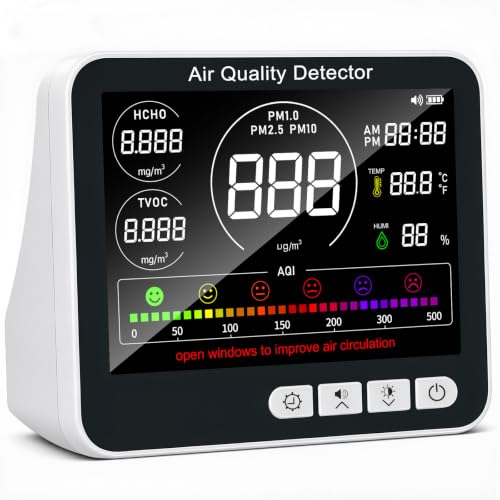
- Measures PM1.0, PM2.5, PM10, HCHO, TVOC, temperature, humidity, AQI, and time
- Large full-color display is easy to read across the room
- Color-coded AQI indicator supports quick checking
Best For: Bedrooms, living rooms, and offices needing a simple desktop monitor
Compact 11-in-1 Pick
LifeBasis 11-in-1 Indoor Monitor

- Tracks 11 air-quality and climate readings
- Uses NDIR, laser, and other sensor types
- Portable with adjustable LCD brightness
Best For: Families and hobbyists who want a compact all-in-one monitor
Large-Display Option

- 7.2-inch screen with adjustable brightness
- Fast 1 to 2 second reading updates
- 7 user-set alert thresholds with clear visual cues
Best For: Large rooms, nurseries, and users who want very readable alerts
Portable 10-in-1 Monitor
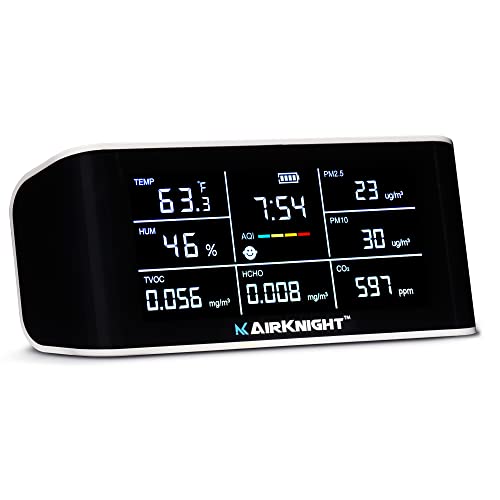
- Tracks CO2, PM2.5, PM10, TVOC, and HCHO
- Large LCD shows readings clearly
- Rechargeable and easy to move room to room
Best For: Everyday home monitoring and wildfire smoke checks
Portable Color-Screen Tester
Portable Color Screen Air Check

- Measures CO2, HCHO, TVOC, benzene, and PM2.5
- Color display highlights unsafe readings
- Up to 20 hours of battery life
Best For: Portable spot checks with easy visual alerts
WiFi App-Connected Monitor
App-Connected Dual-Chip Tracker

- Tracks AQI, CO2, PM2.5, PM1.0, PM10, and gases
- Works with Smart Life and Tuya Smart apps
- Stores history and sends remote updates
Best For: Homes that want app-based tracking and history
Wireless CO2 Focused Monitor – Aranet4 Indoor Air Quality Monitor
For air quality monitors for home science, the Aranet4 is a focused choice when you want to study ventilation and CO2 trends without extra clutter. It tracks CO2, temperature, relative humidity, and atmospheric pressure in real time, and the app stores up to 90 days of historical data for easy review.
Best For: Home users who want a reliable, battery-powered CO2 monitor for ventilation tracking and simple data analysis.
Pros:
- Measures CO2, temperature, humidity, and atmospheric pressure in real time
- Wireless design with an e-ink display and up to 4 years of battery life
- Color coding, large CO2 readout, and optional buzzer make alerts easy to notice
- App supports up to 90 days of historical data with graphs
Cons:
- Focused mainly on CO2-centered monitoring rather than broad particle sensing
- Uses AA batteries, so ongoing battery replacement may still be needed over time
Overall, this model suits buyers who want a precise, low-maintenance indoor monitor for understanding when a room needs fresh air. Its strength is in straightforward CO2 tracking backed by app-based history and clear at-a-glance display cues.
Alexa-Connected Smart Monitor – Amazon Smart Air Quality Monitor
If you want air quality monitors for home science that do more than just display numbers, this Amazon smart model adds alerts and automation. It tracks PM2.5, VOCs, carbon monoxide, humidity, and temperature, then works with Alexa for notifications, color-coded status, and routines.
Best For: Alexa users who want an easy plug-in monitor with alerts and smart-home automation.
Pros:
- Tracks five key factors: PM2.5, VOCs, carbon monoxide, humidity, and temperature
- Gives a color-coded LED and air quality score in the Alexa app
- Sends phone notifications and Echo announcements when air quality drops
- Can trigger Alexa routines for compatible purifiers, dehumidifiers, and fans
Cons:
- Requires Alexa for the full feature set and app-based experience
- Needs to stay plugged in, so it is not a wireless unit
This is a practical pick for households that already use Alexa and want monitoring tied directly to action. The easy setup and automation features make it more of a smart-home air control tool than a standalone meter.
Large-Display Multi-Parameter Monitor – 16 in 1 Air Quality Monitor
Among air quality monitors for home science, this large-screen unit is built for people who want a broad readout at a glance. It monitors nine parameters in real time, including CO2, PM2.5, PM1.0, PM10, HCHO, TVOC, temperature, humidity, AQI, and time, with a 7-inch display that keeps the data easy to read.
Best For: Users who want a big display and broad indoor air readings with audible alerts.
Pros:
- Monitors a wide set of readings, including CO2, particulate matter, HCHO, TVOC, temperature, humidity, and AQI
- 7-inch LED display with three brightness settings for easy viewing
- Includes real-time alert buzzers and a mute button
- Uses external high-precision sensors for direct air sampling
Cons:
- Bulkier desktop format may be less convenient than smaller monitors
- Feature-rich interface may be more than some buyers need for basic tracking
This model makes sense when broad coverage and visibility matter more than portability. The combination of large-screen presentation and multiple sensor types gives you a detailed snapshot of indoor conditions without digging through menus.
Budget Desktop Multi-Sensor Monitor – 10-in-1 Air Quality Monitor Indoor
For shoppers comparing air quality monitors for home science, this Lecoolife desktop unit covers the core readings most people want to watch day to day. It monitors PM1.0, PM2.5, PM10, HCHO, TVOC, temperature, humidity, AQI, and time, with a large color display that keeps the data visible across the room.
Best For: Bedrooms, living rooms, and home offices that need a simple multi-sensor monitor with a big display.
Pros:
- Tracks PM1.0, PM2.5, PM10, HCHO, TVOC, temperature, humidity, AQI, and time
- Oversized full-color screen is easy to read from across the room
- Color-coded AQI indicator helps make air changes easy to spot
- Desktop design works well for everyday indoor placement
Cons:
- Does not list app connectivity or smart-home features
- Battery-powered design may be less convenient than plug-in models for constant use
This is a straightforward option for users who want broad indoor readings without moving into a connected smart ecosystem. Its strength is the clear display and practical set of sensors for general home monitoring.
Compact 11-in-1 Pick – LifeBasis 11-in-1 Indoor Monitor
If you’re comparing air quality monitors for home science, this LifeBasis unit is a practical option for tracking the basics and a few deeper indicators in one place. It shows AQI, CO2, PM levels, HCHO, TVOC, temperature, and humidity, with color and sound alerts to make changes easy to spot.
Best For: Families or hobbyists who want a portable all-in-one monitor with visual and audible alerts.
Pros:
- Tracks 11 indexes, including AQI, CO2, PM1.0, PM2.5, PM10, HCHO, and TVOC.
- Uses multiple sensor types, including NDIR infrared, laser particle, and temperature/humidity sensors.
- Offers color-coded status levels plus a ticking audible alert when normal limits are exceeded.
- Has an adjustable LCD brightness and a built-in rechargeable 2500mAh battery.
Cons:
- Battery life is listed at 11-12 hours, so it is not a full-day cordless solution.
- The feature set is broad, but the display is smaller than some larger-screen competitors.
Overall, this is a solid multi-parameter monitor if you want quick room-by-room checks without app setup. Its strength is broad coverage in a compact body, making it useful for hands-on home air tracking.
Large-Display Option – Sainlogic 16-in-1 Air Monitor
For air quality monitors for home science, this Sainlogic model stands out for its large display and wide set of environmental readings. It tracks CO2, PM levels, AQI, HCHO, TVOC, temperature, and humidity, then uses tri-color alerts and on-screen guidance to make changes easy to interpret.
Best For: Larger rooms, nurseries, or anyone who wants a big screen with highly visible alerts.
Pros:
- Large 7.2-inch screen with three brightness levels for easy viewing across a room.
- Refreshes quickly, with sampling every 1.5 seconds and updates every 1 to 2 seconds.
- Includes 7 user-defined alert thresholds plus visual and audible notifications.
- Can show a ventilation prompt when readings reach higher alert levels.
Cons:
- Battery runtime is listed at up to 8 hours, which is shorter than some rivals.
- Its broad feature set may be more than you need for simple spot checks.
This is a strong choice if readability matters most and you want air data that is easy to monitor from across the room. The combination of a large screen, fast refresh, and customizable alerts makes it especially convenient for busy family spaces.
Portable Calibration Choice – Lwyinp MT13 Smart Monitor
This Lwyinp monitor is a compact pick for air quality monitors for home science when you want core readings and a simple control layout. It measures CO2, HCHO, TVOC, AQI, PM2.5, PM1.0, PM10, temperature, humidity, and time, with a color screen that changes when air quality gets worse.
Best For: Users who want a portable monitor with easy controls and Bluetooth time calibration.
Pros:
- Measures 10 key indicators in real time, including CO2, HCHO, TVOC, and PM levels.
- High-definition color screen uses a 3-color visualization system for quick status checks.
- Offers simple button controls for sound, calibration mode, temperature units, and screen sleep.
- Bluetooth connection to a phone can automatically calibrate the clock time.
Cons:
- The notes emphasize time sync via Bluetooth, which may be unnecessary if you only need air readings.
- Display size and battery details are not highlighted as strongly as on some competing models.
In practice, this is a straightforward monitor for households that want the main indoor air metrics without a complicated setup. Its portability and easy controls make it useful for moving between rooms, cars, or other small spaces.
Portable 10-in-1 Monitor – Real-Time Multi-Gas Tracking
If you want air quality monitors for home science that cover the main indoor risks without a complicated setup, the AirKnight Premium focuses on the essentials in one readable unit. It tracks CO2, PM2.5, PM10, TVOC, HCHO, temperature, and humidity in real time, making it useful for everyday room checks and smoke-season awareness.
Best For: Households that want a simple, portable monitor for everyday indoor air checks and wildfire smoke tracking.
Pros:
- 10-in-1 monitoring with CO2, PM2.5, PM10, TVOC, HCHO, temperature, and humidity
- Large LCD screen makes readings easy to see at a glance
- Rechargeable 3000 mAh battery supports portable use around the home or on the go
- Designed for plug-and-play setup with an included manual and video
Cons:
- No app or WiFi features mentioned in the supplied details
- Screen-based use means it is best suited to local, on-device checking
Overall, this is a practical choice if you want a straightforward monitor that emphasizes core indoor pollutants and easy portability. Its strength is broad real-time coverage without extra complexity.
Portable Color-Screen Tester – Portable Color Screen Air Check
For buyers comparing air quality monitors for home science, this Zemeollo tester stands out for its wide sensing list and simple color-screen feedback. It measures CO2, HCHO, TVOC, benzene, PM2.5, PM10, temperature, and related air conditions, while the display changes color when levels cross safety thresholds.
Best For: Users who want a portable indoor tester with a clear visual display and long battery life.
Pros:
- 10-in-1 detection covers CO2, HCHO, TVOC, benzene, PM2.5, and PM10
- HD color screen presents real-time data in an easy-to-read format
- 2000mAh battery supports up to 20 hours of continuous use
- One-click operation keeps setup simple for home or travel checks
Cons:
- App connectivity is not listed in the supplied notes
- Battery capacity is lower than some larger-screen rivals
This model makes sense if you want broad indoor air coverage in a compact, portable format. Its combination of visual alerts and long runtime is especially convenient for quick spot checks around the house or in the car.
WiFi App-Connected Monitor – App-Connected Dual-Chip Tracker
If you want air quality monitors for home science with remote monitoring, this Sacnahe model adds app-based tracking to a broad sensor package. It measures AQI, CO2, PM2.5, PM1.0, PM10, TVOC, HCHO, temperature, and humidity, and it can store historical data through the Smart Life or Tuya Smart apps.
Best For: Families or users who want WiFi-connected air tracking with history and remote checks.
Pros:
- WiFi and app support for Smart Life and Tuya Smart
- Historical data storage and remote air updates through the app
- Dual-chip design is built for fast response and stable detection
- Large LCD screen with color-coded status bars plus 3000mAh battery
Cons:
- Requires 2.4GHz WiFi and compatibility mode for WiFi 6+ routers
- App-based setup adds more steps than a basic standalone monitor
This is the most feature-rich option in the group if you value app access and logged readings over pure simplicity. It is a strong fit for ongoing indoor air tracking where remote visibility matters.
How We Picked the Best Air Quality Monitors for Home Science
We prioritized monitors that measure the pollutants and comfort factors most useful for indoor experimentation: CO2, PM2.5, VOCs, HCHO/formaldehyde, temperature, and humidity. We also looked for clear displays, fast updates, and features that make repeated observation easier, such as alarms, app connectivity, and stable sensor performance.
Because Air Quality Monitors for Home Science are often used to compare rooms, ventilation changes, or appliance effects, we favored devices that are easy to place, easy to read, and practical for ongoing use rather than one-off checks.
Quick Comparison
Simple CO2-focused monitors are best for ventilation studies and occupancy checks. Multi-sensor units are better if you want a broader indoor environment picture, including particulates and VOCs. App-connected models add convenience for alerts and logging, while large-display desktop units are usually the easiest for families, students, and casual DIY science.
Key Buying Factors for Air Quality Monitors for Home Science
What You Need to Measure
Start with your main goal. If you are studying airflow or room freshness, CO2 matters most. If you want to understand dust, smoke, or cooking effects, look for PM2.5 and PM10. For renovation, cleaning, or material off-gassing, VOC and HCHO readings are more relevant.
Accuracy and Sensor Type
Look for monitors that clearly state what they measure and how often they refresh. More sensors are not automatically better, but they should be credible and consistent. For home science, repeatability is often more valuable than flashy extras.
Display and Logging
A large, easy-to-read screen helps when you are comparing readings across a day. If you plan to chart results or receive alerts, app support or wireless notifications can save time and improve your observations.
Placement and Portability
Choose a monitor that suits the room size and the way you test. Portable units are useful for moving between bedrooms, kitchens, and offices. Desktop models with steady power are better for long-term monitoring in one spot.
Who Should Buy Which Air Quality Monitors for Home Science?
Choose a CO2-first monitor if you care most about ventilation, sleep quality, or occupancy changes. Pick a multi-function monitor if you want one device for broader indoor air quality testing. App-based smart monitors are best for users who want alerts and convenience, while large-display models are ideal for visual, at-a-glance monitoring in a family home or classroom-style setup.
In short, the best Air Quality Monitors for Home Science are the ones that match your test goals, give consistent readings, and make it easy to act on what you learn.