The best advanced chemistry sets turn abstract lessons into hands-on discovery, combining practical equipment, structured experiments, and clear explanations.
Our 2026 roundup includes comprehensive lab kits, molecular model sets, and approachable experiment collections for young learners, students, teachers, and serious home study.
Best 10 Advanced Chemistry Sets Picks for 2026
Top Advanced Chemistry Set

- 333+ experiments across inorganic, organic, and electrochemistry
- Authentic lab equipment and selected chemicals included
- 192-page manual with safety and chemistry explanations
Best For: Serious young scientists, homeschoolers, and students ages 12+
Best Molecular Modeling Set
Advanced General and Organic Chemistry Model Set

- 180 parts for organic and inorganic structures
- Covers VSEPR geometry and stereochemistry
- Quiet assembly with organized storage case
Best For: Visual learners, chemistry students, and classroom instruction
Best Family Science Bundle
National Geographic Mega Science Lab
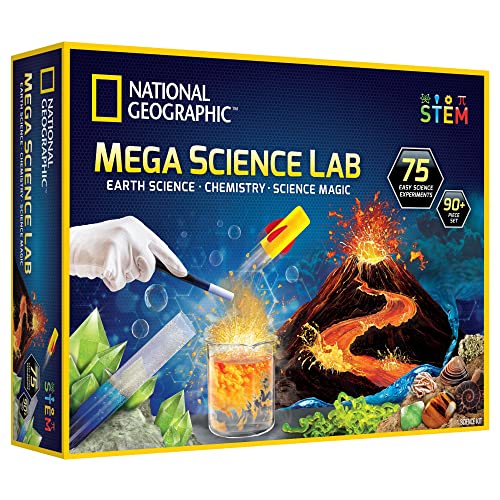
- 75 activities across chemistry, Earth science, and science magic
- Includes specimens and materials for hands-on exploration
- Designed for children ages 8 and up
Best For: Younger children seeking varied, approachable STEM activities
Best Large Molecular Kit
LINKTOR Chemistry Molecular Model Kit

- 444 pieces with atoms, bonds, and Fullerene C60 parts
- Includes ball-and-stick and space-filling models
- Supports geometry, bond angles, and stereochemistry
Best For: Students and teachers developing advanced 3D chemistry understanding
Best Intermediate Lab Kit

- 250 experiments with an extensive 128-page manual
- Real lab tools, chemicals, and alcohol burner included
- Designed for ages 11+ with adult supervision
Best For: Young learners ready for structured, hands-on intermediate chemistry
Best for Everyday Use
239-Piece Organic Chemistry Kit

- Builds reusable 3D atom-and-bond models
- Helps visualize molecular shapes and arrangements
- Includes 239 pieces plus guide and stencil
Best For: Older students studying organic chemistry structures
Best Experiment Starter Set
National Geographic Amazing Chemistry

- Includes materials for 15 featured experiments
- Adds 85 household-item bonus activities
- Designed for hands-on learning ages 8 and up
Best For: Younger children beginning hands-on chemistry
Lab-Ready Glassware
32-Piece Organic Chemistry Kit

- 32-piece borosilicate glass setup
- 24/40 joints for lab configurations
- Includes distillation and separation components
Best For: Experienced learners building an organic chemistry glassware setup
Guided Chemistry Basics

- 28 guided chemistry experiments
- 48-page full-color manual
- Includes basic lab equipment and chemicals
Best For: Ages 10–15 beginning hands-on chemistry
Expanded STEM Lab

- 125 experiments across 10 themed chapters
- 80-page manual with safety guidance
- Includes equipment, goggles, and seven chemicals
Best For: Ages 10+ seeking an extensive supervised chemistry program
Top Advanced Chemistry Set – Thames & Kosmos CHEM C3000
For shoppers seeking advanced chemistry sets for serious young scientists, the Thames & Kosmos CHEM C3000 offers an extensive, experiment-focused home laboratory. It includes more than 333 experiments spanning inorganic, organic, and electrochemistry, along with authentic lab equipment and a detailed manual.
Best For: Students ages 12 and up, homeschoolers, and aspiring chemists preparing for high school chemistry with adult supervision.
Pros:
- More than 333 experiments across 27 chapters and multiple chemistry fields.
- Includes glassware, an alcohol burner, electrodes, goggles, and other authentic equipment.
- 192-page manual explains procedures, chemical concepts, safety, and waste disposal.
- Designed to the EN 71-4 safety standard and includes a selected chemical inventory.
Cons:
- Adult supervision is required throughout use.
- Some experiments require common household additions.
- Its broad scope may be more than beginners need.
The C3000 is the strongest choice here for hands-on chemical reactions and structured study. Its extensive contents and advanced topics make it a substantial learning investment rather than a casual introductory kit.
Best Molecular Modeling Set – Advanced General and Organic Chemistry Model Set
This advanced chemistry set is designed for building and visualizing organic and inorganic structures rather than performing reactions. Its 180 precision parts support molecular geometry, stereochemistry, VSEPR theory, and general chemistry concepts in a portable, organized format.
Best For: Visual learners, chemistry students, teachers, and study groups working with molecular geometry and 3D structures.
Pros:
- Includes five VSEPR geometries plus square planar for complex ions.
- Supports organic and inorganic structures, stereochemistry, and bond types.
- Tool-free push-and-twist assembly is quiet and easy to reverse.
- Eight-compartment storage case keeps the components organized.
Cons:
- It is a molecular modeling kit, not a chemical reaction set.
- The listed product details contain inconsistent age recommendations, so buyers should verify suitability.
Choose this set when the priority is understanding molecular shape and spatial relationships. It complements textbook study especially well, but it will not provide the hands-on reactions or chemicals found in a laboratory-style kit.
Best Family Science Bundle – National Geographic Mega Science Lab
Although less specialized than other advanced chemistry sets, the National Geographic Mega Science Lab gives children a broad introduction to chemistry alongside Earth science and science magic. It combines 45 included experiments with 30 additional household-item activities for varied STEM exploration.
Best For: Children ages 8 and up who want entertaining, approachable experiments across several science topics.
Pros:
- Combines chemistry, Earth science, and science magic in one kit.
- Offers 75 total experiment ideas, including household-item activities.
- Includes rock, mineral, crystal, and fossil-related Earth science materials.
- No batteries are required, and the activities emphasize observation and critical thinking.
Cons:
- Its chemistry content is introductory rather than specialized.
- The kit is aimed at ages 8 and up, so advanced students may outgrow it.
- It covers multiple subjects instead of focusing deeply on chemistry.
This is a strong choice for younger children who benefit from variety and visual, playful activities. Buyers looking for rigorous chemistry theory or advanced laboratory techniques should consider a more specialized option.
Best Large Molecular Kit – LINKTOR Chemistry Molecular Model Kit
For shoppers comparing advanced chemistry sets centered on molecular visualization, the LINKTOR kit stands out with 444 pieces and two modeling approaches. It supports ball-and-stick and space-filling models, allowing learners to examine chemical structures, bond angles, stereochemistry, and Fullerene C60.
Best For: Students from roughly Grade 7 through graduate level, teachers, and learners developing spatial reasoning with 3D molecular models.
Pros:
- Includes 136 atoms, 158 bonds, and 150 Fullerene C60 parts.
- Offers both ball-and-stick and space-filling modeling formats.
- Supports molecular geometry, bond angles, chemical structures, and stereochemistry.
- Color-coded atoms and included disconnecting tools support assembly and reuse.
Cons:
- It teaches through models and does not include reaction chemicals or lab experiments.
- The product details list an inconsistent manufacturer age recommendation, so buyers should verify the intended learner age.
The LINKTOR is particularly appealing when a large component count and Fullerene-focused modeling are priorities. It provides broad 3D construction possibilities, but it works best as a companion to lessons rather than as a complete chemistry laboratory.
Best Intermediate Lab Kit – Thames & Kosmos Chem C2000
For shoppers seeking advanced chemistry sets for aspiring young chemists, the Thames & Kosmos Chem C2000 offers a substantial step beyond beginner kits. It combines 250 experiments, real lab equipment, carefully selected chemicals, and a 128-page manual covering a broad range of chemistry topics.
Best For: Students ages 11–15 who are ready for structured, hands-on chemistry with adult supervision.
Pros:
- Includes 250 experiments organized across 18 themed chapters.
- Real equipment supports heat-based, electrochemistry, chromatography, and reaction experiments.
- Detailed manual includes safety, first-aid, labeling, and waste-disposal guidance.
- Introduces an alcohol burner and apparatus-building components for more advanced activities.
Cons:
- Adult supervision is required, particularly for experiments involving chemicals and the alcohol burner.
- Its intermediate focus may be more involved than needed for younger beginners.
The C2000 is a strong choice when you want a genuine home-lab experience and a clear progression toward high school chemistry. Its extensive materials and manual make it one of the more comprehensive options in this group.
Best for Everyday Use – 239-Piece Organic Chemistry Kit
Among advanced chemistry sets, this 239-piece organic chemistry model kit takes a visual, hands-on approach rather than focusing on chemical reactions. Students can build reusable three-dimensional molecular structures to better understand atoms, bonds, shapes, and arrangements.
Best For: Chemistry students ages 15 and up, classrooms, and STEM learners studying organic molecular structures.
Pros:
- 239 pieces provide a broad collection of atoms and bonds for model building.
- Transforms flat textbook diagrams into physical 3D structures.
- Reusable components support repeated practice with different molecular configurations.
- Includes a bond remover tool, instructional guide, and bonus molecule stencil.
Cons:
- It is a modeling aid rather than a kit for conducting chemical experiments.
- The manufacturer recommends it for ages 15 and up, so it may not suit younger students.
This kit is best viewed as a study and visualization tool for organic chemistry. It can make molecular geometry and bonding easier to explore, especially when learners benefit from physically manipulating structures.
Best Experiment Starter Set – National Geographic Amazing Chemistry
For families comparing advanced chemistry sets for younger learners, the National Geographic Amazing Chemistry Set offers an accessible introduction to hands-on experimentation. It includes materials for 15 featured experiments and a guide with 85 additional activities using common household items.
Best For: Children ages 8 and up who want colorful, engaging chemistry projects with familiar materials.
Pros:
- Includes materials for experiments involving color changes, crystals, glowing test tubes, and more.
- Provides 85 bonus activities that use common household items.
- Includes hands-on tools such as test tubes, beakers, and pipettes.
- Introduces chemistry through visually engaging STEM projects.
Cons:
- Only 15 experiments use the included materials; the bonus activities require household supplies.
- Its age range and project style make it more introductory than the C2000.
This is a practical pick for younger children who are motivated by colorful results and short, hands-on projects. It offers plenty of activity ideas, but learners seeking deeper laboratory progression may want a more advanced intermediate kit.
Lab-Ready Glassware – 32-Piece Organic Chemistry Kit
24/40,New Organic Laboratory Glassware Kit,32 PCS,Lab Unit,Chemistry Set | Borosilicate Glass3.3
Check Price On AmazonFor advanced chemistry sets focused on laboratory technique, this 32-piece kit emphasizes authentic glassware rather than guided, kid-focused activities. Its 24/40-joint borosilicate components support distillation, separation, reflux-style setups, and other organic laboratory workflows.
Best For: Experienced students, educators, or hobbyists who already understand laboratory safety and want a broad organic chemistry glassware setup.
Pros:
- Includes 32 pieces, including round-bottom flasks, condensers, a separatory funnel, adapters, tubing, clips, pH paper, and a thermometer.
- Made from G3.3 borosilicate glass with 24/40 joints.
- Offers multiple condenser types and distillation components for varied setups.
Cons:
- The supplied notes do not indicate that chemicals, a stand, or other complete lab infrastructure are included.
- Its advanced glassware configuration may be unsuitable for beginners without supervision and proper safety equipment.
This is the most equipment-oriented option in the roundup. Choose it when interchangeable glassware and organic laboratory setups matter more than an experiment manual or preplanned activities.
Guided Chemistry Basics – Chem C500 Experiment Kit
Among advanced chemistry sets, the Thames & Kosmos Chem C500 is the more approachable entry point for learners who want structured practice. It combines 28 guided experiments with basic equipment, chemicals, and a 48-page manual covering acids, bases, reactions, gases, and invisible ink.
Best For: Children ages 10–15 who want a guided introduction to chemistry at home, with an adult available to help.
Pros:
- Provides 28 classic experiments with clear setup and explanation instructions.
- Covers acids and bases, fizzy and foamy reactions, invisible ink, and interactions among solids, liquids, and gases.
- Includes beakers, test tubes, chemicals, stoppers, pipettes, and a 48-page full-color guide.
Cons:
- It offers fewer experiments and less equipment than the Chem C1000.
- The supplied notes identify it as an introductory kit, so it may not satisfy learners seeking deeper laboratory technique.
C500 is a sensible choice when clear instructions and accessible demonstrations are the priority. It works well as a first step before moving to a larger, more technique-focused set.
Expanded STEM Lab – Chem C1000 125-Experiment Set
The Chem C1000 is one of the most comprehensive advanced chemistry sets here for young learners ready to move beyond simple kitchen-science activities. It combines 125 experiments, an 80-page manual, real lab equipment, seven chemicals, and safety guidance across ten themed chapters.
Best For: Ages 10 and up, homeschool families, and aspiring young scientists who want a longer, structured chemistry program with adult supervision.
Pros:
- Offers 125 hands-on experiments spanning indicators, chromatography, electrochemistry, crystals, electrolysis, surfactants, and food chemistry.
- Includes an 80-page full-color manual with step-by-step instructions, safety rules, hazard labeling, and disposal guidance.
- Provides lab equipment, Z87-rated safety goggles, and seven listed chemicals.
- Designed to introduce real laboratory technique and serve as a foundation for the CHEM series.
Cons:
- Adult supervision is required.
- The breadth of experiments may be more than a casual learner needs.
- The kit is recommended for ages 10 and up, rather than very young children.
C1000 is the strongest all-around pick for buyers seeking depth, variety, and a progressive learning path. Its extensive manual and built-in safety information make it especially suitable for supervised home or homeschool use.
How We Picked the Best Advanced Chemistry Sets
We compared these kits by the depth of their experiment coverage, the quality and variety of included components, instructional support, suitability for the stated age or study level, and overall usefulness for continued learning. We also considered whether a set emphasizes wet-lab experiments, molecular visualization, organic chemistry, inorganic chemistry, or a combination of approaches.
Because “advanced” can mean different things, this list includes both substantial student lab systems and focused model kits. Always check the manufacturer’s age guidance, supervision requirements, and any materials that must be supplied separately.
Quick Comparison
| Best For | Look For | Typical Strength |
|---|---|---|
| Beginning learners | Clear instructions and guided experiments | Confidence-building fundamentals |
| Intermediate students | More experiments and real lab equipment | Broader practical experience |
| Organic chemistry study | Detailed molecular model pieces | Understanding structure and bonding |
| Classrooms and teachers | Reusable components and flexible activities | Demonstrations and group learning |
| Young STEM learners | Age-appropriate experiments and visual guidance | Safe, engaging introductions |
Key Buying Factors for Advanced Chemistry Sets
Experiment Depth and Progression
Count more than the advertised number of activities. A useful set should explain the concepts behind each experiment and progress from basic observations to more demanding techniques. A well-designed manual is often as important as the equipment.
Equipment and Consumables
Look for practical items such as test tubes, measuring tools, droppers, funnels, protective accessories, and dedicated apparatus. Check whether chemicals, household ingredients, batteries, or replacement supplies are included or required separately. Reusable equipment improves long-term value.
Modeling and Chemistry Coverage
Molecular kits are especially helpful for visualizing three-dimensional structures, bond angles, isomers, and reaction changes. If organic chemistry is the priority, choose a set with enough specialized connectors and atom pieces to build a broad range of compounds.
Safety and Supervision
Read the safety instructions before purchase. Younger children should use experiment kits only with an attentive adult, while older students still need ventilation, protective eyewear where recommended, careful labeling, and responsible disposal practices.
Who Should Buy Which Advanced Chemistry Sets?
Choose a beginner or children’s experiment set for guided discovery and foundational science skills. Intermediate Thames & Kosmos kits are better suited to learners who want a larger experiment library, more realistic equipment, and a structured path toward independent work. Students focused on bonding, molecular geometry, or organic chemistry should prioritize a comprehensive model kit, either alone or alongside a wet-lab set. Teachers and homeschool families will benefit from reusable components, detailed manuals, and activities that can be demonstrated or repeated. For the best fit, match the kit’s complexity to the learner’s current knowledge rather than choosing solely by experiment count.