Choosing a digital temperature recorder for laboratory use comes down to accuracy, channel count, logging depth, and how easily you can review data later. The best models make it simple to monitor samples, equipment, and storage conditions without constant manual checks.
Below, we focus on practical options for lab workflows, from compact USB loggers to multi-channel thermocouple recorders with alarms and calibration features.
Best 10 Digital Temperature Recorder for Laboratory Picks for 2026
4-Channel SD Logger
Digital 4-Channel K-Type Thermocouple Recorder

- Tracks 4 channels with independent alarms
- Logs to the included 8G SD card
- Large LCD with real-time date/time display
Best For: multi-point lab temperature logging with SD-card records
Lab Probe Thermometer
Extra-Long Stainless Steel Probe Thermometer
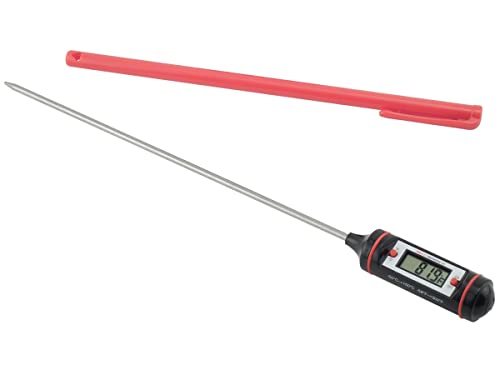
- 8.38-inch stainless steel probe
- High/low alarms with min/max memory
- Portable design with auto power-off
Best For: quick lab spot checks and portable temperature monitoring
Compact 4-Channel Logger
Supco Data View DVT4 4-Channel Logger

- Shows real-time data and logging summaries
- Graph display with scrolling alarm indicators
- Compact battery-powered 4-channel design
Best For: compact display-based lab or storage temperature monitoring
USB Thermocouple Logger
Tzone TC604 4-Channel Thermocouple Logger

- Works with K, T, and J type sensors
- Stores up to 49,920 data groups
- USB reporting with buzzer alarm
Best For: multi-sensor lab and industrial monitoring with USB reporting
Compact USB Logger
Elitech RC-5 Temperature Recorder

- 32,000 recording points
- Built-in USB for direct download
- IP65 protection with alarms
Best For: Labs and cold storage monitoring with easy USB reporting
Multi-Channel Thermocouple Logger

- Logs four thermocouple channels
- Wide range up to 1370°C
- 8G SD card with alarms
Best For: Multi-point lab and industrial temperature measurement
Pen-Style Medical Logger
Elitech RC-51H Temperature Monitor

- 32,000-point USB data logging
- Pen-style body with IP65 protection
- FDA 21 CFR Part 11 standard
Best For: Medical refrigeration and life science storage monitoring
Lab-Grade Multi-Channel Recorder
4-Channel K-Type Logger with CSV Export
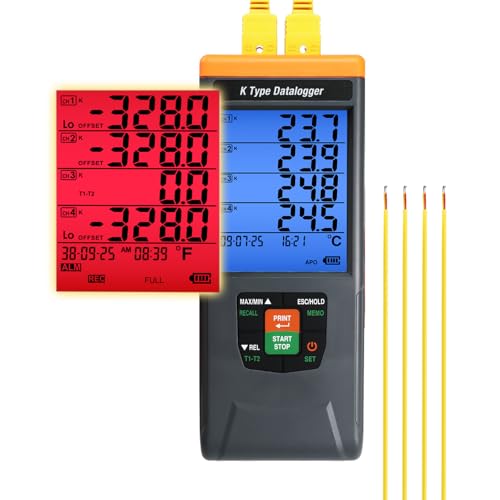
- 4 thermocouple channels
- 48,000-record storage
- USB-C CSV export with alarms
Best For: multi-point lab monitoring with traceable records
Dual-Probe RTD Recorder

- Reads two samples at once
- Large LCD with report output
- Calibration support and sound alarms
Best For: PT100 lab comparisons and simple USB reporting
High-Capacity Thermocouple Logger

- Up to 61,440 records
- Supports K, T, and J sensors
- USB exports to multiple file types
Best For: long-duration lab and process logging with flexible probes
4-Channel SD Logger – Digital 4-Channel K-Type Thermocouple Recorder
If you need a digital temperature recorder for laboratory work that can track multiple probes at once, this AZ Instruments model is built for that kind of monitoring. It offers 4-channel K-type input, real-time display, programmable alarms, and SD-card logging for continuous temperature records.
Best For: Labs that need multi-point temperature logging with alarm limits and SD-card record keeping.
Pros:
- Logs up to 4 channels with independent high/low alarms.
- Supports unlimited manual and auto logging using the included 8G SD card.
- Large LCD with real-time date/time display and blue backlight.
- Wide thermocouple range and 1-second sampling options.
Cons:
- Uses K-type thermocouples, so it’s not a universal sensor solution.
- Designed as a desktop logger, not a compact handheld unit.
Overall, this is a strong pick if your priority is recording multiple laboratory temperatures with straightforward on-device logging and alarm setup. The included probes, SD card, and battery power make it ready to use out of the box.
Lab Probe Thermometer – Extra-Long Stainless Steel Probe Thermometer
This digital temperature recorder for laboratory-style spot checks is a simple probe thermometer focused on fast, readable measurements. The extra-long stainless steel probe, min/max memory, and high/low alarms make it useful when you need a rugged handheld tool for routine monitoring.
Best For: Quick lab checks where a long probe, alarm limits, and easy portable use matter.
Pros:
- 8.38-inch stainless steel probe reaches into deeper containers or setups.
- High/low alarms plus minimum/maximum memory support monitoring tasks.
- 0.1-degree resolution and °F/°C switching for flexible reading.
- Auto power-off helps preserve the included battery.
Cons:
- Single-probe design does not log multiple channels.
- Temperature range is narrower than full thermocouple data loggers.
If you want a practical thermometer rather than a full recording station, this model keeps things straightforward. It’s best suited to users who need a durable, long-probe instrument for direct measurement and basic alarm-based oversight.
Compact 4-Channel Logger – Supco Data View DVT4 4-Channel Logger
For buyers comparing a digital temperature recorder for laboratory or cold-storage monitoring, the Supco DVT4 focuses on clear on-screen status and trend viewing. It shows real-time temperature, logging summary, sample rate, and memory usage, plus a graph display with scrolling and alarm indicators.
Best For: Users who want a compact 4-channel logger with display-based trend review.
Pros:
- 4-channel logging in a compact 4-inch footprint.
- Text and graph displays make it easier to review trends and alarms.
- External probe range supports lower temperatures for monitoring applications.
- USB connectivity and battery power support flexible use.
Cons:
- Internal probe range is much narrower than the external probe range.
- Less suitable if you need very high-temperature measurement.
This is a solid choice when visibility and compact size matter more than extreme temperature range. It’s especially appealing for users who want a small logger with built-in display feedback instead of relying only on downloaded data.
USB Thermocouple Logger – Tzone TC604 4-Channel Thermocouple Logger
If you need a digital temperature recorder for laboratory, HVAC, or industrial work, this Tzone TC604 stands out for its broad thermocouple support and built-in reporting. It measures four channels at once, stores up to 49,920 groups of data, and can generate reports over USB without software.
Best For: Multi-sensor monitoring where fast reporting, alarms, and broad thermocouple support are important.
Pros:
- Supports K, T, and J type sensors across 4 channels.
- Large data capacity with automatic USB report generation.
- Buzzer alarm, backlight, and auto-off improve day-to-day usability.
- Can show real-time, max, min, and average values with chart view.
Cons:
- Included sensor temperature range is more limited than the logger’s full range.
- Some settings require button-based setup rather than software configuration.
For users who want flexibility across different probe types and the convenience of built-in reporting, this logger is a capable option. Its combination of multi-channel measurement, alarm features, and large storage makes it practical for monitoring tasks that need both visibility and record keeping.
Compact USB Logger – Elitech RC-5 Temperature Recorder
If you need a digital temperature recorder for laboratory work that is simple to deploy and easy to review, the Elitech RC-5 is built around convenience. It records up to 32,000 points, covers -30℃ to 70℃, and uses a built-in USB connector so you can download data or generate a PDF report without a separate cable or reader.
Best For: Labs, vaccine storage, and cold-chain monitoring where fast USB downloads and long recording capacity matter.
Pros:
- 32,000 recording points for extended monitoring sessions
- Built-in USB connector for direct data download and PDF reporting
- LCD screen shows temperature, logged points, and alarm status
- IP65 protection and temperature alarms for demanding storage tasks
Cons:
- Single-channel temperature logging only
- Best suited to the stated temperature range of -30℃ to 70℃
- Requires free software for some functions like unit switching
Overall, the RC-5 is a practical pick when you want a straightforward logger with strong capacity, direct USB access, and the kind of durability useful in laboratory and refrigeration environments.
Multi-Channel Thermocouple Logger – 4-Channel SD Card Recorder
For buyers who need a digital temperature recorder for laboratory setups with multiple probes, this 4-channel K-type thermocouple logger offers broad measurement capability. It records to an 8G SD card, displays four readings at once, and supports a very wide temperature range for high-temperature or low-temperature testing.
Best For: Multi-point temperature measurement, industrial testing, and lab workflows that need four thermocouple channels.
Pros:
- Four-channel logging lets you monitor multiple points at once
- Very wide measurement range from -200 to 1370°C
- 8G SD card storage with data logging and alarm function
- Large LCD includes backlight, real-time clock, and Max/Min/Hold
Cons:
- More complex than a simple single-probe logger
- Operating temperature range is limited to 0 to 50°C
- Uses a 9V battery, which may be less convenient for some users
This is a strong choice when the priority is flexibility and multi-point measurement rather than portability. Its four channels, SD-card workflow, and thermocouple support make it especially useful for technical environments.
Pen-Style Medical Logger – Elitech RC-51H Temperature Monitor
The Elitech RC-51H is a digital temperature recorder for laboratory and cold-storage use when you want a small, pen-shaped device with simple data access. It stores up to 32,000 points, supports USB export, and can output PDF data without software, which makes routine checks and documentation easier.
Best For: Medical refrigerators, life science storage, and users who want a compact recorder with compliance-oriented features.
Pros:
- Pen-style design saves space and is easy to place in tight gaps
- Up to 32,000 points with quick PDF export
- IP65 protection helps with dust and water resistance
- Includes calibration certificate and meets FDA 21 CFR Part 11 standard
Cons:
- Temperature range is more limited than some multi-purpose loggers
- Response time is listed at 2 minutes
- Primarily focused on temperature recording rather than multi-sensor monitoring
For users who value compact size, compliance support, and easy reporting, the RC-51H is a practical laboratory and refrigerator monitoring option. Its pen-style body and direct PDF export help streamline day-to-day record keeping.
Lab-Grade Multi-Channel Recorder – 4-Channel K-Type Logger with CSV Export
If you need a digital temperature recorder for laboratory work that can track multiple points at once, this 4-channel K-type logger is built for that job. It covers a wide -200°C to 1370°C range, stores up to 48,000 records, and exports data to CSV over USB-C without software.
Best For: labs and industrial users who need multi-point thermocouple logging, alarms, and simple USB-C data export.
Pros:
- 4-channel thermocouple support with 0.1°C resolution
- Logs up to 48,000 records with adjustable sampling and start delay
- USB-C export to CSV, plus password protection and timestamped records
- Programmable high/low alarms with buzzer and LED alerts
Cons:
- Requires K-type thermocouples
- Manual mode stores only 99 entries
- More feature-rich than a basic single-probe recorder
This is a strong choice when traceability, alarming, and multi-channel monitoring matter more than simplicity. The included probes, long battery life, and handheld or desktop use make it practical for routine lab monitoring.
Dual-Probe RTD Recorder – PT100 Logger with Calibration
For buyers comparing a digital temperature recorder for laboratory use, this PT100 unit is aimed at dual-sample monitoring and quick reporting. It reads two objects at once, shows real-time/MAX/MIN/AVG values on a large LCD, and can generate reports through USB without software.
Best For: labs that need dual-channel PT100 logging, calibration support, and straightforward report output.
Pros:
- Dual-channel PT100 logging for two objects at the same time
- Large LCD with real-time, MAX, MIN, and AVG readings
- Temperature calibration support and adjustable alarm/logging settings
- USB auto-generated reports with no software required
Cons:
- Uses AA batteries rather than a rechargeable pack
- Supplied probes are PT100, so it is not a thermocouple logger
- Probe range listed in the notes is narrower than the device’s full range
Overall, this is a practical lab recorder when you want PT100-based measurement, dual-channel comparison, and easy data handling. The foldable stand, hanging design, and backlight also make it convenient for bench or field use.
High-Capacity Thermocouple Logger – Dual Probe K/T/J Recorder
This digital temperature recorder for laboratory and industrial monitoring focuses on capacity and flexibility. It supports K/T/J type sensors, logs up to 61,440 records, and can create TXT, CSV, XLS, or PDF reports directly over USB with no software.
Best For: labs, HVAC, ovens, and industrial users who need dual-channel thermocouple logging with large storage.
Pros:
- Dual-channel logging with up to 61,440 recordings
- Supports K, T, and J type sensors
- USB auto-reporting to TXT, CSV, XLS, or PDF
- Backlit LCD, alarm functions, and adjustable parameters
Cons:
- External probes are limited to the 0°C to 300°C range noted for the included sensors
- AA battery powered instead of rechargeable
- Bulky enough to be less ideal for very compact setups
For users who need long-run logging and flexible sensor compatibility, this model stands out as the most storage-heavy option in the group. Its dual-probe design, alarm settings, and desktop-friendly hanging or stand setup make it well suited to routine lab and process monitoring.
How We Picked the Best Digital Temperature Recorder for Laboratory
For a Digital Temperature Recorder for Laboratory settings, we prioritized measurement range, probe compatibility, logging capacity, display readability, calibration support, and data export options. We also favored models that fit real lab tasks such as refrigerator monitoring, bench testing, incubator checks, and multi-point temperature tracking.
Quick Comparison
If you need fast checks and simple reporting, USB loggers are usually easiest to manage. If you need live readings from multiple locations, multi-channel thermocouple units are more versatile. For regulated storage or sensitive samples, alarm functions, calibration, and longer recording memory are especially valuable.
Key Buying Factors for Digital Temperature Recorder for Laboratory
Accuracy and Calibration
Look for published accuracy specs and a way to calibrate or offset readings. In laboratory work, even small temperature drift can affect samples, media, or storage compliance.
Channel Count and Probe Type
Single-channel devices are fine for one location, but multi-channel recorders are better when you need to compare points across a refrigerator, incubator, or test setup. Also confirm whether the unit uses K-type thermocouples, PT100/RTD probes, or a built-in sensor so it matches your application.
Logging Capacity and Data Handling
More memory means longer unattended runs. USB download, automatic reporting, or SD card export can save time when you need to document trends or archive results.
Alarms and Visibility
Audible alarms, min/max alerts, and backlit displays help you catch out-of-range conditions quickly. That matters most when the recorder is used for storage, transport, or overnight monitoring.
Temperature Range and Probe Length
Make sure the operating range fits your cold-room, freezer, or heated application. Probe length matters too, especially when the sensing point must sit inside a chamber while the recorder remains outside.
Who Should Buy Which Digital Temperature Recorder for Laboratory?
Choose a compact USB logger if you mainly need simple documentation. Pick a multi-channel thermocouple recorder if you monitor more than one point at once. If your lab uses calibrated systems or RTD-based measurements, a PT100-compatible recorder is the better fit. For general storage monitoring, a model with alarms and reusable logging offers the best balance of convenience and control.
The right Digital Temperature Recorder for Laboratory work is the one that matches your measurement method, required record length, and reporting workflow. Focus on the features you will actually use every day, not just the highest number of specs.