TPU absorbs moisture quickly, which can lead to stringing, popping, rough surfaces, and inconsistent extrusion. A dedicated filament dryer helps restore and maintain the material before and during printing.
We compared 10 popular dryer boxes across temperature range, spool capacity, heating design, controls, and storage features to help you choose a practical setup for TPU and other moisture-sensitive filaments.
Best 10 Filament Dryer for Tpu Picks for 2026
Best Balanced TPU Dryer

- 45–65°C adjustable temperature
- Insulated chamber with circulating fan
- Fits most 1 kg spools
Best For: Everyday TPU drying with simple controls
Best High-Temperature Single-Spool Dryer

- 35–70°C temperature range
- 0–99-hour customizable timer
- Dries while printing with a rotating spindle
Best For: Flexible single-spool TPU drying
Best Multi-Spool TPU Dryer
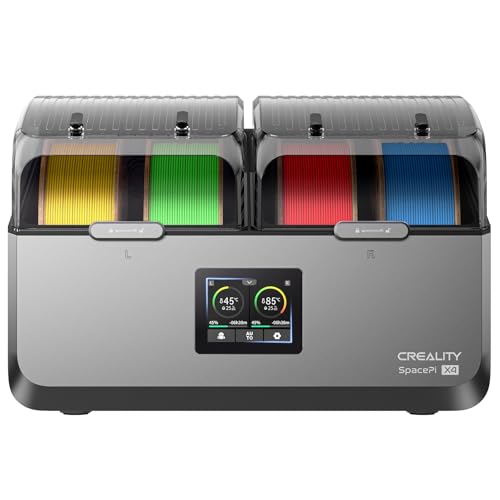
- Dries and prints up to four spools
- Two independently heated chambers
- Reaches up to 85°C
Best For: Multi-printer and mixed-material workflows
Best Simple TPU Dry Box

- Fan-assisted moisture discharge
- LCD shows temperature, time, and humidity
- Supports common filament diameters
Best For: Beginner-friendly single-spool TPU drying
Best Dual-Spool Filament Dryer for TPU

- Dries two 1kg spools at once
- Heats to 70°C with 360° airflow
- Preset mode includes TPU
Best For: Two-spool TPU drying and small multi-printer setups
Best High-Capacity Filament Dryer for TPU

- Dries four 1kg spools simultaneously
- Three fans circulate heat evenly
- Humidity control and triple safety system
Best For: Multi-printer workflows and high-volume TPU drying
Best Sealed Filament Dryer for TPU

- Dries, stores, and prints without breaking the seal
- Includes hygrometer and desiccant support
- Supports TPU and three filament diameters
Best For: Sealed TPU storage and direct-feed printing
Best Overall
Creality Space Pi Plus Filament Dryer

- Two-spool capacity for 1 kg rolls
- 160W PTC heating with 360° airflow
- 45°C–70°C settings and TPU preset
Best For: Multi-spool TPU drying and two-printer setups
Best Budget Storage
Comgrow SH01 Filament Dryer Box

- Holds two 1 kg spools
- Monitors temperature and humidity
- Sealed design supports dry feeding
Best For: Enclosed storage and lower-temperature drying
Best Single-Spool Value
Creality Space Pi Filament Dryer

- 110W PTC heater with 360° airflow
- 48-hour timer and power-off memory
- TPU preset with 45°C–70°C adjustment
Best For: Single-spool TPU drying with flexible scheduling
Best Balanced TPU Dryer – Creality Space Pi SE
If you need a practical filament dryer for TPU, the Creality Space Pi SE offers adjustable heat, timed drying, and compatibility with common 1 kg spools. Its insulated chamber and circulating fan are designed to distribute heat evenly while you print.
Best For: TPU users who want a straightforward dryer with broad filament compatibility and real-time humidity monitoring.
Pros:
- Adjustable 45–65°C temperature range and 0–24-hour timer
- Heats to 65°C within 15 minutes, according to the supplied specifications
- Insulated chamber and built-in fan support even heating
- Fits most 1 kg spools and 1.75 mm or 2.85 mm filament
Cons:
- Maximum temperature is lower than some engineering-filament dryers
- Designed around one 1 kg spool
- Post-drying storage in a vacuum bag is recommended to maintain dryness
The Space Pi SE is a well-rounded choice for TPU and everyday materials. Its broad compatibility and simple controls make it useful for routine drying, while the 65°C ceiling may be limiting for users who also need higher-temperature engineering-filament drying.
Best High-Temperature Single-Spool Dryer – SUNLU Filament Dryer S2
The SUNLU S2 is a versatile filament dryer for TPU that can also function as a spool holder during printing. Its 35–70°C temperature range, long timer, and rotating spindle provide useful control for damp or previously stored filament.
Best For: Makers who want a single-spool dryer with a high maximum temperature, touch controls, and the ability to dry while printing.
Pros:
- Adjustable temperature from 35–70°C and drying time from 0–99 hours
- Built-in spindle rotates the filament for even drying
- Can dry filament during printing and serve as a spool holder
- Supports 1.75 mm, 2.85 mm, and 3.00 mm filament
Cons:
- Single-spool design is less suitable for multi-material workflows
- The supplied notes do not specify a humidity readout
- Large capacity does not indicate compatibility with multiple spools at once
With its 70°C maximum and 99-hour timer, the S2 offers more temperature and time flexibility than many basic dryer boxes. It is a strong option when TPU needs drying during a print, provided one-spool capacity meets your workflow.
Best Multi-Spool TPU Dryer – Creality Space Pi X4
For larger setups, the Creality Space Pi X4 is a high-capacity filament dryer for TPU with four-spool drying and printing. Its two independently heated chambers can run at different temperatures, making it suited to users managing several materials or printers.
Best For: Multi-printer users and advanced makers who need to dry and feed up to four spools while handling different temperature requirements.
Pros:
- Dries and prints with up to four spools at once
- Dual chambers provide independent temperature control
- Dual 200W PTC heaters reach up to 85°C
- Single-chamber mode can save up to 40% energy, according to the supplied notes
Cons:
- More capacity and hardware than a single-spool TPU user may need
- The notes caution that other brands’ plastic trays should be heat resistant
- Higher-temperature operation requires attention to spool and material compatibility
The Space Pi X4 is the most capable option here for throughput and mixed-material workflows. Its independent chambers and 85°C ceiling add flexibility, but its four-spool format makes the most sense for serious multi-printer or engineering-filament users.
Best Simple TPU Dry Box – SUNLU S1 Plus
The SUNLU S1 Plus is a simple, accessible filament dryer for TPU with fan-assisted drying, an LCD display, and controls for temperature and time. Its spool capacity supports common filament diameters and major material types.
Best For: Beginners and casual users who want a compact dryer box for one spool with visible temperature, time, and humidity information.
Pros:
- Fan design helps discharge excess moisture during drying
- 2-inch LCD displays temperature, time, and humidity
- Supports 35–55°C temperature adjustment
- Compatible with 1.75 mm, 2.85 mm, and 3.00 mm filament
Cons:
- 55°C maximum temperature is lower than the other listed options
- The supplied notes do not specify a programmable drying-time range
- Capacity is limited to a single spool
The S1 Plus focuses on ease of use rather than high-temperature or multi-spool performance. It is a sensible entry-level choice for TPU drying and storage, especially when a humidity display and fan-assisted operation are more important than maximum heat.
Best Dual-Spool Filament Dryer for TPU – Comgrow SH02
If you need a filament dryer for TPU that can handle more than one spool, the Comgrow SH02 offers a practical two-roll setup. Its 150W PTC heater reaches up to 70°C, while preset modes simplify drying TPU and other common materials.
Best For: Users who want to dry two 1kg spools at once or feed two printers from one sealed dryer.
Pros:
- Holds and dries two 1kg filament rolls simultaneously.
- Reaches 70°C with 360° circulating hot air.
- One-key presets cover TPU, PLA, PETG, ABS, and other filament types.
- Multiple sealing rings and safety protections support longer drying cycles.
Cons:
- Its two-spool capacity is smaller than four-spool alternatives.
- The 70°C maximum may be limiting for some higher-temperature materials.
The SH02 is a strong fit when capacity, preset controls, and sealed storage matter. Its two-spool design is especially useful for small multi-printer setups without taking up the space of a larger dryer.
Best High-Capacity Filament Dryer for TPU – SUNLU S4
For users searching for a filament dryer for TPU across several printers, the SUNLU S4 provides four-spool capacity and heating up to 70°C. Its three fans circulate heat evenly, while humidity control helps maintain a drier interior during use.
Best For: Multi-printer users and larger projects requiring simultaneous drying of up to four 1kg spools.
Pros:
- Holds four 1kg spools for simultaneous drying.
- Supports common 1.75mm, 2.85mm, and 3.0mm filament diameters.
- Three fans provide 360° circulation for more even heating.
- Includes a triple-safe system with a 350W PTC heater, backup thermal switch, and software monitoring.
Cons:
- Its four-spool design is larger and heavier than compact dryers.
- The 70°C maximum may not suit every high-temperature filament.
The S4 stands out when throughput is the priority. Its large capacity and support for feeding up to four printers make it a practical choice for active multi-material or multi-color workflows.
Best Sealed Filament Dryer for TPU – Polymaker PolyDryer
The Polymaker PolyDryer is a filament dryer for TPU designed around drying, sealed storage, and direct feeding. Its Dry Dock and storage box combination uses heated drying, 360° airflow, a hygrometer, sealing, and desiccant support to reduce moisture exposure between prints.
Best For: TPU users who want to dry, store, and print from the same sealed system.
Pros:
- Combines drying, storage, and direct printing without breaking the seal.
- Supports TPU along with PA Nylon, PLA, PETG, ABS, ASA, and PVB.
- Works with 1.75mm, 2.85mm, and 3.00mm filament sizes.
- Built-in hygrometer and desiccant support help monitor and maintain dry conditions.
Cons:
- It is designed around one filament setup rather than multiple simultaneous spools.
- The supplied notes do not specify a maximum drying temperature or drying time.
Choose the PolyDryer if keeping TPU protected after drying is as important as the drying step itself. Its integrated sealed workflow minimizes handling and helps keep filament ready between print sessions.
Best Overall – Creality Space Pi Plus Filament Dryer
If you need a filament dryer for TPU that can handle more than one spool, the Creality Space Pi Plus is a versatile option. Its two-spool capacity, 160W PTC heating, and 360° hot-air circulation are designed for more even drying, while the touch screen simplifies temperature and time adjustments.
Best For: Makers who want to dry two 1 kg spools or supply two printers at once.
Pros:
- Holds two 1 kg spools and includes four filament outlets with two PTFE tubes.
- Uses 160W PTC heating and 360° hot-air circulation for uniform warming.
- Offers one-key settings for 12 filament types, including TPU, with adjustable temperatures from 45°C to 70°C.
- Features a 4-inch LCD touch screen and supports 1.75 mm and 2.85 mm filament.
Cons:
- Its 5.5-pound design is less compact than a single-spool dryer.
- The temperature range may be limiting for materials requiring higher drying temperatures.
For TPU users who value capacity and straightforward controls, this is the most feature-rich choice in the group. Its dual-spool design is especially useful when drying filament for multiple printers.
Best Budget Storage – Comgrow SH01 Filament Dryer Box
The Comgrow SH01 is a practical filament dryer for TPU when you want drying and enclosed storage in one box. It holds two 1 kg spools, provides adjustable 40°C–50°C heating, and includes temperature and humidity monitoring, though its lower maximum temperature is better suited to basic drying and moisture control.
Best For: Budget-conscious users who prioritize sealed storage and in-printer dry feeding.
Pros:
- Stores two 1 kg spools and supports 1.75 mm and 2.85 mm filament.
- Provides temperature and humidity monitoring through a 2-inch LCD screen.
- Includes a sealed cover, silicone cable sheath, and Teflon tube outlet for feeding filament while enclosed.
- Offers adjustable 40°C–50°C temperatures and six- to 12-hour drying times.
Cons:
- The 50°C maximum temperature is lower than the other listed dryers.
- Operation requires the work state to appear on the screen or the unit may shut down after three minutes.
- The supplied notes identify common materials but do not specifically list TPU compatibility.
This Comgrow model makes the most sense if your priority is keeping spools enclosed during printing rather than using aggressive drying settings. Check that its temperature range suits your TPU before buying.
Best Single-Spool Value – Creality Space Pi Filament Dryer
For a compact filament dryer for TPU, the Creality Space Pi combines 360° hot-air circulation with a 110W PTC heater and simple touchscreen controls. It supports a broad range of materials and adds a 48-hour timer plus power-off memory, making it convenient for longer drying cycles.
Best For: Users who want a single-spool dryer with flexible timing and material presets.
Pros:
- Uses 110W PTC heating with a fan-assisted 360° hot-air circulation system.
- Supports one-key settings for 12 filament types, including TPU, with 45°C–70°C adjustment.
- Offers a 0–48-hour timer and remembers material and temperature settings after power loss.
- Works with common 1.75 mm and 2.85 mm filaments, including TPU, PLA, PETG, ABS, and nylon.
Cons:
- The supplied details list one included dryer rather than a two-spool design.
- Its 3.7-inch screen is smaller than the Plus model’s 4-inch display.
- At 110W, it has less heater power than the 160W Space Pi Plus.
This is a well-rounded pick for one spool at a time, particularly if you value unattended drying and settings recovery after an outage. Choose the Plus model instead if you regularly need two spools drying together.
How We Picked the Best Filament Dryer for Tpu
We focused on features that matter when drying flexible filament: adjustable heat, stable temperature control, useful spool capacity, reliable airflow, and the ability to feed filament directly to a printer. We also considered whether each unit supports one or two spools, accommodates common 1 kg rolls, and provides sealed storage after drying.
Because TPU can deform or become difficult to handle if overheated, precise controls and sensible temperature ranges received more weight than maximum heat alone. Models that also support nylon, PETG, PLA, or ABS offer greater long-term value for mixed-material print setups.
Quick Comparison
Single-spool dryers are compact and often easier to place beside a desktop printer. Dual-spool models are better for users who print frequently, switch colors often, or want to dry two materials at once. Higher-capacity units may include independent chambers, stronger heating, or more advanced displays, but they also take up more space.
For TPU, look for a dryer with adjustable settings around the material manufacturer’s recommended range rather than choosing solely by its advertised maximum temperature. A clear display, timer, and low-noise operation can make repeated drying cycles much easier to manage.
Key Buying Factors for a Filament Dryer for Tpu
Temperature Control
TPU typically needs controlled, moderate heat. Choose a model with adjustable temperature and a sensor-based system instead of a basic heater that runs at one fixed level. Always follow the drying instructions for your specific TPU blend.
Capacity and Spool Compatibility
Check the internal dimensions and supported spool width before buying. Most options in this roundup target standard 1 kg spools, while dual-chamber designs can handle two rolls but may be bulkier. Confirm that the spool holder turns smoothly and that the filament path does not create excessive drag.
Heating, Airflow, and Runtime
PTC heating elements can warm a chamber efficiently, while circulating airflow helps distribute heat. A timer is useful for overnight or multi-hour cycles, but drying performance still depends on the chamber design and how well it limits moisture re-entry.
Dry Storage and Feeding
If you plan to print directly from the box, choose a dryer with sealed exits and a smooth feed path. Storage features such as a tight lid, gasket, or humidity management can help keep TPU dry between prints.
Who Should Buy Which Filament Dryer for Tpu?
Choose a compact single-spool dryer if you print TPU occasionally, have limited desk space, or want the simplest setup. These units are usually sufficient for one roll and easier to move between printers.
Choose a dual-spool dryer if you regularly print flexible filament, maintain several active materials, or want to prepare a spare spool while another is printing. Independent chambers are especially useful when different materials need different settings.
Choose a higher-temperature, feature-rich model if you also use nylon or other demanding engineering filaments. Extra temperature range, stronger heating, and better monitoring can justify the larger footprint when your material library extends beyond TPU.
Whichever model you select, dry TPU before demanding prints, keep the filament sealed afterward, and use the lowest effective temperature recommended by the filament manufacturer.