Nylon absorbs moisture quickly, and damp filament can cause popping, stringing, weak layers, and inconsistent extrusion. A dedicated dryer helps restore and maintain filament quality before and during printing.
We compared 10 filament dryers across temperature control, spool capacity, drying performance, storage design, and compatibility with nylon and other moisture-sensitive materials.
Best 10 Filament Dryer for Nylon Picks for 2026
Best Overall
Creality Space Pi Filament Dryer

- 360° PTC hot-air heating
- Presets for nylon and PA-CF
- 45–70°C range with 48-hour timer
Best For: Makers seeking versatile, even filament drying
Best Simple Option

- Dries while printing
- 0–99-hour timer
- Rotating spindle for even drying
Best For: Straightforward single-spool drying and feeding
Best High-Capacity Pick
Creality Space Pi X4 Filament Dryer

- Four-spool capacity
- Dual independent heating chambers
- Up to 85°C for nylon workflows
Best For: Multi-spool and multi-printer setups
Best Preset Controls

- Nylon and PA-CF presets
- 360° PTC hot-air heating
- Power-failure setting memory
Best For: Single-spool users who value simple guided controls
Best Integrated Nylon Solution

- Dries, stores, and prints without breaking the seal
- Supports PA nylon and multiple filament diameters
- Includes 360° airflow and hygrometer monitoring
Best For: Sealed, ongoing moisture control for nylon and other filaments
Best Dual-Chamber Capacity

- Holds up to four 1 kg spools
- Independent chamber temperature and power controls
- 45–85°C range with automatic drying mode
Best For: High-volume, multi-material filament drying
Best Multi-Printer Nylon Dryer

- Dries four 1 kg spools simultaneously
- Supports nylon and common filament diameters
- Adds humidity-triggered operation and three circulation fans
Best For: Multi-printer workflows needing automated humidity control
Best for Bambu Lab AMS Upgrades
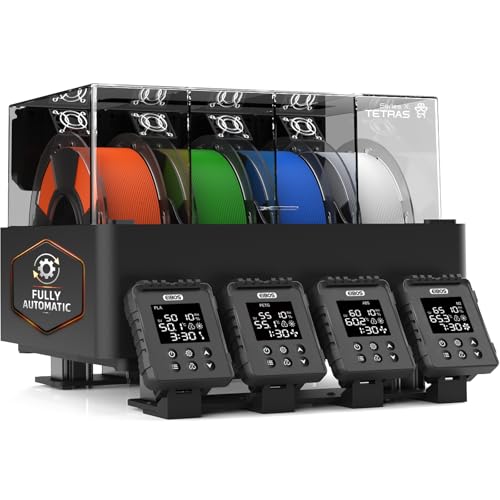
- Four independent drying chambers
- Dries while printing
- Sealed storage with humidity control
Best For: Bambu Lab AMS Gen 1 owners drying multiple spools
Best Dual-Spool Nylon Dryer
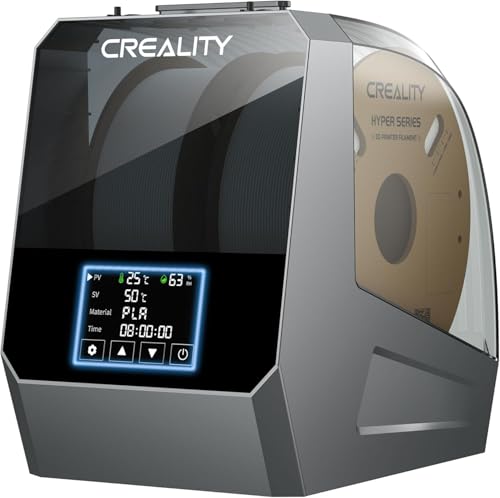
- Dries two 1 kg spools
- 160W 360° PTC heating
- Presets include PA and PA-CF
Best For: Two-spool nylon drying with touchscreen controls
Best Value Sealed Dryer

- Two-spool sealed drying box
- 150W fast PTC heating
- PA preset and safety protections
Best For: Enclosed nylon drying and storage on a practical budget
Best Overall – Creality Space Pi Filament Dryer
For a practical filament dryer for nylon, the Creality Space Pi combines 360° circulating hot air with a 110W PTC heater for more uniform drying. Its adjustable 45–70°C range, material presets, and support for PA-CF make it a versatile choice for everyday and composite-filament users.
Best For: Makers who want even heating, simple controls, and broad filament compatibility.
Pros:
- 360° hot-air circulation and a 110W PTC heater support uniform drying.
- Presets cover 12 filament types, including nylon, PA-CF, PLA-CF, and ASA.
- Features a 0–48-hour timer, 3.7-inch touch screen, and power-failure memory.
- Accepts both 1.75mm and 2.85mm filament.
Cons:
- Its maximum adjustable temperature is 70°C.
- The notes describe capacity for a single filament dryer unit rather than a multi-spool system.
This is a well-rounded nylon-capable dryer for users who value even PTC heating and convenient presets. Consider a higher-temperature model if your drying routine regularly needs more than 70°C.
Best Simple Option – SUNLU Filament Dryer S2
The SUNLU S2 is a straightforward filament dryer for nylon that can dry filament while also serving as a spool holder during printing. It offers adjustable temperatures from 35–70°C, a 0–99-hour timer, and continuous spool rotation for even drying.
Best For: Users who want an easy-to-operate dryer with long timer settings and in-use filament feeding.
Pros:
- Can dry filament during printing and function as a storage dehydrator.
- Built-in spindle continuously rotates the spool for even drying.
- Temperature adjusts from 35–70°C and the timer from 0–99 hours.
- Large capacity supports 1.75mm, 2.85mm, and 3.00mm filament.
Cons:
- The maximum temperature is 70°C.
- The supplied notes do not identify a dedicated nylon preset.
- It is presented as a single-spool dryer.
Choose the S2 when uncomplicated controls, spool rotation, and a very long timer are more important than multi-spool operation or higher-temperature drying.
Best High-Capacity Pick – Creality Space Pi X4 Filament Dryer
For demanding nylon workflows, the Creality Space Pi X4 is a high-capacity filament dryer for nylon with four-spool storage and two independently controlled heating chambers. Its 45–85°C range, separate schedules, and 360° hot-air circulation suit multi-material printing setups.
Best For: Multi-printer users who need to dry several spools or different materials at once.
Pros:
- Holds up to four spools and can run two chambers independently.
- Each chamber supports separate 45–85°C temperature and 0–48-hour duration settings.
- Supports nylon, PA-CF, PLA-CF, ASA, and common 1.75mm or 2.85mm filaments.
- Single-chamber mode can reduce energy use when drying smaller loads.
Cons:
- Its large 14.57-pound build is less compact than single-spool dryers.
- The supplied notes state that materials requiring over 85°C may need extended drying time.
- Higher capacity may be unnecessary for occasional users.
The X4 stands out when capacity and independent control matter. It is especially practical for multi-material projects, though a smaller dryer may be more efficient for one-spool routines.
Best Preset Controls – Creality Space Pi V2
The Creality Space Pi V2 is a user-friendly filament dryer for nylon with one-button material settings, 360° PTC heating, and a 3.7-inch touch screen. It supports nylon and PA-CF alongside common filaments, making it a convenient option for single-spool drying.
Best For: Users who prefer guided material presets and straightforward temperature and time controls.
Pros:
- Preset selection includes PA (nylon), PA-CF, and 10 other filament types.
- Dual 110W PTC heating and 360° hot-air circulation promote uniform drying.
- Offers 45–70°C temperature control and a 0–48-hour timer.
- Remembers material and temperature settings after a power interruption.
Cons:
- Its 70°C adjustable range is lower than the Space Pi X4’s maximum.
- The notes indicate compatibility with most 1kg spools but do not describe multi-spool capacity.
- It lacks the X4’s independent chamber controls.
The Space Pi V2 is a sensible choice for nylon users who want quick preset selection without complicated setup. Look elsewhere if you need simultaneous drying of multiple spools or temperatures above 70°C.
Best Integrated Nylon Solution – Polymaker PolyDryer
If you need a filament dryer for nylon that also handles storage, the Polymaker PolyDryer combines heated drying with a sealed storage box and direct feeding. It supports PA nylon along with PLA, PETG, ABS, ASA, TPU, and PVB, with compatibility for 1.75 mm, 2.85 mm, and 3.00 mm filament.
Best For: Users who want one modular system for drying, storing, monitoring, and printing from filament without breaking the seal.
Pros:
- Combines drying, sealed storage, and direct printing in one setup.
- Supports PA nylon and a broad range of common filament types and diameters.
- Uses 360° airflow, heat control, sealing, desiccant support, and a built-in hygrometer.
Cons:
- Its 1 kg capacity is smaller than the multi-spool alternatives in this roundup.
- The system weighs 1.3 kg and uses a modular dock-and-box design that may take more setup than a basic dryer.
The PolyDryer is a strong choice when moisture management continues between prints. Its main advantage is the connected dry-store-print workflow, especially for nylon users who want to limit ambient exposure.
Best Dual-Chamber Capacity – Comgrow SH03 4-Spool Dryer
The Comgrow SH03 is a high-capacity filament dryer for nylon and other materials, with two independently controlled chambers that can hold up to four 1 kg spools. Its adjustable 45–85°C range, automatic drying mode, and active airflow controls make it suited to varied multi-spool workflows.
Best For: Multi-material users who need simultaneous drying, separate chamber controls, and extended operation for several spools.
Pros:
- Holds up to four 1 kg spools in two independently controlled chambers.
- Supports PA, PC, PLA, ABS, PETG, TPU, and ASA with temperatures up to 85°C.
- Offers automatic humidity-based drying, 360° hot-air circulation, and up to 98 hours of continuous operation.
- Includes multiple monitoring and protection systems, including fan and temperature checks.
Cons:
- Its larger capacity and dual-chamber controls may be more than a single-spool user needs.
- The supplied notes do not specify a humidity display or exact nylon-specific drying profile.
Choose the SH03 when throughput matters more than compactness. Independent chambers are particularly useful when drying different materials or running several spools at once, while the broad temperature range accommodates nylon and other demanding filaments.
Best Multi-Printer Nylon Dryer – SUNLU S4 Filament Dryer
The SUNLU S4 is a practical filament dryer for nylon when you need to prepare several spools at once. It holds four 1 kg rolls, reaches up to 70°C, supports common filament diameters, and is designed to feed up to four FDM printers concurrently.
Best For: Multi-printer setups and users who want automated humidity control with broad filament compatibility.
Pros:
- Holds four 1 kg spools for simultaneous drying.
- Supports nylon, TPU, PLA, PETG, and ABS, plus 1.75 mm, 2.85 mm, and 3.0 mm diameters.
- Uses three circulation fans for 360° surround heating and more even temperature distribution.
- Automatically activates around 30–50% RH and stops below 25% RH.
Cons:
- Its maximum 70°C temperature is lower than the Comgrow SH03’s stated 85°C maximum.
- The large four-spool design may be unnecessary for occasional single-spool drying.
The S4 stands out for capacity and automation rather than the highest heat range. It is a sensible fit for nylon users managing multiple printers, especially those who value humidity-triggered operation and straightforward multi-spool handling.
Best for Bambu Lab AMS Upgrades – EIBOS Tetras 4-Spool Dryer
If you need a filament dryer for nylon and other moisture-sensitive materials while printing, the EIBOS Tetras adds four independently controlled drying chambers to a Bambu Lab AMS Gen 1. Each chamber supports adjustable temperatures from 20°C to 65°C, active airflow, and drying during printing.
Best For: Bambu Lab AMS Gen 1 owners who want simultaneous, independent drying and sealed storage for up to four spools.
Pros:
- Four independent chambers with separate temperature and humidity monitoring.
- Supports nylon, PLA, PETG, ABS, TPU, and other filaments.
- Can dry while printing, then automatically seal chambers for storage.
- Automatic moisture exhaust and humidity-mode reactivation help maintain dry conditions.
Cons:
- Designed as an add-on for Bambu Lab AMS Gen 1; the AMS is not included.
- Requires its own power supply and installation.
The Tetras is the most specialized option here, particularly for multi-material workflows involving nylon. Its independent controls and dry-while-printing design are useful when several spools need different treatment, but compatibility is limited to the specified AMS setup.
Best Dual-Spool Nylon Dryer – Creality Space Pi Plus
The Creality Space Pi Plus is a practical filament dryer for nylon when you want room for two 1 kg spools and straightforward controls. Its 160W PTC system circulates hot air around the chamber, while the touchscreen offers preset settings for PA and other common and composite filaments.
Best For: Users who want to dry two spools at once with touchscreen controls, preset filament profiles, and adjustable temperatures from 45°C to 70°C.
Pros:
- Holds two 1 kg filament rolls and includes four filament holes.
- 360° hot-air circulation and a 160W PTC heater support uniform heating.
- Includes one-key settings for up to 12 filament types, including PA and PA-CF.
- Four-inch LCD touchscreen makes temperature and unit selection simple.
Cons:
- The stated temperature range begins at 45°C, offering less low-temperature flexibility than the EIBOS Tetras.
- It is a two-spool dryer rather than a separately controlled four-chamber system.
For nylon users who do not need AMS integration, the Space Pi Plus offers a balanced combination of capacity, guided settings, and hot-air circulation. Its support for PA and PA-CF presets makes it especially convenient for high-performance filament routines.
Best Value Sealed Dryer – Comgrow SH02 Filament Dryer
The Comgrow SH02 is a compact filament dryer for nylon that combines two-spool capacity with a sealed storage design. Its 150W PTC heater reaches 50°C within seven minutes and 70°C within 25 minutes, while preset PA settings simplify drying for users who prefer one-key operation.
Best For: Makers seeking an enclosed two-spool dryer with fast heating, PA presets, and added sealing and safety features.
Pros:
- Dries two 1 kg spools simultaneously and supports 1.75 mm and 2.85 mm filament.
- 150W 360° PTC heating reaches up to 70°C with a built-in fan.
- One-key presets cover nine filament types, including PA, PC, and PP.
- Sealing rings and PTFE outlet seals help protect stored filament from moisture.
Cons:
- Its maximum temperature is 70°C, which may be limiting for drying routines requiring higher temperatures.
- Preset coverage is narrower than the Creality model’s 12 filament types.
The SH02 is a sensible choice when sealed storage and quick setup matter as much as active drying. It provides dedicated PA support and useful safety protections, while its two-spool layout suits users running multiple printers or materials.
How We Picked the Best Filament Dryer for Nylon
We focused on dryers that can handle nylon’s higher moisture sensitivity rather than treating every filament box as interchangeable. Our comparison considers maximum temperature, heating consistency, airflow, humidity management, spool compatibility, and whether the unit can feed filament while drying. We also weighed capacity, controls, noise, portability, and storage usefulness for common materials such as PLA, PETG, TPU, ABS, and PA nylon.
Temperature claims are only part of the picture. A good dryer should distribute heat evenly, provide practical controls, and make it easy to load the spool and route filament to the printer without exposing it to humid air.
Quick Comparison
- Best for compact setups: Single- or two-spool dryers such as the SUNLU S2, Creality Space Pi models, and Comgrow SH02.
- Best for multiple materials: Four-spool options, including the Creality Space Pi X4, SUNLU S4, Comgrow SH03, and EIBOS Tetras.
- Best for storage and printing: Units with sealed outlets, humidity control, or continuous feed paths.
- Best for AMS-focused workflows: The EIBOS Tetras, designed to integrate with compatible Bambu Lab AMS setups.
- Best for dedicated nylon preparation: A model with a high maximum temperature, stable circulation, and enough space for your largest PA spool.
Key Buying Factors for a Filament Dryer for Nylon
Temperature and Control
Nylon generally benefits from more heat and longer drying times than PLA. Look for a dryer with a temperature range suitable for PA materials, clear controls, and a timer or adjustable drying cycle. Higher maximum temperature is useful, but stable, even heating matters more than a headline number.
Capacity and Spool Fit
Check whether the chamber accepts standard 1kg spools, wider industrial rolls, or multiple spools at once. Extra capacity is valuable only if the dryer maintains adequate airflow and does not make loading or filament routing awkward.
Drying While Printing
For nylon, feeding directly from the dryer can prevent the filament from reabsorbing moisture between drying and printing. Prefer sealed grommets, smooth spool rollers, and a path that does not add excessive resistance to the extruder.
Storage and Moisture Protection
A dryer can double as a storage box, but sealing quality varies. Consider humidity displays, desiccant compatibility, airtight outlets, and whether the chamber can keep filament dry after the heating cycle ends.
Who Should Buy Which Filament Dryer for Nylon?
Choose a compact two-spool dryer if you print nylon occasionally or have limited workspace. A four-spool model is a better fit for production users, multi-material workflows, or anyone who wants several rolls ready to print. Choose an AMS-compatible system if your setup depends on automated spool handling. For frequent PA nylon printing, prioritize the strongest temperature control, continuous-feed design, and reliable sealing over the lowest purchase price.