The best chemistry sets for classrooms make abstract concepts easier to see, handle, and remember. This roundup covers molecular model kits, plastic measuring equipment, test tubes, beakers, and glassware for lessons ranging from introductory science to organic chemistry.
Use the comparison and buying advice below to match your classroom’s age group, curriculum, storage needs, and safety requirements with the right combination of tools.
Best 10 Chemistry Sets for Classrooms Picks for 2026
Best Molecular Modeling Set
LINKTOR 444-Piece Chemistry Kit

- 444 pieces for organic and inorganic structures
- Builds ball-and-stick and space-filling models
- Useful for geometry and stereochemistry lessons
Best For: Middle school through graduate-level molecular modeling
Best Basic Labware Value
Teenitor Plastic Beaker and Cylinder Set

- Ten vessels in varied metric capacities
- Reusable plastic resists acids and alkalis
- Raised scales and stable cylinder bases
Best For: Introductory classroom liquid measurement
Best Portable Molecular Kit
444-Piece Organic Chemistry Set

- Includes atoms, bonds, and fullerene parts
- Builds two styles of molecular models
- Portable snap-lock design for classroom or lab
Best For: Portable high school and college molecular study
Best Complete Plastic Lab Set
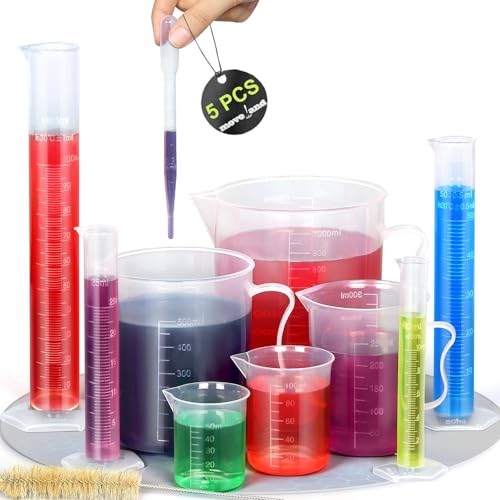
- Includes beakers, cylinders, pipettes, and brush
- Handles improve beaker grip and control
- Durable plastic with stable bases and raised scales
Best For: Home-school and middle-school liquid activities
Advanced Molecular Modeling
Swpeet 122-Piece Chemistry Kit

- 122 pieces for organic and inorganic structures
- Color-coded atoms with multiple bond types
- Storage case and link-remover tool included
Best For: Advanced molecular modeling lessons
Classroom Lab Essentials

- Includes cylinders, beakers, flasks, tubes, and pipettes
- Multiple sizes for measuring and mixing
- Reusable break-resistant plastic construction
Best For: Introductory liquid-handling activities
Hands-On Structure Building
118-Piece Organic Chemistry Kit

- 118 reusable pieces for molecular models
- Makes 3D atom and bond arrangements visible
- Easy assembly for repeated classroom practice
Best For: Visual and tactile organic chemistry lessons
Hands-On Starter Kit
33-Piece Plastic Lab Science Set

- 33 plastic lab tools for experiments
- Includes goggles, gloves, rack, and droppers
- Easy-clean design for classroom activities
Best For: Junior classroom science projects and supervised exploration
Full Glassware Collection
37-Piece Glass Chemistry Lab Kit

- Borosilicate glass labware assortment
- Graduated cylinders from 10 ml to 100 ml
- Beaker capacities up to 1000 ml
Best For: School labs, demonstrations, and science fairs
Measurement-Focused Set

- Six graduated sizes from 25 ml to 250 ml
- Includes six 3 ml plastic droppers
- Shatter-proof polypropylene construction
Best For: Basic classroom measuring and liquid-transfer activities
Best Molecular Modeling Set – LINKTOR 444-Piece Chemistry Kit
For classrooms looking for chemistry sets for classrooms that make molecular structure visible, this LINKTOR kit offers a broad collection of atoms, bonds, and fullerene components. It supports hands-on study of molecular geometry, bond angles, stereochemistry, and both organic and inorganic structures.
Best For: Grade 7 through graduate-level learners studying three-dimensional molecular structures.
Pros:
- 444 pieces include 136 atoms, 158 bonds, and 150 fullerene parts.
- Supports both ball-and-stick and space-filling models.
- Color-coded components and a disconnecting tool simplify assembly and reuse.
Cons:
- Focused on molecular modeling rather than liquid-handling experiments.
- The listing’s recommended-age details are inconsistent with its stated grade-level range.
This is a strong choice when the classroom goal is visualizing complex structures in 3D. Its large piece count makes it more versatile than a basic introductory model set.
Best Basic Labware Value – Teenitor Plastic Beaker and Cylinder Set
This Teenitor set is a practical option for chemistry sets for classrooms that need reusable measuring vessels in several capacities. It combines five graduated cylinders with five beakers, giving students equipment for basic measurement, demonstrations, and classroom experiments.
Best For: Schools needing durable, easy-to-read plastic labware for introductory measurement activities.
Pros:
- Includes cylinders from 10 ml to 250 ml and beakers from 50 ml to 1,000 ml.
- Food-grade plastic is described as acid- and alkali-resistant, odorless, and reusable.
- Raised double-sided scales are designed to remain readable over time.
- Hexagonal cylinder bases improve stability during measurement.
Cons:
- Plastic construction may not suit activities requiring glassware.
- The set does not include pipettes or a cleaning brush.
With ten pieces and a broad capacity range, this set can equip multiple introductory activities without relying on breakable glass. It is best suited to measuring and demonstration work rather than a complete experiment kit.
Best Portable Molecular Kit – 444-Piece Organic Chemistry Set
For teachers comparing chemistry sets for classrooms, this compact molecular kit offers a substantial component count in a portable format. Students can construct ball-and-stick and space-filling models while exploring simple compounds, polymers, fullerene structures, and broader organic chemistry concepts.
Best For: High school and college learners who need a portable tool for organic chemistry, biochemistry, or molecular biology.
Pros:
- Includes 136 atoms, 158 bonds, and 150 C60 fullerene parts.
- Supports both ball-and-stick and space-filling models.
- Snap-lock portability is suitable for moving between home, classroom, and lab.
- Includes a bond remover tool and instructional guide.
Cons:
- It is a modeling set, not a kit for hands-on liquid experiments.
- The listing provides limited detail about the specific atom types included.
This set is especially useful when storage and transport matter as much as model variety. Its combination of fullerene components and standard molecular pieces gives advanced learners room to build beyond basic examples.
Best Complete Plastic Lab Set – moveland 15-Piece Beaker Kit
This moveland set stands out among chemistry sets for classrooms by combining graduated cylinders, beakers, pipettes, and a cleaning brush. Its plastic construction and added handles make it a practical choice for home-school and middle-school activities where durability and easy handling are priorities.
Best For: Younger students and classrooms needing a broad, reusable starter set for measuring and transferring liquids.
Pros:
- Includes four cylinders, five beakers, five pipettes, and a test tube brush.
- Beaker handles support easier gripping and reduce slipping.
- Food-grade plastic is described as acid- and alkali-resistant, odorless, durable, and reusable.
- Hexagonal cylinder bases and raised scales support stable, readable measurements.
Cons:
- Plastic may be less suitable than glass for specialized laboratory applications.
- The cylinders reach only 100 ml, while the largest beaker holds 1,000 ml.
This is the most broadly equipped labware option in the group, adding useful accessories to the core vessels. It offers a convenient starting point for basic classroom demonstrations, measuring, dispensing, and cleanup.
Advanced Molecular Modeling – Swpeet 122-Piece Chemistry Kit
For classrooms seeking chemistry sets for classrooms that make molecular structures tangible, the Swpeet kit provides color-coded atoms and connecting bonds for building organic and inorganic models. Its broad selection supports lessons ranging from simple structures to more complex compounds.
Best For: High school, college, and advanced classroom chemistry lessons focused on molecular structure and bonding.
Pros:
- Includes 122 pieces: 59 atoms, 62 links, and a link-remover tool.
- Supports organic and inorganic models using carbon, hydrogen, oxygen, nitrogen, sulfur, and multiple bond types.
- Color-coded pieces and a storage case help with identification, organization, and transport.
- Designed for easy assembly and disassembly, including for more complex structures.
Cons:
- The manufacturer recommends it for ages 20 and up, so it may be less suitable for younger learners.
- It is a modeling kit rather than a complete wet-lab experiment set.
With its larger piece count and included remover tool, this is a practical choice when students need to repeatedly build, revise, and compare molecular structures during instruction.
Classroom Lab Essentials – Moveland 28-Piece Plastic Set
The Moveland set takes a practical approach to chemistry sets for classrooms by combining measuring, mixing, transferring, and test-tube equipment in one reusable plastic collection. Multiple vessel sizes give students hands-on practice with basic laboratory procedures.
Best For: Classroom demonstrations and introductory experiments involving liquid measurement, mixing, observation, and transfer.
Pros:
- Includes graduated cylinders, handled and unhandled beakers, Erlenmeyer flasks, test tubes, a rack, and pipettes.
- Multiple capacities support different measurement and experiment needs, including a 1,000 ml container.
- Thick, break-resistant plastic is lightweight and intended for repeated use.
- The rack and pipettes help organize setups and control small-volume liquid transfers.
Cons:
- Plastic containers may not provide the same experience as traditional glass laboratory equipment.
- The supplied notes do not specify included chemicals, experiment instructions, or safety gear.
This is the most equipment-focused option in the group, making it useful for teachers who need a broad assortment of basic containers rather than molecular modeling pieces.
Hands-On Structure Building – 118-Piece Organic Chemistry Kit
For chemistry sets for classrooms centered on visual learning, this 118-piece organic chemistry model kit lets students turn flat formulas into physical three-dimensional structures. Reusable components encourage learners to build, adjust, and rebuild models while studying atoms, bonds, and molecular geometry.
Best For: Student-centered lessons that introduce molecular shapes, spatial arrangements, and organic chemistry structures through hands-on construction.
Pros:
- Provides 118 pieces for constructing and examining molecular models.
- Physical 3D structures help students view atom and bond arrangements from different angles.
- Reusable pieces support repeated practice and exploration of different configurations.
- Designed for straightforward assembly, making it convenient for classroom or study use.
Cons:
- The supplied details identify it primarily as an organic chemistry modeling kit, not a wet-lab set.
- The listing’s age information is broad and may require teacher judgment for classroom fit.
- The supplied notes do not mention a dedicated storage case or included curriculum materials.
This kit is a strong fit when the instructional goal is to make molecular geometry and structure more intuitive through repeated, tactile model building.
Hands-On Starter Kit – 33-Piece Plastic Lab Science Set
For classrooms looking for approachable chemistry sets for classrooms, this 33-piece plastic kit provides colorful, easy-to-clean tools for introductory experiments and observation. Its broad assortment supports exploratory activities without relying on fragile glassware.
Best For: Junior learners, classroom science projects, and supervised home exploration.
Pros:
- Includes beakers, test tubes, a rack, droppers, goggles, a magnifying glass, funnel, gloves, stirring tools, and more.
- Colorful plastic materials make reactions easier to observe while offering a simple-to-clean design.
- Designed to encourage curiosity and exploratory skills through hands-on activities.
Cons:
- Plastic construction may not suit activities requiring glass labware.
- The manufacturer recommends it for ages 16 and up, despite its junior-oriented positioning.
This is a practical choice when a classroom needs a large assortment of basic tools in one package. It is particularly useful for structured, supervised demonstrations and introductory exploration.
Full Glassware Collection – 37-Piece Glass Chemistry Lab Kit
For teachers seeking chemistry sets for classrooms with more traditional lab equipment, this 37-piece glass kit combines borosilicate glassware with graduated measuring tools. The assortment is intended for school labs, demonstrations, science fairs, and home projects.
Best For: Middle school through college demonstrations, classroom labs, and science fair preparation.
Pros:
- Includes seven tool types, including beakers, flasks, test tubes, droppers, rods, and graduated cylinders.
- Borosilicate glass pieces provide clear visibility for measuring and observing samples.
- Graduated cylinders range from 10 ml to 100 ml, while beakers range from 50 ml to 1000 ml.
Cons:
- Glass construction is less forgiving than plastic for student handling.
- At 5.5 pounds, the set is heavier to transport and store than smaller plastic kits.
This kit is a stronger fit for classrooms that need varied capacities and conventional glassware in one coordinated collection. Teachers should account for careful handling and appropriate supervision.
Measurement-Focused Set – Six-Size Plastic Beaker Kit
When chemistry sets for classrooms need straightforward measuring and liquid-transfer tools, this polypropylene beaker set keeps the selection focused. It includes six low-form beaker sizes with graduated scales plus six 3 ml droppers for routine classroom experiments.
Best For: Basic measuring activities, liquid-transfer exercises, and classroom or home science work.
Pros:
- Offers six capacities from 25 ml to 250 ml for different measuring tasks.
- Clear graduated scales support straightforward volume comparisons.
- Polypropylene construction is described as sturdy, durable, stable, and shatter-proof.
- Includes six 3 ml plastic droppers for transferring liquids.
Cons:
- Includes beakers and droppers but does not provide a broader collection of lab tools.
- The largest included beaker is 250 ml, limiting higher-volume work.
This is a sensible supplemental set for classrooms that already have other equipment or primarily need durable vessels in multiple small sizes. Its simple format also makes inventory and distribution easy.
How We Picked the Best Chemistry Sets for Classrooms
We focused on the features that matter most in school settings: the number and variety of components, suitability for demonstrations or student stations, ease of cleaning, durability, measurement range, and usefulness across multiple chemistry topics. The selection includes both molecular model kits and labware because many classrooms need visual modeling tools as well as equipment for basic observations and measurements.
We also considered whether a kit appears better suited to individual learners, small groups, teachers, or full-class activities. Product descriptions and listed specifications should still be checked before purchase, particularly for dimensions, material, included accessories, and chemical compatibility.
Quick Comparison
| Kit type | Best suited for | Main advantage |
|---|---|---|
| Molecular model kits | Structure and bonding lessons | Hands-on visualization of atoms and molecules |
| Plastic beaker and cylinder sets | Elementary and middle school activities | Lightweight, reusable, and easier to manage |
| Test tube and beaker sets | Small-group experiments | Supports simple mixing and observation stations |
| Glass lab kits | Advanced demonstrations and older students | More traditional laboratory feel and clearer viewing |
Key Buying Factors for Chemistry Sets for Classrooms
Match the Kit to the Lesson
Molecular kits are most valuable for atoms, bonds, molecular geometry, isomers, and organic structures. Graduated cylinders and beakers support volume, density, solution preparation, and measurement activities. Test tubes are useful for small-scale reactions and side-by-side comparisons.
Choose Suitable Materials
Plastic equipment is generally lighter and more forgiving in busy classrooms, making it a practical choice for younger students and frequent handling. Glassware can offer better visibility and a more realistic lab experience, but it requires stricter supervision, storage, and breakage procedures. Neither type should be used with chemicals unless the manufacturer’s material guidance confirms compatibility.
Check Capacity and Component Mix
A kit with several sizes can support differentiated activities, while a large quantity of identical pieces may work better for student groups. Confirm that graduations are clear enough for teaching and that the included rack, droppers, connectors, or model parts fit your planned activities.
Plan for Safety and Storage
Prioritize rounded edges, stable bases, organized storage, and easy cleanup. Use appropriate goggles, gloves, ventilation, and teacher supervision, and verify that every activity follows your school’s safety policy. Classroom chemistry sets are teaching tools, not substitutes for risk assessment.
Who Should Buy Which Chemistry Sets for Classrooms?
For molecular structure lessons: Choose a 444-piece or similarly comprehensive model kit when students need many atoms and connectors for organic and inorganic chemistry. A smaller model set may be more convenient for individual desks or introductory instruction.
For younger learners and general science rooms: Plastic beakers, cylinders, test tubes, and racks are typically easier to distribute, clean, and replace. Multi-size sets offer more flexibility for demonstrations and rotating activity stations.
For advanced classes: Consider a glass labware kit when students are ready for more traditional equipment and your classroom has suitable supervision and storage. For most schools, combining durable plastic equipment with one well-equipped molecular kit provides the broadest coverage.