The best pH meters make it easier to check acidity accurately without relying on color charts or disposable strips. The right model depends on whether you need portable water testing, food-safe measurements, hydroponic monitoring, or laboratory precision.
This roundup compares 10 selected pH meters across accuracy, probe design, calibration, durability, temperature measurement, and intended use so you can choose with confidence.
Best 10 Ph Meters Picks for 2026
Best Premium Pocket Tester

- ±0.01 pH accuracy and wide range
- Replaceable probe with automatic temperature compensation
- Complete kit with buffers, storage solution, and case
Best For: Detailed water testing across pools, hydroponics, and beverages
Best Lab-Style Meter

- ±0.02 pH accuracy with extended range
- Separate stainless temperature probe and automatic compensation
- Double-junction gel-filled electrode and carrying case
Best For: Portable testing where electrode performance and temperature measurement matter
Best Value Waterproof Tester

- Waterproof body with automatic calibration
- Automatic temperature compensation and stable-value recognition
- Up to 2,000 hours of continuous operation
Best For: Simple everyday water testing on a value-focused budget
Best for Hydroponics and Growing

- Double-junction probe helps limit contamination
- Two-point calibration with included sachets
- Waterproof, floating design with automatic temperature compensation
Best For: Hydroponics, growing tents, aquariums, and everyday water checks
Best Benchtop Pick
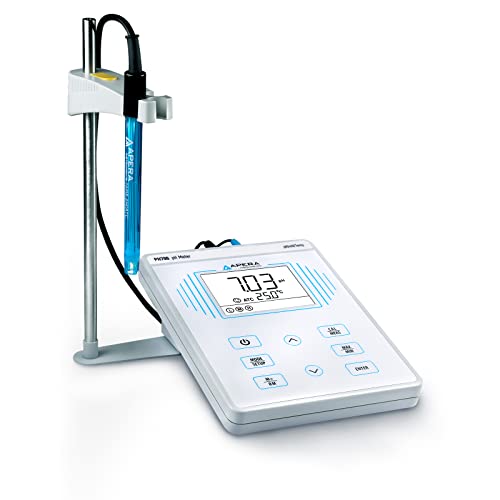
- 0.01 pH accuracy
- 1-3 point auto calibration
- 50-set data storage
Best For: Benchtop testing of general water solutions
Best Smart Food Pick
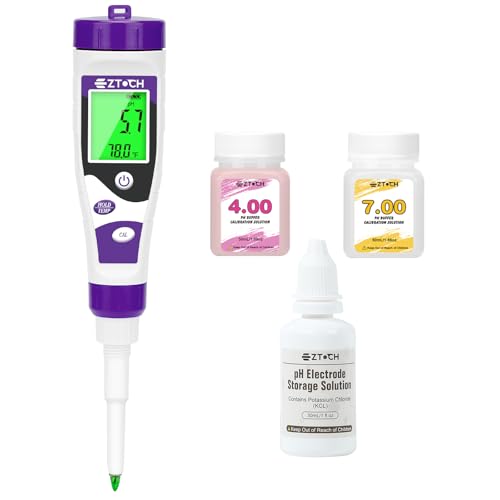
- Bluetooth app tracking
- Stores up to 1,000 readings
- Designed for food and fermentation
Best For: Home cooking, canning, baking, and fermentation
Best Waterproof Pick

- IP67 waterproof design
- Flat-surface electrode
- LCD temperature display
Best For: Portable outdoor and field testing
Best Food Fermentation Pick
YINMIK Spear-Probe Food pH Meter

- Spear probe for dough and semi-solid foods
- 0.00–14.00 range with ±0.1 accuracy
- Three-point calibration with buffer powders
Best For: Sourdough, fermentation, canning, and cosmetic testing
Best Compact Water Tester

- Stated ±0.01 pH accuracy
- ATC and backlit LCD for easier readings
- Compact design with batteries included
Best For: Hydroponics, aquariums, pools, and liquid testing
Best Replaceable-Probe Option
GIDIGI Food Fermentation pH Meter

- Replaceable spear electrode for semi-solid foods
- 0.01 pH precision with ATC and temperature data
- Includes case and three buffer solutions
Best For: Frequent fermentation and food formulation projects
Best Premium Pocket Tester – Apera AI311 PH60
The Apera AI311 is a strong choice among ph meters when you want high accuracy, broad measurement range, and a complete setup in one portable kit. Its replaceable glass probe, automatic temperature compensation, and stable-reading indicator make routine testing easier.
Best For: Pool and spa care, hydroponics, beverages, environmental monitoring, and other regular water solutions.
Pros:
- Provides ±0.01 pH accuracy across a -2.00 to 16.00 pH range.
- Includes automatic calibration, buffer recognition, and automatic temperature compensation.
- Features a replaceable probe, backlit color LCD, temperature display, and stable-reading reminder.
- Complete kit includes calibration solutions, storage solution, batteries, and a rugged case.
Cons:
- Requires regular calibration and probe care for dependable results.
- Automatically powers off after eight minutes without operation.
Choose the AI311 if precision and kit completeness matter more than getting the simplest budget tester. The replaceable probe can also make it a practical long-term option.
Best Lab-Style Meter – Milwaukee MW102
The Milwaukee MW102 is one of the more lab-oriented ph meters in this group, pairing a large digital display with a separate temperature probe. It offers ±0.02 pH accuracy, automatic calibration, and a gel-filled double-junction electrode for routine high-performance testing.
Best For: Users who want a portable meter with a separate temperature probe and lab-grade electrode.
Pros:
- Delivers ±0.02 pH accuracy with an extended -2.00 to 16.00 pH range.
- Provides fast automatic temperature compensation using a stainless temperature probe.
- Uses a low-maintenance, gel-filled, double-junction lab-grade pH electrode.
- Includes the meter, pH probe, temperature probe, and carrying case.
Cons:
- Automatic calibration supports up to two points.
- Uses a 9V battery rather than AAA batteries.
The MW102 is a sensible pick when electrode design and separate temperature measurement are priorities. Its 300-hour battery life also supports repeated portable use.
Best Value Waterproof Tester – Apera PH20
APERA INSTRUMENTS AI209 Value Series PH20 Waterproof pH Tester Kit, ±0.1 pH Accuracy
Check Price On AmazonThe Apera PH20 is a straightforward option for shoppers comparing ph meters on value and ease of use. This waterproof tester includes automatic calibration, temperature compensation, stable-value recognition, and a carrying case with pH 4 and pH 7 buffers.
Best For: Everyday water checks, outdoor use, and buyers seeking a compact value-oriented tester.
Pros:
- Offers automatic calibration with buffer recognition and automatic temperature compensation.
- Waterproof design and a response time of about five seconds suit portable testing.
- Stable-value recognition helps make readings more consistent.
- Provides up to 2,000 hours of continuous operation and includes a two-year instrument warranty.
Cons:
- Its ±0.1 pH accuracy is lower than the Apera AI311’s specification.
- The kit includes pH 4 and pH 7 buffers but has fewer accessories than the premium kit.
The PH20 makes sense when you want essential automated features without paying for a higher-precision instrument. Its waterproof construction and long stated operating time add practical convenience.
Best for Hydroponics and Growing – Bluelab pH Pen
The Bluelab pH Pen is designed for convenient pH and temperature checks across growing and water applications. Among these ph meters, it stands out for its double-junction probe, two-point calibration process, backlit display, and included calibration and hydration sachets.
Best For: Hydroponics, growing tents, aquariums, pools, drinking water, and brewing.
Pros:
- Uses a durable double-junction probe intended to reduce contamination and extend probe life.
- Includes automatic temperature compensation and two-point calibration.
- Backlit LCD shows a 30-day calibration indicator.
- Waterproof, floating design and included pH 7, pH 4, and KCl sachets support portable use.
Cons:
- Measures in 0.1 pH increments, offering less precision than ±0.01 or ±0.02 instruments.
- Readings in tap, reverse-osmosis, or distilled water may be slow or unstable because of insufficient dissolved ions.
The Bluelab pH Pen is a practical fit for growers and hobbyists who value simple calibration and a probe built for repeated use. Keep its low-ion water limitation in mind when testing purified samples.
Best Benchtop Pick – Apera AI501 PH700
For lab-style testing, the Apera AI501 is one of the more capable ph meters in this roundup. It combines 0.01 pH accuracy with automatic temperature compensation, one- to three-point calibration, and a 3-in-1 pH/temperature electrode for general water solutions.
Best For: Benchtop testing of general water solutions when calibration feedback and stored readings are useful.
Pros:
- Offers 0.01 pH accuracy with one- to three-point automatic calibration.
- Includes pH and temperature measurement through its 3-in-1 electrode.
- Provides electrode condition display, self-diagnosis, and 50 data-storage sets.
- Includes calibration solutions, an electrode holder, and IP54 spill and dust protection.
Cons:
- Its benchtop design is less convenient for portable testing.
- The included holder accommodates up to two electrodes, which may limit larger setups.
The AI501 stands out when you want a more structured workstation meter rather than a basic handheld tester. Its calibration features and measurement storage add practical value for repeat testing.
Best Smart Food Pick – YINMIK Food pH Meter
This food-focused option is among the most versatile ph meters for home fermentation, canning, and baking. Bluetooth connectivity, app-based history, and automatic storage for up to 1,000 readings make it useful when you need to track measurements over time.
Best For: Home cooks, bakers, and fermenters measuring food, beverages, sourdough, and canning preparations.
Pros:
- Supports testing for canning, sourdough, brewing, yogurt, kombucha, sauces, and other foods.
- Connects to the YINMIK app through Bluetooth for saved readings and historical review.
- Can automatically store up to 1,000 data points.
- Includes pH 4.00 and 7.00 calibration solutions, protective solution, and a backlit display.
Cons:
- Its food-oriented design may be more specialized than necessary for general water testing.
- The notes do not specify the meter’s measurement accuracy.
Choose this model if recording and reviewing food-related pH readings matters as much as taking the measurement itself. The ready-to-use setup and Bluetooth app make it particularly approachable for home projects.
Best Waterproof Pick – Extech PH100 ExStik II
The Extech PH100 is a compact waterproof choice among these ph meters, with an IP67 rating and a flat-surface electrode. Its LCD temperature display and included protective sensor cap make it suited to users who want a durable reusable meter for field or outdoor work.
Best For: Portable testing where waterproof construction and a flat-surface electrode are priorities.
Pros:
- IP67 waterproof construction supports outdoor use.
- Includes a flat-surface electrode and LCD temperature display.
- Compact 3.8-ounce body with a protective sensor cap and neck strap.
- Uses included lithium metal batteries and has a one-year meter warranty.
Cons:
- The supplied notes do not list pH accuracy or calibration details.
- The product information specifies wired connectivity rather than wireless data transfer.
The PH100 is the practical pick when portability and water resistance matter more than app features or extensive data storage. Its compact form and waterproof specification make it easier to carry for outdoor measurements.
Best Food Fermentation Pick – YINMIK Spear-Probe Food pH Meter
Among ph meters, the YINMIK stands out for food and semi-solid testing. Its spear probe is designed for inserting into sourdough, fermented foods, cosmetics, and lotions without first making a slurry.
Best For: Home bakers, fermenters, canning projects, and cosmetic makers who need a probe for thicker samples.
Pros:
- Spear probe suits sourdough, cheese, sausages, sauces, and other semi-solid samples.
- Offers a 0.00–14.00 pH range and ±0.1 accuracy.
- Three-point auto-calibration, included buffer powders, ATC, and a KCL-moistened protective cap support routine use.
Cons:
- Its stated ±0.1 accuracy is lower than the ±0.01 rating of the other listed meters.
- The specialized spear design may be more than needed for simple water testing.
This is a practical choice when your pH testing involves dough, fermented foods, or lotions rather than only liquids. The included calibration powders and probe-care features add convenience for regular use.
Best Compact Water Tester – VIVOSUN Digital pH Meter
For shoppers comparing ph meters for water-based applications, the VIVOSUN offers a compact pen-style design with a stated ±0.01 pH accuracy rating. It is intended for water, pools, spas, aquariums, hydroponics, liquid food, and laboratory use.
Best For: Hydroponic growers, aquarium owners, and users who want a portable tester for water and other liquids.
Pros:
- Stated ±0.01 pH accuracy with a 0.00–14.00 range.
- Automatic temperature compensation helps adjust readings for water temperature.
- Backlit LCD, auto calibration, memory, compact size, and included batteries improve convenience.
Cons:
- The notes do not indicate a spear probe for dough or other semi-solid foods.
- Only three pH buffer powders are included.
The VIVOSUN is a straightforward option for liquid testing where portability and a clear display matter. Its broad application list makes it more versatile for water-focused tasks than specialized food fermentation work.
Best Replaceable-Probe Option – GIDIGI Food Fermentation pH Meter
The GIDIGI is one of the more specialized ph meters for fermentation and food formulation. It combines a replaceable spear electrode with ±0.01 pH reading precision, ATC, temperature measurement, and a supplied calibration kit.
Best For: Serious home fermenters and makers of sourdough, cheese, cured meats, kombucha, wine, salsa, sauces, soap, and lotions.
Pros:
- Replaceable spear probe is designed for dough, meat, cheese, and other semi-solid samples.
- Stated 0.01 pH reading precision, ATC for 0–60°C samples, and approximately 30-second readings.
- Includes pH 4.00, 7.00, and 10.01 buffer solutions, a carrying case, and temperature readings.
Cons:
- At 1.01 pounds, it is heavier than the compact VIVOSUN.
- Its broader kit and replaceable-probe features may be unnecessary for occasional basic testing.
This is the strongest fit for users who expect frequent food or formulation testing and want to extend the meter’s life with a replaceable electrode. The complete calibration kit and temperature data make it especially well suited to repeatable fermentation work.
How We Picked These Ph Meters
We selected models representing the main pH-testing categories: pocket testers for routine water checks, specialized food meters with spear or flat-surface probes, portable meters for field use, and benchtop instruments for laboratory-style work. We considered stated accuracy, calibration options, replaceable or durable probes, waterproofing, temperature measurement, display readability, and the type of samples each meter is designed to test.
Application fit matters as much as headline accuracy. A meter built for hydroponic water may not perform well on solid or semi-solid food, while a food probe may be unnecessary for aquarium maintenance. Always follow the manufacturer’s calibration, cleaning, and storage instructions.
Quick Comparison
| Best For | What to Look For | Featured Type |
|---|---|---|
| General water testing | Waterproof housing, automatic calibration, temperature compensation | Pocket pH tester |
| Hydroponics and aquariums | Reliable repeatability, clear display, easy calibration | Portable pen meter |
| Food and fermentation | Spear or flat-surface electrode, food-compatible construction | Specialty food meter |
| Laboratory work | Higher precision, multi-point calibration, replaceable electrode | Benchtop meter |
| Field and professional use | Rugged build, temperature display, serviceable probe | Portable professional meter |
Key Buying Factors for Ph Meters
Accuracy and Resolution
Choose accuracy based on the decision you need to make. Basic gardening and water checks may only require around ±0.1 pH, while laboratory work, tightly controlled nutrient solutions, and some food processes benefit from ±0.01 pH accuracy. Resolution shown on the display is not the same as actual accuracy.
Probe Design
The electrode is often the most important component. Standard bulbs work well in liquids, while spear probes are better suited to soft foods and fermentation samples. Flat-surface electrodes can test items that are difficult to immerse. Replaceable probes can extend the useful life of a higher-quality meter.
Calibration and Temperature
Look for automatic calibration, multiple calibration points, and compatibility with common buffer solutions. Automatic temperature compensation improves consistency when sample temperatures vary, but it does not replace proper calibration. Meters with integrated temperature readings are useful when comparing results across batches or locations.
Maintenance and Operating Cost
pH electrodes must remain hydrated and clean. Check whether the kit includes calibration buffers, storage solution, a protective cap, and cleaning supplies. Factor in replacement probe costs, because a low-priced meter may be less economical if its electrode cannot be serviced.
Who Should Buy Which Ph Meters?
Choose a pocket tester for routine aquarium, pool, gardening, or hydroponic checks where portability and simple operation matter most. Choose a food-specific meter if you test fermentation, salsa, canning mixtures, cheese, or other semi-solid samples; its probe geometry is better suited to those materials.
Choose a professional portable meter when you need stronger durability, temperature readings, and more dependable field measurements. Choose a benchtop model for repeatable laboratory or production testing, especially when fine accuracy, multi-point calibration, and a replaceable electrode justify the higher cost.