Finding a reliable wind meter does not require a professional-grade budget. The best anemometers under $100 can measure wind speed, airflow, temperature, and sometimes wind chill for HVAC work, outdoor activities, and home projects.
We compare 10 handheld models across measurement range, display design, accuracy features, portability, and practical versatility so you can choose the right meter for your use case.
Best 10 Anemometers Under 100 Picks for 2026
Best All-Around Pick
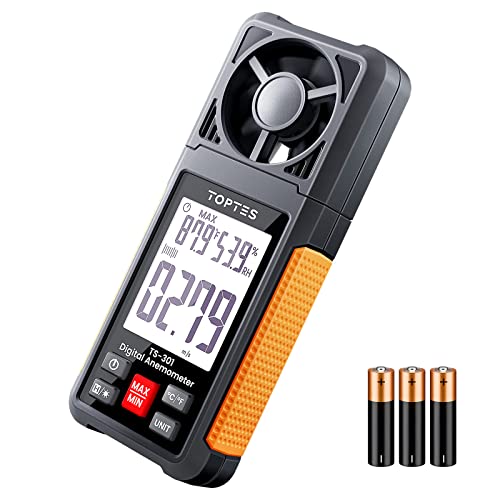
- Large 2.26-inch backlit display
- Six wind-speed measurement units
- Adds temperature and humidity readings
Best For: Outdoor checks and general HVAC airflow testing
Precision-Focused Pick

- 0.01 wind-speed resolution
- 0.5-second sampling interval
- Color-coded wind-speed alarm
Best For: Detailed readings and portable CFM-related work
Best for Tripod Mounting

- Includes a metal tripod thread
- Measures wind speed, temperature, and chill
- Backlit LCD with five speed units
Best For: Hands-free HVAC and outdoor monitoring
Best Compact Option

- Lightweight 53-gram design
- Displays wind chill and temperature
- Includes current, maximum, and average modes
Best For: Portable outdoor and HVAC spot checks
Best HVAC Value
HoldPeak 866B Digital Anemometer

- Measures light airflow from 0.67–67.1 mph
- MAX, MIN, AVG, temperature, and wind chill readings
- Backlit display, case, strap, and tripod mount
Best For: HVAC checks and outdoor wind monitoring
Best Compact Meter
UNI-T UT363 Handheld Anemometer

- Measures wind speeds up to 30 m/s
- Five wind-speed units plus temperature readings
- Backlit LCD with MAX/AVG and data hold
Best For: Portable HVAC and outdoor measurements
Best Simple 3-in-1
Mcbazel Handheld Digital Anemometer

- Measures wind speed, temperature, and Beaufort level
- Five wind-speed units with double-line LCD
- MAX/MIN/AVG, hold, backlight, and low-battery alert
Best For: Routine HVAC and recreational wind checks
Best All-Around Value
AIOMEST AI-100 Handheld Anemometer
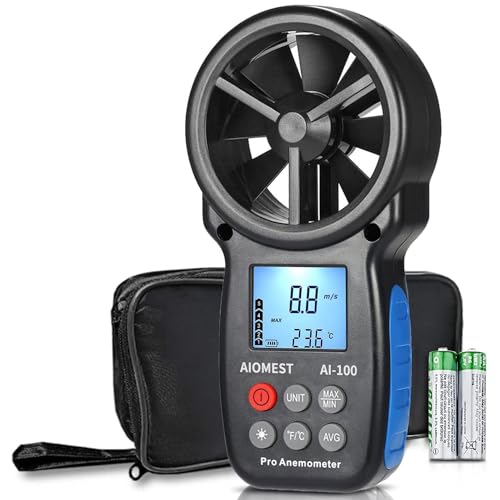
- Measures wind speed, temperature, and airflow
- Offers MAX/MIN/AVG, wind chill, and multiple units
- Tripod mount and carrying case included
Best For: HVAC checks, outdoor use, and general wind monitoring
Best Heavy-Duty Pick

- Measures speed, temperature, and wind level
- Supports five wind-speed units
- Includes data hold, backlight, and MAX/MIN/AVG
Best For: Basic HVAC, ventilation, sailing, and outdoor checks
Best for High Wind Speeds
AIOMEST AI-881M Cup Anemometer

- Measures wind up to 93 mph or 42 m/s
- Cup sensor accepts airflow from multiple directions
- Includes compass, tripod mount, and carrying case
Best For: HVAC work, boating, drone flying, and stronger winds
Best All-Around Pick – TopTes TS-301
For shoppers comparing anemometers under 100, the TopTes TS-301 is a versatile handheld option with a large backlit display, six wind-speed units, and added temperature and humidity readings. It is designed for quick outdoor checks as well as basic airflow assessments around HVAC vents and ducts.
Best For: Outdoor activities, general wind checks, and homeowners or HVAC users who want temperature and humidity data.
Pros:
- Large 2.26-inch backlit LCD is easy to read.
- Supports six selectable wind-speed units.
- Includes temperature and relative-humidity measurements.
- Comes with three AAA batteries, a pouch, and a three-year warranty.
Cons:
- Temperature and humidity sensors may need at least 30 minutes to adjust.
- Automatically shuts off after 10 minutes of inactivity.
The TS-301 stands out when convenience and versatility matter more than specialized monitoring features. Its broad unit selection and environmental readings make it a practical choice for everyday measuring.
Precision-Focused Pick – POROMETISTO AEM01S
The POROMETISTO AEM01S is a strong contender among anemometers under 100 for buyers who prioritize fine readings and fast sampling. It offers 0.01 resolution, a 0.5-second sampling interval, multiple units, and a color-coded wind-speed alarm for outdoor or HVAC work.
Best For: Users who want detailed wind-speed readings, quick response, and a compact tool for outdoor sports or CFM calculations.
Pros:
- Measures from 0.70 to 30.00 m/s with stated accuracy specifications.
- Provides 0.01 resolution and 0.5-second sampling.
- Includes HOLD, MAX, backlight, and multiple-unit functions.
- Ships with two AAA batteries and offers one-year replacement service for quality issues.
Cons:
- Its stated wind-speed range begins at 0.70 m/s.
- CFM measurement requires calculating wind speed times duct area.
With its fine resolution, fast sampling, and alarm colors, the AEM01S is especially appealing when comparing changing airflow or documenting readings. Its ergonomic housing also supports portable, one-handed use.
Best for Tripod Mounting – BT-100 Handheld Anemometer
The BT-100 is a practical choice among anemometers under 100 when hands-free monitoring is useful. Along with wind speed, it measures wind temperature and wind chill, and its threaded tripod hole can help when checking airflow or outdoor conditions during drone, RC, or shooting activities.
Best For: HVAC airflow checks, outdoor users who need temperature and wind chill, and tripod-based monitoring.
Pros:
- Measures wind speed in five units and temperature in Celsius or Fahrenheit.
- Displays wind chill and includes a bright backlit LCD.
- Tripod mounting hole supports hands-free use.
- Includes batteries, carry bag, neck strap, and a one-year warranty.
Cons:
- Temperature range is limited to 14°F–113°F.
- It is larger than the especially compact BT-816B.
The BT-100 offers a useful combination of airflow and outdoor-weather information. Its tripod thread gives it an advantage for extended or hands-free readings, while the included case and batteries make it ready to use.
Best Compact Option – BTMETER BT-816B
For buyers seeking anemometers under 100 that are easy to carry, the BTMETER BT-816B combines a small 53-gram design with wind-speed, temperature, and wind-chill readings. Its backlit LCD and current, maximum, and average modes make it useful for quick checks indoors or outdoors.
Best For: Travelers, outdoor enthusiasts, and anyone wanting a lightweight meter for sailing, shooting, drone use, or HVAC checks.
Pros:
- Very compact and lightweight at 53 grams.
- Measures wind speed from 0.3 to 30 m/s and displays temperature and wind chill.
- Offers current, maximum, and average measurement modes.
- Includes a backlit display, lanyard, and one-year support.
Cons:
- Stated wind-speed accuracy is ±5% of the reading.
- The package listing does not specify included batteries.
The BT-816B is the most pocket-friendly option in this group. Choose it when portability and basic environmental information matter more than a larger display or advanced mounting features.
Best HVAC Value – HoldPeak 866B Digital Anemometer
For shoppers comparing anemometers under 100, the HoldPeak 866B is a practical choice for checking light airflow, temperature, and changing wind conditions. Its eight-blade impeller, backlit display, and tripod mount make it useful for both quick handheld checks and longer measurements.
Best For: HVAC airflow checks, outdoor wind monitoring, drone flights, and sailing.
Pros:
- Measures airflow from 0.67 to 67.1 mph with stated ±5% accuracy.
- Includes MAX, MIN, and AVG readings plus five wind-speed units.
- Offers temperature, wind chill, backlight, wrist strap, case, and tripod compatibility.
Cons:
- Tripod is not included.
- The backlight switches off after 15 seconds.
The 866B stands out among anemometers under 100 for combining HVAC-oriented airflow testing with useful outdoor features. Its carrying case and one-year warranty add convenience for regular field use.
Best Compact Meter – UNI-T UT363 Handheld Anemometer
The UNI-T UT363 is a compact option for buyers seeking anemometers under 100 with straightforward controls and broad measurement coverage. It reads wind speed up to 30 m/s, shows air temperature, and adds MAX/AVG, data hold, and wind-chill functions.
Best For: Portable HVAC checks, boating, drone operation, and general outdoor measurements.
Pros:
- Measures wind speed up to 30 m/s with 0.1 m/s resolution.
- Supports m/s, km/h, ft/min, knots, and mph.
- Includes a backlit LCD, Beaufort scale display, data hold, MAX/AVG, and selectable power-off behavior.
Cons:
- Its temperature range is listed as 14–122°F (-10–50°C).
- The listed package includes the meter and manuals but no carrying case or strap.
With its small 3.5-ounce body and direct LCD readout, the UT363 is well suited to users who prioritize portability. It provides the core readings needed for HVAC, marine, and outdoor tasks without adding unnecessary complexity.
Best Simple 3-in-1 – Mcbazel Handheld Digital Anemometer
Among anemometers under 100, the Mcbazel 3-in-1 handheld meter offers an uncomplicated way to view wind speed, temperature, and Beaufort wind level together. Its double-line LCD, backlight, and MAX/MIN/AVG functions make it convenient for indoor and outdoor spot checks.
Best For: HVAC, sailing, fishing, and general indoor-outdoor wind checks.
Pros:
- Displays wind speed, wind temperature, and Beaufort scale readings.
- Supports m/s, km/h, kts, ft/s, and mph.
- Includes MAX/MIN/AVG, data hold, backlight, low-battery indicator, and auto power-off.
Cons:
- AAA batteries are required but not included.
- The supplied notes do not specify a wind-speed measurement range or accuracy figure.
The Mcbazel is a lightweight, 100-gram option for buyers who want several essential readings visible at once. Its feature set is useful for routine checks, though shoppers needing documented accuracy or range should verify those specifications before purchasing.
Best All-Around Value – AIOMEST AI-100 Handheld Anemometer
For shoppers comparing anemometers under 100, the AIOMEST AI-100 is a versatile choice for measuring wind speed, temperature, and airflow. Its broad 1–65 mph range, multiple units, and CFM calculation support make it practical for HVAC work, outdoor activities, and general wind monitoring.
Best For: HVAC checks, duct-vent maintenance, outdoor recreation, and users who want tripod-supported readings.
Pros:
- Measures wind speed in five units with ±5% accuracy.
- Includes temperature, wind chill, Beaufort scale, and MAX/MIN/AVG readings.
- Supports CFM calculations and has a 1/4-20 tripod mount.
- Includes a carrying case, wrist strap, battery, and 12-month warranty.
Cons:
- Its plastic construction may be less rugged than metal-bodied alternatives.
- The maximum stated speed is lower than the 93 mph capacity of the AIOMEST 881M.
The AI-100 stands out as a balanced, feature-rich option for buyers who want more than basic wind-speed readings without moving beyond a budget-friendly handheld format.
Best Heavy-Duty Pick – Soonkoda Handheld Anemometer
Among anemometers under 100, the Soonkoda 3-in-1 model focuses on the core measurements many users need: wind speed, temperature, and wind level. Its 0.06–30.0 m/s range and double-line display make it a straightforward option for HVAC, ventilation, sailing, and other outdoor applications.
Best For: Buyers seeking a compact basic meter for ventilation work, recreation, or routine wind-speed checks.
Pros:
- Combines wind speed, wind temperature, and Beaufort wind level.
- Supports m/s, km/h, knots, ft/s, and mph.
- Provides MAX/MIN/AVG, data hold, backlight, and low-battery indication.
- Displays wind speed and temperature simultaneously.
Cons:
- Its supplied specifications do not state an accuracy rating.
- The stated 30.0 m/s maximum is below the AIOMEST 881M’s 42 m/s range.
- The product details provide limited information about included accessories.
The Soonkoda is a sensible choice when you value essential functions and a clear display over extras such as a carrying case or tripod mount.
Best for High Wind Speeds – AIOMEST AI-881M Cup Anemometer
For anemometers under 100 that need to handle stronger airflow, the AIOMEST AI-881M measures up to 93 mph, or 42 m/s. Its 360-degree wind-cup sensor can be easier to position than a directional vane, making it useful for HVAC diagnostics, boating, drone flying, and weather monitoring.
Best For: Stronger wind measurement, HVAC airflow checks, and users who want a compass and tripod mount.
Pros:
- Measures 1.5–93 mph with ±4% accuracy and 0.1 resolution.
- Wind cups accept airflow from any horizontal direction without precise aiming.
- Displays temperature, wind chill, Beaufort scale, and real-time, maximum, and average readings.
- Includes a compass, backlit LCD, tripod thread, carrying case, and 365-day warranty.
Cons:
- The minimum stated wind speed of 1.5 mph is higher than the AI-100’s 0.2 mph sensitivity.
- The cup design is larger than a compact vane-style meter and may be less convenient in tight spaces.
The AI-881M is the strongest fit in this group for higher wind speeds and hands-free monitoring, while its cup sensor simplifies positioning during field or HVAC measurements.
How We Picked the Best Anemometers Under 100
We focused on handheld meters that offer useful wind-speed measurements without exceeding a $100 budget. The selected models were compared for stated speed range, resolution, display readability, airflow and temperature functions, portability, and suitability for common tasks such as HVAC testing, weather observation, sailing, surfing, drone flying, and shooting.
Because specifications and included accessories can vary by seller, check the current product listing before buying. Pay particular attention to the measurement units, operating temperature range, battery requirements, and whether the device uses a vane or a cup-style sensor.
Quick Comparison
| Best For | What to Prioritize |
|---|---|
| General home and outdoor use | Clear backlit display, simple controls, and a practical speed range |
| HVAC and ventilation checks | CFM or airflow modes, temperature readings, and good resolution |
| Sailing, surfing, and drone flying | Portable design, fast readings, and a broad wind-speed range |
| Low-light or evening work | Backlit LCD and easy-to-read large digits |
| High-wind environments | A sensor rated comfortably above the expected wind speed |
Key Buying Factors for Anemometers Under $100
Measurement Range and Resolution
Choose a range suited to your environment. A meter rated for moderate wind may be adequate indoors or for casual weather checks, while sailing, roof work, and exposed outdoor locations benefit from a higher maximum speed. Resolution describes the smallest displayed increment; finer resolution can make small changes easier to track, but it does not automatically guarantee laboratory-level accuracy.
Sensor Style and Airflow Functions
Vane-style meters are common for directional handheld measurements and can be useful for HVAC grilles, fans, and ducts. Cup-style designs are often convenient for outdoor wind readings. If you need ventilation measurements, look for CFM or airflow modes rather than wind speed alone, and confirm whether the meter requires you to enter an area value.
Display, Temperature, and Wind Chill
A backlit screen helps in dark equipment rooms and changing outdoor conditions. Temperature and wind-chill functions add useful context for weather-related work, but check the stated temperature range if you expect very cold or hot conditions. Maximum and average readings are helpful when airflow fluctuates.
Usability and Durability
Consider one-handed operation, button layout, automatic shutoff, battery type, protective covers, and overall size. A compact meter is easier to carry for sports or drone trips, while a larger display may be preferable for repeated HVAC inspections.
Who Should Buy Which Anemometers Under 100?
Choose a straightforward backlit meter for occasional home projects, weather checks, or recreational use. Choose an HVAC-focused model with airflow, CFM, temperature, and average functions if you are checking vents, fans, or ventilation performance. Choose a wide-range model for sailing, surfing, roof work, or other exposed locations where wind can rise quickly. Choose a higher-resolution option when you need to notice subtle changes rather than simply confirm whether air is moving.
For most buyers, the best choice is the model that matches the expected wind range and offers the measurements you will actually use. Avoid paying for advanced modes if a simple speed-and-temperature meter meets your needs, and verify the current specifications before placing an order.