The best large mineral collection kits make it easier to explore geology through hands-on specimens rather than pictures alone. The 10 options in this roundup range from kid-friendly bulk sets to more structured classroom collections and adult-focused geology kits.
As you compare them, look beyond the piece count. Specimen size, variety, identification materials, fossils, presentation, and intended age can make a bigger difference than the number printed on the box.
Best 10 Large Mineral Collection Kits Picks for 2026
Best Jumbo Starter
20-Piece Large Rock Collection
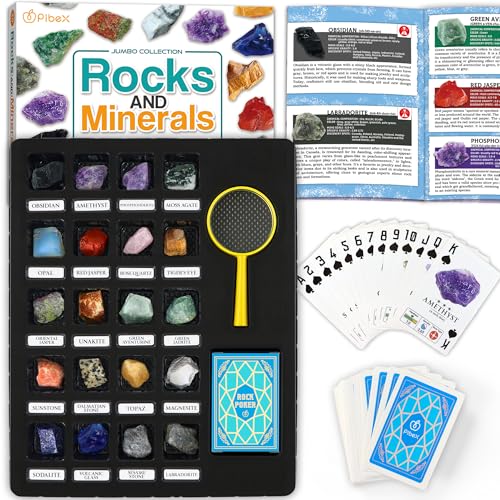
- 20 raw specimens about 1.5–2 inches
- Collector box, magnifier, guide, and game cards
- Designed for ages 6+ and beginner geology
Best For: Kids, beginners, homeschool, and rock tumbling
Best for Sharing
National Geographic 50-Specimen Set

- Includes 50 specimens across five rock types
- Over 1 pound of polished rocks and gems
- Ten bags support classroom or group sharing
Best For: Classrooms, groups, parties, and trading activities
Best Adult Collection

- Combines minerals, fossils, shark teeth, and arrowheads
- Includes a raw amethyst druzy centerpiece
- Adds a 10.5-inch sand sifter and documentation
Best For: Adult collectors and advanced geology hobbyists
Best Educational Set
Complete Rock, Mineral & Fossil Collection

- Contains 57 authentic specimens
- Includes charts, labels, trays, and guides
- Features a 70-million-year-old fossil
Best For: Classrooms, students, and structured home learning
Best Bulk Variety
800-Piece Gemstones and Crystals Set

- Approximately 800 stones weighing 3 pounds
- More than 30 possible crystal varieties
- Useful for collecting, crafts, and STEM study
Best For: Bulk collectors and hands-on crystal projects
Best Classroom Set
American Educational 50-Specimen Rock Collection

- Contains 50 geological specimens
- Covers major rock types, ores, gemstones, and minerals
- Includes coded key sheet and compartmented tray
Best For: Classroom instruction and organized specimen study
Best Compact Display
Dancing Bear 18-Piece Rock and Mineral Kit

- Includes 18 rocks and minerals
- Comes with a collection box and description sheet
- Compact format suits young learners and beginners
Best For: Starter collections, gifts, and compact displays
Classroom-Ready Pick
75-Piece Earth Science Collection

- 75 numbered rock and mineral samples
- Includes streak plate, magnet, magnifier, and guide
- Covers all three major rock types
Best For: Structured earth science lessons and homeschool STEM study
Collector’s Choice

- Contains 4 pounds of natural specimens
- Includes a 64-page identification guide
- Designed for adult collectors and STEM learning
Best For: Adult rock hounds and substantial specimen collections
Family Activity Pick
250+ Rocks, Fossils, and Crystals
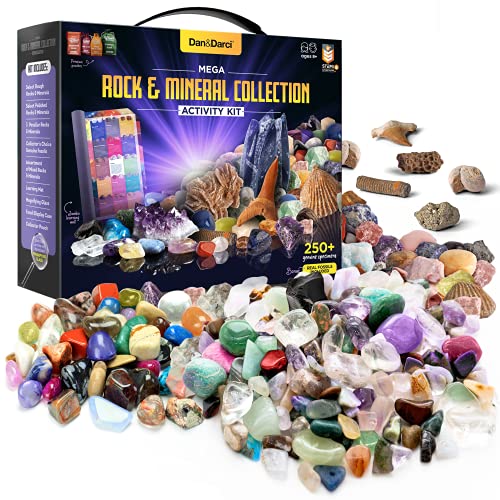
- Includes more than 250 specimens
- Features fossils, polished pieces, and rough samples
- Adds a learning mat, magnifier, and display case
Best For: Family STEM activities and children ages 6 and up
Best Jumbo Starter – 20-Piece Large Rock Collection
This jumbo kit is a strong pick among large mineral collection kits for children and beginners who want sizable specimens rather than tiny samples. It combines 20 raw rocks and minerals with a compartmented case, magnifier, learning guide, and illustrated game cards.
Best For: Kids ages 6 and up, beginner collectors, homeschool activities, and rock-tumbling projects.
Pros:
- Includes 20 approximately 1.5–2-inch raw rocks and minerals.
- Comes with a clear-lid collector box, name labels, magnifier, guide, and 54 game cards.
- Supports observation, matching, STEM learning, and hands-on geology exploration.
Cons:
- The specimens are unpolished, so they may not suit shoppers seeking finished display stones.
- The kit is designed for children and beginners rather than advanced collectors.
Choose this set when specimen size, organization, and kid-friendly learning tools matter more than having the largest overall quantity.
Best for Sharing – National Geographic 50-Specimen Set
For families or groups comparing large mineral collection kits, this National Geographic set emphasizes quantity and shareability. It includes 50 specimens across five types, more than a pound of polished rocks and gems, carrying bags, and a learning guide.
Best For: Classrooms, homeschool groups, parties, trading activities, and children ages 8 and up.
Pros:
- Provides 50 sharing specimens, including pyrite, quartz, desert rose, pumice, and tiger’s eye.
- Includes over 1 pound of polished rocks and gems.
- Ten carrying bags make it practical for sharing, trading, or group activities.
Cons:
- The set offers less specimen variety than a collection built around many different minerals.
- It is focused on sharing specimens rather than large individual display pieces.
This is a practical choice when you need enough rocks for several learners and value polished samples and easy distribution.
Best Adult Collection – Advanced Geology Specimen Kit
This adult-focused option stands apart from basic large mineral collection kits with its broader geology theme and field-style equipment. The collection combines minerals, fossils, shark teeth, arrowheads, a raw amethyst druzy centerpiece, specimen bags, and technical documentation.
Best For: Adult collectors, geology hobbyists, advanced specimen study, lapidary interests, and natural-history displays.
Pros:
- Includes a 10+ ounce gemstone mix, 4-ounce fossil mix, and 15–20 real shark teeth.
- Features a raw amethyst druzy centerpiece, hand-carved arrowheads, and specimen bags.
- Includes a 10.5-inch sand sifter for hands-on exploration.
Cons:
- Its adult-oriented assortment may be too advanced for young children.
- The broad mix of fossils, teeth, and artifacts may not fit shoppers seeking only minerals.
- The listed collection weighs 10 pounds, making it less convenient for casual transport.
Consider this kit when variety and a more serious collecting experience are priorities, especially if fossils and shark teeth are welcome alongside minerals.
Best Educational Set – Complete Rock, Mineral & Fossil Collection
This Educational Insights set is a classroom-friendly choice among large mineral collection kits, offering 57 authentic rocks, fossils, and minerals in a structured identification format. Color charts, labels, storage trays, and information guides help turn the specimens into a study collection.
Best For: Students ages 8 and up, home learning, classroom geology lessons, and organized specimen identification.
Pros:
- Contains 57 authentic rocks, fossils, and minerals.
- Includes five-color identification charts, labels, storage trays, and information guides.
- Features large, handpicked specimens, including a 70-million-year-old fossil.
Cons:
- The set combines several specimen categories, so it is not a minerals-only collection.
- It is recommended for ages 8 and up rather than very young learners.
Pick this collection when educational organization and identification materials are more important than games, sharing bags, or specialized field tools.
Best Bulk Variety – 800-Piece Gemstones and Crystals Set
For shoppers comparing large mineral collection kits, this set emphasizes quantity and variety. It includes approximately 800 irregular, polished crystal stones weighing about 3 pounds, with more than 30 possible types represented.
Best For: Bulk collecting, hands-on geology exploration, crafts, jewelry projects, and classroom or home STEM activities.
Pros:
- Includes approximately 800 stones and more than 30 kinds of crystals.
- Offers a broad mix that may include amethyst, rose quartz, tiger’s eye, jasper, obsidian, fluorite, and other varieties.
- Small polished pieces are suitable for collecting, DIY crafts, vase filling, and study.
- Provides a substantial 3-pound quantity for the price category.
Cons:
- Stones are random, so the exact selection is not guaranteed.
- Irregular pieces vary in size, generally from about 0.2 to 0.5 inch.
- The small pieces may be less suitable for younger children without supervision.
This is the quantity-focused choice among these large mineral collection kits. Choose it when a wide assortment and a high piece count matter more than individually labeled specimens or a display case.
Best Classroom Set – American Educational 50-Specimen Rock Collection
This classroom-oriented option takes a more structured approach to large mineral collection kits. It contains 50 specimens spanning major rock categories, ores, gemstones, and minerals, with number coding and a key sheet for identification.
Best For: Geological study, classroom instruction, specimen identification, and organized individual learning.
Pros:
- Includes 50 specimens covering igneous, sedimentary, and metamorphic rocks.
- Also includes ores, gemstones, and minerals for broader geological comparison.
- Number-coded specimens and a key sheet support identification.
- Compartmented tray provides display and storage in one format.
Cons:
- It offers fewer individual pieces than the 800-piece bulk set.
- The collection is designed more for study than for craft applications.
- The supplied notes do not specify the exact specimen names.
Choose this kit if organization and identification are priorities. Its tray, coded specimens, and instructional guide make it a stronger fit for formal geology learning than for bulk decorative or DIY use.
Best Compact Display – Dancing Bear 18-Piece Rock and Mineral Kit
For buyers who want a compact introduction rather than a bulk assortment, this 18-piece kit combines rocks and minerals with a collection box. A description sheet and educational information add context for young learners and casual collectors.
Best For: Beginners, children ages 4–12, teachers, gift giving, and compact rock displays.
Pros:
- Includes 18 rocks and minerals in a dedicated collection box.
- Comes with a description sheet and educational information.
- Compact box measures about 9.25 by 4.5 by 1.5 inches for convenient storage.
- Suitable for a young rock collector, teacher, or general enthusiast.
Cons:
- Contains substantially fewer specimens than other large mineral collection kits.
- The supplied notes do not identify the individual rocks and minerals.
- The plastic and acrylic components may feel less substantial than a larger specimen tray.
This is the most approachable compact option of the three. It makes sense when easy storage, basic educational information, and a ready-to-display box are more important than maximum specimen count.
Classroom-Ready Pick – 75-Piece Earth Science Collection
Geosciences Industries 13357 Introductory Earth Science Classroom Rocks and Minerals Collection
Check Price On AmazonFor shoppers comparing large mineral collection kits for structured earth science study, this classroom-oriented set provides 75 labeled rock and mineral samples in a compact case. It also includes basic tools and reference materials for hands-on identification and classification.
Best For: Middle-school earth science lessons, homeschool STEM activities, and organized specimen study.
Pros:
- Includes 75 numbered and identified rock and mineral samples.
- Covers igneous, sedimentary, and metamorphic rocks.
- Includes a streak plate, magnifier, magnet, study guide, and rock-cycle charts.
Cons:
- Samples are relatively small at approximately 1–2 inches.
- The manufacturer recommends it for ages 11–13 and up rather than very young children.
This is a strong choice when organization and curriculum support matter more than maximum specimen weight. The numbered index and classification resources make it especially practical for guided study.
Collector’s Choice – 4-Pound Rock and Mineral Kit
Among large mineral collection kits, this option emphasizes specimen quantity and a more detailed identification resource. It contains 4 pounds of hand-selected natural crystals, rocks, and minerals plus a 64-page guide for learning about geology and collection techniques.
Best For: Adult rock hounds, serious beginners, homeschool earth science, and classroom demonstrations that benefit from heavier specimens.
Pros:
- Provides 4 pounds of natural crystals, rocks, and mineral specimens.
- Includes a 64-page guide with geological information and identification tips.
- Supports STEM learning, sorting practice, and collection building.
Cons:
- The manufacturer recommends the kit for ages 18 and up.
- The supplied notes do not specify the exact number or types of individual specimens.
This kit makes sense for buyers who prioritize material volume and an in-depth guide over a numbered classroom assortment. Its adult positioning also makes it a better fit for dedicated collecting than for young children.
Family Activity Pick – 250+ Rocks, Fossils, and Crystals
For families seeking large mineral collection kits with plenty of variety, this set includes more than 250 rocks, gemstones, crystals, fossils, and minerals. A jumbo learning mat and activity accessories turn the assortment into a hands-on geology and paleontology project.
Best For: Children ages 6 and up, family activities, group STEM projects, and gift shoppers seeking a broad introduction to geology.
Pros:
- Includes more than 250 rocks, fossils, gems, and minerals.
- Offers rough and polished specimens, genuine fossils, a learning mat, and display case.
- Comes with a magnifying glass and collector’s pouch for interactive exploration.
Cons:
- The 2-pound assortment is lighter by weight than the 4-pound adult-focused kit.
- The supplied notes do not indicate that every specimen is individually numbered.
This is the most activity-focused option of the three, with a high piece count and child-friendly accessories. Choose it when variety, discovery, and shared play are more important than a formal classroom index.
How We Picked These Large Mineral Collection Kits
We selected these kits to cover the main ways people use a mineral collection: early science activities, classroom demonstrations, family learning, hobby collecting, and display. We considered specimen quantity, the mix of rocks, minerals, crystals, fossils, and other geological materials, plus whether the kit includes labels, an identification guide, descriptions, or an organized storage box.
Because “large” can refer to either the number of specimens or the total material weight, we included both high-count bulk sets and collections built around fewer, larger, or more deliberately selected pieces. This gives shoppers a clearer way to compare value without treating piece count as the only measure of quality.
Quick Comparison
- Best for a broad family activity: Choose a kit with many varied specimens, simple explanations, and a manageable sorting experience.
- Best for classrooms: Prioritize duplicate or shareable specimens, durable packaging, and clear educational information.
- Best for serious exploration: Look for larger raw samples, fossils, shark teeth, crystals, and a detailed identification guide.
- Best for display or collecting: Favor organized cases, description sheets, attractive specimens, and enough variety to build a themed collection.
Key Buying Factors for Large Mineral Collection Kits
Specimen Count Versus Specimen Size
A 250-piece set may contain small chips or tumbled stones, while a 20-piece kit may offer larger samples that are easier to examine. Decide whether your priority is sorting practice and variety or closer observation of individual rocks and minerals.
Contents and Variety
Check whether the kit includes only rocks and minerals or also adds fossils, crystals, gemstones, geodes, or shark teeth. A broader mix can make lessons more engaging, but a focused collection may be better for learning classification.
Identification Support
Labels, specimen cards, an ID guide, and educational notes are especially valuable for beginners and children. Without them, a large set can become a box of attractive but difficult-to-identify stones.
Age, Safety, and Organization
Small specimens require supervision around young children. Also consider dust, sharp edges, and storage. A compartmented box or labeled container helps prevent pieces from being lost and makes repeated activities easier.
Who Should Buy Which Large Mineral Collection Kits?
Parents and young learners should look for approachable explanations, colorful variety, and a reasonable number of pieces for sorting. Teachers and homeschoolers may benefit more from classroom-sized collections with multiple specimens and shareable reference materials. Adult beginners should consider kits that combine rocks, minerals, fossils, crystals, and a substantial guide. Experienced hobbyists may prefer larger raw samples or bulk sets that complement an existing collection rather than basic introductory assortments.
Before buying, match the kit’s format to the activity you have planned. For identification practice, prioritize labels and guides; for art or display, focus on specimen appearance; and for group learning, choose quantity, durability, and organization.