Whether you need to protect a refrigerator, monitor a greenhouse, check an outdoor enclosure, or track room conditions remotely, the right WiFi temperature data logger can provide a dependable record and timely alerts.
We compared these 10 options by connectivity, sensing range, alert features, data storage, probe design, and overall practicality so you can choose the best fit for your space and monitoring requirements.
Best 10 Wifi Temperature Data Loggers Picks for 2026
Best Subscription-Free Pick
Temp Stick WiFi Temperature & Humidity Sensor

- No subscription or gateway required
- Unlimited text, app, and email alerts
- Up to 1–2 years of AA battery life
Best For: Remote monitoring of homes, RVs, refrigerators, and freezers
Best for Refrigerators and Freezers
Traceable Wi-Fi Data Logging Thermometer

- Includes two bottle probes
- Dual-line LCD with WiFi connectivity
- Stores 672 records and 100 alarms
Best For: Indoor refrigerator and freezer monitoring
Best for Teams and Long-Term Cloud History
S22D WiFi Temperature & Humidity Sensor

- Up to one year of cloud history
- Unlimited multi-user access and data exports
- Text, email, buzzer, and LED alerts
Best For: Shared monitoring in greenhouses, server rooms, and cold storage
Best Display and Data Export Value
Govee H5103 WiFi Thermometer Hygrometer

- Readable electronic ink display
- WiFi and Bluetooth app monitoring
- Up to two years of data export
Best For: Indoor spaces such as wine cellars, basements, and bedrooms
Best Outdoor Probe Logger
YoLink X3 Temperature Data Logger

- Probe supports water, pipes, freezers, and more
- Offline logging with up to five-year battery life
- Requires a YoLink Hub; protect from direct moisture
Best For: Remote outdoor temperature monitoring with a probe
Best USB Report Logger
Elitech RC-5 Temperature Data Logger

- Records up to 32,000 readings
- Built-in USB creates downloadable PDF reports
- LCD, alarms, and -22°F to 158°F range
Best For: Storage and transport records requiring local data downloads
Best Temperature and Humidity Logger
YoLink X3 Thermometer Hygrometer

- Tracks temperature and humidity remotely
- App alerts, offline logging, and five-year battery life
- Requires a hub and protected outdoor installation
Best For: Remote environmental monitoring with humidity data
Best Overall
Elitech RCW-800W-TDE WiFi Temperature Logger
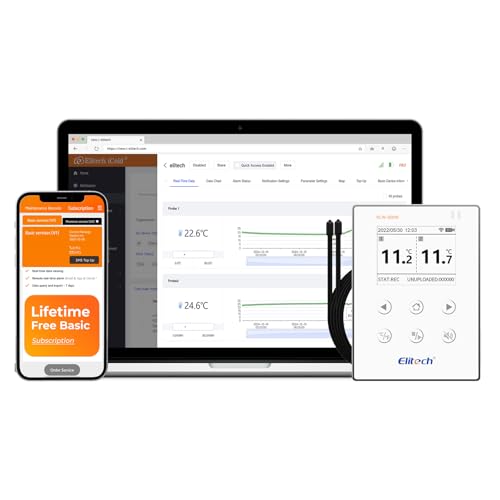
- Dual external temperature probes
- Cloud monitoring with multi-channel alerts
- At least seven days of outage uploading under stated conditions
Best For: Dual-point temperature monitoring in refrigerators and storage areas
Best for Temperature and Humidity
Elitech RCW-360Pro WiFi Temperature Humidity Logger

- Tracks temperature and 0–100% RH
- Includes a 16.4-foot external probe
- Stores up to 100,000 offline data sets
Best For: Warehouses, pharmacies, and humidity-sensitive storage
Best Temperature-Only Value
Elitech RCW-360Pro WiFi Temperature Logger
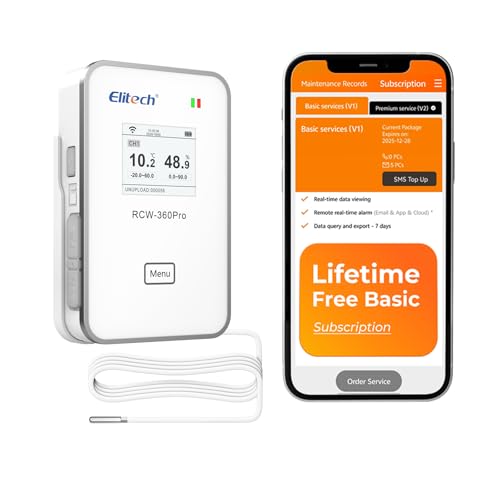
- -40°F to 176°F temperature range
- 16.4-foot external temperature probe
- Cloud alerts and 100,000-set offline storage
Best For: Remote temperature-only monitoring in storage environments
Best Subscription-Free Pick – Temp Stick WiFi Temperature & Humidity Sensor
Temp Stick is a strong choice for shoppers comparing wifi temperature data loggers with remote alerts and no recurring subscription. It monitors temperature and humidity over 2.4GHz WiFi, sends unlimited text, app, and email alerts, and continues recording for up to a month while temporarily offline.
Best For: Homes, RVs, refrigerators, freezers, and other locations needing long-term remote monitoring without a monthly fee.
Pros:
- No subscription, gateway, or wired installation required.
- Unlimited text alerts plus app and email notifications.
- One to two years of battery life from two AA batteries.
- Automated reports, multi-user access, Alexa and IFTTT compatibility, and free API access.
Cons:
- Works with 2.4GHz WiFi only.
- Not designed for public or guest WiFi networks.
With long battery life, flexible alert settings, and offline data retention, Temp Stick is a practical all-around option for unattended monitoring. Its U.S.-based support and free software updates add useful long-term value.
Best for Refrigerators and Freezers – Traceable Wi-Fi Data Logging Thermometer
For buyers seeking wifi temperature data loggers for cold storage, this Traceable model combines WiFi connectivity with a dual-line LCD and two bottle probes. It is designed for refrigerator and freezer monitoring, with alarms and a NIST specification.
Best For: Indoor refrigerator and freezer applications where probe-based readings, a local display, and stored alarm records are important.
Pros:
- Includes two bottle probes for cold-storage monitoring.
- Dual-line LCD provides local readings.
- Stores up to 672 records, or about seven days at 15-minute intervals.
- Supports up to 100 stored alarms and TraceableLIVE cloud service compatibility.
Cons:
- Its listed memory covers only about seven days at the stated 15-minute interval.
- Uses four AAA alkaline batteries.
- Indoor use is specified.
This is a focused choice for cold-storage logging rather than a general-purpose home sensor. The two probes, visible display, and alarm memory make it especially suitable where documented refrigerator or freezer conditions matter.
Best for Teams and Long-Term Cloud History – S22D WiFi Temperature & Humidity Sensor
This S22D sensor stands out among wifi temperature data loggers for shared monitoring and extended cloud history. It provides temperature and humidity readings over 2.4GHz WiFi, supports text, email, sound, and light alerts, and can export records in CSV, Excel, or PDF formats.
Best For: Greenhouses, server rooms, vacation homes, cold storage, and other shared locations where multiple people need access to alerts and reports.
Pros:
- No monthly subscription and support for unlimited team members.
- Cloud history can extend up to one year, depending on update frequency.
- Stores more than 30 days of data offline and supports multiple export formats.
- Includes local buzzer and flashing LED alerts, plus power-outage and offline notifications.
Cons:
- Supports 2.4GHz WiFi only.
- External probe sensors are sold separately.
- A full charge lasts up to four months, with a stated seven-hour charging time.
With collaborative access, local warning signals, and flexible data exports, this model is well suited to team-based monitoring. Its rechargeable design and external-probe support add flexibility for remote or specialized locations.
Best Display and Data Export Value – Govee H5103 WiFi Thermometer Hygrometer
Govee’s H5103 is a convenient option for shoppers comparing wifi temperature data loggers that also offer an easy-to-read local display. It uses WiFi and Bluetooth, tracks temperature and humidity, and provides app alerts, 13-day online graphs, and data export for up to two years.
Best For: Wine cellars, basements, bedrooms, and other indoor spaces where a visible display and app-based history are useful.
Pros:
- Electronic ink display is easy to read.
- Supports WiFi and Bluetooth monitoring through the Govee Home app.
- Offers preset-range alerts for temperature and humidity.
- Provides 13-day online graphs and up to two years of data export.
Cons:
- Supports 2.4GHz WiFi only, not 5GHz.
- Listed operating temperature range is 32°F to 122°F.
- Battery life is about six months.
The H5103 balances at-a-glance visibility with convenient app access and long-term export capability. It is a particularly practical fit for ordinary indoor monitoring where extreme temperature coverage is not required.
Best Outdoor Probe Logger – YoLink X3 Temperature Data Logger
The YoLink X3 is a flexible option among wifi temperature data loggers for monitoring water, pipes, refrigeration, livestock troughs, HVAC equipment, and other temperature-sensitive applications. Its probe design, offline logging, and long battery life make it useful for extended monitoring, provided you already have a compatible YoLink Hub.
Best For: Outdoor and remote temperature monitoring where a probe and long battery life are priorities.
Pros:
- Supports many applications, including pools, freezers, boilers, tanks, and pipes.
- Offers offline data logging when the device is temporarily disconnected from the hub.
- Up to five-year battery life with included AA batteries.
- Can provide app, email, push, SMS, siren, or SpeakerHub notifications.
Cons:
- Requires a YoLink Hub, which is not included.
- Outdoor installation must be protected from direct rain, standing water, condensation, and excessive moisture.
- Some SMS notifications beyond the included allowance require an additional fee.
This is a strong choice if you need a versatile probe-based logger and remote alerts across varied household or business applications. Factor in the required hub and protected installation location before buying.
Best USB Report Logger – Elitech RC-5 Temperature Data Logger
The Elitech RC-5 is a practical choice for buyers who want a compact temperature recorder rather than a cloud-connected system. As one of the simpler wifi temperature data loggers alternatives, it stores up to 32,000 readings and uses a built-in USB connector to download data and generate PDF reports.
Best For: Temperature tracking for storage, transport, vaccine handling, dry ice, freezers, and other situations needing downloadable records.
Pros:
- Stores up to 32,000 temperature readings across a -22°F to 158°F range.
- Built-in USB connector needs no separate cable or reader for data retrieval.
- LCD shows temperature, logged points, alarm status, and other key information.
- Includes temperature alarms, switchable Fahrenheit/Celsius settings, and IP65 protection.
Cons:
- Uses USB for data access rather than remote app-based monitoring.
- Battery life is listed at up to 365 days, shorter than some long-life wireless sensors.
- A calibration certificate must be requested from the seller.
The RC-5 makes sense when straightforward local logging and PDF documentation matter more than remote notifications. Its display, broad measuring range, and direct USB access keep the workflow simple.
Best Temperature and Humidity Logger – YoLink X3 Thermometer Hygrometer
The YoLink X3 YS8015 expands temperature monitoring with humidity readings and remote alerts. It suits buyers comparing wifi temperature data loggers for homes, businesses, and protected outdoor locations, with app access, offline data logging, smart-home integrations, and a claimed battery life of up to five years.
Best For: Remote monitoring of temperature and humidity where app alerts and environmental history are useful.
Pros:
- Measures both temperature and humidity through the YoLink app.
- Sends smartphone push, email, and SMS notifications when set conditions are met.
- Provides offline data logging and up to five-year battery life.
- Supports IFTTT and Alexa temperature queries, with a stated operating range of -22°F to 140°F.
Cons:
- Requires a YoLink Hub, sold separately.
- Not waterproof; outdoor placement needs protection from rain, standing water, condensation, and excess moisture.
- Alexa supports temperature queries only, not humidity queries or Alexa routine triggers.
Choose the YS8015 if humidity is as important as temperature and you want remote visibility from the YoLink app. Its hub requirement and protected mounting needs should be included in your setup plan.
Best Overall – Elitech RCW-800W-TDE WiFi Temperature Logger
For buyers comparing wifi temperature data loggers, the Elitech RCW-800W-TDE stands out for remote monitoring, dual external probes, and configurable alerts. It measures from -40°F to 176°F with stated accuracy of 0.5°C and uploads readings to the cloud for access through the app or web platform.
Best For: Refrigerators, storage areas, and other locations needing dual-probe temperature monitoring with remote alarms.
Pros:
- Dual external probes cover two measurement points.
- Supports SMS, email, app, web, audible, and visual alerts.
- Rechargeable battery can provide at least seven days of uploading after power failure under the stated test conditions.
- Built-in magnet simplifies refrigerator installation.
Cons:
- It measures temperature only; humidity monitoring is not included.
- The stated battery endurance depends on conditions and upload interval.
This is a practical choice when temperature visibility and outage resilience matter more than compact simplicity. Its dual-probe design is especially useful for comparing two locations from one logger.
Best for Temperature and Humidity – Elitech RCW-360Pro WiFi Temperature Humidity Logger
If you need wifi temperature data loggers that also track moisture, the Elitech RCW-360Pro-W-THE adds humidity measurement, a long external probe, and broad remote-alert support. Its probe covers -40°F to 176°F and 0% to 100% RH, while dual-band WiFi supports connection on either 2.4GHz or 5GHz networks.
Best For: Warehouses, pharmacies, and other spaces where both temperature and humidity records are important.
Pros:
- Measures temperature and humidity with a 16.4-foot external probe.
- Supports 2.4GHz and 5GHz WiFi plus cloud access through the app and web platform.
- Stores up to 100,000 sets of offline data.
- Offers SMS, email, app, and web notifications, with an included calibration certificate.
Cons:
- The longer probe may be more equipment than needed for simple temperature-only monitoring.
- Battery life is specified as 10+ days at five-minute intervals, so other settings may vary.
Choose this version when humidity is as important as temperature. Its color screen, offline storage, and audit-oriented calibration documentation make it well suited to ongoing environmental records.
Best Temperature-Only Value – Elitech RCW-360Pro WiFi Temperature Logger
Among wifi temperature data loggers, the Elitech RCW-360Pro-W-TE is a focused option for remote temperature monitoring without the added humidity specification. It uses a 16.4-foot external probe, supports 2.4GHz and 5GHz WiFi, and provides cloud history plus SMS, email, app, and web alarms.
Best For: Temperature-only monitoring in warehouses, pharmacies, and locations where a probe must be positioned away from the display.
Pros:
- Wide -40°F to 176°F temperature range.
- 16.4-foot probe supports flexible sensor placement.
- Stores up to 100,000 sets of offline readings.
- Rechargeable battery supports 10+ days of monitoring at five-minute intervals.
Cons:
- Unlike the related THE model, the supplied notes do not specify humidity measurement.
- Probe placement may require more installation planning than an integrated sensor.
This model makes sense when temperature is the main compliance or storage concern. It retains the RCW-360Pro platform’s remote access, alerts, display, and offline storage while keeping the monitoring target focused.
How We Picked the Best Wifi Temperature Data Loggers
We focused on the features that matter after installation: reliable WiFi access, useful temperature and humidity ranges, accurate readings, remote alerts, historical data, and straightforward setup. We also considered whether each device uses an external probe, supports cloud or app access, requires a subscription, and suits indoor, outdoor, refrigerator, freezer, or commercial applications.
The selection includes dedicated WiFi monitors, cloud-connected professional instruments, probe-based outdoor loggers, and simpler display-oriented sensors. A USB logger is also included for situations where continuous local recording matters more than live remote access.
Quick Comparison
- Best for simple remote monitoring: Choose a no-subscription sensor with app, email, or text alerts.
- Best for refrigerators and freezers: Look for a dedicated data logger with bottle probes and a temperature range suited to cold storage.
- Best for outdoor use: Select an outdoor-rated unit or a logger with a properly positioned external probe.
- Best for commercial records: Prioritize cloud history, exportable data, alarm logs, and multiple notification methods.
- Best for offline logging: A high-capacity USB recorder can work well where WiFi is unavailable or unnecessary.
Key Buying Factors for Wifi Temperature Data Loggers
Connectivity and Network Compatibility
Confirm whether the logger supports 2.4GHz WiFi, 5GHz WiFi, or both. A strong signal is essential, particularly in garages, storage rooms, and outbuildings. Cloud-based models may need an account, while local USB loggers do not depend on a network.
Alerts and Data History
For valuable inventory or safety-sensitive environments, choose adjustable high and low thresholds with push, email, or SMS alerts. Check how long records remain available, whether data can be exported, and whether a paid subscription is required for advanced history or notifications.
Probe Placement and Measurement Range
External probes are useful when the display or electronics must stay outside a refrigerator, freezer, cabinet, or weather enclosure. Compare the stated temperature and humidity ranges with your actual conditions, and check cable length before purchasing.
Power, Accuracy, and Installation
Battery-powered models are convenient but require a replacement schedule. Plug-in devices may be better for permanent monitoring. Also consider calibration options, measurement intervals, display readability, and whether the device can be mounted where its sensors will not be affected by heat or airflow.
Who Should Buy Which Wifi Temperature Data Loggers?
Homeowners and renters should favor easy-to-install, no-subscription monitors with clear apps and dependable alerts. Refrigerator, freezer, and food-storage users should choose a probe-based logger designed for low temperatures and continuous records. Greenhouse, shed, and outdoor users need an outdoor-capable design, weather protection, or a long external probe.
Businesses, laboratories, and facilities teams should prioritize cloud dashboards, multiple alert channels, data exports, and a documented history suitable for audits. If remote access is not needed, a USB data logger may be the simpler and lower-cost choice. Before buying, verify network compatibility, power requirements, operating range, and any subscription terms.