The best science experiment sets for high school students turn abstract lessons into hands-on investigations. This roundup compares chemistry, biology, genetics, microbiology, electricity, and magnetism kits for different ages, skill levels, and project goals.
Whether you need a structured lab course, a science-fair project, or an engaging STEM supplement, look for complete materials, clear instructions, meaningful experiments, and appropriate safety guidance.
Best 10 Science Experiment Sets for High School Students Picks for 2026
Advanced Chemistry Pick

- 333+ experiments across inorganic, organic, and electrochemistry
- Includes real lab equipment, chemicals, and safety goggles
- 192-page manual with detailed scientific explanations
Best For: Aspiring chemists and advanced, supervised home labs
Electricity & Magnetism Starter
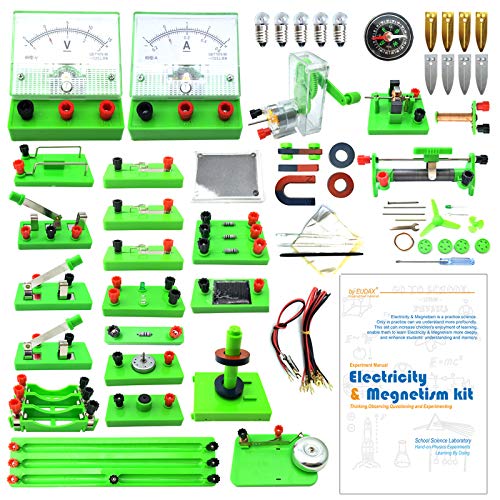
- Includes electricity and magnetism components with a color manual
- Builds circuits, electromagnets, an electric bell, and a generator
- Designed for hands-on work in grades 9–11
Best For: Students exploring introductory circuits and magnetism
Intermediate Chemistry Value

- Includes 250 experiments in 18 chemistry chapters
- Adds an alcohol burner and real laboratory apparatus
- Covers acids, gases, food chemistry, electrolysis, and chromatography
Best For: Intermediate chemistry learners and homeschool students
Buildable Circuit Projects

- Builds simple, series, parallel, and switch circuits
- Includes parts for LEDs, electromagnets, generators, and a wind-power car
- Organizes components in a transparent storage box
Best For: Students learning circuits through guided building projects
DNA Discovery Pick

- 20 guided genetics and DNA experiments
- Includes plant DNA isolation materials
- Manual, worksheets, puzzles, and DNA model included
Best For: Hands-on introductory genetics and biology learning
Science Fair Culture Pick

- 10 pre-poured sterile LB-agar plates
- Includes 10 sterile cotton swabs
- Science-fair e-book with project guidance
Best For: Structured bacteria-culture and science-fair projects
Hands-On Chemistry Pick

- 57-piece chemistry station setup
- Includes slime, fizzing, bubbles, and chromatography activities
- Non-hazardous chemicals; no borax
Best For: Accessible, activity-based introductory chemistry
Best Classroom DNA Activity

- Supports a cheek-cell DNA extraction activity
- Includes materials for up to 32 students
- Provides teacher and student instructional resources
Best For: Classroom biology lessons and group DNA labs
Best Variety Experiment Set

- Includes 150 guided science activities
- Covers chemistry, physics, earth science, and more
- Uses an illustrated step-by-step manual
Best For: Younger learners and family science activities
Best High School Physics Kit

- Includes 77 electrical and magnetism components
- Supports circuits, Ohm’s law, and electromagnet projects
- Designed for junior and senior high coursework
Best For: Introductory high school electricity and magnetism labs
Advanced Chemistry Pick – Thames & Kosmos CHEM C3000
For shoppers seeking science experiment sets for high school students, the Thames & Kosmos CHEM C3000 is a comprehensive choice for serious, chemistry-focused learners. It combines more than 333 experiments, authentic laboratory equipment, a broad chemical inventory, and a detailed 192-page manual covering inorganic, organic, and electrochemistry.
Best For: Aspiring chemists, homeschoolers, and students ready for advanced, adult-supervised chemistry work.
Pros:
- Includes more than 333 experiments across 27 chapters.
- Provides real lab equipment, including glassware, an alcohol burner, electrodes, and safety goggles.
- Explains advanced topics such as chemical bonding, electrolysis, redox reactions, and organic chemistry.
- Includes safety, first-aid, labeling, and waste-disposal guidance.
Cons:
- Adult supervision is required throughout.
- Some experiments require common household additions.
- Its advanced scope may be more than beginners need.
With its extensive experiment count and textbook-style manual, the CHEM C3000 offers the deepest chemistry experience in this roundup. It is best suited to families prepared to provide supervision and follow the included safety procedures.
Electricity & Magnetism Starter – EUDAX School Physics Labs Kit
The EUDAX School Physics Labs kit is a practical option among science experiment sets for high school students who want hands-on electricity and magnetism projects. It includes separate electricity and magnetism components, a color manual, storage bag, and projects that connect classroom principles to working circuits and models.
Best For: Students in grades 9–11 exploring introductory electricity, magnetism, and basic electronics.
Pros:
- Includes 56 electricity items, 21 magnetism items, repair tools, and a color manual.
- Supports series circuits, parallel circuits, fruit batteries, and Ohm’s law activities.
- Extends into electromagnets, an electric bell, Oersted experiments, and a hand-crank generator.
- Components can be stored in the included storage bag.
Cons:
- Three AA batteries are required but not included.
- The kit focuses on introductory electricity and magnetism rather than broader physics topics.
This set offers a useful balance of guided learning and construction-based experimentation. Buyers should plan for the required batteries and choose it when electricity and magnetism are the main learning goals.
Intermediate Chemistry Value – Thames & Kosmos CHEM C2000
The Thames & Kosmos CHEM C2000 is a strong middle-ground choice for science experiment sets for high school students who want genuine chemistry without moving immediately to the most advanced kit. Its 250 experiments, real laboratory tools, alcohol burner, and 128-page manual build a structured foundation across acids, bases, gases, food chemistry, electrolysis, and chromatography.
Best For: Intermediate learners, homeschoolers, and students building a foundation for high school chemistry.
Pros:
- Offers 250 experiments organized across 18 themed chapters.
- Includes an alcohol burner for combustion, evaporation, crystallization, and other heat-based work.
- Provides glassware, tubing, electrodes, goggles, and selected chemicals for genuine reactions.
- The manual combines step-by-step instructions with scientific explanations.
Cons:
- Adult supervision is required.
- Some experiments require careful handling of heat and chemicals.
- It is less extensive than the CHEM C3000.
The CHEM C2000 is a sensible progression kit for learners who have outgrown beginner activities but do not yet need the C3000’s broader scope. Its included burner and real lab apparatus add meaningful depth to the experiment selection.
Buildable Circuit Projects – EUDAX Upgrade Physics Kit
For students who learn best by assembling working models, the EUDAX Upgrade Physics kit is one of the more approachable science experiment sets for high school students. It centers on electricity and magnetism, with switches, wires, bulbs, LEDs, and project components stored in a transparent box.
Best For: Junior and senior high school students practicing circuit construction and basic electrical concepts.
Pros:
- Supports simple, series, parallel, and stair double-switch circuits.
- Includes parts for electromagnets, a hand-crank generator, a wind-power car, LEDs, and a traffic light.
- Comes ready to use apart from the required two AA batteries.
- Transparent storage helps keep the components organized.
Cons:
- Two AA batteries are required but not included.
- Its focus is limited mainly to basic electricity and magnetism.
- The project selection may be better for guided building than advanced electrical analysis.
This upgrade kit is a practical pick for hands-on circuit practice and project-based learning. It is especially useful when the priority is building visible working models rather than conducting a broad range of physics investigations.
DNA Discovery Pick – Genetics & DNA Lab
For shoppers comparing science experiment sets for high school students, the Thames & Kosmos Genetics & DNA Lab offers a focused introduction to genetics through 20 guided experiments. Students can isolate plant DNA, study biological inheritance, and assemble a model of DNA’s double helix using the included materials and 48-page manual.
Best For: Students interested in genetics, cells, chromosomes, and hands-on biology experiments.
Pros:
- Includes 20 experiments with a full-color instructional manual.
- Provides materials for plant DNA isolation and DNA model assembly.
- Covers biological inheritance with worksheets, puzzles, and visual aids.
Cons:
- Its subject focus is primarily genetics and DNA rather than broad science topics.
- The manufacturer’s recommended age range is 10–16 years.
This is a strong choice for learners who want a structured biology kit with both experiments and conceptual activities. The included glass bottle, test tubes, filters, model, and classroom-style resources make it especially suitable for guided study.
Science Fair Culture Pick – Bacteria Science Kit
Among science experiment sets for high school students, this bacteria kit is designed for culture-based projects and science-fair preparation. It includes 10 pre-poured sterile LB-agar plates, 10 sterile cotton swabs, and an e-book with step-by-step experiment guidance, project ideas, and troubleshooting advice.
Best For: Students ages 13 and up planning structured bacteria or environmental microorganism investigations.
Pros:
- Supplies 10 pre-poured 100-mm LB-agar plates and 10 sterile swabs.
- Includes a science-fair e-book with tested project guidance and common-mistake tips.
- Resealable packaging supports reuse of the kit’s supplies.
- Offers access to live support from PhD scientists for product questions.
Cons:
- The kit is specialized for bacteria-culture investigations rather than general science experiments.
- It is recommended for ages 13 and up, so younger students may need a different kit.
This kit is most compelling when the goal is a focused project rather than broad STEM exploration. The prepared plates and project e-book reduce setup work, while the included support may help students troubleshoot their investigation.
Hands-On Chemistry Pick – Ooze Labs Chemistry Station
For families seeking science experiment sets for high school students that emphasize active lab play, the Ooze Labs Chemistry Station provides a complete plastic workstation and 57 pieces. Experiments include glowing slime, fizzing reactions, oozing bubbles, and chromatography, with cards and a 16-page manual for guidance.
Best For: Beginners who want a colorful, approachable chemistry setup with multiple short experiments.
Pros:
- Includes a large chemistry station and 57 experiment-related pieces.
- Offers varied activities, including slime, fizzing reactions, bubbles, and chromatography.
- Experiment cards clip onto the station for convenient reference.
- Uses non-hazardous chemicals and does not contain borax.
Cons:
- The manufacturer recommends it for ages 6 and up, making it less specifically targeted to advanced high-school chemistry.
- Experiments are centered on introductory, activity-based chemistry rather than specialized laboratory techniques.
This is a practical option for learners who value an organized workspace and visual, engaging demonstrations. Older students seeking rigorous chemistry may prefer a more advanced kit, but beginners can benefit from the broad selection and clear experiment references.
Best Classroom DNA Activity – Wearable DNA Necklace Lab
For science experiment sets for high school students, this Carolina DNA Necklace Kit offers a focused biology activity rather than a large assortment of projects. Students extract DNA from their own cheek cells, observe visible strands after ethanol precipitation, and preserve the sample in a wearable pendant.
Best For: Biology classrooms, homeschool labs, and educators seeking a beginner-friendly DNA extraction activity for groups of up to 32 students.
Pros:
- Includes core materials for 32 students.
- Connects hands-on DNA extraction with NGSS-aligned biology concepts.
- Includes a teacher’s manual, reproducible student guides, and digital resources.
- Turns each student’s extracted DNA sample into a necklace pendant.
Cons:
- Its focus is limited to one DNA extraction and modeling activity.
- The kit is designed primarily for classroom use rather than a broad home experiment collection.
This is a strong choice when the goal is a structured, memorable genetics lesson with materials and guidance for an entire class. It is less suitable for students wanting a multi-topic science kit.
Best Variety Experiment Set – 150-Project STEM Science Kit
Among science experiment sets for high school students, the UNGLINGA kit stands out for its breadth, with 150 activities spanning chemistry, physics, earth science, surface tension, crystals, volcanoes, and more. However, its recommended age is 8 years and up, so older students may find the projects introductory.
Best For: Families or younger learners who want a large selection of guided experiments and can supplement the included materials with common household items.
Pros:
- Offers 150 experiments across several basic science topics.
- Includes a step-by-step, illustrated manual.
- Provides science tools and kid-friendly materials, including goggles.
- Supports hands-on learning during school breaks or at home.
Cons:
- The manufacturer recommends it for ages 8 and up, making it less specialized for high school coursework.
- Some activities require ordinary household items.
- The supplied notes do not indicate alignment with specific high school standards.
This kit provides impressive project variety and accessible instructions, but it is better viewed as a general STEM activity collection than a rigorous high school lab set. Check the individual project level before using it for advanced coursework.
Best High School Physics Kit – Electricity and Magnetism Lab
For science experiment sets for high school students focused on physics, this electricity and magnetism kit provides a more specialized lab experience. It combines 55 electrical components and 22 magnetism components with guided experiments involving circuits, Ohm’s law, electromagnets, generators, and related topics.
Best For: Junior and senior high school students studying introductory electricity, magnetism, electronics, or STEM physics projects.
Pros:
- Includes 77 components organized in a sturdy double-layer storage box.
- Supports series and parallel circuits, fruit batteries, Ohm’s law, electromagnets, and other projects.
- Provides a detailed manual with procedures, equipment lists, and investigation guidance.
- Includes specialized parts such as an ammeter, magnetic switch, and Joule’s First Law module.
Cons:
- Three AA batteries are required but not included.
- The kit is focused on electricity and magnetism rather than general science topics.
- Students may need supervision when conducting electrical experiments.
This is the most directly targeted option here for high school physics practice. Its component range and manual support both prescribed labs and student-designed investigations, provided users supply the required batteries.
How We Picked the Best Science Experiment Sets for High School Students
We focused on kits that support genuine hands-on learning rather than simple demonstration toys. The selection includes chemistry sets with broad experiment libraries, physics kits for circuits and electromagnetism, and biology-focused options covering DNA, genetics, cell extraction, and bacterial growth.
We also considered the quality of the included lab manual or instructions, the variety and educational value of the activities, the level of teacher or adult supervision required, and whether the kit is best suited to classroom work, independent study, or science-fair preparation. Because included materials can vary by production run, check the current package contents before ordering.
Quick Comparison
| Kit type | Best for | What to check |
|---|---|---|
| Advanced chemistry | Students wanting many experiments and broader lab practice | Equipment, chemical handling, manual quality, and supervision |
| Intermediate chemistry | Structured home or classroom chemistry study | Experiment count, replacement supplies, and workspace needs |
| Electricity and magnetism | Learning circuits, current, resistance, and electromagnetism | Component durability, diagrams, and power-source requirements |
| DNA and genetics | Biology lessons and visible molecular concepts | Consumables, activity complexity, and storage requirements |
| Microbiology | Science-fair investigations involving bacterial cultures | Aseptic technique, disposal instructions, and adult supervision |
| General experiment kits | Broad STEM exploration and introductory activities | Depth of instructions and suitability for the student’s age |
Key Buying Factors for Science Experiment Sets for High School Students
Curriculum Fit and Difficulty
Choose activities that match the student’s coursework and confidence. A large experiment count is useful only when the manual explains the underlying concepts and provides enough guidance to produce reliable results. Advanced chemistry or microbiology kits may require prior knowledge and close adult oversight.
Materials, Equipment, and Replenishment
Check whether the kit includes real laboratory tools, prepared media, reagents, wires, meters, or other specialized components. Some supplies are consumable, so investigate replacement availability and shelf life before starting a long-term project.
Safety and Workspace
Review the safety instructions, protective-equipment recommendations, ventilation requirements, and disposal procedures. Chemistry and biology activities should be performed in a suitable workspace with responsible adult supervision. Never culture unknown environmental samples or perform experiments outside the kit’s instructions.
Documentation and Project Value
A strong lab manual should explain the objective, procedure, variables, observations, and expected results. For science-fair work, prioritize kits that encourage a testable question and controlled comparison rather than activities that only demonstrate a fixed outcome.
Who Should Buy Which Science Experiment Sets for High School Students?
- For broad chemistry practice: Choose a comprehensive Thames & Kosmos chemistry set with a substantial manual and varied equipment.
- For a more structured chemistry course: An intermediate chemistry kit can provide a manageable progression from basic reactions to more involved investigations.
- For circuits and electromagnetism: Select an EUDAX or comparable physics kit with clearly labeled components and repeatable circuit diagrams.
- For DNA and genetics: DNA lab and necklace kits are accessible choices for introducing extraction, heredity, and molecular biology concepts.
- For microbiology projects: A prepared-plate bacteria kit may suit a supervised science-fair investigation, provided its safety and disposal requirements are followed carefully.
- For younger or mixed-experience learners: A general experiment set or introductory chemistry station offers variety without committing to one advanced subject.
Before buying, match the kit to the student’s learning objective, available supervision, and workspace. The best choice is the one that can be completed safely while producing observations the student can explain, record, and build on.