The best physics experiment sets for science fairs make it easier to turn abstract concepts into measurable, repeatable projects. This roundup covers practical kits for circuits, magnetism, optics, mechanics, motion, and simple machines.
Whether you need a focused electricity kit or a broader STEM set for exploring multiple ideas, use the guide below to match the equipment, difficulty, and project potential to your student’s goals.
Best 10 Physics Experiment Sets for Science Fairs Picks for 2026
Best Complete Electricity & Magnetism Kit
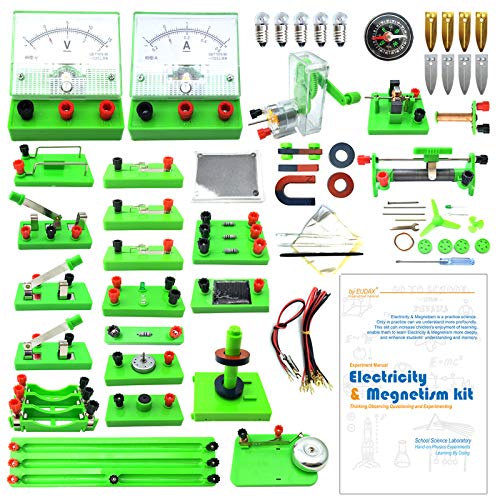
- 79 components for electricity and magnetism projects
- Includes a color manual and storage bag
- Batteries required and not included
Best For: High school circuit and electromagnetism projects
Best Variety for Younger Explorers

- Includes 150 activities across multiple sciences
- Illustrated step-by-step manual
- Some projects use household items
Best For: Younger students exploring possible science-fair topics
Best for Optics Demonstrations
Multifunction Physics Optical Set

- Includes lenses, mirrors, prism, and light source
- Covers reflection and refraction demonstrations
- Requires two AAA batteries
Best For: Focused optics and light science-fair projects
Best Guided Electricity & Magnetism Set

- 18 guided experiments with a 40-page manual
- Includes ammeter and voltmeter options
- Combines circuits, magnets, motors, and generators
Best For: Family-guided circuit and electromagnetism projects
Hands-On Mechanics

- Builds 26 models using classic simple machines
- Includes a spring scale for force measurements
- Guided by a 32-page illustrated manual
Best For: Ages 8+ exploring levers, pulleys, gears, and force
Magnetic Discovery
Junior Magnetism Experiment Set

- Includes multiple magnet shapes and magnetic cars
- Uses iron filings and a compass for investigations
- Designed for ages 8+ and common household add-ons
Best For: Introductory magnetism projects at home or school
Motion Model Lab
Inertia, Friction & Circular Motion Kit

- Builds six working motion-related models
- Covers inertia, friction, and circular motion
- Includes theory, experiments, quizzes, and a 3D app
Best For: Ages 9+ building demonstrations about laws of motion
Best Comprehensive Mechanics Kit

- Covers 26 hands-on mechanics experiments
- Includes pulleys, ramp, trolley, balance, and force gauge
- Manual and storage box included
Best For: Middle- and high-school mechanics projects
Best Introductory Circuit Set
Basic Electricity Experiment Kit

- Builds series and parallel circuits
- English instructions support assembly
- Storage box included; batteries required separately
Best For: Grades 7–9 electricity projects
Best Electromagnet Project Kit
DIY Electricity and Magnetism Set

- Builds electromagnets and a magnet car
- Also supports simple, series, and parallel circuits
- Full-color manual included
Best For: Introductory electromagnetism science projects
Best Complete Electricity & Magnetism Kit – EUDAX Basic Physics Lab
For students building physics experiment sets for science fairs, the EUDAX Basic Electricity and Magnetism Kit offers a focused way to explore circuits, resistance, electromagnetism, and generators. Its 79 components and color-page manual support hands-on projects for students in grades 9–11, although three AA batteries are required and not included.
Best For: High school students who want a broad electricity and magnetism kit for structured science-fair investigations.
Pros:
- Supports projects including series and parallel circuits, fruit batteries, Ohm’s law, electromagnets, electric bells, and hand-crank generators.
- Includes 56 electricity items, 21 magnetism items, repair tools, and a color manual.
- Provides a hands-on introduction to core electricity and magnetism principles.
Cons:
- Requires three AA batteries, which are not included.
- The wide range of components may require adult or teacher guidance for younger users.
This is a strong choice when a project needs multiple related experiments rather than one narrow demonstration. The included storage bag and manual also make setup and organization more manageable.
Best Variety for Younger Explorers – UNGLINGA 150 Experiments Kit
If you are comparing physics experiment sets for science fairs for a younger student, the UNGLINGA 150 Experiments Kit provides a broad selection of activities spanning physics, chemistry, earth science, surface tension, crystals, and volcanoes. The illustrated manual uses step-by-step instructions, with many projects supplemented by common household items.
Best For: Children ages 8 and up who want a varied science activity set and help choosing a project topic.
Pros:
- Offers 150 activities across physics and several other science subjects.
- Includes science tools and kid-friendly materials, plus goggles for a scientist-style activity experience.
- Uses an illustrated, step-by-step manual to make activities easier to follow.
Cons:
- It is not dedicated exclusively to physics, so only part of the collection targets physics concepts.
- Some experiments require regular household items beyond the included materials.
This kit works best when flexibility matters more than a tightly sequenced physics curriculum. Its large activity count can help a child test several ideas before selecting a manageable science-fair demonstration.
Best for Optics Demonstrations – Multifunction Physics Optical Set
For science fairs centered on light, the Multifunction Physics Optical Experiment Set gives students a compact collection of lenses, a prism, mirrors, a reflector, and a three-way linear light source. It is designed for hands-on demonstrations of reflection and refraction, with an English color-page manual included.
Best For: Students ages 14 and up preparing a focused project on reflection, refraction, lenses, or prisms.
Pros:
- Supports demonstrations of plane-mirror, diffuse, convex-mirror, and concave-mirror reflection.
- Includes biconvex, concave, and convex lenses, an acrylic tile, triangular prism, reflector, and light source.
- Compact design and manual make it suitable for indoor classroom or home demonstrations.
Cons:
- Requires two AAA batteries, which are not included.
- Its subject range is concentrated on optics rather than general physics.
- The light-source direction requires screwdriver adjustment.
This is a practical pick when a science-fair question can be demonstrated visually with controlled light paths. Its specialized components are more useful for an optics investigation than for a broad introductory project.
Best Guided Electricity & Magnetism Set – Teenii STEM Physics Kit
The Teenii Electricity and Magnetism Kit is a practical option among physics experiment sets for science fairs when students need clearly defined circuit and electromagnetism activities. Its 50 pieces, meters, electrical components, magnets, and 40-page full-color manual support 18 listed experiments for children ages 8 and up.
Best For: Children and families seeking guided electricity and magnetism experiments with measurement tools and reusable components.
Pros:
- Includes 18 hands-on experiments such as fruit batteries, electric bells, hand-crank generators, and double-rail activities.
- Provides ammeter and voltmeter options, lightbulbs, switches, resistors, a potentiometer, and wiring components.
- Adds magnetism equipment including bar and horseshoe magnets, a compass, solenoid, motor, and iron-filing box.
- The full-color 40-page manual supports parent-child and school-project use.
Cons:
- The notes do not specify whether batteries are included.
- With many components and measurement options, younger users may benefit from supervision.
This set balances guided activities with enough electrical and magnetic components for a student to develop a measurable demonstration. It is especially useful when a project benefits from comparing circuit behavior or showing electromagnetism in action.
Hands-On Mechanics – Simple Machines Physics Set
For shoppers comparing physics experiment sets for science fairs, this kit offers a practical way to investigate how simple machines affect force. Children build 26 models involving levers, pulleys, gears, wheels and axles, inclined planes, screws, and wedges, then use the included spring scale to measure force changes.
Best For: Children ages 8 and up who enjoy building models and exploring introductory mechanics through hands-on experiments.
Pros:
- Covers all six classic simple machines plus gears through 26 model-building activities.
- Includes a spring scale for measuring the direction and magnitude of forces.
- Provides a 32-page, full-color manual with step-by-step instructions and science explanations.
- Modular pieces are compatible with other Thames & Kosmos construction, physics, and engineering kits.
Cons:
- Focuses on simple machines rather than a broad range of physics topics.
- Plastic construction pieces may require careful organization during multi-model projects.
This is a strong choice when a science-fair project benefits from visible mechanical demonstrations and basic force measurements. Its structured manual and 8+ age recommendation make it approachable for younger learners, while the reusable building system supports follow-up experiments.
Magnetic Discovery – Junior Magnetism Experiment Set
This magnetism kit is a compact option among physics experiment sets for science fairs, especially for projects centered on attraction, repulsion, magnetic fields, and the Earth’s magnetism. It supplies several magnet shapes, a compass, magnetic cars, and an iron-filings box, while leaving room to add everyday items such as paper, rulers, and pens.
Best For: Learners over age 8 developing simple magnetism investigations at home or in the classroom.
Pros:
- Includes 14 magnetism-related pieces and accessories, including bar, U-shaped, and ring magnets.
- Iron filings and a compass support visual and directional investigations.
- Three magnetic cars add an engaging way to explore magnetic effects.
- Encourages students to design experiments using common household tools.
Cons:
- Experiments require additional everyday materials that are not included.
- Provides a focused magnetism experience rather than a broad physics curriculum.
- The included compass is made from plastic.
Choose this set when the planned display or experiment is specifically about magnets and observation. Its small size and straightforward components make it easy to use in a classroom or home setting, although students will need to develop or adapt investigations beyond the supplied accessories.
Motion Model Lab – Inertia, Friction & Circular Motion Kit
For older children seeking physics experiment sets for science fairs, this Engino kit combines construction with experiments on inertia, friction, and circular motion. Students can build six working models, including a rocket launcher, crash test rig, and sharpening wheel, then use the theory material, quizzes, and app to reinforce what they observe.
Best For: Children ages 9 and up who want a project-oriented introduction to motion laws with multiple working models.
Pros:
- Explores inertia, friction, and circular motion through six working models.
- Includes a theory book, experiments, quiz section, and easy-to-follow instructions.
- Offers an interactive 3D app for virtual building support.
- Models connect physics concepts to practical examples such as crashes and launching.
Cons:
- Its subject focus is limited to selected motion laws rather than general physics.
- Building and testing six models may require more time and supervision than a simple activity set.
- The kit is intended for ages 9 and up.
This set suits science-fair preparation when the student wants a moving demonstration rather than a single static experiment. The combination of physical builds, explanatory theory, quizzes, and app-based guidance gives the project more structure, though families should allow time for model construction and testing.
Best Comprehensive Mechanics Kit – 26-Experiment Physics Lab Set
For students who need broad coverage, this mechanics kit is one of the more fully equipped physics experiment sets for science fairs. Its pulleys, balance, force gauge, trolley, ramp, lever ruler, and pressure gauge support hands-on investigations into forces, motion, friction, pressure, buoyancy, and simple machines.
Best For: Middle- and high-school students, classroom labs, independent study, and projects focused on classical mechanics.
Pros:
- Includes equipment for 26 experiments covering Newton’s laws, kinematics, gravity, pressure, and buoyancy.
- Provides several useful mechanics tools, including pulleys, a spring dynamometer, trolley, ramp, and tray balance.
- Comes with a professional manual and organized storage box.
- Metal and plastic components are designed for repeated classroom or home use.
Cons:
- Its mechanics focus may not suit projects centered on electricity or magnetism.
- The manufacturer recommends it for ages 14 and up.
This is the strongest all-around choice here for a science fair project involving measurable mechanical principles. It offers enough hardware for varied experiments, though younger students may need supervision and guidance.
Best Introductory Circuit Set – Basic Electricity Experiment Kit
This basic EUDAX set is a practical entry point among physics experiment sets for science fairs, especially for students building and comparing simple electrical circuits. The included instructions guide series and parallel circuit projects while encouraging hands-on learning and basic electrical awareness.
Best For: Grades 7–9, science fairs, science clubs, summer camps, homeschool units, and introductory electricity activities.
Pros:
- Supports construction of both series and parallel circuits.
- Includes English instructions to help students follow circuit-building activities.
- Designed to reinforce classroom concepts while developing hands-on and problem-solving skills.
- Components come in a plastic storage box for organization.
Cons:
- Two AA batteries are not included.
- Its basic design is intended for introductory electricity rather than broad physics coverage.
Choose this kit when the project goal is a straightforward circuit demonstration or comparison. It is less versatile than a full mechanics lab set, but its focused format can make an electricity-based fair project easier to plan.
Best Electromagnet Project Kit – DIY Electricity and Magnetism Set
For science fair ideas that combine circuits and magnetism, this EUDAX model kit offers a focused set of physics experiment materials. Students can investigate a finished electromagnet, magnet car, homemade electromagnet, and simple, series, and parallel circuits using the included full-color manual.
Best For: School lab activities and student projects exploring introductory electromagnets, circuits, and hands-on discovery.
Pros:
- Supports multiple projects involving both basic electricity and electromagnetism.
- Includes a full-color manual explaining the basic principles and project steps.
- Encourages practical building, observation, thinking, and exploration.
Cons:
- Instructions require careful battery installation and short-circuit precautions.
- The kit is small and focused on introductory concepts rather than advanced experiments.
- Its project selection is narrower than a comprehensive mechanics kit.
This is a good match for a student who wants a more distinctive electricity project than a basic circuit demonstration. The electromagnet and magnet-car activities provide clear project directions, provided the student follows the safety instructions closely.
How We Picked These Physics Experiment Sets for Science Fairs
We selected kits that support observable experiments rather than passive demonstrations. The list includes focused sets for electricity, magnetism, optics, and mechanics, along with broader STEM kits that can help students develop several project ideas. We also considered the clarity of the components, the range of included activities, likely age suitability, and how easily a student can vary one factor and record results.
For a science fair, a kit is most useful when it provides a reliable starting point but leaves room for a testable question. Students should be able to repeat an experiment, collect measurements, compare results, and explain limitations.
Quick Comparison
| Kit type | Best for | Typical project directions |
|---|---|---|
| Electricity and circuits | Current, voltage, switches, and electromagnets | Resistance, circuit design, conductivity, magnetic strength |
| Magnetism | Field behavior and electromagnetic effects | Distance, materials, coils, and force comparisons |
| Optics | Light, lenses, mirrors, and refraction | Focal length, angles, image formation, and reflection |
| Mechanics | Force, balance, pulleys, and motion | Mechanical advantage, friction, mass, and acceleration |
| Simple machines and motion | Engineering-focused investigations | Work, torque, inertia, friction, and circular motion |
| Multi-topic science kits | Exploration across STEM subjects | Early project discovery and broad concept testing |
Key Buying Factors for Physics Experiment Sets for Science Fairs
Choose the Right Physics Topic
Start with the intended project. A circuit kit is a better choice for testing conductivity or electromagnets than a general science set, while an optics kit is more appropriate for lenses, mirrors, and refraction. Focused equipment usually provides more usable parts for one subject.
Check Measurement Capability
Look for components that allow controlled changes and meaningful observations. Force gauges, balances, graduated scales, light sources, pulleys, and clearly arranged circuit parts can make data collection easier. If the kit does not include measuring tools, plan to supply them separately.
Match Complexity and Durability
Review the recommended age, assembly demands, and supervision needs. Younger students may benefit from guided, color-coded components, while older students can use modular parts to design less scripted investigations. Confirm that small pieces, batteries, magnets, and electrical connections will be used safely.
Consider Documentation and Expansion
Instructions are valuable, but a science-fair project should not simply copy a demonstration. Favor kits that can be modified with household materials or additional sensors, wires, weights, mirrors, or measuring tools.
Who Should Buy Which Physics Experiment Sets for Science Fairs?
Choose an electricity or electromagnetism kit for projects involving circuits, switches, conductivity, voltage, resistance, or magnetic coils. These are strong options for students who want a clear experimental setup with visible results.
Choose an optics set for investigations into reflection, refraction, lenses, focal length, and image formation. It is especially useful when the project depends on angles and repeated distance measurements.
Choose a mechanics or simple-machines kit for force, balance, pulleys, friction, work, torque, and mechanical advantage. These sets suit students who prefer physical demonstrations and engineering-style testing.
Choose a magnetism or motion-focused kit when the student already has a specific question about magnetic fields, inertia, friction, or circular motion. For beginners still exploring topics, a broader multi-experiment STEM kit can provide ideas, but verify that it contains enough measurement tools for a rigorous final project.