Abstract astronomy concepts become easier to understand when students can see planetary order, compare sizes, and model orbital movement. The best solar system models for classrooms turn a lesson into a hands-on experience rather than a diagram on a page.
This roundup includes magnetic displays, motorized models, glow-in-the-dark sets, project kits, and interactive teaching tools for different ages, budgets, and classroom activities.
Best 10 Solar System Models for Classrooms Picks for 2026
Best Hands-On Classroom Display

- 12-piece magnetic set with realistic NASA imagery
- Large pieces work on whiteboards and metal surfaces
- Supports planetary order and size demonstrations
Best For: Interactive lessons for ages 4–10
Best Motorized Demonstration
GeoSafari Motorized Solar System

- Shows planets orbiting at different speeds
- Projects constellations with the star dome
- Includes a 28-page planetary and constellation guide
Best For: Visual STEM lessons for ages 8–12
Best Build-and-Paint Project

- Build and customize all eight planets and the Sun
- Includes paints, tools, decals, and a facts poster
- Movable arms support adjustable display positions
Best For: Creative astronomy projects for ages 8 and up
Best Projector Combination
Orbiting Solar System Projector

- Eight planets rotate on moving orbiting arms
- Projects 32 planet and constellation images
- Includes NASA media and a space-facts guide
Best For: Interactive indoor lessons for ages 5 and up
Best Hands-On Starter

- 64-piece kit with foam shapes and painting supplies
- Supports astronomy, creativity, and fine-motor practice
- Designed for ages 6–12
Best For: Elementary classroom projects and guided space-themed activities
Best Interactive Learning Tool
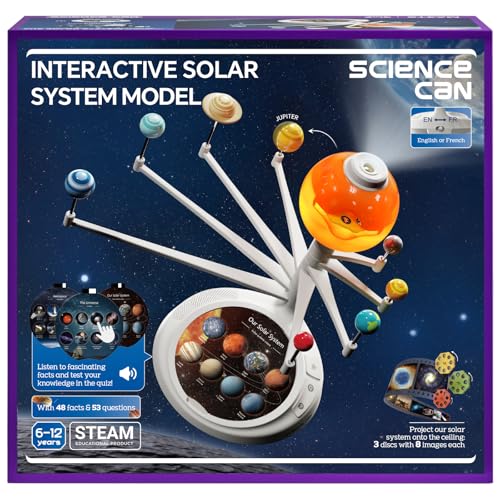
- Includes 48 facts and 53 quiz questions
- Projects 24 full-color space images
- Offers English and French options
Best For: Interactive demonstrations and STEM review activities
Best Construction Activity

- Builds a rotating planetary model
- Explores orbits, motion, and day and night
- Designed for ages 8–14
Best For: Upper-elementary and middle-school STEM building activities
Best Immersive Display
Inflatable Solar System Planets
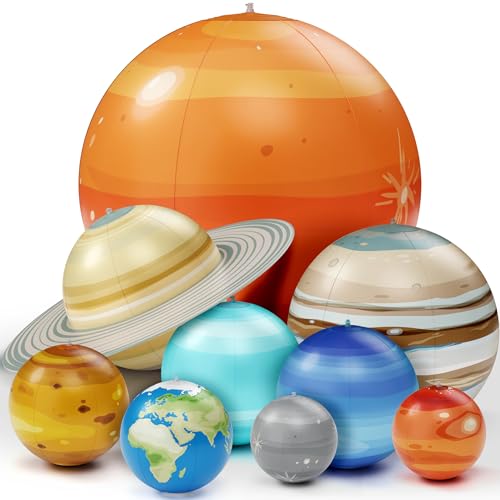
- Jumbo Sun and eight-planet set
- Includes learning cards and hanging strings
- Deflates for reusable storage
Best For: Interactive displays and younger elementary classrooms
Best Group Craft Activity

- Includes 36 cardstock model kits
- Supplied with 80 metal brads
- Designed for hands-on science activities
Best For: Group projects and older student activities
Best Orbital Demonstration

- Shows Earth and Moon orbital movement
- Demonstrates seasons and eclipses
- Includes seasonal information plate
Best For: Earth science and astronomy demonstrations
Best Hands-On Classroom Display – Giant Magnetic Solar System
For classrooms needing solar system models for classrooms that support active demonstration, this 12-piece magnetic set makes planetary order and size comparisons easy to show on whiteboards, metal doors, and other magnetic surfaces. Its large, flexible pieces are designed for repeated hands-on use.
Best For: Teachers introducing planetary sequence, relative size, and basic astronomy to children ages 4–10.
Pros:
- Includes the Sun, Moon, planets, asteroid belt, and Pluto with realistic NASA satellite imagery.
- Large magnets support whole-class demonstrations and tactile exploration.
- Flexible magnetic construction is suited to regular classroom handling.
Cons:
- Requires a magnetic surface for display.
- It is a wall or board display rather than a freestanding orbital model.
This is a practical choice when visibility and student participation matter most. The included educational guide adds fun facts for follow-up lessons and independent exploration.
Best Motorized Demonstration – GeoSafari Motorized Solar System
Among solar system models for classrooms, this motorized display stands out for showing planets orbiting the Sun at different speeds. It combines a moving model with interchangeable light-up sun and star domes for lessons that extend from planets to constellations.
Best For: Teachers and learners ages 8–12 who benefit from a moving, visual introduction to planetary motion and constellations.
Pros:
- Displays inner and outer planets orbiting at different speeds.
- Swappable domes provide either a light-up Sun or projected constellations.
- Includes eight planets, a sturdy base, and a 28-page full-color guide.
Cons:
- Requires four AA batteries, which are not included.
- The motorized unit needs tabletop space and is less suited to large-group handling.
This model offers more visual activity than a static display and adds a night-light feature with automatic shutoff. It is especially useful when a lesson benefits from motion and constellation imagery.
Best Build-and-Paint Project – Glow-in-the-Dark Solar System
This build-and-paint option gives solar system models for classrooms a creative, project-based format. Students assemble and customize all eight planets and the Sun, then use movable arms to adjust the display and glow-in-the-dark paint for continued interest after the activity.
Best For: Hands-on astronomy projects for children ages 8 and up that combine construction, painting, and science learning.
Pros:
- Includes planets, Sun, paints, glow paint, brush, palette, decals, and a facts poster.
- Movable arms allow students to rearrange the planetary display.
- Combines astronomy facts with creativity and model-building skills.
Cons:
- Students must assemble and paint the model before it is ready to display.
- The small parts and project format may require teacher supervision.
This kit is a strong fit for a multi-step classroom activity rather than a quick demonstration. Its glow feature and customizable finish can also extend the model’s appeal as a science-room display.
Best Projector Combination – Orbiting Solar System Projector
For classrooms seeking solar system models for classrooms with an added presentation element, this rotating model combines eight orbiting planets with a Sun-shaped projector. It includes 32 images featuring planets, constellations, asteroids, and other space subjects for projected exploration.
Best For: Space lessons for children ages 5 and up that pair a physical model with projected NASA media and astronomy visuals.
Pros:
- Eight planets move on orbiting arms around the Sun.
- Four discs provide 32 premium images, including NASA photographs.
- Includes a guide with space facts and supports ceiling projection.
Cons:
- Requires three AA batteries, which are not included.
- Projection is intended for indoor use and needs a suitable viewing surface.
This is a versatile choice for teachers who want both a tangible orbiting model and media-rich visual exploration. The projector can help capture attention during group instruction, while the physical planets support closer examination.
Best Hands-On Starter – Foam Solar System Project Kit
For classrooms seeking hands-on solar system models for classrooms, the wookidel kit provides foam pieces, paints, brushes, sticks, flags, and instructions for a planet-building project. Students can color and assemble their models while reinforcing basic astronomy concepts and practicing fine-motor skills.
Best For: Elementary classroom projects and guided space-themed art and science activities.
Pros:
- 64-piece set includes foam shapes, paints, brushes, palette, sticks, flags, and instructions.
- Coloring and assembly support creativity, hand-eye coordination, focus, and science learning.
- Foam surfaces are designed to be easy to color, with 12 acrylic paints included.
- Suitable for school or family solar system activities.
Cons:
- Students must paint and assemble the model, so the project requires classroom time and supervision.
- The manufacturer recommends it for ages 6–12, limiting its fit for older students.
This is a practical choice when the goal is an engaging make-and-learn activity rather than a ready-made display. Teachers should plan for setup, drying, and construction time.
Best Interactive Learning Tool – Talking Solar System Model
Among solar system models for classrooms, this talking model stands out for its built-in knowledge cards, quiz mode, bilingual English/French options, and space projector. It offers a low-prep way to introduce planets, orbits, and space phenomena during STEM lessons.
Best For: Interactive group demonstrations, review activities, and classrooms that want audio, quiz, and projection features.
Pros:
- Three knowledge cards present 48 space facts.
- Interactive quiz mode includes 53 questions to reinforce astronomy concepts.
- Three projector disks provide 24 full-color space images for walls or ceilings.
- English and French options support bilingual learning environments.
Cons:
- Requires three AA batteries, which are not included.
- Its electronic features may be less suitable for classrooms seeking a purely hands-on construction project.
- The supplied notes do not specify a classroom storage or display format.
Choose this model when engagement and quick access to facts matter more than student assembly. The projection and quiz functions can help vary lessons, though teachers should prepare batteries before use.
Best Construction Activity – Gear-Driven Planet Model
For older students comparing solar system models for classrooms, the Smartivity kit focuses on building and rotating a gear-driven model. Its construction-based design gives learners a way to explore planetary movement, orbits, day and night, and the solar system’s structure through hands-on STEM play.
Best For: Upper-elementary and middle-school building activities for students ages 8–14.
Pros:
- Students assemble a rotating solar system model to explore planetary motion.
- Combines construction, creativity, and introductory astronomy concepts.
- Made from eco-friendly, child-safe MDF materials according to the supplied notes.
- Compact package dimensions can make classroom storage easier.
Cons:
- The kit requires assembly, so it may need teacher guidance and dedicated project time.
- The supplied details list the included component as a box and do not identify paints or supplementary classroom materials.
- Its recommended age begins at 8, making it less appropriate for younger learners.
This model is a strong fit for classes that value making and mechanical exploration. It is less of an instant teaching aid and more of a structured build project that can anchor a lesson on motion and planetary systems.
Best Immersive Display – Inflatable Solar System Planets
For classrooms looking for solar system models for classrooms that students can see and touch, this inflatable set offers a large, engaging display. It includes the Sun, all eight planets, hanging strings, and learning cards for guided exploration.
Best For: Interactive classroom decoration, visual STEM lessons, and space-themed learning areas for younger children.
Pros:
- Includes the Sun and all eight planets in a jumbo inflatable format.
- Built-in hanging loops and included strings support ceiling or room displays.
- Learning cards add planet facts and visuals to hands-on activities.
- Deflates for compact storage and can be reused.
Cons:
- Recommended for ages 5 to 8, so it may be limited for older students.
- Designed for indoor use and does not include a motorized orbital mechanism.
This is a strong choice when visibility, tactile interaction, and classroom atmosphere matter more than precise scale or moving planetary orbits.
Best Group Craft Activity – DIY Solar System Model Kits
For teachers who want solar system models for classrooms that double as student projects, this 36-set cardstock kit supports hands-on construction. Students assemble colorful models featuring the Sun, Moon, and planets using the included metal brads.
Best For: Group science activities, Montessori-style instruction, homeschooling, and take-home classroom projects.
Pros:
- Provides 36 individual DIY kits for larger classes or repeated activities.
- Includes 80 metal brads for assembling the paper models.
- Cardstock pieces have clear printing and measure about 11 inches.
- Supports hands-on learning about planets and the wider universe.
Cons:
- Assembly is required, so it is less suitable as an immediate display model.
- The listed manufacturer recommendation is 12 years and up.
- Cardstock construction may be less durable than a solid physical model.
This kit offers excellent quantity for classroom stations or group lessons, especially when the learning goal includes building and manipulating a model rather than simply viewing one.
Best Orbital Demonstration – Sun Earth Moon Orbital Model
For lessons that need more than planet identification, this Sun-Earth-Moon orbital model gives teachers a working demonstration tool. Its rotating components are designed to show planetary orbit, seasons, moon phases, and solar and lunar eclipses.
Best For: Earth science instruction, astronomy demonstrations, and school projects for children over age 6.
Pros:
- Demonstrates Earth orbiting the Sun and the Moon orbiting Earth.
- Supports explanations of seasons, solar eclipses, lunar eclipses, and moon phases.
- Includes a seasonal plate with season names, dates, and traditional Chinese calendar terms.
- Measures approximately 15.2 by 7.87 by 11.02 inches.
Cons:
- Focuses on the Sun, Earth, and Moon rather than all eight planets.
- Requires assembly and alignment according to the supplied instructions.
- Its single-model format may be less practical for simultaneous small-group use.
This is the most lesson-focused option of the three for explaining motion and Earth-Moon-Sun relationships, although it is not a complete planetary system display.
How We Picked the Best Solar System Models for Classrooms
We focused on how effectively each model supports classroom instruction, not just how attractive it looks. The selection covers products suited to demonstrations, student projects, display stations, and guided exploration. We considered construction quality, ease of assembly, visibility from across a classroom, educational features, age guidance, storage needs, and whether the model encourages active participation.
Because classroom needs vary, the list includes both reusable teaching aids and craft-style kits. A motorized or orbiting model may work best for teacher-led demonstrations, while magnetic, inflatable, or build-your-own sets can support group activities and tactile learning.
Quick Comparison
| Model Type | Best For | What to Look For |
|---|---|---|
| Magnetic display | Interactive wall or board lessons | Strong magnets, clear labels, and easy repositioning |
| Motorized or orbiting model | Explaining movement and sequence | Reliable motion, visible planets, and manageable noise |
| Glow-in-the-dark set | Displays and visual reinforcement | Readable colors, charging instructions, and safe mounting |
| DIY project kit | Hands-on group or individual work | Complete materials, age-appropriate steps, and cleanup requirements |
| Inflatable planets | Large-group demonstrations | Scale, visibility, inflation method, and storage space |
Key Buying Factors for Solar System Models for Classrooms
Accuracy and Instructional Value
Look for clearly identified planets and useful visual differences in color, size, or surface features. Models are not usually built to true scale, so explain that they represent relationships rather than exact proportions. Orbital products should make movement easy to observe without implying that planetary distances are accurately reproduced.
Durability and Classroom Handling
Frequent use favors sturdy plastic, secure connections, reinforced hanging points, and parts that can be stored together. DIY kits may be excellent for projects but less suitable for repeated handling unless finished components are protected.
Visibility, Space, and Setup
Choose a large or inflatable set for whole-class demonstrations, and a compact magnetic or tabletop model for limited space. Check assembly time, power requirements, mounting hardware, and storage dimensions before buying.
Age Range and Safety
Match the product to student abilities. Small parts, adhesives, batteries, paints, and tools may require supervision. For younger learners, prioritize oversized pieces and simple labels; older students may benefit from gear-driven, projection, or construction-based activities.
Who Should Buy Which Solar System Models for Classrooms?
For teacher-led demonstrations: Choose a motorized, orbiting, or interactive talking model that makes planetary order and movement easy to explain.
For hands-on stations: Magnetic sets and durable movable pieces work well when students need to manipulate the planets themselves.
For project-based learning: DIY kits offer opportunities to build, paint, label, and present a model, making them a good fit for individual assignments or small groups.
For large classrooms: Inflatable planets or oversized displays are easier to see from the back of the room and can support movement-based activities.
For displays and astronomy corners: Glow-in-the-dark or visually detailed models add interest while reinforcing planet names and sequence. The best choice ultimately depends on whether your priority is explanation, interaction, construction, or visibility.