If you need reliable measurements for capacitors, inductors, and resistors, a benchtop LCR meter is the right tool for the job. The best models deliver stable readings, useful test frequencies, and the connectivity modern labs expect.
Below, we’ve narrowed the field to 10 strong options for electronics work, repair benches, and production testing, with a focus on accuracy, range, and practical features that matter in real-world use.
Best 10 Benchtop Lcr Meters Picks for 2026
Lab-Grade All-Rounder
MATRIX MCR5200 Benchtop LCR Meter

- 0.1% basic accuracy
- 40Hz to 200kHz, 41 frequency points
- USB, RS232C, Handler, SCPI/GPIB support
Best For: R&D, QC, and repair benches needing wide frequency coverage
Industrial Bench Classic
GW INSTEK LCR-6002 Precision LCR Meter

- 2kHz max test frequency
- Wide measurement ranges for L, C, and R
- RoHS compliant bench design
Best For: Routine bench testing at lower frequencies
Programmable Value Pick

- 0.2% accuracy with 10 frequencies
- Dual 5-digit TFT display and sorting
- RS232, USB, and SCPI support
Best For: Production screening and programmable bench testing
Fast Precision Choice
GW INSTEK LCR-6100 Bench Meter

- 0.05% basic accuracy
- 10Hz to 100kHz range
- Fast measuring speed up to 25ms
Best For: Precision bench testing with faster cycle times
Compact Entry-Level Bench Meter

- 10 fixed frequencies from 100 Hz to 10 kHz
- Measures L/C/R/Z, X/D/Q/theta, and ESR
- RS232 and USB Device communication
Best For: Routine bench checks and compact setups
High-Precision Lab Favorite
Gw Instek LCR-6020 Bench Meter
- 0.05% basic accuracy
- 3.5-inch color LCD with multi-parameter display
- PASS/FAIL judgment plus zero methods
Best For: R&D, production test, and IQC
Wide-Range Modern Pick
ET4510 10-100KHz Benchtop LCR Meter

- 10 Hz to 100 kHz frequency control in 1 Hz steps
- 0.1% basic accuracy with 5-digit display
- 3.5-inch TFT LCD plus comparator tools
Best For: Labs needing flexible frequency control and broad range
Bench-Ready Precision

- 0.1% precision for component testing
- Supports capacitor, inductor, and resistor checks
- Open/short calibration helps reduce fixture error
Best For: Engineers and labs needing a precision bench meter
Wide-Frequency Lab Tool
GW INSTEK LCR-6200 Precision LCR Meter

- 10 Hz to 200 kHz frequency range
- 0.05% basic accuracy
- Measuring speed up to 25 ms
Best For: Labs and technicians needing broad frequency coverage
Feature-Rich Bench Tester
MATRIX MCR-5030 Benchtop LCR Meter
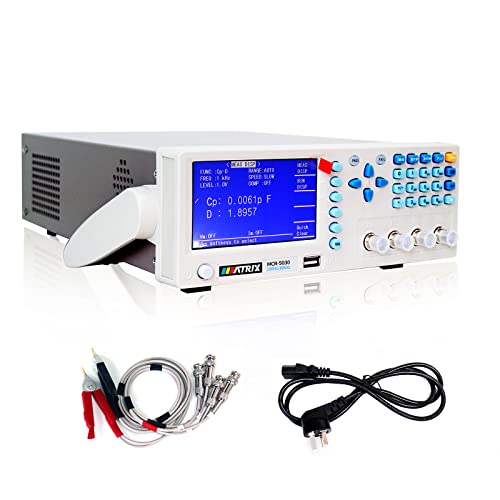
- 0.1% accuracy with 5-digit resolution
- Comparator, sorting, and alarm functions
- U-disk support for saving and managing test data
Best For: Users needing advanced bench testing and file-handling features
Lab-Grade All-Rounder – MATRIX MCR5200 Benchtop LCR Meter
If you need benchtop LCR meters for a lab, repair bench, or production setup, the MATRIX MCR5200 stands out for its wide 40Hz to 200kHz frequency range and 0.1% basic accuracy. It measures inductance, capacitance, resistance, impedance, D, Q, and phase, so it covers everyday component checks and deeper troubleshooting without moving to another instrument.
Best For: R&D, quality control, repair work, and general-purpose component analysis where frequency flexibility matters.
Pros:
- 0.1% basic accuracy with 41 selectable frequency points from 40Hz to 200kHz
- Broad measurement coverage for L, C, R, |Z|, X, ESR, D, Q, and phase angle
- USB Host, RS232C, Handler ports, and SCPI/GPIB support for data handling
- Open/short calibration, comparator mode, and data save features for repeat testing
Cons:
- At 7.7 pounds, it is a dedicated bench instrument rather than a portable meter
- Only 30Ω and 100Ω source resistance options are listed
For buyers comparing benchtop LCR meters by capability, this model offers a strong mix of accuracy, interface options, and measurement range. It is especially appealing if you want a bench tool that can support both analysis and automated workflows.
Industrial Bench Classic – GW INSTEK LCR-6002 Precision LCR Meter
Among benchtop LCR meters, the GW INSTEK LCR-6002 is a straightforward precision option built around a 2kHz maximum test frequency and broad measurement limits. It is a practical fit when you want a bench instrument for standard component checks rather than extended high-frequency analysis.
Best For: Basic bench testing where proven precision and wide measurement ranges matter more than advanced frequency coverage.
Pros:
- Bench-style LCR meter with a compact 4 kg form factor
- Measures inductance up to 9.99999kH, capacitance up to 9.99999F, and resistance up to 99.9999Mohm
- RoHS compliant for regulated environments
Cons:
- Maximum test frequency is only 2kHz
- No warranty is listed in the supplied details
If your workflow centers on common LCR measurements at lower frequencies, this model keeps things simple and focused. It is best viewed as a dependable bench meter for routine test environments rather than a feature-heavy analyzer.
Programmable Value Pick – ET4401 Benchtop LCR Analyzer
If you are shopping benchtop LCR meters for QC, lab validation, or batch sorting, the ET4401 offers a useful feature set at a focused 100Hz to 10kHz range. It combines 0.2% accuracy, dual display readouts, and programmable functions that make it practical for repeatable component testing.
Best For: Production screening, R&D testing, and bench use where sorting and programmable controls are helpful.
Pros:
- 0.2% basic accuracy with 10 selectable test frequencies from 100Hz to 10kHz
- Dual 5-digit TFT display shows primary and secondary parameters at once
- Includes DCR, electrolytic capacitor mode, open/short calibration, and adjustable test speed
- RS232, USB Device, SCPI support, and 5-group comparator sorting for batch testing
Cons:
- Frequency range tops out at 10kHz
- Smaller 3.5-inch display than some larger bench instruments
This is a solid choice if your work benefits from guided testing and automated sorting rather than maximum frequency range. It brings together the core functions most teams need for reliable bench diagnostics.
Fast Precision Choice – GW INSTEK LCR-6100 Bench Meter
For buyers comparing benchtop LCR meters, the GW INSTEK LCR-6100 is notable for combining a 10Hz to 100kHz sweep with 0.05% basic accuracy. It is aimed at users who want a precision bench meter with a color display and faster measuring performance for routine component work.
Best For: Precision lab and bench measurements when you want broader frequency coverage and quicker test cycles.
Pros:
- 10Hz to 100kHz test range with consecutive test frequency support
- 0.05% basic accuracy for detailed component measurement
- 3.5-inch color LCD for clearer readout
- Fast measuring speed up to 25ms maximum
Cons:
- No interface or data-saving features are listed in the supplied details
- Measurement focus is narrower than feature-rich programmable analyzers
This model is a good fit if accuracy and speed matter more than extra software features. It gives you a practical precision platform for bench testing across a wider frequency span than lower-frequency entry models.
Compact Entry-Level Bench Meter – 100Hz~10K Digital LCR Tester
If you want a straightforward benchtop LCR meter for everyday component checks, this model keeps the essentials in a compact footprint. It covers L/C/R/Z plus X/D/Q/theta/ESR, and its fixed test frequencies make it easy to get repeatable readings without a lot of setup.
Best For: Bench testing passive components, basic lab work, and users who want RS232/USB connectivity in a compact meter.
Pros:
- 10 fixed test frequencies from 100 Hz to 10 kHz
- Measures L/C/R/Z, X/D/Q/theta, and ESR with a 5-digit display
- Wide stated measurement ranges for inductance, capacitance, and resistance
- Includes open/short calibration and electrolytic capacitor DCR mode
Cons:
- Frequency selection is limited to fixed points rather than fully continuous control
- Accuracy is listed as 0.10%, not the tightest in this group
- Some SCPI protocol details require contacting the seller
Overall, this is a practical benchtop option if you need broad measurement coverage and basic computer connectivity in a compact tester. It looks best suited to routine component evaluation rather than high-end metrology.
High-Precision Lab Favorite – Gw Instek LCR-6020 Bench Meter
Among benchtop LCR meters, the Gw Instek LCR-6020 stands out for users who value precision and workflow efficiency. It offers a 20 kHz test frequency range, 0.05% basic accuracy, and a compact 2U half-rack design that works well on a bench or in a system rack.
Best For: R&D, production test, and IQC workflows that need a compact precision meter with fast pass/fail evaluation.
Pros:
- 0.05% basic accuracy for high-precision measurements
- 3.5-inch color LCD with primary, secondary, and two monitoring parameters
- PASS/FAIL judgment and enlarged display mode for faster evaluation
- Zero methods support both full-frequency-range and spot workflows
Cons:
- Test frequency range tops out at 20 kHz
- More expensive and specialized than basic bench testers
- Compact rack-style format may be less familiar than a traditional benchtop enclosure
This is a strong choice when measurement consistency and display efficiency matter more than maximum frequency range. For production and lab environments, the LCR-6020’s combination of accuracy, visibility, and convenience is a real advantage.
Wide-Range Modern Pick – ET4510 10-100KHz Benchtop LCR Meter
If you need benchtop LCR meters with a broader frequency range, the ET4510 is built around flexibility. It offers 10 Hz to 100 kHz testing in 1 Hz steps, a 5-digit display, and a wide set of measurement functions for L/C/R/Z and secondary parameters like X/D/Q/θ/ESR.
Best For: Technicians and labs that want adjustable frequency control, wide measurement ranges, and a readable TFT display.
Pros:
- Adjustable test frequency from 10 Hz to 100 kHz in 1 Hz steps
- 0.1% basic accuracy with 5-digit display
- Large 3.5-inch TFT LCD for clear measurement readouts
- Includes calibration, screening, and multiple-group comparator settings
Cons:
- Accuracy is strong, but not as tight as the 0.05% model in this roundup
- Solar-powered spec may be less conventional for a bench instrument
- Details focus on features rather than full interface or accessory depth
For buyers comparing benchtop LCR meters, this model offers one of the most flexible frequency ranges in the set. It is especially appealing if you want fine frequency control and broad component coverage in a modern display-focused design.
Bench-Ready Precision – ET4401 Benchtop LCR Meter
If you want benchtop lcr meters for component checks in a lab or test bench, the ET4401 is positioned as a high-precision bridge for capacitors, inductors, and resistors. Its notes emphasize 0.1% accuracy plus open and short calibration before use, which is important if you want to reduce fixture-related error and keep measurements consistent.
Best For: Engineers and labs that need a precision bench meter for routine component testing with calibration support.
Pros:
- 0.1% precision targeting accurate component measurements
- Supports capacitor, inductor, and resistor testing
- Open and short calibration helps minimize fixture error
- SCPI support is useful for automated test setups
Cons:
- Requires open and short calibration before use
- Notes provided focus on the measurement role without many workflow details
Overall, the ET4401 reads like a straightforward choice for buyers who prioritize measurement accuracy and bench integration. If calibration and lab-style testing are part of your process, it fits the practical needs of a serious component-checking station.
Wide-Frequency Lab Tool – GW INSTEK LCR-6200 Precision LCR Meter
Among benchtop lcr meters, the GW INSTEK LCR-6200 stands out for its wide 10 Hz to 200 kHz range and fast measuring speed. The supplied notes also highlight 0.05% basic accuracy, a 3.5-inch color LCD, and consecutive test frequency support, making it a strong fit for users who value speed and flexibility on the bench.
Best For: Labs and technicians who want a fast benchtop meter with broad frequency coverage.
Pros:
- 10 Hz to 200 kHz frequency range covers many test cases
- 0.05% basic accuracy for precision-oriented work
- Measuring speed up to 25 ms can improve throughput
- 3.5-inch color LCD helps with day-to-day use
Cons:
- No warranty is listed in the supplied details
- Less emphasis on advanced automation features than some alternatives
For buyers comparing benchtop lcr meters, this model is appealing when coverage and speed matter as much as accuracy. It looks especially practical for labs running repeated measurements across a broad range of frequencies.
Feature-Rich Bench Tester – MATRIX MCR-5030 Benchtop LCR Meter
The MATRIX MCR-5030 is one of the more feature-heavy benchtop lcr meters here, with a 4.3-inch TFT LCD, 0.1% accuracy, and a 100 Hz to 30 kHz range. Its notes also call out multiple measurement parameters, two signal-source impedances, built-in comparator functions, and U-disk support, which makes it appealing for detailed component evaluation and test-file management.
Best For: Users who want a bench LCR meter with more parameter options, sorting, and file-handling features.
Pros:
- 0.1% accuracy with 5-digit test resolution
- Measures L, C, R, |Z|, D, Q, X, ESR, and phase angles
- Built-in comparator with 5-level sorting and alarm mode
- U-disk support for saving data and expanding test files
Cons:
- Frequency range is narrower than some wider-coverage bench meters
- Feature depth may be more than casual users need
If you need a bench meter that goes beyond simple component reads, the MCR-5030 offers a lot of useful lab functionality. It is especially compelling when you want sorting, file storage, and multiple measurement modes in one instrument.
How We Picked These Benchtop Lcr Meters
We prioritized measurement accuracy, usable frequency coverage, display quality, interface options, and overall suitability for bench testing. For Benchtop Lcr Meters, specs alone do not tell the whole story, so we also looked for tools that make routine component verification easier, faster, and more repeatable.
We favored models that balance precision with practical lab features such as PC connectivity, Kelvin connections, programmable test settings, and clear readouts.
Quick Comparison
In this lineup, some meters are aimed at higher-frequency analysis, while others are better suited to general-purpose component checks. Lower-frequency units can be a good fit for basic repair and incoming inspection, while higher-frequency benchtop instruments are more useful when you need broader characterization of parts and tighter lab workflows.
If you want a simple bench tester, prioritize ease of use. If you need data capture or repeatable QA workflows, look for SCPI, USB, or RS232 support.
Key Buying Factors for Benchtop Lcr Meters
Test Frequency Range
Frequency affects how accurately a meter evaluates real components. Wider frequency support is helpful when testing parts that behave differently across operating conditions. If you mainly check common passive components, a moderate range may be enough; for deeper analysis, choose a meter with higher upper-frequency capability.
Accuracy and Resolution
Look for the stated accuracy class, display resolution, and measurement stability. A meter that offers consistent readings with fine resolution is often more valuable than one with a headline spec that is hard to trust in daily use.
Connectivity and Automation
USB, RS232C, and SCPI support can save time if you log data, run production tests, or integrate with software. These features are especially useful in quality control and engineering environments.
Fixture and Lead Support
Kelvin clamps or four-wire measurement support help reduce lead error, which matters when testing low-value components. Good fixtures improve confidence in the numbers you see on screen.
Display and Workflow
A clear screen, programmable test conditions, and intuitive menus can make a big difference during repeated measurements. For bench use, speed and readability are often as important as raw specs.
Who Should Buy Which Benchtop Lcr Meters?
Choose a higher-end benchtop LCR meter if you work in calibration, product development, or production testing and need repeatability plus data export. Pick a midrange unit if you want dependable lab measurements without paying for advanced automation.
For hobbyists, repair technicians, and small workshops, a straightforward benchtop model with solid accuracy and an easy interface is often the best value. If your work spans many component types, favor flexibility; if your tasks are narrow, focus on simplicity and reliability.