Choosing the right LCR meter comes down to accuracy, test frequency, component type, and how you plan to use it. Whether you need a bench instrument for lab work or a handheld tester for fast diagnostics, the best pick should match your measurement needs.
This roundup highlights 10 options for 2026 across hobby, repair, and engineering use cases, with a focus on practical features that matter in real-world component testing.
Best 10 Lcr Meters Picks for 2026
Bench-Ready Auto-LCR Tester
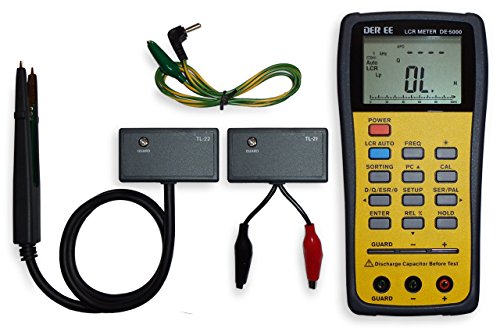
- 19,999/9,999-count dual display with auto-ranging
- AUTO-LCR mode handles L/C/R and serial or parallel selection
- Measures D, Q, phase angle, and ESR/Rp at up to 100kHz
Best For: users who want a handheld meter with smart auto-detection and broad test frequency options
Feature-Rich Sorting Meter
FNIRSI LC1020E 100kHz LCR Meter

- Dual-parameter display with AUTO, C, R, and L modes
- Sorting/comparison mode checks parts against preset tolerance
- 2.8-inch TFT, Type-C charging, and open/short calibration
Best For: users who want a modern LCR meter with sorting and calibration features
Compact Bench Standard
Peak Atlas LCR45 LCR and Impedance Meter
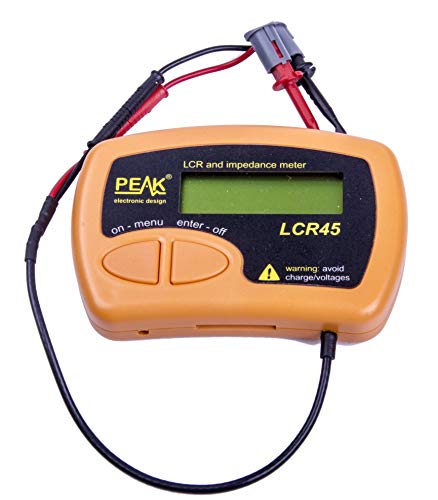
- Automatic or manual component type and frequency selection
- Measures at DC, 1kHz, 15kHz, or 200kHz
- Resolution to 0.2uH, 0.2pF, and 0.2 Ohms
Best For: users who want a compact corded meter with simple controls and fine resolution
Budget All-Purpose Tester
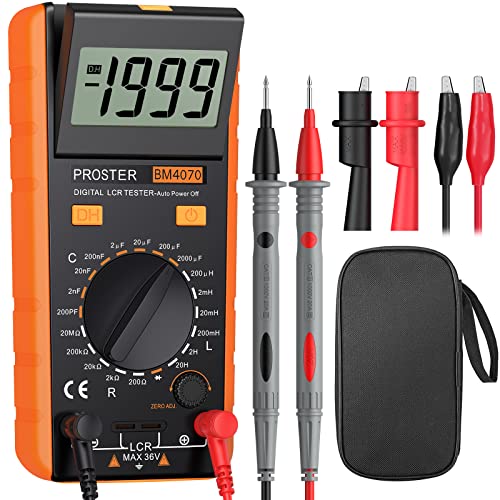
- Capacitance ranges from 200pF to 2000μF
- Inductance ranges from 200μH to 20H
- Rotatable LCD, data hold, and zero adjustment
Best For: budget-minded users who need a straightforward meter for basic component testing
Bench-Ready Precision
Extech LCR200 Passive Component Meter
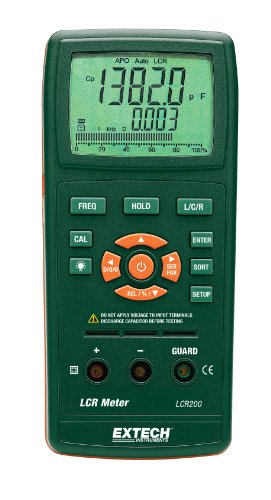
- Measures L, C, and R with Q/D/ESR readouts
- Dual backlit display with 20,000/2,000 counts
- Five test frequencies and open/short calibration
Best For: Users needing a versatile handheld LCR meter for detailed passive component testing
Budget Multi-Function

- Measures L, C, R, continuity, and diodes
- Includes data hold, auto power off, and low battery indication
- Wide ranges for capacitors, inductors, and resistors
Best For: DIY troubleshooting and casual component testing on a budget
Bench Precision
GW INSTEK LCR-6002 Bench Meter

- Bench LCR meter with 2 kHz max test frequency
- Large ranges for inductance, capacitance, and resistance
- RoHS compliant precision instrument
Best For: Stationary lab or bench users needing broad measurement ranges
Portable Tweezer LCR
FNIRSI LCR-ST2 100kHz Tweezer Tester
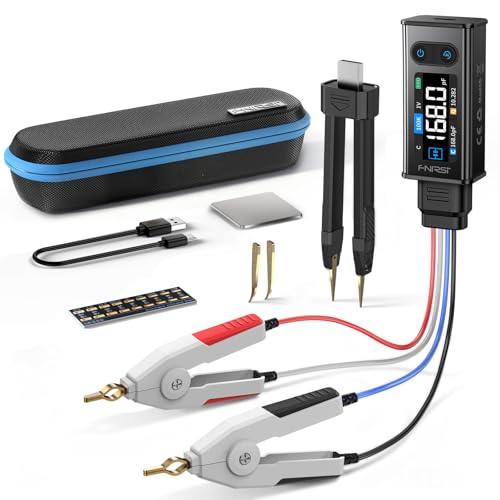
- Measures R, C, L, diodes, continuity, and voltage
- 100 Hz to 100 kHz scan range with auto sorting
- Includes Kelvin clips, tweezer tips, hooks, and pouch
Best For: Portable component testing on SMD and through-hole parts
Benchtop Precision LCR
MATRIX MCR5200 200kHz Benchtop Bridge

- 0.1% basic accuracy and 41 test frequencies
- Measures L, C, R, Z, ESR, D, Q, and phase
- USB/RS232C data saving with calibration features
Best For: Lab, repair, and production bench testing
Handheld Auto-ID LCR
Precision LCR-101A Portable Meter

- Auto-identifies L, C, or R with clear display values
- Selectable 100 Hz, 1 kHz, and 10 kHz testing
- USB data logging for thousands of readings
Best For: Portable testing with auto-ID and PC logging
Bench-Ready Auto-LCR Tester – DE-5000 Handheld LCR Meter
If you want an LCR meter that feels built for serious bench work, the DE-5000 stands out with its 19,999/9,999-count dual display, AUTO-LCR smart mode, and automatic serial/parallel selection. It measures inductance, capacitance, resistance, and secondary parameters like D, Q, phase angle, and ESR/Rp, while offering selectable test frequencies from 100Hz up to 100kHz.
Best For: Technicians and hobbyists who want a handheld LCR meter with automatic component detection and multiple test frequencies.
Pros:
- Auto-ranging AUTO-LCR mode measures L/C/R without manual function selection.
- Supports five test frequencies: 100Hz, 120Hz, 1kHz, 10kHz, and 100kHz.
- Includes sorting mode for quick component sorting.
- Measures key secondary values such as D, Q, phase angle, and ESR/Rp.
Cons:
- IR-to-USB cable is listed as an option and is not included.
- Battery-powered design means you need to manage battery life.
Overall, this is a practical choice if you want an LCR meter that automates a lot of the workflow while still giving you useful measurement detail. The included accessories also make it ready for common bench tasks right away.
Feature-Rich Sorting Meter – FNIRSI LC1020E 100kHz LCR Meter
The FNIRSI LC1020E is a feature-heavy LCR meter for users who want more than basic component reading. It supports AUTO, capacitance, resistance, and inductance modes with dual-parameter display, open/short calibration, adjustable test voltage, and sorting/comparison functions for screening components against preset tolerances.
Best For: Buyers who want a modern LCR meter with sorting, calibration, and a color display for faster component checking.
Pros:
- Dual-parameter display shows main and secondary values together.
- Sorting/comparison mode calculates relative error against nominal values.
- Open/short calibration and adjustable test voltage add measurement control.
- 2.8-inch TFT display, Type-C charging, and 3000mAh battery improve usability.
Cons:
- Requires open/short calibration before measurement.
- Not intended for live circuits; components must be fully discharged.
This model makes sense if you value screening workflow and modern interface features as much as raw measurement capability. Its sorting tools and detailed display are especially useful when handling lots of parts.
Compact Bench Standard – Peak Atlas LCR45 LCR and Impedance Meter
The Peak Atlas LCR45 is a straightforward LCR meter and impedance meter aimed at compact bench use. It offers automatic or manual component type selection, automatic or manual test frequency selection, and measurements at DC, 1kHz, 15kHz, or 200kHz, with fine resolution for inductance, capacitance, and resistance.
Best For: Users who want a small, corded LCR meter with simple operation and high measurement resolution.
Pros:
- Automatic or manual component type and frequency selection.
- Test frequencies include DC, 1kHz, 15kHz, and 200kHz.
- High resolution down to 0.2uH, 0.2pF, and 0.2 Ohms.
- Hold function and easy menu system simplify bench work.
Cons:
- Corded electric power means it is less portable than battery-powered options.
- Fewer workflow features than some newer meters with color displays and sorting modes.
If you need a compact meter that keeps operation simple while still offering strong resolution, the LCR45 is a solid fit. It leans more toward dependable bench measurement than extra smart features.
Budget All-Purpose Tester – Proster LCR Meter Multimeter
The Proster BM4070 is a practical LCR meter for basic component testing, with dedicated ranges for capacitance, inductance, resistance, and diode checks. Its 3 1/2 digit LCD, zero adjustment for capacitance, and rotatable display make it useful for everyday troubleshooting, hobby work, and sorting parts on the bench.
Best For: Budget-minded users who need a straightforward LCR meter for capacitance, inductance, and resistance checks.
Pros:
- Capacitance ranges cover 200pF to 2000μF.
- Inductance ranges cover 200μH to 20H.
- Zero adjustment helps reduce stray lead or circuit capacitance error.
- Rotatable LCD and data hold improve readability and recording.
Cons:
- 3 1/2 digit display is less detailed than higher-count meters.
- Does not include the advanced sorting or dual-parameter features of pricier models.
For simple component checks, this meter covers the essentials without adding complexity. It is a sensible pick if you want broad range coverage and practical bench-friendly features at a more basic level.
Bench-Ready Precision – Extech LCR200 Passive Component Meter
If you want an LCR meter with more measurement detail than a basic handheld tester, the Extech LCR200 is built for passive component work. It measures inductance, capacitance, and resistance, while also showing Q, dissipation, phase, and ESR on a dual backlit display for faster comparisons.
Best For: Bench and field users who want a versatile LCR meter with secondary parameter readouts and calibration support.
Pros:
- Measures L, C, and R plus Q, D, phase, and ESR
- Dual backlit display shows primary and secondary values at once
- Five test frequencies from 100 Hz to 100 kHz
- Open/short calibration helps reduce stray impedance effects
Cons:
- Requires a 9V battery for power
- Handheld design may be less convenient than a dedicated bench unit for some workflows
Overall, the LCR200 stands out for users who care about measurement flexibility and more complete component data. The included fixture, leads, and limit settings make it a practical option for routine troubleshooting and component verification.
Budget Multi-Function – CAMWAY LCD LCR Tester
The CAMWAY LCR meter is a straightforward option if you need a low-cost tester for basic component checks and quick troubleshooting. It measures inductance, capacitance, resistance, continuity, and diodes, with an LCD display that helps keep readings easy to follow.
Best For: DIY users and general troubleshooting when you want an affordable LCR meter with simple operation.
Pros:
- Measures inductance, capacitance, resistance, continuity, and diodes
- Wide measurement ranges for C, L, and R
- Data hold, auto power off, and low power indication
- Includes crocodile clips and a 9V battery
Cons:
- 3 1/2-digit LCD is less detailed than higher-end meters
- Accuracy is modest compared with precision bench units
This model makes sense when you want a practical, no-frills tester for household or automotive diagnostics. Its feature set covers the basics well, but buyers needing higher precision or richer display detail may want to step up.
Bench Precision – GW INSTEK LCR-6002 Bench Meter
The GW INSTEK LCR-6002 is a bench LCR meter for users who want a more serious measurement setup. It supports a maximum test frequency of 2 kHz and is specified for large measurement ranges, making it suitable for precision component evaluation in a bench environment.
Best For: Bench users who need a precision LCR meter with broad measurement ranges.
Pros:
- Bench-style meter designed for stationary test setups
- High maximum measurement ranges for inductance, capacitance, and resistance
- RoHS compliant
- Precision-oriented instrument for component evaluation
Cons:
- Maximum test frequency is limited to 2 kHz
- No warranty listed in the supplied details
- Heavier and larger than handheld meters
For a bench workflow, this model is about range and precision rather than portability. It is a strong fit when you want a dedicated meter for repeatable component measurements instead of a compact field tool.
Portable Tweezer LCR – FNIRSI LCR-ST2 100kHz Tweezer Tester
If you want a compact way to handle lcr meters tasks on SMD and through-hole parts, this FNIRSI tweezer tester is built for quick component checks. It measures resistors, capacitors, inductors, diodes, continuity, and voltage, while the 100 Hz to 100 kHz scan range helps it cover everything from RF-style parts to large electrolytics.
Best For: Technicians and hobbyists who need a portable all-in-one tester for mixed component work.
Pros:
- Measures R, C, L, diodes, continuity, and voltage in one handheld tool.
- Four RMS test levels and series/parallel modes help reduce parasitic effects.
- Primary and secondary displays show extra values like X, D, Q, and θ.
- Includes Kelvin clips, tweezer tips, hooks, and a storage pouch.
Cons:
- Not a benchtop meter, so it is less suited to fixed lab workflows.
- Small handheld format may be less convenient for long bench sessions.
Overall, this is a practical pick if you value portability, auto sorting, and broad component coverage in a single meter. The rechargeable battery, bright display, and included probes make it easy to carry and use for everyday diagnostics.
Benchtop Precision LCR – MATRIX MCR5200 200kHz Benchtop Bridge
For buyers comparing lcr meters for lab, repair, or production use, the MATRIX MCR5200 stands out as a benchtop bridge with wide frequency coverage and detailed measurement output. It offers 40 Hz to 200 kHz testing, 0.1% basic accuracy, and a full set of readings for inductance, capacitance, resistance, impedance, ESR, D, Q, and phase angles.
Best For: Bench users who need high-accuracy measurement, data handling, and calibration control.
Pros:
- 0.1% basic accuracy with 41 frequency points from 40 Hz to 200 kHz.
- Measures L, C, R, Z, X, ESR, D, Q, and phase angles.
- USB Host, RS232C, and Handler ports support data saving and SCPI/GPIB.
- Includes open/short calibration, comparator modes, and automatic test-condition saving.
Cons:
- Benchtop design is less portable than handheld LCR meters.
- Requires AC power, so it is meant for fixed workstations.
In practice, this is the stronger choice when measurement repeatability, frequency flexibility, and logging matter more than portability. Its display, calibration tools, and data export options make it a solid fit for troubleshooting and QC workflows.
Handheld Auto-ID LCR – Precision LCR-101A Portable Meter
If you want lcr meters that are easy to carry but still useful for detailed component checks, the LCR-101A is aimed at field work and bench use alike. It measures capacitance, inductance, resistance, and impedance, and also shows secondary values such as dissipation factor and quality factor for more complete analysis.
Best For: Engineers, technicians, and advanced hobbyists who want a portable meter with auto identification and PC logging.
Pros:
- Auto-identifies L, C, or R and displays key parameters clearly.
- Selectable 100 Hz, 1 kHz, and 10 kHz test frequencies.
- Large backlit LCD and 180-degree screen rotation improve usability.
- USB data logging supports thousands of readings for analysis and reporting.
Cons:
- USB cable is not included, so PC logging needs an extra accessory.
- Battery-powered handheld format is less suited to heavy bench workflows than a dedicated benchtop unit.
This model makes sense if you want a portable tester that still offers useful multi-frequency measurement and data capture. It is especially appealing for users who need quick identification in the field and the option to log readings later on a computer.
How We Picked These Lcr Meters
We focused on measurement range, test frequency, display clarity, component recognition, and overall usability. For Lcr Meters, the most important factor is not just whether they can read R, L, and C, but how reliably they do it across the parts you actually test.
We also considered whether a model is better suited to quick field checks, SMD work, or more controlled bench measurements. Features like auto-detection, ESR/Q/D/θ support, and stable fixturing can make a big difference in day-to-day use.
Quick Comparison: Which Type Fits Your Workflow?
Handheld Lcr Meters are best for portability and fast component checks. Bench models are better when you want repeatability, more control, and often broader test capability. Tweezer-style testers are especially useful for SMD parts, while passive-component meters are a solid fit for general electronics troubleshooting.
If you work on mixed boards, a meter with auto component recognition can save time. If you calibrate, characterize, or verify parts more carefully, look for higher test frequency options and stronger accuracy specs.
Key Buying Factors for Lcr Meters
Test Frequency
Frequency affects how a component behaves during measurement, especially inductors and capacitors. Higher frequencies can reveal details that low-frequency units may miss, while lower-frequency bench meters may be preferred for precision work at standard test conditions.
Accuracy and Resolution
Look for enough resolution to distinguish closely matched parts. Accuracy matters more than a long feature list if you need dependable results for sorting, repair, or verification.
Component Support
Make sure the meter handles the parts you test most often, including small capacitors, inductors, resistors, and any secondary readings such as ESR, Q, or dissipation factor.
Form Factor and Ease of Use
Handheld models are ideal for mobility, while bench instruments generally offer better stability and ergonomics for longer sessions. Large displays, auto-ranging, and clear leads or tweezers reduce setup time and measurement errors.
Calibration and Connectivity
For more serious testing, calibration support and PC connectivity can be valuable. USB or RS232C options help with logging, comparison, and lab workflows.
Who Should Buy Which Lcr Meters?
Buy a handheld meter if you want quick checks, occasional diagnostics, or portable service use. Choose a tweezer-style tester if you regularly handle tiny SMD parts. Pick a bench LCR meter if you need higher consistency, better control, or more advanced measurement work.
For hobbyists and general repair users, a balanced midrange model is often enough. For labs, design validation, or component characterization, prioritize accuracy, frequency range, and repeatability over convenience features.