Choosing the right particle counter for air testing comes down to accuracy, channel range, portability, and whether you need simple IAQ readings or professional-grade counts.
Below, we’ve narrowed the field to 10 strong options for buyers who want dependable air quality data without overspending on features they won’t use.
Best 10 Particle Counters for Air Testing Picks for 2026
7-in-1 Indoor Monitoring
Temtop LKC-1000S+ Air Quality Monitor

- Tracks PM2.5, PM10, HCHO, VOCs, humidity, temperature, and AQI
- Exports 3 months of data to Excel via USB
- Includes a 12-hour trend histogram for spotting pollution peaks
Best For: Indoor air monitoring with particle counts plus formaldehyde and VOC tracking
Cleanroom Audit Tool
6-Channel Handheld Particle Counter

- Measures six particle sizes from 0.3µm to 10µm
- Supports counting and weighing modes with temperature/humidity
- Exports PDF reports directly from the device
Best For: Cleanroom inspection and audit-ready particle testing
Portable PM2.5 Tracker

- Measures PM2.5 and PM10 with visual health indicators
- Shows a 12-hour histogram for trend checking
- Lightweight handheld design for indoor and outdoor use
Best For: Simple PM2.5 and PM10 monitoring at home or outdoors
Industrial Sampling Meter
Professional Laser Particle Counter

- Measures 0.3µm, 2.5µm, and 10µm particles
- Includes tripod mounting for hands-free sampling
- Exports PDF reports and stores up to 999 records
Best For: Professional cleanroom checks and documented air sampling
Multi-Function Lab Monitor

- Six-channel particle counting from 0.3–10 µm
- Tracks CO2, HCHO, CO, TVOC, PM1.0/2.5/10
- Logs up to 10,000 groups with CSV export
Best For: all-in-one indoor air testing and data logging
Handheld Field Counter
Temtop Professional Particle Counter

- Measures 0.3, 0.5, and 1.0 µm particles
- Tracks PM2.5, PM10, TSP, temp, and humidity
- Includes 32GB storage with USB transfer
Best For: portable air testing and facility inspections
Compact Dust Counter

- Measures 0.3, 2.5, and 10.0 µm particles
- Custom sampling from 1 second to 59:59
- Uses semiconductor laser detection
Best For: basic dust testing with adjustable sampling
Professional 3-Channel Dust Monitor
Laser Particle Counter with Data Logging
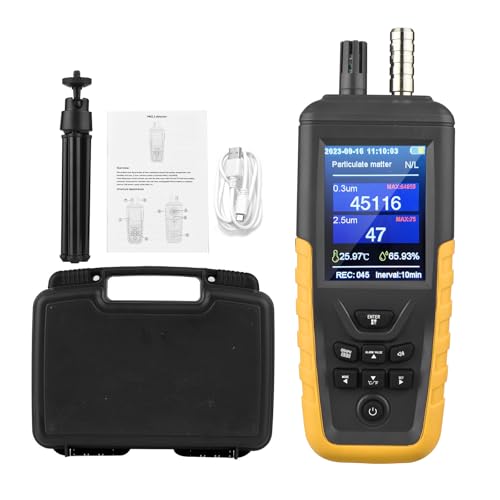
- Counts 0.3μm, 2.5μm, and 10μm particles
- Stores 999 records and exports data to PC as PDF
- Includes alarms, pollution indicator, and tripod
Best For: Users who want particle counting with logging and fixed-point monitoring
Advanced Indoor Air Monitor
Temtop LKC1000S Particle Counter

- Tracks PM2.5, PM10, HCHO, humidity, temperature, and AQI
- Stores at least 3 months of data and supports export
- Uses pre-calibrated sensors and a long-life particle sensor
Best For: Buyers who want a portable air monitor with particle and formaldehyde readings
Portable Multi-Parameter Counter
Triplett EPC175 Air Quality Meter

- Measures PM2.5, PM10, HCHO, TVOCs, temperature, and humidity
- Stores 5,000 data sets with historical curves
- Has a 3-inch color display and programmable alarms
Best For: Users who need a compact meter with particle counts and longer memory
7-in-1 Indoor Monitoring – Temtop LKC-1000S+ Air Quality Monitor
If you want particle counters for air testing that do more than just count dust, this Temtop monitor is built for broader indoor air checks. It tracks PM2.5, PM10, HCHO, VOCs, humidity, temperature, and AQI, while also giving you trend data to spot pollution spikes from cooking, renovation, or poor ventilation.
Best For: Homeowners, offices, and renovation monitoring where you want particle readings plus formaldehyde and VOC tracking.
Pros:
- 7-in-1 monitoring covers PM2.5, PM10, HCHO, VOCs, humidity, temperature, and AQI
- Built-in 12-hour trend histogram helps identify spikes and ventilation effects
- USB data export to Excel supports longer-term reporting without a subscription
- Battery-powered for spot checks, with Type-C support for continuous use
Cons:
- Not designed to detect gas or CO leaks
- For best accuracy, it needs warm-up time after temperature changes
- Avoid nearby sprays and strong cleaners during testing
Overall, this is a practical pick if you want a portable monitor that combines particle counting with broader indoor air-quality metrics and straightforward data export.
Cleanroom Audit Tool – 6-Channel Handheld Particle Counter
For particle counters for air testing in controlled environments, this handheld model is aimed at cleanroom work and inspection reporting. It measures six particle sizes, supports both counting and weighing modes, and adds temperature and humidity readings so you can validate air conditions on site.
Best For: Cleanroom checks, filter leak testing, and industrial air-quality inspections that need PDF reporting.
Pros:
- Measures six particle sizes from 0.3µm to 10µm
- Supports particle counting and mass weighing modes
- One-click PDF report export and USB data transfer for audits
- Stores up to 999 records and includes audible threshold alarms
Cons:
- More specialized than a basic home air monitor
- Battery life is rated at over 9 hours, so long jobs may still need charging
This is a strong choice when documentation matters, especially if you need a compact instrument that can support ISO 14644-1 cleanroom classification and on-device reporting.
Portable PM2.5 Tracker – Temtop P600 Particle Counter
If you want a simpler option among particle counters for air testing, the Temtop P600 focuses on PM2.5 and PM10 monitoring with easy-to-read visual indicators. It is designed for everyday indoor and outdoor use, with a built-in trend histogram that helps you understand how air quality changes over time.
Best For: Everyday PM2.5 and PM10 monitoring at home or on the go.
Pros:
- Measures PM2.5 and PM10 with colorful visual health indicators
- Industrial-grade sensor is rated for more than 20,000 hours of lifespan
- 12-hour data graph helps track air quality trends
- Lightweight handheld design with a back stand for easy placement
Cons:
- Tracks fewer parameters than multi-sensor air monitors
- Does not include formaldehyde, VOC, temperature, or humidity readings
The P600 works well if you mainly care about particle levels and want a straightforward monitor that is easy to use indoors or outdoors.
Industrial Sampling Meter – Professional Laser Particle Counter
This professional unit is built for particle counters for air testing where hands-free sampling and reporting are important. It measures 0.3µm, 2.5µm, and 10µm particles, displays temperature and humidity, and includes one-click PDF export plus USB transfer for recordkeeping.
Best For: Industrial cleanroom checks, filter inspections, and particulate source investigations.
Pros:
- Measures 0.3µm, 2.5µm, and 10µm particles
- 3.2-inch TFT display shows real-time data and trend curves
- One-click PDF export and USB data transfer simplify documentation
- Tripod mounting holes support continuous hands-free sampling
Cons:
- Offers fewer particle sizes than some 6-channel competitors
- Best suited to professional inspection use rather than casual home monitoring
If your priority is quick sampling with clear reporting, this model is a practical fit for field inspections and cleanroom workflows.
Multi-Function Lab Monitor – 12-in-1 Air Quality Monitor
If you want particle counters for air testing that do more than count dust, this 12-in-1 monitor combines six-channel particle counting with gas detection and environmental readings. It tracks PM1.0, PM2.5, PM10, CO2, HCHO, CO, TVOC, temperature, and humidity, making it a practical pick for broad indoor checks in homes, offices, labs, and industrial spaces.
Best For: users who need a portable all-in-one monitor for air quality testing, logging, and spot checks across multiple contaminants.
Pros:
- Counts particles from 0.3 to 10 µm across six channels.
- Includes integrated gas pump active sampling for more controlled readings.
- Supports data logging up to 10,000 groups with CSV export to a computer.
- Offers adjustable alarm thresholds and CO2 calibration options.
Cons:
- Needs a 10-minute warm-up time before stable readings.
- Best suited to monitoring and inspection rather than simple one-button use.
Overall, this is a strong choice if you want one device to cover particle counts plus key air-quality gases. Its logging, alerts, and calibration features make it more useful for repeat testing than a basic dust counter.
Handheld Field Counter – Temtop Professional Particle Counter
For particle counters for air testing in the field, this handheld Temtop model focuses on the core measurements many users need most: 0.3, 0.5, and 1.0 µm particles, plus PM2.5, PM10, and TSP. The built-in temperature and humidity sensors, pump suction design, and large display make it a practical option for environmental monitoring, workshop checks, and facility inspections.
Best For: technicians and inspectors who want a handheld particle counter with strong logging capacity and straightforward operation.
Pros:
- Measures particle sizes at 0.3, 0.5, and 1.0 µm.
- Also tracks PM2.5, PM10, and TSP for broader dust assessment.
- Includes temperature and humidity sensing for fuller context.
- Offers 32GB internal storage and USB data transfer.
Cons:
- Focuses on particulate and environmental readings rather than gases.
- Designed as a handheld unit, so it is less suited to fixed monitoring.
This is a solid pick when you need a portable particle counter with good storage and a simple interface. It fits hands-on air testing workflows where fast readings and data capture matter more than advanced gas sensing.
Compact Dust Counter – PerfectPrime AQ9600
PerfectPrime AQ9600, PM 0.3/2.5/10 Μm Air Quality Particle/Dust Detector/Counter
Check Price On AmazonIf you need particle counters for air testing in a compact format, the PerfectPrime AQ9600 focuses on three key sizes: 0.3, 2.5, and 10.0 µm. It is built for dust and particle detection with adjustable sampling settings, making it useful for basic room checks, filter comparisons, and general air-quality spot testing.
Best For: buyers who want a simple particle and dust counter with configurable sampling for quick testing.
Pros:
- Tests particle sizes at 0.3, 2.5, and 10.0 µm.
- Supports custom sampling intervals from 1 second to 59 minutes 59 seconds.
- Offers selectable sampling frequency, including continuous mode.
- Uses semiconductor laser light source and includes an adapter.
Cons:
- Does not include broader gas or humidity monitoring.
- 9V DC battery is not included.
The AQ9600 is best when you want a focused counter without extra complexity. Its strengths are simple particle-size coverage and flexible sampling, which make it handy for targeted dust checks and repeated air testing.
Professional 3-Channel Dust Monitor – Laser Particle Counter with Data Logging
If you need particle counters for air testing that do more than just count dust, this laser particle counter is built for broad environmental monitoring. It tracks 0.3μm, 2.5μm, and 10μm particles, adds PM2.5/PM10 mass concentration, and also measures temperature and humidity for a more complete read on indoor air.
Best For: Home users, offices, schools, cleanrooms, and fixed-point monitoring where you want particle counts plus temperature, humidity, and logging.
Pros:
- Counts 0.3μm, 2.5μm, and 10μm particles with a very wide stated range.
- Stores up to 999 records and can export history to PC as PDF via USB.
- Includes customizable alarms, a color pollution indicator, and a tripod for hands-free use.
- Rechargeable 2000mAh battery supports long runtime and power-saving features.
Cons:
- PM2.5/PM10 mass concentration range and accuracy are specified, but the unit is still best used as a monitoring tool rather than a lab instrument.
- Uses a smaller feature set than some multi-gas environmental monitors.
This model stands out if your priority is straightforward particle counting with practical extras like exportable logs and alarm settings. It is a strong pick for ongoing air quality checks in spaces where portability and fixed-point monitoring both matter.
Advanced Indoor Air Monitor – Temtop LKC1000S Particle Counter
For buyers comparing particle counters for air testing, the Temtop LKC1000S 2nd adds more than particle measurement alone. It monitors PM2.5 and PM10 along with formaldehyde, humidity, temperature, and AQI, making it useful when you want a broader indoor air snapshot in one portable unit.
Best For: Anyone who wants a portable multi-parameter air quality monitor with particle counting and formaldehyde tracking.
Pros:
- Measures PM2.5, PM10, HCHO, humidity, temperature, and AQI in one device.
- Data export and memory for at least 3 months of continuous recording support longer-term review.
- Pre-calibrated Dart electrochemical sensors are designed to capture formaldehyde accurately.
- Industrial-grade laser particle sensor is rated for up to 20,000 hours of life.
Cons:
- More focused on indoor air monitoring than simple dust counting alone.
- Not the most stripped-down or basic option if you only need particle totals.
This is a strong choice when you want particle data plus broader air-quality context, especially for rooms where formaldehyde and general comfort readings matter. Its long sensor life and exportable history make it practical for ongoing monitoring.
Portable Multi-Parameter Counter – Triplett EPC175 Air Quality Meter
If you want particle counters for air testing with a simple display and lots of logged history, the Triplett EPC175 covers the essentials well. It measures PM2.5, PM10, temperature, relative humidity, formaldehyde, and TVOCs, giving you a practical view of air quality in one handheld meter.
Best For: Users who need a compact air quality meter with particle counts, VOC-related readings, and substantial memory.
Pros:
- Displays PM2.5, PM10, temperature, humidity, HCHO, and TVOCs.
- Stores 5,000 data sets and can show historical curves.
- 3-inch color TFT display offers 5 brightness levels for easier viewing.
- Programmable PM2.5 alarms, auto power-off, and auto sleep add flexibility.
Cons:
- Specified memory focuses on PM2.5 and PM10 data sets rather than every reading type.
- Included documentation emphasizes monitoring features more than advanced calibration details.
The EPC175 is a balanced option if you want a portable meter that combines particle detection with air-quality indicators beyond dust. Its larger memory and clear display make it a sensible choice for routine inspections and recordkeeping.
How We Picked These Particle Counters for Air Testing
We focused on practical buying criteria: particle size channels, measurement consistency, display clarity, sample speed, portability, and the value of extra air-quality metrics like temperature, humidity, PM readings, and VOC detection. For professional use, we also gave more weight to pump-driven designs, broader size coverage, and models that suit repeatable testing.
The goal is to help you choose Particle Counters for Air Testing that match your environment, whether that’s a home, HVAC job site, cleanroom-adjacent space, or industrial inspection workflow.
Quick Comparison: What Matters Most
If you need simple indoor air quality snapshots, a compact monitor with PM readings may be enough. If you’re tracking airborne contamination or verifying ventilation performance, look for a true particle counter with multiple size channels and stable sampling. If you’ll test in ducts, workshops, or variable environments, handheld units with pump suction and broader particle detection ranges usually offer better utility.
Particle Size Range
More channels usually mean more insight. Common sizes such as 0.3, 0.5, 1.0, 2.5, 5.0, and 10 microns can help you understand fine and coarse particulate behavior, especially when comparing before-and-after conditions.
Sampling Method and Portability
Handheld units are easier for spot checks and field use, while benchtop or monitor-style units can be more convenient for stationary tracking. Pump suction can improve sampling consistency in many real-world testing scenarios.
Extra Air-Quality Metrics
Some users benefit from added readings like PM2.5, PM10, TVOC, formaldehyde, temperature, and humidity. These features are helpful, but they should not replace core particle-counting performance if contamination monitoring is your main goal.
Key Buying Factors for Particle Counters for Air Testing
First, decide whether you need a monitor or a dedicated particle counter. Monitors are often better for general air-quality awareness, while counters are better for detailed particulate analysis. Next, check the minimum particle size the device can detect and whether it provides enough channels for your use case.
Also consider data presentation. Clear counts, trend visibility, and easy mode switching save time during repeated tests. Battery life and charging method matter for fieldwork, and build quality matters if the device will be moved often or used in harsher environments.
Finally, make sure the device matches your testing environment. For home use, a lightweight monitor may be ideal. For HVAC diagnostics, manufacturing spaces, or inspections where repeatability matters, choose a more capable particle counter with a pump and broader detection range.
Who Should Buy Which Particle Counters for Air Testing?
Homeowners and renters should usually start with an easy-to-use monitor that shows PM levels and basic environmental data. HVAC technicians, facility managers, and inspectors should lean toward multi-channel Particle Counters for Air Testing with handheld portability and stable sampling. Buyers who need broader contamination awareness may prefer a hybrid unit that combines particle counts with gas and comfort readings.
If you want the most useful all-around choice, prioritize the model that best balances particle-size coverage, usability, and measurement confidence for your specific environment.