A good thermal imaging camera can reveal hot spots, missing insulation, overloaded circuits, and HVAC issues before they turn into bigger problems.
In this roundup, we focus on practical options for homeowners, technicians, and field pros who want clear thermal data without unnecessary complexity.
Best 10 Thermal Imaging Camera Picks for 2026
Ultra-Light Dual-Mode Pick
GT14S Thermal Imaging Camera, Thermometer Mode

- Dual thermal view and thermometer mode
- Ultra-light 240g body with easy controls
- Up to 14 hours of battery life
Best For: portable inspections with quick switching between thermal and spot temperature readings
Big-Screen Reporting Pick
TOPDON TC004 3.5" Thermal Camera

- 3.5-inch display with easy viewing
- TISR-enhanced 256×192 thermal resolution
- 64GB storage plus Wi-Fi reporting
Best For: field inspections where screen size and fast report transfer matter
PC Analysis Value Pick
FOXWELL RT280 Thermal Imaging Camera

- TISR-enhanced clarity with 2.8-inch LCD
- Windows analysis software with report generation
- 8GB storage for over 20,000 images
Best For: buyers who want PC analysis and organized inspection records
Rugged Pro Brand Pick
Flir TG165-X Thermal Imaging Camera

- MSX-enhanced images with bullseye laser
- IP54 rugged design for tough environments
- Backed by FLIR 2-10 warranty coverage
Best For: quick spot checks where durability and brand trust matter
Professional Shop Thermal Camera
MILESEEY TR10 Thermal Imaging Camera

- 192×192 IR resolution with 25Hz refresh
- NETD below 50mK and ±2°C accuracy
- 6.6 ft drop protection with 8-hour battery life
Best For: Technicians and DIY users needing a rugged inspection tool
Compact Troubleshooting Thermal Camera
Klein Tools TI250 Rechargeable Thermal Imaging Camera

- Over 19,200 pixels for hot and cold spot checks
- Adjustable emissivity plus high/low alarms
- USB-C image saving with included carrying case
Best For: Electricians and maintenance users needing a portable spot-check tool
Phone-Connected Inspection Thermal Camera
TOPDON TC002C Duo Thermal Imaging Camera

- USB-C support for iOS, Android, and Windows
- 256×192 imaging with 512×384 TISR super resolution
- 25Hz refresh plus photo and video recording
Best For: Mobile inspectors and HVAC users wanting app-based thermal imaging
Rugged High-Clarity Pick
H128 Handheld Thermal Camera, 240 x 240 TISR Resolution

- 240 x 240 TISR via TISR technology
- Up to 24-hour battery life
- IP65 protection and drop resistance
Best For: Inspectors needing long runtime and rugged durability
Touchscreen Scene Recognition Pick
HP96 Thermal Imaging Camera, 3.5" Touch Screen
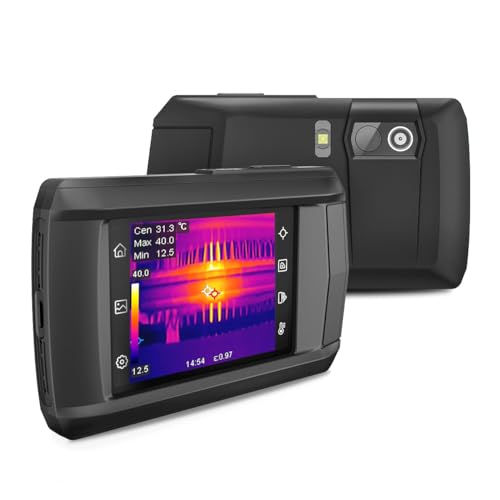
- IntellFault scene recognition for leaks and gaps
- 3.5-inch touchscreen with multiple image modes
- Live super resolution to 240 x 240
Best For: Users wanting guided inspections with a touchscreen
Best Compact All-Rounder
TOPDON TC004 Mini Thermal Imaging Camera, 240 x 240 TISR Resolution

- Pocket-size thermal camera with 240 x 240 TISR
- 15-hour battery life and auto photo capture
- IP54 rating with 2-meter drop resistance
Best For: General-purpose inspections in a compact form
Ultra-Light Dual-Mode Pick – GT14S Thermal Imaging Camera, Thermometer Mode
If you want a thermal imaging camera that can switch between full thermal view and point-and-shoot temperature readings, the GT14S is built for flexible everyday inspections. Its lightweight 240g body, 7 color palettes, and simple controls make it easy to use for home checks, automotive work, HVAC, or kitchen tasks.
Best For: users who want a lightweight thermal imager with both thermal view and thermometer mode.
Pros:
- Dual mode design combines thermal imaging and thermometer mode for different tasks
- Very light 240g body with a non-slip grip for easier handheld use
- NETD under 50mK and a 50° field of view help spot small temperature differences quickly
- Up to 14 hours of battery life supports longer inspection sessions
Cons:
- Lower-res detail is not specified in the provided notes
- Best suited to practical inspections rather than advanced reporting workflows
The GT14S is a strong fit if portability and quick switching between thermal imaging and exact temperature readouts matter more than extra software features. It covers a wide range of inspection jobs without feeling bulky.
Big-Screen Reporting Pick – TOPDON TC004 3.5" Thermal Camera
The TOPDON TC004 is a thermal imaging camera aimed at users who want a larger viewing screen and easier documentation. With a 3.5-inch display, 256×192 infrared resolution enhanced by TISR, built-in Wi-Fi, and 64GB of storage, it is geared toward inspections where image clarity and reporting matter.
Best For: buyers who want a larger screen, Wi-Fi transfer, and strong onboard storage for field reporting.
Pros:
- 3.5-inch display offers a more comfortable viewing experience during inspections
- 256×192 IR resolution with TISR up to 512×384 for sharper thermal detail
- 64GB built-in storage lets you save thousands of images and videos
- Wi-Fi support makes file transfer and report generation faster
Cons:
- Heavier than compact handheld alternatives at 2.11 pounds
- More reporting-focused than basic grab-and-go models
TC004 stands out when you want a practical inspection tool that also helps streamline documentation. The screen, storage, and wireless workflow make it well suited to frequent field use.
PC Analysis Value Pick – FOXWELL RT280 Thermal Imaging Camera
The FOXWELL RT280 is a thermal imaging camera for buyers who want detailed inspection tools and PC-based analysis. It combines a 2.8-inch LCD, TISR-enhanced thermal clarity, 8GB eMMC storage, and Windows software for point, line, and area temperature analysis.
Best For: users who want thermal capture plus Windows-based analysis and report generation.
Pros:
- TISR boosts effective thermal resolution for clearer inspection images
- Windows software supports 2D/3D analysis and automatic report generation
- Stores over 20,000 images and videos in 8GB eMMC memory
- Includes laser pointer, LED light, and high/low alarms for practical field use
Cons:
- PC software is not compatible with Mac, limiting cross-platform use
- 2.8-inch screen is smaller than some alternatives
The RT280 is a good match if you want more than just a handheld image view. Its analysis software and large storage capacity make it useful for organized, professional-style inspection work.
Rugged Pro Brand Pick – Flir TG165-X Thermal Imaging Camera
The FLIR TG165-X is a thermal imaging camera built around durability and straightforward spot temperature work. It uses MSX image enhancement, a bullseye laser pointer, and a rugged IP54 enclosure, making it a practical option for users who want a trusted tool for fast, non-contact inspections.
Best For: buyers who want a rugged FLIR camera for quick spot checks and clearer thermal images.
Pros:
- MSX helps overlay visual detail for easier-to-read thermal images
- Bullseye laser pointer helps identify the measurement area quickly
- Rugged IP54 construction is designed to handle dirty or dusty work areas
- Backed by FLIR’s 2-10 warranty coverage
Cons:
- Temperature range is narrower than some broader-range inspection cameras
- Does not include the larger-screen or wireless reporting features found on some rivals
TG165-X makes sense when you value simplicity, durability, and a proven brand more than advanced workflow features. It is especially suited to quick, reliable inspection tasks in tougher environments.
Professional Shop Thermal Camera – MILESEEY TR10 Thermal Imaging Camera
If you need a thermal imaging camera for inspections, the MILESEEY TR10 is built around clear imaging, stable temperature readings, and rugged everyday use. Its 192×192 IR resolution, 25Hz refresh rate, and adjustable emissivity make it practical for spotting hot areas on components, surfaces, and equipment.
Best For: Technicians and DIY users who want a durable thermal imager for routine troubleshooting and anomaly checks.
Pros:
- 192×192 thermal resolution with 25Hz refresh for smoother live viewing
- NETD below 50mK and ±2°C accuracy for dependable temperature checks
- High/low temperature alarms help flag unusual heat patterns quickly
- Built to handle tough use with 6.6 ft drop protection and recessed lens protection
Cons:
- Wired connectivity may be less convenient than wireless options
- Not as lightweight or phone-based as some compact clip-on thermal cameras
- Designed for indoor use, so it is less suited to broader outdoor workflows
Overall, the TR10 balances image quality, temperature measurement features, and durability well for hands-on inspection work. It is a solid choice if you want a thermal imaging camera that feels more like a dedicated tool than a casual accessory.
Compact Troubleshooting Thermal Camera – Klein Tools TI250 Rechargeable Thermal Imaging Camera
The Klein Tools TI250 is a compact thermal imaging camera for quick troubleshooting when you want a simple, pocketable tool with useful measurement features. With over 19,200 pixels, adjustable emissivity, and selectable color palettes, it is designed to help identify hot and cold spots more clearly.
Best For: Electricians, maintenance workers, and users who want a portable thermal imager for fast spot checks.
Pros:
- Over 19,200 pixels for better hot and cold spot analysis
- Adjustable emissivity from 0.01 to 0.99 for different materials
- User-selectable high and low temperature alarms from -4°F to 752°F
- USB-C image saving and included carrying case add convenience
Cons:
- Lower pixel count than higher-resolution inspection cameras
- Built-in battery is non-removable
- May be less advanced for users wanting super-resolution features
The TI250 is a practical pick if portability and straightforward thermal checks matter more than maximum imaging detail. It offers enough control and capture options to work well as an everyday troubleshooting thermal imaging camera.
Phone-Connected Inspection Thermal Camera – TOPDON TC002C Duo Thermal Imaging Camera
The TOPDON TC002C Duo is a USB-C thermal imaging camera made for users who want phone-and-tablet convenience with stronger imaging detail. It pairs 256×192 thermal resolution with TISR super resolution, a 25Hz refresh rate, and a 40mK heat sensitivity to help track temperature changes in real time.
Best For: Home inspectors, HVAC technicians, and mobile users who want a compact thermal imager that works with USB-C devices.
Pros:
- Works with USB-C smartphones and tablets on iOS, Android, and Windows
- 256×192 thermal imaging enhanced to 512×384 with TISR super resolution
- 25Hz refresh rate and 40mK sensitivity support smooth heat tracking
- Supports photo and video recording plus temperature limits and waveform views
Cons:
- Not compatible with Mac devices or Android 16 devices at the moment
- Requires the TopInfrared app for operation
- Shorter safe measurement distance than full-size inspection cameras at up to 16.4 ft
For users who prefer a phone-based workflow, the TC002C Duo offers strong image enhancement and easy portability. It stands out as a flexible thermal imaging camera for field work, especially when you want detailed readings without carrying a larger handheld unit.
Rugged High-Clarity Pick – H128 Handheld Thermal Camera, 240 x 240 TISR Resolution
If you want a thermal imaging camera that balances sharper image detail with long runtime, the H128 is a practical choice. Its 240 x 240 TISR output, 25Hz refresh rate, and 40mk sensitivity help you spot temperature differences clearly during inspections, while the wide -4°F to 842°F range keeps it flexible for many jobs.
Best For: Inspectors and DIY users who want a durable thermal imaging camera with long battery life and clear anomaly detection.
Pros:
- 240 x 240 TISR resolution improves clarity over the base 128 x 128 image.
- Up to 24 hours of battery life supports long inspection sessions.
- Temperature alarm and max/min/center tracking make hot spots easier to find.
- IP65 protection and 6.56-foot drop resistance add jobsite durability.
Cons:
- Resolution is enhanced through TISR rather than a native 240 x 240 sensor.
- Fewer advanced interface features are listed compared with touchscreen models.
The H128 stands out if you value endurance and ruggedness as much as thermal detail. It is a solid all-around option for routine inspections where reliable temperature alerts and portable handling matter most.
Touchscreen Scene Recognition Pick – HP96 Thermal Imaging Camera, 3.5" Touch Screen
The HP96 is a feature-rich thermal imaging camera built for faster, easier inspections. Its 3.5-inch touchscreen, scene detection, and multiple viewing modes make it especially useful when you want a more guided workflow for spotting leaks, insulation gaps, or electrical problems.
Best For: Users who want a touchscreen thermal imaging camera with scene recognition and flexible inspection modes.
Pros:
- IntellFault scene recognition helps identify water leaks and insulation gaps automatically.
- 3.5-inch touchscreen and phone-style interface make operation straightforward.
- Thermal, visual, fusion, PIP, and blending modes add inspection flexibility.
- Live super resolution boosts viewing and photo clarity from 96 x 96 to 240 x 240.
Cons:
- The notes do not include moisture readings, despite leak-focused scene detection.
- Battery life is listed only as up to 4 hours in the supplied notes.
- Some storage and recording features are useful, but this model is less compact than mini units.
For buyers who want a more modern, guided inspection experience, the HP96 is the most software-driven option here. Its touchscreen controls and automated scene detection can speed up everyday fault finding without sacrificing imaging flexibility.
Best Compact All-Rounder – TOPDON TC004 Mini Thermal Imaging Camera, 240 x 240 TISR Resolution
The TOPDON TC004 Mini is a pocket-friendly thermal imaging camera built for everyday checks around the home, workshop, or electrical system. It starts with 128 x 128 imaging and uses TISR to reach 240 x 240 clarity, while the 40-degree by 30-degree field of view and 25Hz refresh rate keep the display smooth and practical.
Best For: Anyone who wants a compact thermal imaging camera for general-purpose inspections and quick temperature alerts.
Pros:
- 240 x 240 TISR-enhanced imaging improves detail for common inspection tasks.
- Instant warnings and auto photo capture help document temperature issues quickly.
- 15-hour battery life supports longer use between charges.
- Mini, lightweight design with IP54 rating and 2-meter drop resistance.
Cons:
- Built-in storage is limited to 8,000 photos on 512MB eMMC.
- No charging head is included with the cable.
- It is optimized for general use rather than the more advanced interface features of larger models.
The TC004 Mini is a strong choice if you want a small thermal imaging camera that still covers the essentials well. It combines useful alerts, solid runtime, and portable durability in a package that is easy to carry and simple to use.
How We Picked the Best Thermal Imaging Camera Options
We prioritized models that balance image clarity, temperature range, usability, and durability. For most buyers, the best Thermal Imaging Camera is not simply the one with the highest resolution; it is the one that delivers reliable readings, a readable display, and enough battery life for real jobs.
We also looked at portability, refresh rate, thermal sensitivity features, and how well each device fits common use cases like electrical inspections, HVAC checks, automotive troubleshooting, and home energy audits.
Quick Comparison
Some cameras are better for fast spot checks, while others are designed for broader inspection work. Compact models are easier to carry and use in tight spaces, while larger-screen options can make interpretation easier on the job. USB-C phone-connected choices are best for users who want an always-available tool with a familiar interface.
Key Buying Factors for a Thermal Imaging Camera
Resolution and Image Quality
Higher resolution can make it easier to separate small heat differences and identify precise problem areas. If you inspect panels, motors, or building envelopes, clearer imagery can save time and reduce guesswork.
Temperature Range and Accuracy
Make sure the temperature span matches your work. HVAC and electrical users often need broader ranges, while home users may care more about dependable spot checks than extreme temperature ceilings.
Screen, Controls, and Portability
A bright screen and simple controls matter more than many shoppers expect. If you will use the camera one-handed or in confined spaces, weight, grip, and button layout can be just as important as specs.
Battery Life and Refresh Rate
Long battery life helps during inspections, and a smoother refresh rate makes moving targets easier to follow. These details are especially useful if you are scanning large areas or working in the field.
Who Should Buy Which Thermal Imaging Camera?
Homeowners should look for an easy-to-use Thermal Imaging Camera with a solid display and enough resolution for insulation, leaks, and appliance checks. HVAC and electrical professionals should favor stronger image detail, a wider temperature range, and dependable ergonomics. If you prefer mobile convenience, a phone-connected model may be the best fit. If you want a dedicated standalone tool, choose a handheld unit with the best balance of clarity, battery life, and measurement features for your workflow.
For most buyers, the right choice comes down to where you will use it and how much detail you need from each scan.