If you are comparing a kids microscope for a birthday, holiday, or first science kit, this 1600X model is built around easy observation rather than lab-grade complexity.
The appeal is the combination of a 4.0-inch screen, camera, lights, and multiple viewing modes in one compact package.
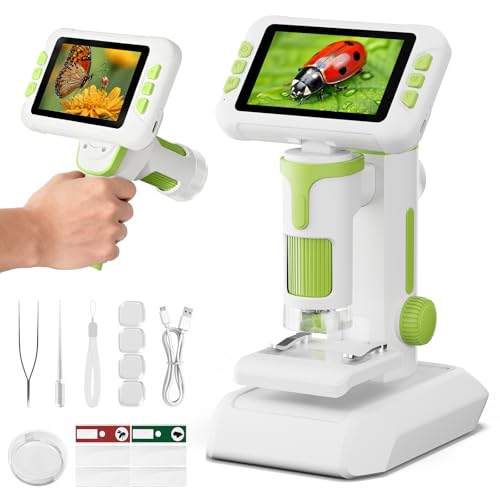
1600X Kids Microscope Review Summary
The best reason to buy this 1600X kids microscope is simple: it tries to make microscopic exploration feel immediate and approachable for children.
Instead of asking a child to stare through eyepieces and coordinate fine focus all at once, the listing centers the experience on a screen, built-in capture, and flexible use modes that are easier to understand for beginners.
That makes it a strong fit for younger students, curious hobbyists, and gift buyers who want something that feels educational without requiring a steep learning curve.
It is also a sensible option if you want a microscope that can move between desk use, handheld viewing, and portable exploration.
Review Scorecard
| Category | Score | Rationale |
|---|---|---|
| Ease of use | 8/10 | Screen-based viewing and detachable modes reduce the friction common with beginner microscopes. |
| Learning value | 9/10 | The 100x to 1600x range and photo/video capture support hands-on science discovery. |
| Versatility | 8/10 | Desktop, handheld, and portable configurations make it adaptable to different activities. |
| Visibility | 8/10 | The 4.0-inch IPS screen and 6 LED lights should help with clearer viewing in varied conditions. |
| Gift appeal | 9/10 | The educational positioning and included slides kit make it easy to present as a complete gift. |
| Portability | 7/10 | Compact enough for shared use and travel, though still more of a toy-like device than a pocket tool. |
| Buyer confidence | 7/10 | The feature list is broad and attractive, but buyers should expect a kid-focused experience, not a precision lab instrument. |
Key Features and Specifications of 1600X Kids Microscope
The listing positions this as a 3-in-1 digital microscope for children ages 3 to 14, and that framing matters more than raw magnification.
It is designed to make observation simple, visible, and repeatable, which is usually what matters most for a first microscope.
Here are the most useful facts from the product record:
| Feature | Details |
|---|---|
| Magnification | Adjustable from 100x to 1600x |
| Screen | 4.0-inch IPS display |
| Camera | Built-in 48MP camera with 1080P photo and video support |
| Lighting | 6 LED fill lights with 3 brightness modes |
| Viewing modes | Desktop, handheld, and portable |
| Battery | Rechargeable battery with up to 4 hours of continuous use |
| Connectivity | Can connect to a computer for real-time viewing |
| Intended use | Educational gift and science exploration for children |
| Dimensions | 6.29 in x 4.72 in x 10.23 in |
| Weight | 450 g |
The headline features point to a product that is less about traditional microscope technique and more about accessibility.
The screen reduces the need to balance your eye, the focus, and the sample all at once.
That makes it a friendlier choice for kids, classrooms, and parents who want fewer setup complaints.
The included slides kit also matters.
A microscope for children is much more likely to be used again when it comes with something ready to observe on day one.
Without that, even a good device can end up sitting in a box after the novelty fades.
Pros and Cons of 1600X Kids Microscope
Pros
- Easy for beginners: The built-in screen should make the learning curve gentler than a traditional eyepiece microscope.
- Flexible use modes: Desktop, handheld, and portable setups expand how and where it can be used.
- Strong capture features: Photo and video support add a shareable, recordable part to the experience.
- Good low-light support: Six LED lights with brightness adjustment should help with clearer viewing.
- Gift-ready concept: It is clearly framed as an educational present, which helps if you are buying for a child.
Cons
- Not a lab instrument: The product is aimed at children, so serious hobbyists may want more precision and optical depth.
- Screen-first design has tradeoffs: A display is easier for kids, but some buyers may still prefer a classic optical path.
- Large claims need realistic expectations: Very high magnification numbers on kid microscopes often sound more dramatic than they feel in practice.
- Battery life is finite: Up to 4 hours is useful, but long sessions will still need planning and recharging.
The balance here is straightforward.
If your priority is approachability and discovery, the strengths are aligned with the job.
If your priority is technical rigor, this is probably not the right category.
Who Should Buy 1600X Kids Microscope?
This microscope makes sense for parents, grandparents, and gift buyers who want an educational toy that nudges children toward real observation.
It is especially relevant if the child likes insects, plants, rocks, fabric, or other everyday objects that become interesting under magnification.
It also suits families that want a shared device.
The screen-based format makes it easier for multiple people to look at the same sample without passing around an eyepiece.
That can be a practical advantage when children are learning together or when an adult is helping explain what they are seeing.
You should probably skip it if you want a serious biology setup for older students, high-detail specimen work, or advanced optics.
The listing reads like a beginner-friendly science toy with real educational value, not a precision tool for demanding users.
How the 1600X Kids Microscope Fits Real Use
Screen-First Viewing
The 4.0-inch IPS screen is the feature that most clearly defines the experience.
For a child, being able to see a live image directly on the device is usually more intuitive than aligning an eye to a lens and adjusting everything at once.
It also makes it easier for an adult to coach the process from the side.
Capturing Discoveries
The built-in camera is a practical addition because it turns a quick look into something recordable.
Photos and videos make the device more than a novelty, especially when a child wants to show a parent, sibling, or teacher what they found.
That kind of shareable result often extends the useful life of a gift.
Lighting and Visibility
The six LED lights with three brightness levels should help across different samples and room conditions.
That matters because kid-focused microscopes often lose appeal when a sample looks dull or hard to see.
Adjustable light is one of the simplest ways to make the device feel more consistent and rewarding.
Modes and Mobility
The 3-in-1 design is another practical advantage.
Desktop mode should be best for steadier viewing, handheld mode supports quick exploration, and portable mode is useful when a child wants to move around the house or outside.
The flexibility is not just a feature list bullet; it is part of what makes a kid microscope stay interesting.
Alternatives to 1600X Kids Microscope
If you want similar options, look at the following Amazon search pages for comparable product lines:
- Carson MicroBrite
- NATIONAL GEOGRAPHIC microscope for kids
- OMAX digital microscope
- Celestron kids microscope
These alternatives cover a few different buyer goals.
Carson often appeals to simple portability, National Geographic-branded kits tend to target educational gifting, OMAX is a familiar name for more instrument-like digital microscopes, and Celestron can be a sensible middle ground for family learning.
When comparing, focus less on headline magnification and more on the viewing experience, included accessories, and whether the device looks easy enough for the intended child to use repeatedly.
Is 1600X Kids Microscope Worth It?
Yes, if your goal is a kid-friendly introduction to microscopy. The combination of screen viewing, capture features, LED lighting, and multiple modes makes it more accessible than a basic traditional microscope for many children.
It is worth considering because it solves a common beginner problem: making the first microscope easy enough to enjoy.
The product seems especially suitable as a gift for younger students who need something visual, simple, and fun to keep using.
If you are shopping for advanced optical performance, though, this is not the one to anchor on.
The better reading is that it is a well-positioned educational starter microscope with broad appeal for families, not a specialist instrument.